PUBLISHER: Global Market Insights Inc. | PRODUCT CODE: 2071164

PUBLISHER: Global Market Insights Inc. | PRODUCT CODE: 2071164
Asia-Pacific Industrial Burner Market Opportunity, Growth Drivers, Industry Trend Analysis, and Forecast 2026 - 2035
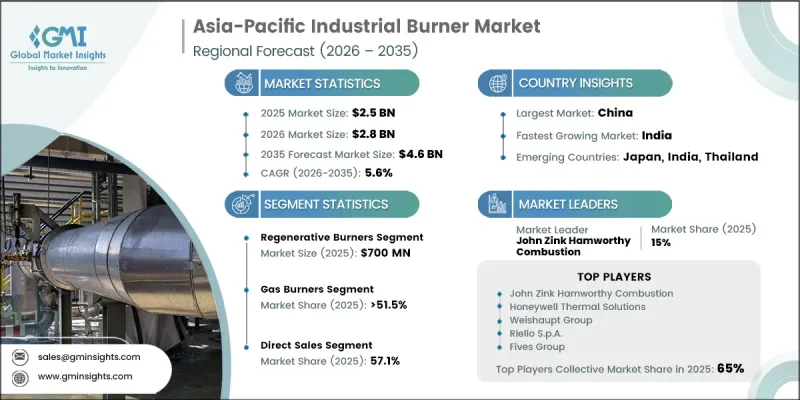
Asia-Pacific Industrial Burner Market was valued at USD 2.5 billion in 2025 and is estimated to grow at a CAGR of 5.6% to reach USD 4.6 billion by 2035.
Expansion is driven by increasing capital investments in industrial infrastructure and a growing focus on improving combustion efficiency across energy-intensive operations. Demand is further reinforced by the modernization of production facilities, where industries are prioritizing advanced heating systems that improve performance while reducing fuel consumption. Continuous upgrades in manufacturing capabilities across key economies are also contributing to higher adoption of advanced burner technologies. In addition, growing emphasis on operational efficiency and emissions reduction is encouraging industries to adopt next-generation combustion systems. Digitalization in procurement and industrial equipment sourcing is improving market accessibility, allowing manufacturers to reach wider customer bases. Rising awareness of material quality, system reliability, and lifecycle performance is further shaping purchasing decisions across industrial sectors in the region.
| Market Scope | |
|---|---|
| Start Year | 2025 |
| Forecast Year | 2026-2035 |
| Start Value | $2.5 Billion |
| Forecast Value | $4.6 Billion |
| CAGR | 5.6% |
Regenerative burner systems accounted for 24.6% share in 2025, with revenue reaching USD 700 million. This segment leads due to its high energy efficiency, effective heat recovery capabilities, and reduced fuel consumption advantages. These burners are widely deployed in high-temperature industrial processes where energy optimization is critical. Their adoption is increasing as industries seek advanced combustion technologies that improve operational efficiency while maintaining consistent performance levels across demanding applications.
The direct sales segment held a 57.1% share in 2025, generating USD 1.5 billion. This dominance is driven by the technical complexity of industrial burner systems, which require tailored solutions and close coordination between manufacturers and end users. Direct engagement enables better customization, technical consultation, and after-sales support, making it the preferred procurement method for large-scale industrial projects. Strong manufacturer involvement also ensures accurate specification alignment and improved system performance across diverse industrial applications.
China Industrial Burner Market held a 29.8% share, generating USD 800 million in 2025. This leadership is supported by a strong industrial base, ongoing manufacturing expansion, and rising demand for energy-efficient combustion systems. Continuous improvements in production infrastructure and increasing focus on operational efficiency are driving greater adoption of advanced burner technologies across industries.
Key companies operating in the Asia-Pacific industrial burner market include Mitsubishi Power, Weishaupt Group, Alfa Laval, Riello S.p.A., Thermax Limited, John Zink Hamworthy Combustion, Honeywell Thermal Solutions, SAACKE GmbH, Oilon Group, Forbes Marshall Pvt. Ltd., Fives Group, EBICO China Environment Co., Ltd., ZOZEN Boiler Co., Ltd., Jiangsu Jufeng Thermal Technology Co., Ltd., Hirose Burner Co., Ltd., Oxilon Pvt. Ltd., Wesman Engineering Company Pvt. Ltd., and NFK Holdings. Market participants are strengthening their competitive position through continuous innovation in combustion efficiency, emissions control, and digital monitoring technologies. Companies are increasingly investing in advanced burner systems that support energy optimization and improved operational reliability. Strategic collaborations with industrial end users are helping firms deliver customized solutions tailored to specific process requirements. Expansion of service networks and after-sales support systems is also enhancing customer retention. Manufacturers are focusing on integrating smart control systems and automation features to improve performance monitoring and system precision.
Table of Contents
Chapter 1 Methodology & Scope
- 1.1 Market scope and definition
- 1.2 Research design
- 1.2.1 Research approach
- 1.2.2 Data collection methods
- 1.3 Data mining sources
- 1.3.1 Global
- 1.3.2 Regional/Country
- 1.4 Base estimates and calculations
- 1.4.1 Base year calculation
- 1.4.2 Key trends for market estimation
- 1.5 Primary research and validation
- 1.5.1 Primary sources
- 1.6 Forecast model
- 1.7 Research assumptions and limitations
Chapter 2 Executive Summary
- 2.1 Industry 360° synopsis
- 2.2 Key market trends
- 2.2.1 Type
- 2.2.2 Fuel Type
- 2.2.3 Mode of Operation
- 2.2.4 Burner Design
- 2.2.5 Application
- 2.2.6 End Use Industry
- 2.2.7 Distribution channel
Chapter 3 Industry Insights
- 3.1 Industry ecosystem analysis
- 3.1.1 Supplier landscape
- 3.1.2 Profit margin
- 3.1.3 Value addition at each stage
- 3.1.4 Factor affecting the value chain
- 3.2 Industry impact forces
- 3.2.1 Drivers
- 3.2.2 Pitfalls & Challenges
- 3.2.3 Opportunities
- 3.3 Growth potential analysis
- 3.4 Future market trends
- 3.5 Technology and innovation landscape
- 3.5.1 Current technological trends
- 3.5.2 Emerging technologies
- 3.6 Pricing Analysis (Driven by Primary Research)
- 3.6.1 Historical Price Trend Analysis (Driven by Primary Research)
- 3.6.2 Pricing Strategy by Player Type (Premium/Value/Cost-plus) (Driven by Primary Research)
- 3.6.3 Average Selling Price by Type
- 3.7 Regulatory landscape
- 3.7.1 Standards and compliance requirements
- 3.7.2 Regional regulatory frameworks
- 3.7.3 Certification standards
- 3.8 Porter's analysis
- 3.9 PESTEL analysis
- 3.10 Trade Data Analysis (Driven by Primary Research)
- 3.10.1 Import/Export Volume & Value Trends (2020-2024) (Driven by Primary Research)
- 3.10.2 Key Trade Corridors & Origin Countries (China, Vietnam, South Korea) (Driven by Primary Research)
- 3.10.3 Tariff Impact & Trade Agreement Implications
- 3.11 Impact of AI & Generative AI on the Market
- 3.11.1 AI-Driven Disruption of Existing Business Models
- 3.11.2 GenAI Use Cases & Adoption Roadmap by Segment
- 3.11.3 Risks, Limitations & Regulatory Considerations
- 3.12 Capacity & Production Landscape (Driven by Primary Research)
- 3.12.1 Installed Manufacturing Capacity by Region & Key Producer (Driven by Primary Research)
- 3.12.2 Capacity Utilization Rates & Expansion Pipelines (Driven by Primary Research)
Chapter 4 Competitive Landscape, 2025
- 4.1 Introduction
- 4.2 Company market share analysis
- 4.3 Company matrix analysis
- 4.4 Competitive analysis of major market players
- 4.5 Competitive positioning matrix
- 4.6 Key developments
- 4.6.1 Mergers & acquisitions
- 4.6.2 Partnerships & collaborations
- 4.6.3 New product launches
- 4.6.4 Expansion plans
Chapter 5 Market Estimates & Forecast, By Type, 2022 - 2035, (USD Billion) (Thousand Units)
- 5.1 Key trends
- 5.2 Regenerative burners
- 5.3 Radiant tube burners
- 5.4 Air staged burners
- 5.5 Self-recuperative burners
- 5.6 Others (flat flame burners etc.)
Chapter 6 Market Estimates & Forecast, By Fuel Type, 2022 - 2035, (USD Billion) (Thousand Units)
- 6.1 Key trends
- 6.2 Gas burners
- 6.3 Oil burners
- 6.4 Dual fuel burners
Chapter 7 Market Estimates & Forecast, By Mode of Operation, 2022 - 2035, (USD Billion) (Thousand Units)
- 7.1 Key trends
- 7.2 Manual
- 7.3 Semi-automatic
- 7.4 Fully automatic
Chapter 8 Market Estimates & Forecast, By Burner Design, 2022 - 2035, (USD Billion) (Thousand Units)
- 8.1 Key trends
- 8.2 Monoblock
- 8.3 Duoblock
Chapter 9 Market Estimates & Forecast, By Application, 2022 - 2035, (USD Billion) (Thousand Units)
- 9.1 Key trends
- 9.2 Process heating
- 9.3 Drying
- 9.4 Boilers
- 9.5 Incineration
- 9.6 Furnaces
- 9.7 Others (space heating, etc.)
Chapter 10 Market Estimates & Forecast, By End Use Industry, 2022 - 2035, (USD Billion) (Thousand Units)
- 10.1 Key trends
- 10.2 Power generation
- 10.3 Chemical and petrochemical
- 10.4 Metalworking
- 10.5 Food processing
- 10.6 Textile
- 10.7 Others (pulp and paper etc.)
Chapter 11 Market Estimates & Forecast, By Distribution Channel, 2022 - 2035, (USD Billion) (Thousand Units)
- 11.1 Key trends
- 11.2 Direct sales
- 11.3 Indirect sales
Chapter 12 Market Estimates and Forecast, By Region, 2022 - 2035 (USD Billion) (Thousand Units)
- 12.1 Key trends
- 12.2 China
- 12.3 India
- 12.4 Japan
- 12.5 South Korea
- 12.6 Indonesia
- 12.7 Thailand
- 12.8 Singapore
- 12.9 Australia
Chapter 13 Company Profiles
- 13.1 Top Global Player
- 13.1.1 Honeywell Thermal Solutions
- 13.1.2 John Zink Hamworthy Combustion
- 13.1.3 Alfa Laval
- 13.1.4 Fives Group
- 13.1.5 Weishaupt Group
- 13.1.6 SAACKE GmbH
- 13.2 Regional Player
- 13.2.1 Mitsubishi Power
- 13.2.2 EBICO China Environment Co., Ltd.
- 13.2.3 Oilon Group
- 13.2.4 NFK Holdings
- 13.2.5 Wesman Engineering Company Pvt. Ltd.
- 13.2.6 Forbes Marshall Pvt. Ltd.
- 13.2.7 Riello S.p.A.
- 13.3 Emerging Players
- 13.3.1 Thermax Limited
- 13.3.2 ZOZEN Boiler Co., Ltd.
- 13.3.3 Oxilon Pvt. Ltd.
- 13.3.4 Hirose Burner Co., Ltd.
- 13.3.5 Jiangsu Jufeng Thermal Technology Co., Ltd.

