
PUBLISHER: Global Market Insights Inc. | PRODUCT CODE: 2083050

PUBLISHER: Global Market Insights Inc. | PRODUCT CODE: 2083050
North America Industrial Burner Market Opportunity, Growth Drivers, Industry Trend Analysis, and Forecast 2026 - 2035
North America Industrial Burner Market was valued at USD 2.1 billion in 2025 and is estimated to grow at a CAGR of 5.1% to reach USD 3.4 billion by 2035.
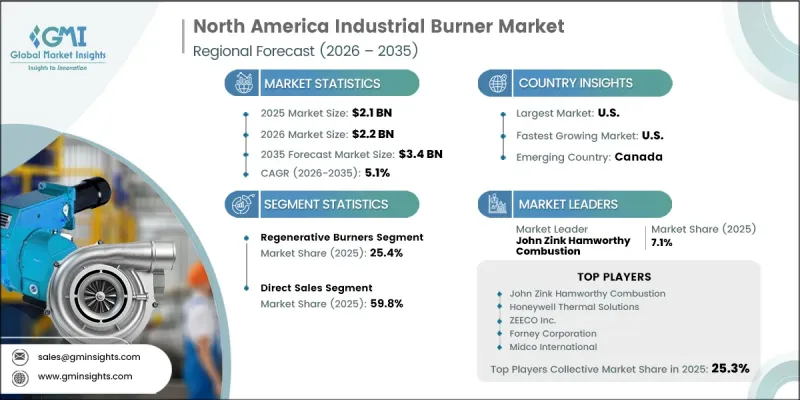
Growth is driven by stricter industrial emission regulations, rising adoption of energy-efficient combustion systems, and sustained expansion in industrial production capacity across the United States and Canada. The market is also benefiting from structural energy dynamics, particularly the strong availability of natural gas, which is reshaping fuel utilization patterns across industrial heating applications. Increasing regulatory scrutiny on combustion-related emissions is accelerating the replacement of legacy burner systems with advanced, low-emission alternatives. In parallel, emerging interest in hydrogen-compatible combustion technologies is opening new pathways for multi-fuel burner adoption, enabling industries to transition toward flexible and future-ready energy systems. These combined factors are reinforcing steady demand for high-efficiency, compliance-oriented industrial burner solutions across multiple end-use sectors.
| Market Scope | |
|---|---|
| Start Year | 2025 |
| Forecast Year | 2026-2035 |
| Start Value | $2.1 Billion |
| Forecast Value | $3.4 Billion |
| CAGR | 5.1% |
Regenerative burner systems accounted for 25.4% share in 2025 and is expected to record the fastest growth with a CAGR of 5.8% through 2035. This segment's strong performance is attributed to its widespread application in high-temperature industrial processes, particularly in energy-intensive manufacturing environments. Its ability to recover and reuse waste heat significantly improves fuel efficiency and reduces operational costs, making it highly suitable for continuous thermal processing applications. As industries continue to prioritize energy optimization and emission reduction, regenerative burner technologies are expected to maintain strong adoption momentum across heavy industrial sectors.
The direct sales channels held a 59.8% share in 2025 and is projected to grow at a CAGR of 5% through 2035, maintaining their dominant position in the distribution landscape. This channel structure reflects the highly technical and customized nature of industrial burner procurement, where system design, engineering integration, and installation support play a critical role. Large-scale industrial projects typically require direct collaboration between end users and manufacturers to ensure performance optimization and compliance with stringent operational standards. This has reinforced the importance of direct engagement models across complex combustion system deployments.
United States Industrial Burner Market accounted for 82.6% share in 2025 and is projected to grow at a CAGR of 5.3% through 2035, making it both the largest and most dynamic national market in the region. Strong industrial output, combined with strict emission control regulations, continues to drive widespread adoption of advanced combustion technologies. The country's abundant natural gas availability further supports the transition toward efficient burner systems optimized for lower emissions and higher thermal performance. Ongoing modernization across industrial infrastructure continues to strengthen long-term demand across multiple end-use industries.
Key companies operating in the North America Industrial Burner Market include John Zink Hamworthy Combustion, Honeywell Thermal Solutions, ZEECO Inc., Weishaupt, Riello S.p.A., SAACKE GmbH, Bloom Engineering (Wabtec), Fives Group (North American Combustion), WS Thermal Process Technology, Oilon Group, Selas Heat Technology, Power Flame Incorporated, Forney Corporation, Limpsfield Combustion Engineering, Midco International, Wayne Combustion Systems (R.W. Beckett), Algas-SDI, Alzeta Corporation, CIB Unigas, Faber Burner Company, and Santin Industrial. Companies in the North America Industrial Burner Market are prioritizing technological innovation, emission reduction capabilities, and fuel flexibility to strengthen their competitive position. Manufacturers are investing in low-NOx burner technologies, regenerative combustion systems, and hydrogen-ready platforms to align with tightening environmental regulations. Strategic partnerships with industrial operators and engineering contractors are enabling customized system integration for complex applications. Companies are also expanding service offerings, including maintenance, retrofitting, and lifecycle optimization solutions, to enhance customer retention and recurring revenue streams. Digitalization is playing a growing role, with smart monitoring systems and predictive maintenance tools improving operational efficiency and reliability.
Table of Contents
Chapter 1 Methodology & Scope
- 1.1 Research approach
- 1.2 Quality Commitments
- 1.2.1 GMI AI policy & data integrity commitment
- 1.2.1.1 Source consistency protocol
- 1.2.1 GMI AI policy & data integrity commitment
- 1.3 Research Trail & Confidence Scoring
- 1.3.1 Research Trail Components
- 1.3.2 Scoring Components
- 1.4 Data Collection
- 1.4.1 Partial list of primary sources
- 1.5 Data mining sources
- 1.5.1 Paid sources
- 1.5.1.1 Sources, by region
- 1.5.1 Paid sources
- 1.6 Base estimates and calculations
- 1.6.1 Base year calculation for any one approach
- 1.7 Forecast model
- 1.7.1 Quantified market impact analysis
- 1.7.1.1 Mathematical impact of growth parameters on forecast
- 1.7.1 Quantified market impact analysis
- 1.8 Research transparency addendum
- 1.8.1 Source attribution framework
- 1.8.2 Quality assurance metrics
- 1.8.3 Our commitment to trust
Chapter 2 Executive Summary
- 2.1 Industry 360° synopsis, 2022 - 2035
- 2.2 Key market trends
- 2.2.1 Country
- 2.2.2 Type
- 2.2.3 Fuel Type
- 2.2.4 Mode of Operation
- 2.2.5 Application
- 2.2.6 End Use Industry
- 2.2.7 Distribution Channel
Chapter 3 Industry Insights
- 3.1 Industry ecosystem analysis
- 3.1.1 Supplier landscape
- 3.1.2 Profit margin
- 3.1.3 Value addition at each stage
- 3.1.4 Factor affecting the value chain
- 3.2 Industry impact forces
- 3.2.1 Growth drivers
- 3.2.1.1 Stringent emission regulations and environmental compliance requirements.
- 3.2.1.2 Industrial energy efficiency initiatives and fuel cost optimization.
- 3.2.1.3 Adoption of natural gas and cleaner fuel alternatives.
- 3.2.1.4 Rising demand for hydrogen-ready & multi-fuel burner systems
- 3.2.2 Industry pitfalls & challenges
- 3.2.2.1 High capital investment for advanced burner system upgrades.
- 3.2.2.2 Technical complexity of retrofitting existing industrial facilities.
- 3.2.3 Opportunities
- 3.2.3.1 Industrial decarbonization and hydrogen-ready burner systems.
- 3.2.3.2 Digital combustion management and predictive maintenance integration.
- 3.2.1 Growth drivers
- 3.3 Growth potential analysis
- 3.4 Regulatory framework
- 3.4.1 U.S. EPA Emission Standards- NOx, CO2, PM (Clean Air Act)
- 3.4.2 California Air Resources Board (CARB)- State-Level Stringency
- 3.4.3 Canada Environment & Climate Change- Industrial Combustion Rules
- 3.4.4 NFPA 86 Standard - Ovens & Furnaces Safety
- 3.4.5 ASME Boiler & Pressure Vessel Code Compliance
- 3.4.6 Inflation Reduction Act (IRA) Energy Efficiency Incentives & Impact
- 3.4.7 Regulatory Trajectory
- 3.5 Major market trends and disruptions
- 3.6 Technology/innovation landscape
- 3.6.1 Current trends
- 3.6.2 Emerging trends
- 3.7 Pricing Analysis (driven by primary research)
- 3.7.1 Historical price trend analysis (driven by primary research)
- 3.7.2 Pricing strategy by player type (premium / value / cost- plus) (driven by primary research)
- 3.8 Future market trends
- 3.9 Trade data analysis (driven by paid database) (HS Code-8416)
- 3.9.1 Import/export volume & value trends (driven by primary research)
- 3.9.2 Key trade corridors & tariff impact (driven by primary research)
- 3.10 Impact of AI & Generative AI on the Market
- 3.10.1 AI- driven disruption of existing business models
- 3.10.2 Gen- AI use cases & adoption roadmap by segment
- 3.10.3 Risks, limitations & regulatory considerations
- 3.11 Porter's analysis
- 3.12 PESTEL analysis
- 3.13 Capacity & production landscape (driven by primary research)
- 3.13.1 Installed burner base by region & key producer - U.S. & CANADA (driven by primary research)
- 3.13.2 Capacity utilization rates & manufacturing expansion pipelines (driven by primary research)
Chapter 4 Competitive Landscape, 2025
- 4.1 Introduction
- 4.2 Company market share analysis
- 4.2.1 By Country
- 4.2.1.1 U.S.
- 4.2.1.2 Canada
- 4.2.1 By Country
- 4.3 Company matrix analysis
- 4.4 Competitive analysis of major market players
- 4.5 Competitive positioning matrix
- 4.6 Key developments
- 4.6.1 Mergers & acquisitions
- 4.6.2 Partnerships & collaborations
- 4.6.3 New product launches
- 4.6.4 Expansion plans
Chapter 5 Market Estimates & Forecast, By Type, 2022-2035 (USD Billion) (Units)
- 5.1 Key trends
- 5.2 Regenerative burners
- 5.2.1 Monoblock configuration
- 5.2.2 Duoblock configuration
- 5.3 Radiant tube burners
- 5.3.1 Single-Ended Radiant Tubes
- 5.3.2 Double-Ended (U-Type) Radiant Tubes
- 5.4 Air staged burners
- 5.4.1 Monoblock Configuration
- 5.4.2 Duoblock Configuration
- 5.5 Self-recuperative burners
- 5.5.1 Monoblock Configuration
- 5.5.2 Duoblock Configuration
- 5.6 Others (flat flame, direct-fired, pulse combustion, etc.)
Chapter 6 Market Estimates & Forecast, By Fuel Type, 2022-2035 (USD Billion) (Units)
- 6.1 Key trends
- 6.2 Gas burners
- 6.3 Oil burners
- 6.4 Dual fuel burners
Chapter 7 Market Estimates & Forecast, By Mode of Operation, 2022-2035 (USD Billion) (Units)
- 7.1 Key trends
- 7.2 Manual
- 7.3 Semi-automatic
- 7.4 Fully automatic
Chapter 8 Market Estimates & Forecast, By Application, 2022-2035 (USD Billion) (Units)
- 8.1 Key trends
- 8.2 Process heating
- 8.3 Drying
- 8.4 Boilers
- 8.5 Incineration
- 8.6 Furnaces
- 8.7 Others (space heating etc.)
Chapter 9 Market Estimates & Forecast, By End Use Industry, 2022-2035 (USD Billion) (Units)
- 9.1 Key trends
- 9.2 Power generation
- 9.3 Chemical and petrochemical
- 9.4 Metalworking
- 9.5 Food processing
- 9.6 Textile
- 9.7 Others (pulp and paper etc.)
Chapter 10 Market Estimates & Forecast, By Distribution Channel, 2022-2035 (USD Billion) (Units)
- 10.1 Key trends
- 10.2 Direct sales
- 10.3 Indirect sales
Chapter 11 Market Estimates & Forecast, By Country, 2022-2035 (USD Billion) (Units)
- 11.1 Key trends
- 11.2 U.S.
- 11.3 Canada
Chapter 12 Company Profiles
- 12.1 Global Companies
- 12.1.1 Fives Group (North American Combustion)
- 12.1.1.1 Business Overview
- 12.1.1.2 Financial Data
- 12.1.1.3 Product Landscape
- 12.1.1.4 Strategic Outlook
- 12.1.1.5 SWOT Analysis
- 12.1.2 Honeywell Thermal Solutions
- 12.1.3 John Zink Hamworthy Combustion
- 12.1.4 Oilon Group
- 12.1.5 Riello S.p.A.
- 12.1.6 SAACKE GmbH
- 12.1.7 Weishaupt
- 12.1.8 ZEECO Inc.
- 12.1.1 Fives Group (North American Combustion)
- 12.2 Regional Companies
- 12.2.1 Bloom Engineering (Wabtec)
- 12.2.2 Faber Burner Company
- 12.2.3 Forney Corporation
- 12.2.4 Midco International
- 12.2.5 Power Flame Incorporated
- 12.2.6 Selas Heat Technology
- 12.2.7 Wayne Combustion Systems (R.W. Beckett)
- 12.2.8 WS Thermal Process Technology
- 12.3 Emerging Companies
- 12.3.1 Algas-SDI
- 12.3.2 Alzeta Corporation
- 12.3.3 CIB Unigas
- 12.3.4 Limpsfield Combustion Engineering
- 12.3.5 Santin Industrial

