PUBLISHER: Global Market Insights Inc. | PRODUCT CODE: 2071166

PUBLISHER: Global Market Insights Inc. | PRODUCT CODE: 2071166
Action Figures Market Opportunity, Growth Drivers, Industry Trend Analysis, and Forecast 2026 - 2035
The Global Action Figures Market was valued at USD 11.6 billion in 2025 and is estimated to grow at a CAGR of 6.9% to reach USD 22.6 billion by 2035.
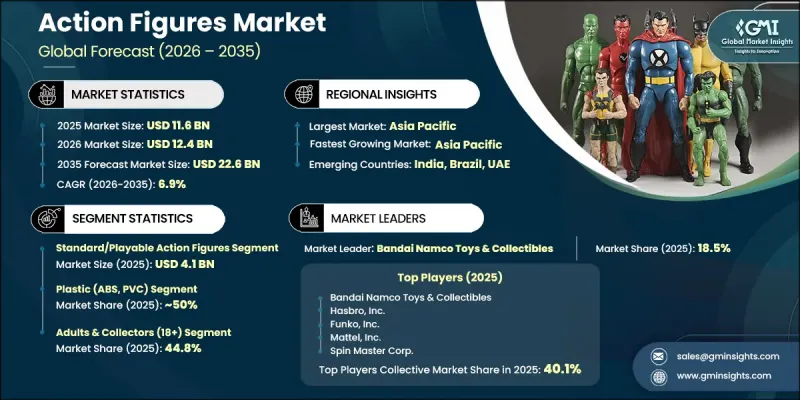
Growth across the Action Figures Market is fueled by the increasing influence of entertainment-based intellectual properties, expanding global fan communities, and the continued popularity of character-driven merchandise. Licensed content associated with films, television programming, digital entertainment, gaming, and animation has become a key catalyst for consumer demand, creating strong connections between content engagement and merchandise purchases. The rapid expansion of e-commerce infrastructure is also contributing significantly to market growth by increasing product accessibility and enabling manufacturers to reach consumers directly across a broader geographic footprint. In addition, the growing popularity of collectibles culture has expanded the market beyond traditional toy buyers, attracting enthusiasts and collectors seeking premium and limited-edition products. As entertainment franchises continue to gain global audiences and digital platforms broaden content visibility, demand for action figures is expected to remain strong. These factors collectively support long-term market expansion and reinforce the sector's importance within the broader global toy and collectibles industry.
| Market Scope | |
|---|---|
| Start Year | 2025 |
| Forecast Year | 2026-2035 |
| Start Value | $11.6 Billion |
| Forecast Value | $22.6 Billion |
| CAGR | 6.9% |
The commercial success of licensed entertainment properties continues to serve as one of the most influential growth drivers within the Action Figures Market. Merchandise demand increasingly aligns with content performance cycles, creating recurring opportunities for manufacturers and licensors to capitalize on consumer enthusiasm generated by popular intellectual properties. As entertainment brands expand their global reach, merchandise sales benefit from stronger consumer awareness, broader retail distribution, and higher levels of engagement across multiple demographics. Industry trends indicate that licensed action figures continue to outperform non-licensed alternatives, reflecting the importance of recognizable characters and established franchises in shaping purchasing decisions and sustaining market growth.
The standard and playable action figures segment generated USD 4.1 billion in 2025. Its leadership position is supported by widespread consumer familiarity, strong retail penetration, and broad appeal among children and mainstream buyers. These products continue to benefit from affordability, accessibility, and strong brand recognition, making them a foundational category within the global action figures industry. Consistent demand across multiple age groups and distribution channels continues to support the segment's significant market presence.
The plastic materials, including ABS and PVC, segment held a 50% share in 2025. These materials provide the durability, production efficiency, design flexibility, and manufacturing scalability required for large-scale action figure production. Their ability to support detailed designs while maintaining cost-effective manufacturing processes has made them the preferred material choice across both mass-market and collectible product categories. The widespread adoption of plastic materials continues to support product affordability, consistent quality, and efficient production capabilities throughout the industry.
Asia Pacific Action Figures Market accounted for 39% share in 2025. The region benefits from a combination of strong consumer demand, extensive manufacturing capabilities, and a growing collector community. Market growth is supported by rising disposable incomes, increasing consumer interest in collectibles, and the continued expansion of local and international action figure brands. Strong manufacturing infrastructure and growing participation in collectibles culture continue to strengthen the region's leadership position within the global market.
Major companies operating in the Global Action Figures Market include Hasbro, Inc.; Mattel, Inc.; Bandai Namco Toys & Collectibles Inc.; Funko, Inc.; The LEGO Group; JAKKS Pacific, Inc.; Jazwares, LLC; McFarlane Toys; Good Smile Company, Inc.; Kotobukiya Co., Ltd.; Hot Toys Limited; Spin Master Corp.; Square Enix Co., Ltd. (Play Arts Kai); Playmates Toys Ltd.; Super7, Inc.; Mezco Toyz; NECA (National Entertainment Collectibles Association); Threezero Ltd.; Iron Studios; Medicom Toy Corporation; and Storm Collectibles. Companies operating in the action figures market are adopting a variety of strategies to strengthen their market position and expand their global footprint. Product innovation remains a key focus, with manufacturers introducing premium collectibles, limited-edition releases, and highly detailed figures designed to attract both mainstream consumers and dedicated collectors. Licensing agreements and intellectual property partnerships continue to play a critical role in expanding product portfolios and enhancing brand visibility. Businesses are also investing in direct-to-consumer channels, e-commerce platforms, and digital marketing initiatives to improve customer engagement and increase market reach.
Table of Contents
Chapter 1 Research Methodology
- 1.1 Research approach
- 1.2 Quality Commitments
- 1.2.1 GMI AI policy & data integrity commitment
- 1.2.1.1 Source consistency protocol
- 1.2.1 GMI AI policy & data integrity commitment
- 1.3 Research Trail & Confidence Scoring
- 1.3.1 Research Trail Components
- 1.3.2 Scoring Components
- 1.4 Data Collection
- 1.4.1 Partial list of primary sources
- 1.5 Data mining sources
- 1.5.1 Paid sources
- 1.5.1.1 Sources, by region
- 1.5.1 Paid sources
- 1.6 Base estimates and calculations
- 1.6.1 Base year calculation for any one approach
- 1.7 Forecast model
- 1.7.1 Quantified market impact analysis
- 1.7.1.1 Mathematical impact of growth parameters on forecast
- 1.7.1 Quantified market impact analysis
- 1.8 Research transparency addendum
- 1.8.1 Source attribution framework
- 1.8.2 Quality assurance metrics
- 1.8.3 Our commitment to trust
Chapter 2 Executive Summary
- 2.1 Industry 360° synopsis, 2022 - 2035
- 2.2 Key market trends
- 2.2.1 Regional
- 2.2.2 Product type
- 2.2.3 Material
- 2.2.4 End user
- 2.2.5 Distribution channel
Chapter 3 Industry Insights
- 3.1 Industry ecosystem analysis
- 3.1.1 Factor affecting the value chain
- 3.1.2 Profit margin analysis
- 3.1.3 Disruptions
- 3.1.4 Future outlook
- 3.1.5 Manufacturers
- 3.1.6 Distributors
- 3.2 Supplier landscape
- 3.3 Key news & initiatives
- 3.4 Technology & innovation landscape
- 3.5 Regulatory landscape
- 3.6 Impact on forces
- 3.6.1 Growth drivers
- 3.6.2 Industry pitfalls & challenges
- 3.6.3 Opportunities
- 3.7 Porter's analysis
- 3.8 PESTEL analysis
- 3.9 Pricing analysis (driven by primary research)
- 3.9.1 Historical price trend analysis (driven by primary research)
- 3.9.2 Pricing strategy by player type (premium / value / cost-plus) (driven by primary research)
- 3.9.3 Price benchmarking by product category (standard vs. collectible vs. premium) (driven by primary research)
- 3.9.4 Licensing royalty cost impact on end-market pricing (driven by primary research)
- 3.10 Trade data analysis (driven by paid database)
- 3.10.1 Import/export volume & value trends by region (driven by paid database)
- 3.10.2 Key trade corridors & tariff impact (China-US, China-EU, Japan-global) (driven by paid database)
- 3.11 Impact of AI & generative AI on the market
- 3.11.1 AI-driven disruption of design, prototyping & customization workflows
- 3.11.2 GenAI use cases & adoption roadmap by segment (collectibles, mass market, licensing)
- 3.11.3 Risks, limitations & regulatory considerations (deepfake likeness, IP infringement)
- 3.12 Distribution infrastructure & channel penetration landscape (driven by primary research)
- 3.12.1 Channel coverage by region & format (modern vs. traditional trade) (driven by primary research)
- 3.12.2 Last-mile infrastructure gaps & emerging channel shifts (D2C, social commerce, live-stream retail) (driven by primary research)
Chapter 4 Competitive Landscape, 2025
- 4.1 Introduction
- 4.2 Company market share analysis
- 4.3 Competitive positioning matrix
- 4.4 Strategic outlook matrix
- 4.5 Competitive analysis of major market players
- 4.6 Key developments
- 4.6.1 Mergers & acquisitions
- 4.6.2 Partnerships & collaborations
- 4.6.3 New product launches
- 4.6.4 Expansion plans
Chapter 5 Market Estimates & Forecast, By Product Type, 2022-2035 (USD Billion) (Million Units)
- 5.1 Key trends
- 5.2 Standard / playable action figures
- 5.3 Collectible action figures
- 5.4 Premium / articulated action figures
- 5.5 Action figure accessories & playsets
Chapter 6 Market Estimates & Forecast, By Material, 2022-2035 (USD Billion) (Million Units)
- 6.1 Key trends
- 6.2 Plastic (ABS, PVC)
- 6.3 Vinyl
- 6.4 Resin
- 6.5 Metal
- 6.6 Hybrid
Chapter 7 Market Estimates & Forecast, By End User, 2022-2035 (USD Billion) (Million Units)
- 7.1 Key trends
- 7.2 Children (3-8 Years)
- 7.3 Tweens & teens (9-17 Years)
- 7.4 Adults & collectors (18+ Years)
Chapter 8 Market Estimates & Forecast, By Distribution Channel, 2022-2035 (USD Billion) (Million Units)
- 8.1 Key trends
- 8.2 Online
- 8.3 Offline
- 8.3.1 Supermarkets & hypermarkets
- 8.3.2 Specialty toy & hobby stores
- 8.3.3 Direct-to-consumer (brand stores)
- 8.3.4 Others
Chapter 9 Market Estimates & Forecast, By Region, 2022-2035 (USD Billion) (Million Units)
- 9.1 Key trends
- 9.2 North America
- 9.2.1 U.S.
- 9.2.2 Canada
- 9.3 Europe
- 9.3.1 Germany
- 9.3.2 U.K.
- 9.3.3 France
- 9.3.4 Italy
- 9.3.5 Spain
- 9.4 Asia Pacific
- 9.4.1 China
- 9.4.2 India
- 9.4.3 Japan
- 9.4.4 South Korea
- 9.4.5 Australia
- 9.5 Latin America
- 9.5.1 Brazil
- 9.5.2 Mexico
- 9.5.3 Argentina
- 9.6 MEA
- 9.6.1 UAE
- 9.6.2 Saudi Arabia
- 9.6.3 South Africa
Chapter 10 Company Profiles (Business Overview, Financial Data, Product Landscape, Strategic Outlook, SWOT Analysis)
- 10.1 Global players
- 10.1.1 DMG Mori Co. Ltd.
- 10.1.2 Yamazaki Mazak Corporation
- 10.1.3 FANUC Corporation
- 10.1.4 Haas Automation, Inc.
- 10.1.5 Trumpf GmbH + Co. KG
- 10.1.6 DN Solutions Co., Ltd.
- 10.1.7 Amada Holdings Co., Ltd.
- 10.2 Regional players
- 10.2.1 Okuma Corporation
- 10.2.2 Makino Milling Machine Co., Ltd.
- 10.2.3 Nidec Machine Tool Corporation
- 10.2.4 Maschinenfabrik Berthold Hermle AG
- 10.2.5 Shibaura Machine Co., Ltd.
- 10.2.6 JTEKT Corporation
- 10.2.7 ANDRITZ Schuler
- 10.2.8 Shenyang Machine Tool Co., Ltd.
- 10.2.9 United Machining Solutions
- 10.3 Emerging players
- 10.3.1 EMAG Group
- 10.3.2 INDEX-Werke GmbH & Co. KG
- 10.3.3 Genertec Dalian Machine Tool Co., Ltd. (DMTG)
- 10.3.4 Biesse Group S.p.A.

