PUBLISHER: Global Market Insights Inc. | PRODUCT CODE: 2071213

PUBLISHER: Global Market Insights Inc. | PRODUCT CODE: 2071213
Glass Substrate Advanced Packaging Market Opportunity, Growth Drivers, Industry Trend Analysis, and Forecast 2026 - 2035
The Global Glass Substrate Advanced Packaging Market was valued at USD 2 billion in 2025 and is estimated to grow at a CAGR of 8.9% to reach USD 4.7 billion by 2035.
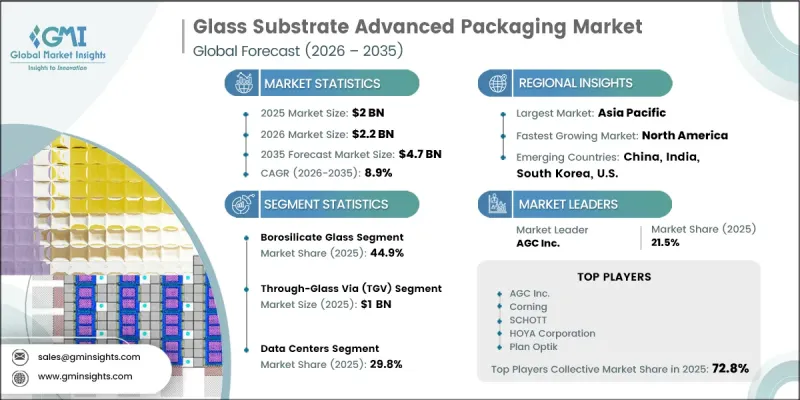
Growth in the glass substrate advanced packaging industry is driven by accelerating demand for artificial intelligence and high-performance computing semiconductor solutions, alongside rapid advancements in chiplet-based architectures and panel-level packaging technologies. Increasing requirements for high-density interconnects in next-generation semiconductor devices are further strengthening market expansion. Rising deployment of AI accelerators and advanced data center processors is placing significant pressure on traditional substrate technologies, driving the transition toward glass-based solutions. Glass substrates are gaining traction due to their ability to support ultra-fine redistribution layers, enabling improved electrical performance and higher interconnect density in compact chip designs. The growing need for enhanced input/output density, superior signal integrity, and scalable packaging formats is further reinforcing adoption. Additionally, the industry is benefiting from ongoing ecosystem development, pilot-scale production efforts, and increasing focus on overcoming the limitations of organic substrate materials. These factors collectively support the long-term adoption of glass substrates in advanced semiconductor packaging applications.
| Market Scope | |
|---|---|
| Start Year | 2025 |
| Forecast Year | 2026-2035 |
| Start Value | $2 Billion |
| Forecast Value | $4.7 Billion |
| CAGR | 8.9% |
The borosilicate glass segment held a 44.9% share in 2025. Its dominance is attributed to its strong balance of thermal stability, mechanical strength, and cost efficiency. The material's compatibility with established semiconductor manufacturing processes has further strengthened its adoption in high-volume production environments. These properties make borosilicate glass a preferred option for manufacturers seeking reliable and scalable substrate solutions for advanced electronic packaging applications.
The hybrid (TGV combined with RDL) segment is projected to grow at a CAGR of 12.6% during 2026-2035. This growth is driven by increasing demand for integrated vertical interconnect structures combined with high-resolution redistribution layers, enabling improved design flexibility and enhanced system performance. Hybrid packaging approaches support more efficient signal routing, improved integration density, and greater scalability for complex semiconductor architectures. Their adoption is expanding rapidly in advanced chip designs that require high interconnect performance and optimized packaging efficiency.
North America Glass Substrate Advanced Packaging Market accounted for 24.3% share in 2025. The region is witnessing strong growth supported by rising investments in semiconductor packaging infrastructure, research facilities, and advanced manufacturing capabilities. Expanding focus on domestic semiconductor production and innovation in AI-driven chip technologies is further strengthening regional demand. Continued development of advanced packaging ecosystems is enhancing supply chain resilience while accelerating the commercialization of next-generation substrate technologies across North America.
Key companies operating in the global glass substrate advanced packaging market include Corning, Intel Corporation, SCHOTT, AGC Inc., HOYA Corporation, AT&S (Austria Technologie & Systemtechnik), Nippon Sheet Glass Co., Ltd., Avanstrate Inc., NEG (Nippon Electric Glass Co., Ltd.), Absolics, Plan Optik, Ohara Inc., Mosaic Microsystems, TOPPAN, and Shyawei Optronics (Taiwan). Companies participating in the glass substrate advanced packaging industry are focusing on strategic initiatives aimed at strengthening technological capabilities and expanding market presence. A major emphasis is placed on research and development to improve substrate performance, enhance thermal and electrical properties, and enable finer interconnect scaling for next-generation semiconductor devices. Market participants are also investing in pilot production lines and scaling up manufacturing capacity to support the commercialization of advanced packaging solutions. Strategic collaborations with semiconductor manufacturers, foundries, and technology developers are helping accelerate innovation and ecosystem development. In addition, companies are working on improving process integration, cost efficiency, and material optimization to enhance competitiveness.
Table of Contents
Chapter 1 Methodology and Scope
- 1.1 Market scope and definition
- 1.2 Research design
- 1.2.1 Research approach
- 1.2.2 Data collection methods
- 1.3 Data mining sources
- 1.3.1 Global
- 1.3.2 Regional/Country
- 1.4 Base estimates and calculations
- 1.4.1 Base year calculation
- 1.4.2 Key trends for market estimation
- 1.5 Primary research and validation
- 1.5.1 Primary sources
- 1.6 Forecast model
- 1.7 Research assumptions and limitations
Chapter 2 Executive Summary
- 2.1 Industry 360° synopsis, 2022 - 2035
- 2.2 Key market trends
- 2.2.1 Material type trends
- 2.2.2 Packaging architecture type trends
- 2.2.3 Interconnect technology trends
- 2.2.4 End-user industry trends
- 2.2.5 Regional trends
- 2.3 TAM Analysis, 2026-2035
- 2.4 CXO perspectives: Strategic imperatives
Chapter 3 Industry Insights
- 3.1 Industry ecosystem analysis
- 3.1.1 Supplier Landscape
- 3.1.2 Profit Margin
- 3.1.3 Cost structure
- 3.1.4 Value addition at each stage
- 3.1.5 Factor affecting the value chain
- 3.1.6 Disruptions
- 3.2 Industry impact forces
- 3.2.1 Growth drivers
- 3.2.1.1 Rising AI, HPC demand requiring higher interconnect density
- 3.2.1.2 Glass substrates enable ultra-fine line redistribution layers
- 3.2.1.3 Superior thermal stability vs organic substrates
- 3.2.1.4 Increasing chiplet-based heterogeneous integration adoption
- 3.2.1.5 Panel-level packaging improves cost efficiency at scale
- 3.2.2 Industry pitfalls and challenges
- 3.2.2.1 Limited ecosystem readiness vs organic substrates
- 3.2.2.2 Fragility concerns during handling and manufacturing
- 3.2.3 Market opportunities
- 3.2.3.1 Adoption in next-gen AI accelerators and data center chips
- 3.2.3.2 Expansion into automotive high-performance computing systems
- 3.2.1 Growth drivers
- 3.3 Growth potential analysis
- 3.4 Regulatory landscape
- 3.4.1 North America
- 3.4.2 Europe
- 3.4.3 Asia Pacific
- 3.4.4 Latin America
- 3.4.5 Middle East & Africa
- 3.5 Porter's analysis
- 3.6 PESTEL analysis
- 3.7 Technology and Innovation landscape
- 3.7.1 Current technological trends
- 3.7.2 Emerging technologies
- 3.8 Price trends
- 3.8.1 By region
- 3.8.2 By product
- 3.9 Pricing Strategies
- 3.10 Emerging Business Models
- 3.11 Compliance Requirements
- 3.12 Patent and IP analysis
Chapter 4 Competitive Landscape, 2025
- 4.1 Introduction
- 4.2 Company market share analysis
- 4.2.1 By region
- 4.2.1.1 North America
- 4.2.1.2 Europe
- 4.2.1.3 Asia Pacific
- 4.2.1.4 Latin America
- 4.2.1.5 Middle East & Africa
- 4.2.2 Market concentration analysis
- 4.2.1 By region
- 4.3 Competitive benchmarking of key players
- 4.3.1 Financial performance comparison
- 4.3.1.1 Revenue
- 4.3.1.2 Profit margin
- 4.3.1.3 R&D
- 4.3.2 Product portfolio comparison
- 4.3.2.1 Product range breadth
- 4.3.2.2 Technology
- 4.3.2.3 Innovation
- 4.3.3 Geographic presence comparison
- 4.3.3.1 Global footprint analysis
- 4.3.3.2 Service network coverage
- 4.3.3.3 Market penetration by region
- 4.3.4 Competitive positioning matrix
- 4.3.4.1 Leaders
- 4.3.4.2 Challengers
- 4.3.4.3 Followers
- 4.3.4.4 Niche players
- 4.3.5 Strategic outlook matrix
- 4.3.1 Financial performance comparison
- 4.4 Key developments
- 4.4.1 Mergers and acquisitions
- 4.4.2 Partnerships and collaborations
- 4.4.3 Technological advancements
- 4.4.4 Expansion and investment strategies
- 4.4.5 Digital transformation initiatives
- 4.5 Emerging/ startup competitors landscape
Chapter 5 Market Estimates and Forecast, By Material Type, 2022 - 2035 (USD Million)
- 5.1 Key trends
- 5.2 Borosilicate glass
- 5.3 Aluminosilicate glass
- 5.4 Fused silica / quartz
- 5.5 Specialty engineered glasses
Chapter 6 Market Estimates and Forecast, By Packaging Architecture Type, 2022 - 2035 (USD Million)
- 6.1 Key trends
- 6.2 2.5D interposer packages
- 6.3 3D-IC / chiplet packages
- 6.4 Fan-out wafer-level packages (FOWLP)
- 6.5 Co-packaged optics / photonics packages
Chapter 7 Market Estimates and Forecast, By Interconnect Technology, 2022 - 2035 (USD Million)
- 7.1 Key trends
- 7.2 Through-glass via (TGV)
- 7.3 Redistribution layer (RDL)
- 7.4 Hybrid (TGV + RDL)
Chapter 8 Market Estimates and Forecast, By End-User Industry, 2022 - 2035 (USD Million)
- 8.1 Key trends
- 8.2 Data centers
- 8.3 Telecommunications
- 8.4 Consumer electronics
- 8.5 Automotive
- 8.6 Aerospace & defense
Chapter 9 Market Estimates and Forecast, By Region, 2022 - 2035 (USD Million)
- 9.1 Key trends
- 9.2 North America
- 9.2.1 U.S.
- 9.2.2 Canada
- 9.3 Europe
- 9.3.1 Germany
- 9.3.2 UK
- 9.3.3 France
- 9.3.4 Spain
- 9.3.5 Italy
- 9.3.6 Netherlands
- 9.4 Asia Pacific
- 9.4.1 China
- 9.4.2 India
- 9.4.3 Japan
- 9.4.4 Australia
- 9.4.5 South Korea
- 9.5 Latin America
- 9.5.1 Brazil
- 9.5.2 Mexico
- 9.5.3 Argentina
- 9.6 Middle East and Africa
- 9.6.1 South Africa
- 9.6.2 Saudi Arabia
- 9.6.3 UAE
Chapter 10 Company Profiles
- 10.1 Global Key Players
- 10.1.1 AGC Inc.
- 10.1.2 Corning
- 10.1.3 SCHOTT
- 10.1.4 HOYA Corporation
- 10.1.5 Intel Corporation
- 10.2 Regional key players
- 10.2.1 North America
- 10.2.1.1 Mosaic Microsystems
- 10.2.2 Asia Pacific
- 10.2.2.1 Absolics
- 10.2.2.2 NEG (Nippon Electric Glass Co., Ltd.)
- 10.2.2.3 Nippon Sheet Glass Co., Ltd.
- 10.2.2.4 Ohara Inc.
- 10.2.2.5 Shyawei Optronics (Taiwan)
- 10.2.2.6 TOPPAN
- 10.2.3 Europe
- 10.2.3.1 AT&S (Austria Technologie & Systemtechnik)
- 10.2.3.2 Plan Optik
- 10.2.1 North America
- 10.3 Niche Players/Disruptors
- 10.3.1 Avanstrate Inc.

