PUBLISHER: Global Market Insights Inc. | PRODUCT CODE: 2071214

PUBLISHER: Global Market Insights Inc. | PRODUCT CODE: 2071214
Optical Inter-Satellite Link (OISL) Systems Market Opportunity, Growth Drivers, Industry Trend Analysis, and Forecast 2026 - 2035
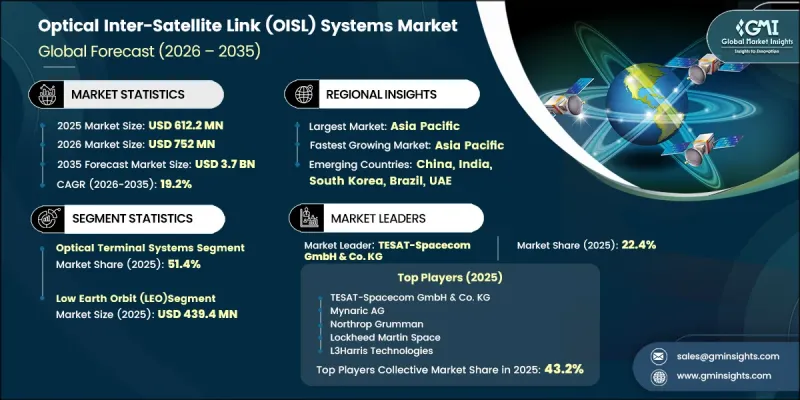
The Global Optical Inter-Satellite Link Systems Market was valued at USD 612.2 million in 2025 and is estimated to grow at a CAGR of 19.2% to reach USD 3.7 billion by 2035.
The increasing deployment of satellite networks designed to support seamless global connectivity is a major factor contributing to market growth. Rising requirements for secure, high-capacity communication systems, combined with growing demand for faster and more dependable data transmission capabilities, are accelerating adoption across the space communication sector. Continuous advancements in optical communication technologies are improving the performance and reliability of inter-satellite communication systems, further strengthening market expansion. In addition, increasing investments from both public and private organizations focused on enhancing space-based communication infrastructure are creating favorable opportunities for industry participants. As satellite operators continue to pursue more efficient methods of transferring information across orbital networks, optical inter-satellite link systems are becoming increasingly important for enabling high-speed communication and supporting next-generation space architectures. The combination of technological progress, expanding satellite deployments, and increasing requirements for secure data exchange is expected to sustain robust growth across the global optical inter-satellite link systems industry over the coming years.
| Market Scope | |
|---|---|
| Start Year | 2025 |
| Forecast Year | 2026-2035 |
| Start Value | $612.2 Million |
| Forecast Value | $3.7 Billion |
| CAGR | 19.2% |
The optical inter-satellite link systems market is experiencing significant growth due to the accelerating deployment of satellite constellations designed to improve communication coverage and network performance worldwide. As the number of satellites operating in orbit continues to increase, the need for efficient data exchange between space assets has become more critical. Optical communication links provide a highly effective solution by enabling direct, high-speed information transfer without depending extensively on terrestrial infrastructure. Market expansion is also supported by increasing investments in secure space-based communication networks. Defense organizations are placing greater emphasis on resilient satellite communication architectures that offer enhanced security, reduced latency, and improved operational reliability. These factors are contributing to the growing adoption of optical inter-satellite communication technologies across both commercial and government sectors.
The optical terminal systems segment accounted for 51.4% share in 2025. The segment's strong position is attributed to its fundamental role in enabling laser-based communication between satellites. Optical terminal systems serve as the primary hardware responsible for transmitting large volumes of data across orbital networks while supporting efficient communication performance. Growing integration of these systems across commercial satellite programs and defense-oriented space initiatives continues to drive demand, reinforcing their leading position within the market.
The low data rate (<= 2.5 Gbps) segment held a share of 43.6% in 2025, making it the leading category by data rate. Its dominance is largely supported by widespread adoption across established satellite communication networks and deployments where moderate transmission capacity remains sufficient for operational requirements. These systems offer cost advantages and relatively straightforward integration capabilities, making them attractive for a broad range of space communication applications. Continued utilization across existing satellite infrastructure is expected to support steady demand for this segment throughout the forecast period.
North America Optical Inter-Satellite Link Systems Market captured 52.5% share in 2025. Regional growth is being driven by the presence of major space technology developers, satellite operators, and defense organizations actively investing in advanced communication solutions. The region continues to witness increasing deployment of satellite networks alongside broader adoption of optical communication technologies across both commercial and government applications. Rising demand for secure, high-speed data transmission capabilities within space-based communication environments is further supporting market expansion. Ongoing investments in next-generation satellite infrastructure and advanced space technologies continue to strengthen North America's position as a leading regional market.
Key companies operating in the Global Optical Inter-Satellite Link Systems Market include Northrop Grumman, Lockheed Martin Space, L3Harris Technologies, Honeywell Aerospace, Teledyne Technologies, CACI International, General Atomics Electromagnetic Systems (GA-EMS), Airbus Defence and Space, Thales Alenia Space, NEC Corporation, Mynaric AG, TESAT-Spacecom GmbH & Co. KG, BridgeComm Inc., Skyloom Global, Transcelestial Technologies, TNO, and China Aerospace Science and Technology Corporation (CASC). Companies participating in the optical inter-satellite link systems industry are implementing a range of strategic initiatives to strengthen their competitive position and expand market presence. Significant investments in research and development remain a primary focus, enabling manufacturers to enhance transmission performance, reliability, and system efficiency. Organizations are also pursuing strategic collaborations with satellite operators, aerospace firms, and government agencies to accelerate technology deployment and broaden commercial opportunities. Product innovation aimed at improving communication speed, reducing latency, and supporting next-generation satellite architectures continues to play a critical role in market expansion. Many companies are further strengthening their foothold through capacity expansion, advanced manufacturing capabilities, and global business development efforts.
Table of Contents
Chapter 1 Methodology and Scope
- 1.1 Market scope and definition
- 1.2 Research design
- 1.2.1 Research approach
- 1.2.2 Data collection methods
- 1.3 Data mining sources
- 1.3.1 Global
- 1.3.2 Regional/Country
- 1.4 Base estimates and calculations
- 1.4.1 Base year calculation
- 1.4.2 Key trends for market estimation
- 1.5 Primary research and validation
- 1.5.1 Primary sources
- 1.6 Forecast model
- 1.7 Research assumptions and limitations
Chapter 2 Executive Summary
- 2.1 Industry 360° synopsis, 2022 - 2035
- 2.2 Key market trends
- 2.2.1 Component type trends
- 2.2.2 Orbit type trends
- 2.2.3 Data rate class trends
- 2.2.4 Application trends
- 2.2.5 End-User trends
- 2.2.6 Regional trends
- 2.3 TAM Analysis, 2026-2035
- 2.4 CXO perspectives: Strategic imperatives
Chapter 3 Industry Insights
- 3.1 Industry ecosystem analysis
- 3.1.1 Supplier Landscape
- 3.1.2 Profit Margin
- 3.1.3 Cost structure
- 3.1.4 Value addition at each stage
- 3.1.5 Factor affecting the value chain
- 3.1.6 Disruptions
- 3.2 Industry impact forces
- 3.2.1 Growth drivers
- 3.2.1.1 Expansion of low earth orbit (LEO) satellite constellations
- 3.2.1.2 Growing deployment of secure space-based military communication infrastructure
- 3.2.1.3 Growing demand for low-latency global connectivity networks
- 3.2.1.4 Rising private sector investments and public-private partnerships in space communication infrastructure
- 3.2.1.5 Advancements in laser communication and optical tracking technologies
- 3.2.2 Industry pitfalls and challenges
- 3.2.2.1 High cost and complexity of optical terminal integration
- 3.2.2.2 Challenges related to pointing, acquisition, and tracking (PAT) accuracy
- 3.2.3 Market opportunities
- 3.2.3.1 Development of space-based, data reliant gateway networks
- 3.2.3.2 Increased adoption of OISL in Earth observation and remote sensing missions
- 3.2.1 Growth drivers
- 3.3 Growth potential analysis
- 3.4 Regulatory landscape
- 3.4.1 North America
- 3.4.2 Europe
- 3.4.3 Asia Pacific
- 3.4.4 Latin America
- 3.4.5 Middle East & Africa
- 3.5 Porter's analysis
- 3.6 PESTEL analysis
- 3.7 Technology and Innovation landscape
- 3.7.1 Current technological trends
- 3.7.2 Emerging technologies
- 3.8 Price trends
- 3.8.1 By region
- 3.8.2 By product
- 3.9 Pricing Strategies
- 3.10 Emerging Business Models
- 3.11 Compliance Requirements
- 3.12 Patent and IP analysis
Chapter 4 Competitive Landscape, 2025
- 4.1 Introduction
- 4.2 Company market share analysis
- 4.2.1 By region
- 4.2.1.1 North America
- 4.2.1.2 Europe
- 4.2.1.3 Asia Pacific
- 4.2.1.4 Latin America
- 4.2.1.5 Middle East & Africa
- 4.2.2 Market concentration analysis
- 4.2.1 By region
- 4.3 Competitive benchmarking of key players
- 4.3.1 Financial performance comparison
- 4.3.1.1 Revenue
- 4.3.1.2 Profit margin
- 4.3.1.3 R&D
- 4.3.2 Product portfolio comparison
- 4.3.2.1 Product range breadth
- 4.3.2.2 Technology
- 4.3.2.3 Innovation
- 4.3.3 Geographic presence comparison
- 4.3.3.1 Global footprint analysis
- 4.3.3.2 Service network coverage
- 4.3.3.3 Market penetration by region
- 4.3.4 Competitive positioning matrix
- 4.3.4.1 Leaders
- 4.3.4.2 Challengers
- 4.3.4.3 Followers
- 4.3.4.4 Niche players
- 4.3.5 Strategic outlook matrix
- 4.3.1 Financial performance comparison
- 4.4 Key developments
- 4.4.1 Mergers and acquisitions
- 4.4.2 Partnerships and collaborations
- 4.4.3 Technological advancements
- 4.4.4 Expansion and investment strategies
- 4.4.5 Digital transformation initiatives
- 4.5 Emerging/ startup competitors landscape
Chapter 5 Market Estimates and Forecast, By Component Type, 2022 - 2035 (USD Million)
- 5.1 Key trends
- 5.2 Optical terminal systems
- 5.3 Tracking, acquisition & pointing (PAT) modules
- 5.4 Communication processing electronics
- 5.5 Optical subsystems & components
- 5.6 Integration & support services
Chapter 6 Market Estimates and Forecast, By Orbit Type, 2022 - 2035 (USD Million)
- 6.1 Key trends
- 6.2 Low earth orbit (LEO)
- 6.3 Medium earth orbit (MEO)
- 6.4 Geostationary earth orbit (GEO)
Chapter 7 Market Estimates and Forecast, By Data Rate Class, 2022 - 2035 (USD Million)
- 7.1 Key trends
- 7.2 Low data rate (≤ 2.5 Gbps)
- 7.3 Medium data rate (2.5-10 Gbps)
- 7.4 High data rate (> 10 Gbps)
Chapter 8 Market Estimates and Forecast, By Application, 2022 - 2035 (USD Million)
- 8.1 Key trends
- 8.2 Broadband & constellation networking
- 8.3 Earth observation data relay
- 8.4 Defense & secure communications
- 8.5 Scientific & deep space communications
Chapter 9 Market Estimates and Forecast, By End-User, 2022 - 2035 (USD Million)
- 9.1 Key trends
- 9.2 Commercial satellite operators
- 9.3 Government & research organizations
- 9.4 Defense & military organizations
Chapter 10 Market Estimates and Forecast, By Region, 2022 - 2035 (USD Million)
- 10.1 Key trends
- 10.2 North America
- 10.2.1 U.S.
- 10.2.2 Canada
- 10.3 Europe
- 10.3.1 Germany
- 10.3.2 UK
- 10.3.3 France
- 10.3.4 Spain
- 10.3.5 Italy
- 10.3.6 Russia
- 10.4 Asia Pacific
- 10.4.1 China
- 10.4.2 India
- 10.4.3 Japan
- 10.4.4 Australia
- 10.4.5 South Korea
- 10.5 Latin America
- 10.5.1 Brazil
- 10.5.2 Mexico
- 10.5.3 Argentina
- 10.6 Middle East and Africa
- 10.6.1 South Africa
- 10.6.2 Saudi Arabia
- 10.6.3 UAE
Chapter 11 Company Profiles
- 11.1 Global Key Players
- 11.1.1 TESAT-Spacecom GmbH & Co. KG
- 11.1.2 Mynaric AG
- 11.1.3 Northrop Grumman
- 11.1.4 Lockheed Martin Space
- 11.1.5 L3Harris Technologies
- 11.2 Regional key players
- 11.2.1 North America
- 11.2.1.1 BridgeComm Inc.
- 11.2.1.2 Skyloom Global
- 11.2.1.3 General Atomics Electromagnetic Systems (GA-EMS)
- 11.2.1.4 CACI International
- 11.2.1.5 Teledyne Technologies
- 11.2.1.6 Honeywell Aerospace
- 11.2.2 Asia Pacific
- 11.2.2.1 NEC Corporation
- 11.2.2.2 China Aerospace Science and Technology Corporation (CASC)
- 11.2.3 Europe
- 11.2.3.1 Thales Alenia Space
- 11.2.3.2 Airbus Defence and Space
- 11.2.3.3 TNO
- 11.2.1 North America
- 11.3 Niche Players/Disruptors
- 11.3.1 Transcelestial Technologies

