PUBLISHER: Global Market Insights Inc. | PRODUCT CODE: 2071223

PUBLISHER: Global Market Insights Inc. | PRODUCT CODE: 2071223
Industrial Camera Market Opportunity, Growth Drivers, Industry Trend Analysis, and Forecast 2026 - 2035
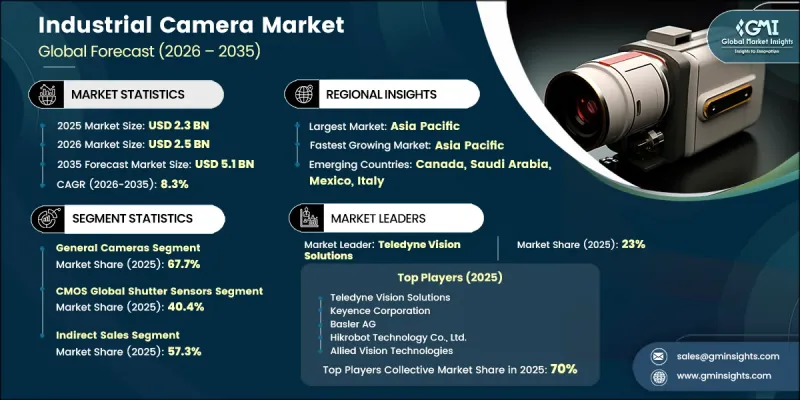
The Global Industrial Camera Market was valued at USD 2.3 billion in 2025 and is estimated to grow at a CAGR of 8.3% to reach USD 5.1 billion by 2035.
Growth in the Industrial Camera Market is driven by the increasing deployment of machine vision technologies across manufacturing industries, the growing adoption of artificial intelligence-enabled imaging systems, and the continued transition from traditional sensor technologies to more advanced imaging architectures that offer enhanced performance at competitive costs. Rising emphasis on automation, production efficiency, and product quality is encouraging manufacturers to integrate advanced vision systems into their operations. Regulatory requirements related to product inspection, process monitoring, and quality assurance are further supporting market expansion. In addition, the increasing adoption of three-dimensional imaging technologies in industrial automation, logistics, and robotic systems is creating new growth opportunities beyond conventional inspection applications. Continuous advancements in image resolution, frame rates, dynamic range capabilities, and embedded processing technologies are broadening the scope of industrial camera applications while improving overall system efficiency. As manufacturers increasingly prioritize automation and data-driven decision-making, industrial cameras are becoming a critical component of modern production infrastructure across multiple industries.
| Market Scope | |
|---|---|
| Start Year | 2025 |
| Forecast Year | 2026-2035 |
| Start Value | $2.3 Billion |
| Forecast Value | $5.1 Billion |
| CAGR | 8.3% |
The Industrial Camera Market is segmented accounted for 67.7% share in 2025, representing USD 1.56 billion, and is projected to grow at a CAGR of 8.1% during 2026-2035. These camera systems serve as essential imaging components within machine vision environments and are widely utilized in applications that require external processing capabilities. Their flexibility, scalability, and compatibility with a broad range of industrial imaging systems continue to support strong demand across manufacturing and automation sectors.
The indirect sales segment held a 57.3% share in 2025 and expected to grow at a CAGR of 7.8% through 2035. The prominence of this channel reflects the important role played by system integrators, specialized distributors, and value-added resellers in delivering complete machine vision solutions to end users. Industrial camera purchasing decisions often involve technical consultation, system design assistance, optical configuration, lighting optimization, and software integration services. As a result, indirect distribution networks remain a critical route to market, particularly for organizations seeking customized machine vision solutions and specialized deployment support.
North America Industrial Camera Market captured 29.3% share in 2025, equivalent to approximately USD 0.67 billion, and is anticipated to register a CAGR of 8.1% through 2035. The region continues to benefit from strong investments in advanced manufacturing, industrial automation, and high-technology production facilities. Growing demand for precision inspection systems, automated quality control technologies, and advanced imaging solutions across multiple industries is supporting market expansion throughout the region. In addition, ongoing investments in next-generation manufacturing infrastructure and increased adoption of machine vision technologies are expected to sustain long-term growth opportunities for industrial camera providers.
Leading companies operating in the Global Industrial Camera Market include Teledyne Vision Solutions, Keyence Corporation, Hikrobot, TKH / Allied Vision, Basler AG, IDS Imaging Development Systems, LUCID Vision Labs, Baumer Group, Sony Industrial Solutions, JAI A/S, Cognex Corporation, Omron Corporation, Vieworks, Imperx, and FLIR Systems (Industrial Division). Companies operating in the Industrial Camera Market are focusing on technological innovation, product portfolio expansion, and strategic partnerships to strengthen their market position. Leading manufacturers are investing heavily in research and development to enhance imaging performance, improve sensor capabilities, and integrate artificial intelligence and edge-processing technologies into industrial camera systems. Businesses are also expanding their presence through collaborations with automation providers, machine vision specialists, and industrial software companies to deliver comprehensive solutions for end users.
Table of Contents
Chapter 1 Methodology and Scope
- 1.1 Market scope and definition
- 1.2 Research design
- 1.2.1 Research approach
- 1.2.2 Data collection methods
- 1.3 Data mining sources
- 1.3.1 Global
- 1.3.2 Regional/Country
- 1.4 Base estimates and calculations
- 1.4.1 Base year calculation
- 1.4.2 Key trends for market estimation
- 1.5 Primary research and validation
- 1.5.1 Primary sources
- 1.6 Forecast model
- 1.7 Research assumptions and limitations
Chapter 2 Executive Summary
- 2.1 Industry 360° synopsis
- 2.2 Key market trends
- 2.2.1 Regional
- 2.2.2 Camera type
- 2.2.3 Interface
- 2.2.4 Sensor technology
- 2.2.5 Application
- 2.2.6 End use industry
- 2.2.7 Distribution channel
Chapter 3 Industry Insights
- 3.1 Industry ecosystem analysis
- 3.1.1 Supplier landscape
- 3.1.2 Profit margin
- 3.1.3 Value addition at each stage
- 3.1.4 Factor affecting the value chain
- 3.2 Industry impact forces
- 3.2.1 Growth drivers
- 3.2.1.1 Increasing adoption of machine vision
- 3.2.1.2 Industry 4.0 & smart manufacturing
- 3.2.1.3 Advancements in imaging technology
- 3.2.2 Industry pitfalls & challenges
- 3.2.2.1 High initial investment
- 3.2.2.2 System integration complexity
- 3.2.3 Opportunities
- 3.2.3.1 AI-powered vision systems
- 3.2.3.2 3D vision & advanced imaging
- 3.2.1 Growth drivers
- 3.3 Growth potential analysis
- 3.4 Regulatory framework
- 3.4.1 Machine safety standards (ISO 13849, IEC 62061)
- 3.4.2 Export control & ITAR regulations for vision components
- 3.4.3 CE, FCC & regional compliance requirements by geography
- 3.5 Pricing analysis (driven by primary research)
- 3.5.1 Historical price trend analysis (2022-2025)
- 3.5.2 Pricing strategy by player type (premium / value / cost-plus)
- 3.6 Trade data analysis (driven by paid database)
- 3.6.1 Import/export volume & value trends by HS Code (852589)
- 3.6.2 Key trade corridors & tariff impact
- 3.7 Impact of AI & generative AI on the market
- 3.7.1 AI-driven disruption of existing business models
- 3.7.2 GenAI use cases & adoption roadmap by segment
- 3.7.3 Risks, limitations & regulatory considerations
- 3.8 Capacity & production landscape (driven by primary research)
- 3.8.1 Installed capacity by region & key producer
- 3.8.2 Capacity utilization rates & expansion pipelines
Chapter 4 Competitive Landscape, 2025
- 4.1 Introduction
- 4.2 Company market share analysis
- 4.2.1 By region
- 4.2.1.1 North America
- 4.2.1.2 Europe
- 4.2.1.3 Asia Pacific
- 4.2.1.4 Latin America
- 4.2.1.5 Middle East and Africa
- 4.2.1 By region
- 4.3 Company matrix analysis
- 4.4 Competitive analysis of major market players
- 4.5 Competitive positioning matrix
- 4.6 Key developments
- 4.6.1 Mergers & acquisitions
- 4.6.2 Partnerships & collaborations
- 4.6.3 New product launches
- 4.6.4 Expansion plans
Chapter 5 Market Estimates and Forecast, By Camera Type, 2022 - 2035 (USD Billion) (Thousand Units)
- 5.1 Key trends
- 5.2 General camera
- 5.2.1 2D camera (area scan)
- 5.2.2 3D camera (structured light & laser triangulation)
- 5.2.3 Frame grabber
- 5.3 Smart Camera
- 5.3.1 AI-based smart camera
- 5.3.2 3D smart camera
- 5.3.3 Others (embedded vision modules, FGPA-based)
Chapter 6 Market Estimates and Forecast, By Interface, 2022 - 2035 (USD Billion) (Thousand Units)
- 6.1 Key trends
- 6.2 GigE Vision
- 6.3 5GigE / 10GigE Vision
- 6.4 USB 3.0 (USB3 Vision)
- 6.5 CoaXPress
- 6.6 Camera Link & Camera Link HS
- 6.7 Others (FireWire, MIPI, Thunderbolt)
Chapter 7 Market Estimates and Forecast, By Sensor Technology, 2022 - 2035 (USD Billion) (Thousand Units)
- 7.1 Key trends
- 7.2 CMOS - global shutter
- 7.3 CMOS - rolling shutter
- 7.4 CCD (charge-coupled device)
- 7.5 SWIR / MWIR (infrared sensor)
- 7.6 Time-of-Flight (ToF) - 3D depth sensor
Chapter 8 Market Estimates and Forecast, By Application, 2022 - 2035 (USD Billion) (Thousand Units)
- 8.1 Key trends
- 8.2 Quality assurance & inspection
- 8.3 Measurement & metrology
- 8.4 Positioning & guidance
- 8.5 Identification / OCR & traceability
- 8.6 Predictive & condition monitoring
- 8.7 Others (traffic monitoring, etc.)
Chapter 9 Market Estimates and Forecast, By End Use Industry, 2022 - 2035 (USD Billion) (Thousand Units)
- 9.1 Key trends
- 9.2 Electronics & semiconductor
- 9.3 Automotive
- 9.4 Food & beverage
- 9.5 Healthcare & life sciences
- 9.6 Logistics & warehousing
- 9.7 Oil & gas
- 9.8 Metal & mining
- 9.9 Aerospace & defence
- 9.10 Others (textiles, packaging, ITS, research)
Chapter 10 Market Estimates and Forecast, By Distribution Channel, 2022 - 2035 (USD Billion) (Thousand Units)
- 10.1 Key trends
- 10.2 Direct sales
- 10.3 Indirect sales
Chapter 11 Market Estimates and Forecast, By Region, 2022 - 2035 (USD Billion) (Thousand Units)
- 11.1 Key trends
- 11.2 North America
- 11.2.1 U.S.
- 11.2.2 Canada
- 11.3 Europe
- 11.3.1 Germany
- 11.3.2 UK
- 11.3.3 France
- 11.3.4 Italy
- 11.3.5 Spain
- 11.4 Asia Pacific
- 11.4.1 China
- 11.4.2 Japan
- 11.4.3 India
- 11.4.4 Australia
- 11.4.5 South Korea
- 11.5 Latin America
- 11.5.1 Brazil
- 11.5.2 Mexico
- 11.5.3 Argentina
- 11.6 Middle East and Africa
- 11.6.1 South Africa
- 11.6.2 Saudi Arabia
- 11.6.3 UAE
Chapter 12 Company Profiles
- 12.1 Global players
- 12.1.1 Basler AG
- 12.1.2 Teledyne Vision Solutions
- 12.1.3 Cognex Corporation
- 12.1.4 Keyence Corporation
- 12.1.5 Allied Vision Technologies
- 12.1.6 Baumer Group
- 12.1.7 OMRON Corporation
- 12.2 Regional players
- 12.2.1 IDS Imaging Development Systems GmbH
- 12.2.2 JAI A/S
- 12.2.3 SICK AG
- 12.2.4 Hikrobot Technology Co., Ltd.
- 12.2.5 Daheng Imaging Co., Ltd.
- 12.2.6 Vieworks Co., Ltd.
- 12.2.7 Toshiba Teli Corporation
- 12.3 Emerging players
- 12.3.1 XIMEA GmbH
- 12.3.2 Photonfocus AG
- 12.3.3 LUCID Vision Labs Inc.
- 12.3.4 Emergent Vision Technologies Inc.
- 12.3.5 Imperx Inc.
- 12.3.6 Heliotis AG
- 12.3.7 Tattile Srl

