PUBLISHER: Global Market Insights Inc. | PRODUCT CODE: 2071231

PUBLISHER: Global Market Insights Inc. | PRODUCT CODE: 2071231
North America Smart Dishwasher Market Opportunity, Growth Drivers, Industry Trend Analysis, and Forecast 2026 - 2035
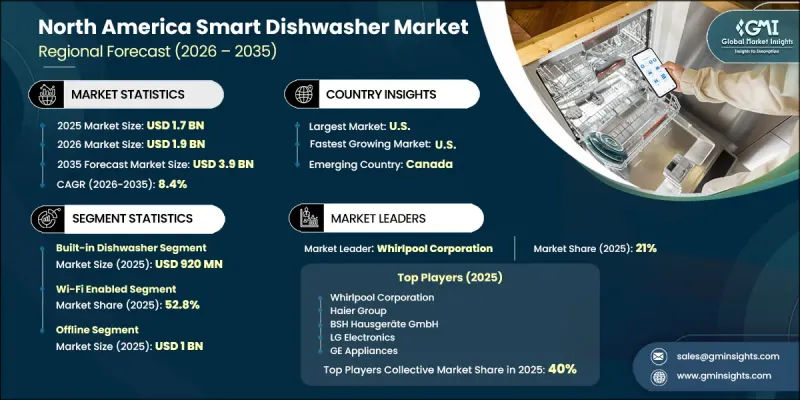
North America Smart Dishwasher Market was estimated at USD 1.7 billion in 2025 and is estimated to grow at a CAGR of 8.4% to reach USD 3.9 billion by 2035.
Growth in the North America smart dishwasher industry is fueled by the rapid adoption of connected home technologies and the increasing integration of intelligent appliances into modern households. Consumers are increasingly seeking home appliances that seamlessly interact with broader smart home environments, enabling centralized management and enhanced convenience. As connected living becomes more common, purchasing decisions are no longer based solely on cleaning performance but also on connectivity, automation capabilities, and ease of integration with other household technologies. Demand is also being driven by consumers' preference for appliances that simplify everyday routines through remote accessibility, intelligent operation, and automated functionality. Smart dishwashers are evolving from standalone kitchen appliances into essential components of a connected home ecosystem. The growing importance of interoperability among household devices is encouraging consumers to invest in products that contribute to a more efficient and streamlined living experience. As smart home adoption continues to expand across North America, demand for advanced dishwasher technologies is expected to remain strong throughout the forecast period.
| Market Scope | |
|---|---|
| Start Year | 2025 |
| Forecast Year | 2026-2035 |
| Start Value | $1.7 Billion |
| Forecast Value | $3.9 Billion |
| CAGR | 8.4% |
Built-in dishwashers accounted for USD 920 million in 2025. Their popularity continues to rise among homeowners seeking modern, integrated kitchen solutions that combine functionality with visual appeal. Built-in models are specifically designed to blend seamlessly with surrounding cabinetry, creating a cohesive and refined kitchen appearance. Growing interest in contemporary kitchen aesthetics, along with increasing investments in home improvement and residential construction projects, is supporting demand for these appliances. Their ability to complement customized kitchen layouts while maximizing space efficiency has further strengthened their position as the preferred product category within the market.
The Wi-Fi-enabled segment held a 52.8% share in 2025. Wireless connectivity has become a defining feature of smart dishwashers, allowing users to access appliance controls and performance information through connected digital platforms. Consumers increasingly value the ability to monitor, manage, and adjust appliance functions remotely, providing greater flexibility and convenience in daily household management. Connectivity features also enhance the overall user experience by offering operational updates, maintenance notifications, and cycle status information. As consumers continue to prioritize convenience and connected functionality, Wi-Fi-enabled dishwashers are expected to maintain strong demand across the region.
United States Smart Dishwasher Market held a 78.7% share, generating USD 1.3 billion in 2025. Market leadership is supported by high consumer awareness of smart home technologies, strong purchasing power, and widespread adoption of connected household devices. Consumers increasingly favor intelligent appliances that offer enhanced control, automation, and real-time performance monitoring capabilities. The country's advanced smart home ecosystem and growing preference for technology-driven household solutions continue to create favorable conditions for market expansion. As digital connectivity becomes an increasingly important aspect of residential living, demand for smart dishwashers is expected to remain strong across the United States.
Key companies operating in the North America smart dishwasher market include Whirlpool Corporation, LG Electronics, Samsung Electronics, BSH Hausgerate GmbH, Electrolux AB, GE Appliances, Haier Group, Fisher & Paykel, Midea Group, ASKO Appliances, Thermador, Sharp Home Electronics, Cafe Appliances, Cove Appliances, Beko (Arcelik), SMEG S.p.A., Hisense Group, Monogram, Signature Kitchen Suite, and Daan Tech. Companies participating in the North America smart dishwasher industry are implementing several strategic initiatives to strengthen their market position and enhance competitive advantage. Product innovation remains a primary focus, with manufacturers investing in advanced connectivity features, artificial intelligence capabilities, energy-efficient technologies, and improved user interfaces. Businesses are increasingly emphasizing seamless integration with broader smart home ecosystems to meet evolving consumer expectations. Strategic partnerships with technology providers, smart home platform developers, and distribution networks are helping companies expand market reach and improve product accessibility. In addition, manufacturers are investing in premium product offerings, customization options, and sustainable appliance technologies to differentiate themselves in a competitive marketplace. Enhanced digital marketing efforts, direct-to-consumer sales strategies, and expanded after-sales support services are also helping companies strengthen customer loyalty and establish a stronger foothold in the North America smart dishwasher market.
Table of Contents
Chapter 1 Methodology and Scope
- 1.1 Market scope and definition
- 1.2 Research design
- 1.2.1 Research approach
- 1.2.2 Data collection methods
- 1.3 Data mining sources
- 1.3.1 Global
- 1.3.2 Regional/Country
- 1.4 Base estimates and calculations
- 1.4.1 Base year calculation
- 1.4.2 Key trends for market estimation
- 1.5 Primary research and validation
- 1.5.1 Primary sources
- 1.6 Forecast model
- 1.7 Research assumptions and limitations
Chapter 2 Executive Summary
- 2.1 Industry 360° synopsis
- 2.2 Key market trends
- 2.2.1 Country
- 2.2.2 Product type
- 2.2.3 Connectivity technology
- 2.2.4 Capacity
- 2.2.5 Application
- 2.2.6 Distribution channel
Chapter 3 Industry Insights
- 3.1 Industry ecosystem analysis
- 3.1.1 Supplier landscape
- 3.1.2 Profit margin
- 3.1.3 Value addition at each stage
- 3.1.4 Factor affecting the value chain
- 3.2 Industry impact forces
- 3.2.1 Growth drivers
- 3.2.1.1 Smart home ecosystem expansion
- 3.2.1.2 Sustainability & energy efficiency
- 3.2.1.3 Premium kitchen & remodeling trends
- 3.2.2 Industry pitfalls & challenges
- 3.2.2.1 High product cost
- 3.2.2.2 Cybersecurity & data privacy concerns
- 3.2.3 Opportunities
- 3.2.3.1 Sustainability-led innovation
- 3.2.3.2 Smart kitchen integration
- 3.2.1 Growth drivers
- 3.3 Growth potential analysis
- 3.4 Regulatory framework
- 3.4.1 U.S. ENERGY STAR program & doe appliance efficiency standards
- 3.4.2 Canada energy efficiency regulations (EER) natural resources canada
- 3.4.3 FCC IoT device standards & cybersecurity requirements (U.S.)
- 3.4.4 ISED canada radio equipment standards for connected appliances
- 3.4.5 ADA accessibility compliance standards for appliances
- 3.4.6 USMCA trade regulations impact on appliance manufacturing & imports
- 3.5 Pricing analysis
- 3.5.1 Historical price trend analysis (driven by primary research)
- 3.5.2 Pricing strategy by player type (premium / value / cost-plus)
- 3.6 Trade data analysis (driven by paid database) (842211)
- 3.6.1 Import/export volume & value trends
- 3.6.2 Key trade corridors & tariff impact
- 3.7 Impact of AI & generative AI on the market
- 3.7.1 AI-driven disruption of existing business models
- 3.7.2 GenAI use cases & adoption roadmap by segment
- 3.7.3 Risks, limitations & regulatory considerations
- 3.8 Distribution infrastructure & channel penetration landscape (driven by primary research)
- 3.8.1 Channel coverage by region & format (modern vs. Traditional trade)
- 3.8.2 Last-mile infrastructure gaps & emerging channel shifts
Chapter 4 Competitive Landscape, 2025
- 4.1 Introduction
- 4.2 Company market share analysis
- 4.2.1 By country
- 4.2.1.1 U.S.
- 4.2.1.2 Canada
- 4.2.1 By country
- 4.3 Company matrix analysis
- 4.4 Competitive analysis of major market players
- 4.5 Competitive positioning matrix
- 4.6 Key developments
- 4.6.1 Mergers & acquisitions
- 4.6.2 Partnerships & collaborations
- 4.6.3 New product launches
- 4.6.4 Expansion plans
Chapter 5 Market Estimates and Forecast, By Product Type, 2022 - 2035 (USD Billion) (Thousand Units)
- 5.1 Key trends
- 5.2 Built-in dishwasher
- 5.3 Freestanding dishwasher
- 5.4 Semi-integrated dishwasher
- 5.5 Countertop dishwasher
- 5.6 Drawer dishwasher
Chapter 6 Market Estimates and Forecast, By Connectivity Technology, 2022 - 2035 (USD Billion) (Thousand Units)
- 6.1 Key trends
- 6.2 Wi-Fi enabled
- 6.3 Bluetooth enabled
- 6.4 NFC (near field communication)
- 6.5 Multi-protocol (Wi-Fi + Bluetooth + Voice Assistant)
Chapter 7 Market Estimates and Forecast, By Capacity, 2022 - 2035 (USD Billion) (Thousand Units)
- 7.1 Key trends
- 7.2 Less than 8 place settings
- 7.3 8-12 place settings
- 7.4 13-16 place settings
- 7.5 Above 16 place settings
Chapter 8 Market Estimates and Forecast, By Application, 2022 - 2035 (USD Billion) (Thousand Units)
- 8.1 Key trends
- 8.2 Household
- 8.3 Commercial
- 8.3.1 Hotels & hospitality
- 8.3.2 Restaurants & food service
- 8.3.3 Healthcare & institutional
- 8.3.4 Others
- 8.4 Industrial
Chapter 9 Market Estimates and Forecast, By Distribution Channel, 2022 - 2035 (USD Billion) (Thousand Units)
- 9.1 Key trends
- 9.2 Offline
- 9.2.1 Specialty appliance stores
- 9.2.2 Hypermarkets
- 9.2.3 Brand showrooms
- 9.3 Online
- 9.3.1 E-commerce websites
- 9.3.2 Company websites
Chapter 10 Market Estimates and Forecast, By Country, 2022 - 2035 (USD Billion) (Thousand Units)
- 10.1 Key trends
- 10.2 U.S.
- 10.3 Canada
Chapter 11 Company Profiles
- 11.1 Global players
- 11.1.1 Whirlpool Corporation
- 11.1.2 BSH Hausgerate GmbH
- 11.1.3 LG Electronics
- 11.1.4 Samsung Electronics
- 11.1.5 Electrolux AB
- 11.1.6 Haier Group
- 11.1.7 GE Appliances
- 11.2 Regional players
- 11.2.1 Midea Group
- 11.2.2 Fisher & Paykel
- 11.2.3 ASKO Appliances
- 11.2.4 Sharp Home Electronics
- 11.2.5 Cove Appliances
- 11.2.6 Thermador
- 11.2.7 Cafe Appliances
- 11.3 Emerging players
- 11.3.1 Beko (Arcelik)
- 11.3.2 SMEG S.p.A.
- 11.3.3 Hisense Group
- 11.3.4 Daan Tech (Bob)
- 11.3.5 Signature Kitchen Suite
- 11.3.6 Monogram

