PUBLISHER: Global Market Insights Inc. | PRODUCT CODE: 2101613

PUBLISHER: Global Market Insights Inc. | PRODUCT CODE: 2101613
North America Dishwasher Market Opportunity, Growth Drivers, Industry Trend Analysis, and Forecast 2026 - 2035
North America Dishwasher Market was valued at USD 7.2 billion in 2025 and is estimated to grow at a CAGR of 1.8% to reach USD 8.8 billion by 2035.
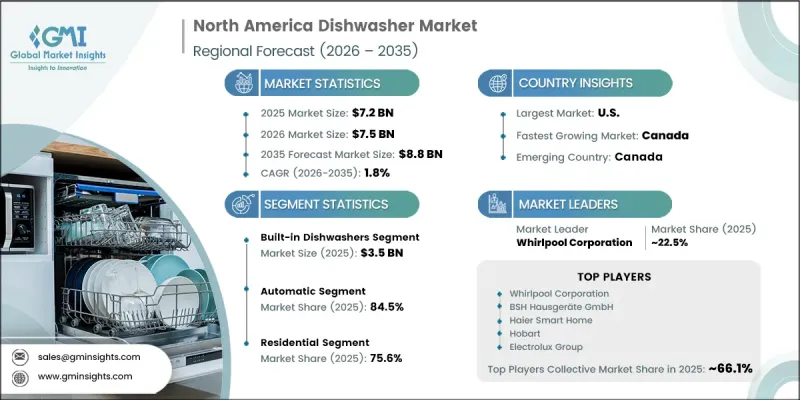
Increasing adoption of smart home technologies continues to create favorable growth opportunities for the North America dishwasher industry as consumers prioritize connected appliances that improve convenience and simplify everyday kitchen operations. Demand for smart dishwashers is rising steadily because homeowners prefer appliances that can be managed remotely and integrated into digital home ecosystems. Manufacturers are focusing on introducing advanced dishwasher solutions equipped with intelligent operating capabilities, enhanced energy management, personalized washing functions, and app-enabled controls to meet evolving consumer expectations. Expanding investments in connected residential infrastructure across North America are further supporting product adoption. At the same time, changing lifestyles and the growing number of dual-income households are accelerating demand for appliances that reduce household workloads and improve time efficiency. Consumers continue to favor dishwashers that minimize manual cleaning while delivering reliable performance and greater convenience, making automated kitchen appliances an increasingly important part of modern residential environments. Continuous interest in innovative, efficient, and technology-driven household appliances is expected to support sustained growth across the North America dishwasher market throughout the forecast period.
| Market Scope | |
|---|---|
| Start Year | 2025 |
| Forecast Year | 2026-2035 |
| Start Value | $7.2 Billion |
| Forecast Value | $8.8 Billion |
| CAGR | 1.8% |
The built-in segment accounted for USD 3.5 billion in 2025 and is expected to grow at a CAGR of 3.4% between 2026 and 2035. Built-in dishwashers remain the leading product category within the North America dishwasher market because consumers increasingly prefer integrated kitchen appliances that complement modern kitchen layouts while maximizing available space. These systems offer higher loading capacity, streamlined installation, improved user convenience, and an enhanced visual appearance, making them a preferred choice across both residential and commercial environments. Rising demand for organized and aesthetically appealing kitchen spaces continues to strengthen the adoption of built-in dishwasher solutions throughout the region.
The automatic segment represented 84.5% share in 2025 and is forecast to grow at a CAGR of 2.2% from 2026 to 2035. Market leadership of this segment is supported by increasing consumer demand for kitchen appliances that simplify daily cleaning routines and reduce the need for manual effort. Automatic dishwashers deliver dependable washing performance, effective sanitation, optimized water consumption, and consistent operational efficiency, making them suitable for a broad range of residential and commercial applications. Consumers continue to choose automated dishwasher solutions because they enhance household productivity while offering greater convenience and dependable cleaning performance.
U.S. Dishwasher Market generated USD 6.6 billion in 2025 and is anticipated to witness a CAGR of 1.8% from 2026 to 2035, maintaining its leadership position within the North America dishwasher market. Strong demand for automated dishwashing appliances across residential and commercial end users continues to support market expansion. Consumer preference is steadily shifting toward smart and built-in dishwasher models that offer improved operational efficiency, enhanced water conservation, and seamless integration into modern kitchen designs, contributing to continued market growth across the United States.
Leading participants operating in the North America dishwasher market include Whirlpool Corporation, BSH Hausgerate GmbH, Haier Smart Home, Hobart, and Electrolux Group. Companies operating in the North America dishwasher market are strengthening their market position by prioritizing product innovation, smart appliance development, and continuous portfolio expansion. Manufacturers are investing in advanced technologies that improve energy efficiency, water conservation, and user convenience while incorporating connected features that enhance the overall consumer experience. Businesses are also introducing models across multiple price points to serve both premium and value-conscious customers, allowing them to reach a broader customer base. Strategic investments in manufacturing capabilities, distribution networks, and after-sales service continue to improve product availability and customer satisfaction.
Table of Contents
Chapter 1 Methodology & Scope
- 1.1 Market scope and definition
- 1.2 Research design
- 1.2.1 Research approach
- 1.2.2 Data collection methods
- 1.3 Data mining sources
- 1.3.1 Global
- 1.3.2 Regional/Country
- 1.4 Base estimates and calculations
- 1.4.1 Base year calculation
- 1.4.2 Key trends for market estimation
- 1.5 Primary research and validation
- 1.5.1 Primary sources
- 1.6 Forecast model
- 1.7 Research assumptions and limitations
Chapter 2 Executive Summary
- 2.1 Industry 360° synopsis
- 2.2 Key market trends
- 2.2.1 Country
- 2.2.2 Product Type
- 2.2.3 Capacity
- 2.2.4 Mode of Operation
- 2.2.5 Price Range
- 2.2.6 End User
- 2.2.7 Distribution channel
Chapter 3 Industry Insights
- 3.1 Industry ecosystem analysis
- 3.1.1 Supplier landscape
- 3.1.2 Profit margin
- 3.1.3 Value addition at each stage
- 3.1.4 Factor affecting the value chain
- 3.2 Industry impact forces
- 3.2.1 Growth drivers
- 3.2.1.1 Rising adoption of automated kitchen appliances across residential and commercial sectors
- 3.2.1.2 Growing awareness regarding water conservation and hygiene standards
- 3.2.1.3 Expansion of hospitality and foodservice infrastructure
- 3.2.2 Pitfalls & Challenges
- 3.2.2.1 High installation and maintenance costs associated with advanced dishwasher systems
- 3.2.2.2 Dependence on stable water and electricity infrastructure
- 3.2.3 Opportunities
- 3.2.3.1 Rising demand for smart and energy-efficient kitchen appliances
- 3.2.3.2 Expansion of modular kitchen and premium housing projects
- 3.2.1 Growth drivers
- 3.3 Growth potential analysis
- 3.4 Future market trends
- 3.5 Technology and innovation landscape
- 3.5.1 Current technological trends
- 3.5.2 Emerging technologies
- 3.6 Regulatory landscape
- 3.6.1 Standards and compliance requirements
- 3.6.2 Regional regulatory frameworks
- 3.6.3 Certification standards
- 3.7 Porter's analysis
- 3.8 PESTEL analysis
- 3.9 Pricing analysis (driven by primary research)
- 3.9.1 Historical price trend analysis (driven by primary research)
- 3.9.2 Pricing strategy by player type (premium / value / cost-plus) (driven by primary research)
- 3.9.3 Regional price variations (driven by primary research)
- 3.9.4 Impact of component costs on end-user pricing (driven by primary research)
- 3.10 Trade data analysis (HS code of household dishwasher- 8422.11 (driven by paid database))
- 3.10.1 Import/export volume and value trends (driven by paid database)
- 3.10.2 Key trade corridors and tariff impact (driven by paid database)
- 3.10.3 Major importing and exporting countries (driven by paid database)
- 3.11 Impact of AI and generative AI on the market
- 3.11.1 AI-driven disruption of existing business models
- 3.11.2 GenAI use cases and adoption roadmap by segment
- 3.11.3 Predictive maintenance and diagnostics
- 3.11.4 Risks, limitations and regulatory considerations
- 3.12 Distribution infrastructure and channel penetration landscape (driven by primary research)
- 3.12.1 Channel coverage by region and format (modern vs. traditional trade) (driven by primary research)
- 3.12.2 Last-mile infrastructure gaps and emerging channel shifts (driven by primary research)
Chapter 4 Competitive Landscape, 2025
- 4.1 Introduction
- 4.2 Company market share analysis
- 4.2.1 By Country
- 4.2.1.1 U.S.
- 4.2.1.2 Canada
- 4.2.1 By Country
- 4.3 Company matrix analysis
- 4.4 Competitive analysis of major market players
- 4.5 Competitive positioning matrix
- 4.6 Key developments
- 4.6.1 Mergers & acquisitions
- 4.6.2 Partnerships & collaborations
- 4.6.3 New product launches
- 4.6.4 Expansion plans
Chapter 5 Market Estimates & Forecast, By Product Type, 2022 - 2035, (USD Billion) (Thousand Units)
- 5.1 Key trends
- 5.2 Built-in Dishwasher
- 5.3 Freestanding Dishwasher
- 5.4 Countertop Dishwasher
- 5.5 Tabletop Dishwasher
Chapter 6 Market Estimates & Forecast, By Capacity, 2022 - 2035, (USD Billion) (Thousand Units)
- 6.1 Key trends
- 6.2 Up to 6 Place Settings
- 6.3 7-10 Place Settings
- 6.4 Above 10 Place Settings
Chapter 7 Market Estimates & Forecast, By Mode of Operation, 2022 - 2035, (USD Billion) (Thousand Units)
- 7.1 Key trends
- 7.2 Automatic
- 7.3 Semi-automatic
- 7.4 Manual
Chapter 8 Market Estimates & Forecast, By Price Range, 2022 - 2035, (USD Billion) (Thousand Units)
- 8.1 Key trends
- 8.2 Economy
- 8.3 Mid-Range
- 8.4 Premium
Chapter 9 Market Estimates & Forecast, By End User, 2022 - 2035, (USD Billion) (Thousand Units)
- 9.1 Key trends
- 9.2 Residential
- 9.3 Commercial
- 9.3.1 Hotels & restaurants
- 9.3.2 Office and school canteens
- 9.3.3 Others
Chapter 10 Market Estimates & Forecast, By Distribution Channel, 2022 - 2035, (USD Billion) (Thousand Units)
- 10.1 Key trends
- 10.2 Offline
- 10.2.1 Hypermarkets/Supermarkets
- 10.2.2 Specialty Stores
- 10.2.3 Multi-brand Stores
- 10.2.4 Other Retail Stores
- 10.3 Online
- 10.3.1 E-commerce Platforms
- 10.3.2 Company-owned Websites
Chapter 11 Market Estimates & Forecast, By Country, 2022 - 2035, (USD Billion) (Thousand Units)
- 11.1 Key trends
- 11.2 U.S.
- 11.3 Canada
Chapter 12 Company Profiles
- 12.1 Top Global Players
- 12.1.1 BSH Hausgerate GmbH
- 12.1.2 Whirlpool Corporation
- 12.1.3 Haier Smart Home
- 12.1.4 Electrolux Group
- 12.1.5 Samsung Electronics
- 12.1.6 LG Electronics
- 12.1.7 Miele & Cie. KG
- 12.2 Regional Champions
- 12.2.1 Hobart
- 12.2.2 Ali Group S.r.l.
- 12.2.3 Electrolux Professional AB
- 12.2.4 Winterhalter Gastronom GmbH
- 12.2.5 Meiko Maschinenbau GmbH & Co. KG
- 12.2.6 ASKO Appliances
- 12.2.7 Smeg S.p.A.
- 12.3 Emerging & Specialized Players
- 12.3.1 Sub-Zero Group (Cove)
- 12.3.2 Arcelik A.S.
- 12.3.3 Midea Group
- 12.3.4 Franke Group
- 12.3.5 Danby Products Inc.
- 12.3.6 Mabe
- 12.3.7 Vestel A.S.

