PUBLISHER: Global Market Insights Inc. | PRODUCT CODE: 2071232

PUBLISHER: Global Market Insights Inc. | PRODUCT CODE: 2071232
Automated Weight Checking and Reject Systems Market Opportunity, Growth Drivers, Industry Trend Analysis, and Forecast 2026 - 2035
The Global Automated Weight Checking and Reject Systems Market was valued at USD 1.7 billion in 2025 and is estimated to grow at a CAGR of 5.7% to reach USD 3 billion by 2035.
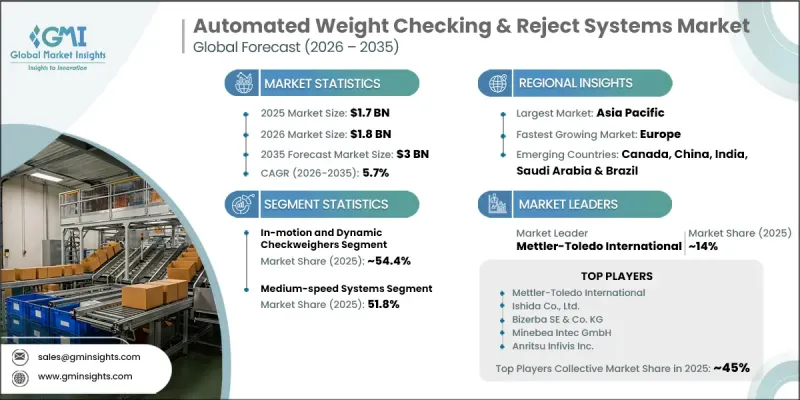
Market growth is driven by the rising need for precise in-line weight verification and automated rejection of non-compliant products across high-throughput manufacturing environments. Demand is particularly strong across food and beverage, pharmaceutical, and logistics operations where accuracy, compliance, and operational efficiency are critical. Increasing regulatory scrutiny on product fill accuracy, combined with the global shift toward fully automated packaging lines, is further accelerating adoption. Manufacturers are also under pressure to minimize product giveaway losses, which is pushing investment in high-precision weighing systems. As production environments become more digitally integrated, automated checkweighers are increasingly evolving into intelligent data nodes within Industry 4.0 ecosystems. Regulatory frameworks continue to reinforce this trend, with structured compliance requirements governing packaged product weights and measurement accuracy. In the United States, commercial weighing systems are regulated through national standards enforced at the state level, while European regulations mandate strict statistical conformity with declared weights. These regulatory pressures, along with rising automation across FMCG and pharmaceutical manufacturing, are expected to sustain long-term market expansion across global industrial sectors.
| Market Scope | |
|---|---|
| Start Year | 2025 |
| Forecast Year | 2026-2035 |
| Start Value | $1.7 Billion |
| Forecast Value | $3 Billion |
| CAGR | 5.7% |
The in-motion and dynamic checkweighers segment accounted generated USD 925.3 million in 2025, held a 54.4% share. Its leadership is supported by widespread adoption in continuous production environments where products must be weighed without interrupting line speed. Strong demand from high-volume packaging operations continues to reinforce the importance of dynamic weighing systems as a core component of modern automated production lines.
The medium-speed systems segment held a 51.8% share and is expected to grow at a CAGR of 5.9% through 2035. This segment's dominance is linked to its alignment with standard production line throughput levels across multiple industries, including packaged foods, beverages, and consumer goods. Medium-speed configurations offer an optimal balance between accuracy and operational efficiency, making them widely applicable across diverse manufacturing setups where consistent production flow is required.
North America Automated Weight Checking and Reject Systems Market accounted for USD 454.3 million in 2025 and is projected to grow at a CAGR of 5.9% through 2035 in the automated weight checking and reject systems market. The United States represented the largest share within the region at approximately USD 379 million, capturing about 84% of regional revenue. Market growth is supported by a strong manufacturing base in food, beverage, and pharmaceutical sectors, along with increasing automation in logistics and fulfillment operations. Regulatory compliance requirements and standardized measurement frameworks continue to support consistent replacement cycles for installed systems, contributing to sustained demand for upgraded and high precision checkweighing technologies across industrial applications.
Key companies operating in the global automated weight checking and reject systems market include Ishida Co., Ltd., Mettler-Toledo International Inc., Bizerba SE & Co. KG, Anritsu Corporation, WIPOTEC-OCS GmbH, Minebea Intec GmbH, Robert Bosch GmbH, A&D Company, Limited, Thermo Fisher Scientific Inc., Yamato Scale Co., Ltd., Multivac Group, Shanghai Shigan Industrial Co., Ltd., High Dream Machinery Co., Ltd., Varpe Control Peso S.L., and Cassel Messtechnik GmbH. Companies operating in the automated weight checking and reject systems market are adopting advanced automation, digital integration, and precision engineering strategies to strengthen their competitive position. Leading players are increasingly investing in smart checkweighing technologies equipped with IoT connectivity and real-time data analytics to enhance production visibility and quality control. Many firms are integrating their systems with broader packaging automation lines to support seamless Industry 4.0 adoption. Strategic partnerships with packaging equipment manufacturers and industrial automation providers are expanding market reach and improving system interoperability.
Table of Contents
Chapter 1 Methodology & Scope
- 1.1 Market scope and definition
- 1.2 Research design
- 1.2.1 Research approach
- 1.2.2 Data collection methods
- 1.3 Data mining sources
- 1.3.1 Global
- 1.3.2 Regional/Country
- 1.4 Base estimates and calculations
- 1.4.1 Base year calculation
- 1.4.2 Key trends for market estimation
- 1.5 Primary research and validation
- 1.5.1 Primary sources
- 1.6 Forecast model
- 1.7 Research assumptions and limitations
Chapter 2 Executive Summary
- 2.1 Industry 360° synopsis
- 2.2 Key market trends
- 2.2.1 Regional
- 2.2.2 System type
- 2.2.3 Rejection mechanism
- 2.2.4 Speed
- 2.2.5 Weighing technology
- 2.2.6 Weight capacity
- 2.2.7 Level of automation
- 2.2.8 End-user industry
- 2.2.9 Distribution channel
Chapter 3 Industry Insights
- 3.1 Industry ecosystem analysis
- 3.1.1 Supplier landscape
- 3.1.2 Profit margin
- 3.1.3 Value addition at each stage
- 3.1.4 Factor affecting the value chain
- 3.2 Industry impact forces
- 3.2.1 Growth drivers
- 3.2.1.1 Stringent net-content regulations & legal metrology compliance requirements across key markets
- 3.2.1.2 Rapid packaging line automation adoption in FMCG, pharma & logistics sectors
- 3.2.1.3 Growing cost awareness around product giveaway & overfill losses
- 3.2.1.4 Surge in micro-fulfillment & e-commerce logistics demanding high-accuracy weight verification
- 3.2.2 Industry pitfalls & challenges
- 3.2.2.1 Calibration drift & measurement uncertainty management at high-speed production rates
- 3.2.2.2 Vibration & environmental interference affecting weighing precision on plant floors
- 3.2.2.3 Fragmented regional regulatory certification requirements increasing compliance costs
- 3.2.2.4 Manual override culture & operator behavior compromising rejection system integrity
- 3.2.3 Opportunities
- 3.2.3.1 AI & IIoT integration enabling predictive calibration drift detection & autonomous threshold management
- 3.2.3.2 Expansion of combination inspection systems
- 3.2.3.3 Untapped market penetration in Asia Pacific & Latin America food processing sectors
- 3.2.3.4 Rising demand for track-and-trace & serialization integration in pharma packaging lines
- 3.2.1 Growth drivers
- 3.3 Growth potential analysis
- 3.4 Future market trends
- 3.5 Technology and innovation landscape
- 3.5.1 Current technological trends
- 3.5.2 Emerging technologies
- 3.6 Regulatory landscape
- 3.6.1 Standards and compliance requirements
- 3.6.2 Regional regulatory frameworks
- 3.6.3 Certification standards
- 3.7 Trade data analysis (HS Code 8423)
- 3.7.1 Import/export volume & value trends
- 3.7.2 Key trade corridors & tariff impact
- 3.8 Pricing analysis
- 3.8.1 Historical price trend analysis (driven by primary research)
- 3.8.2 Pricing strategy by player type (premium / value / mass market)
- 3.9 Impact of AI & generative AI on the market
- 3.9.1 AI-driven disruption of existing business models
- 3.9.2 GenAI use cases & adoption roadmap by segment
- 3.9.3 Risks, limitations & regulatory considerations
- 3.10 Porter's analysis
- 3.11 PESTEL analysis
Chapter 4 Competitive Landscape, 2025
- 4.1 Introduction
- 4.2 Company market share analysis
- 4.2.1 By Region
- 4.2.1.1 North America
- 4.2.1.2 Europe
- 4.2.1.3 Asia Pacific
- 4.2.1.4 Latin America
- 4.2.1.5 Middle East & Africa
- 4.2.1 By Region
- 4.3 Company matrix analysis
- 4.4 Competitive analysis of major market players
- 4.5 Competitive positioning matrix
- 4.6 Key developments
- 4.6.1 Mergers & acquisitions
- 4.6.2 Partnerships & collaborations
- 4.6.3 New product launches
- 4.6.4 Expansion plans
Chapter 5 Market Estimates & Forecast, By System Type, 2022 - 2035, (USD Million) (Thousand Units)
- 5.1 Key trends
- 5.2 In-motion / dynamic checkweighers
- 5.3 Intermittent / static checkweighers
- 5.4 Combination inspection systems
Chapter 6 Market Estimates & Forecast, By Rejection Mechanism, 2022 - 2035, (USD Million) (Thousand Units)
- 6.1 Key trends
- 6.2 Air blast rejection
- 6.3 Pusher / paddle rejection
- 6.4 Drop flap / trapdoor rejection
- 6.5 Diverter / deflector rejection
- 6.6 Dual rejection systems
Chapter 7 Market Estimates & Forecast, By Speed, 2022 - 2035, (USD Million) (Thousand Units)
- 7.1 Key trends
- 7.2 High-speed (>300 Units/Min)
- 7.3 Medium-speed (50-300 Units/Min)
- 7.4 Low-speed (≤50 Units/Min)
Chapter 8 Market Estimates & Forecast, By Weighing Technology, 2022 - 2035, (USD Million) (Thousand Units)
- 8.1 Key trends
- 8.2 Strain gauge load cell
- 8.3 Electro-magnetic force restoration (EMFR)
- 8.4 Hybrid / advanced sensor systems
Chapter 9 Market Estimates & Forecast, By Weight Capacity, 2022 - 2035, (USD Million) (Thousand Units)
- 9.1 Key trends
- 9.2 Up to 12 kg
- 9.3 12 to 60 kg
- 9.4 60-150 kg
- 9.5 Above 150 kg
Chapter 10 Market Estimates & Forecast, By Level of Automation, 2022 - 2035, (USD Million) (Thousand Units)
- 10.1 Key trends
- 10.2 Standalone / manual-assist systems
- 10.3 Semi-automated systems
- 10.4 Fully automated systems
Chapter 11 Market Estimates & Forecast, By End User, 2022 - 2035, (USD Million) (Thousand Units)
- 11.1 Key trends
- 11.2 Food & beverage
- 11.3 Pharmaceuticals & life sciences
- 11.4 Logistics & parcel
- 11.5 Cosmetics & personal care
- 11.6 Chemical & petrochemical
- 11.7 Automotive & electronics
- 11.8 Others (tobacco, agriculture, building materials)
Chapter 12 Market Estimates & Forecast, By Distribution Channel, 2022 - 2035, (USD Million) (Thousand Units)
- 12.1 Key trends
- 12.2 Direct sales
- 12.3 Indirect sales
Chapter 13 Market Estimates & Forecast, By Region, 2022 - 2035, (USD Million) (Thousand Units)
- 13.1 Key trends
- 13.2 North America
- 13.2.1 U.S.
- 13.2.2 Canada
- 13.3 Europe
- 13.3.1 Germany
- 13.3.2 UK
- 13.3.3 France
- 13.3.4 Italy
- 13.3.5 Spain
- 13.4 Asia Pacific
- 13.4.1 China
- 13.4.2 India
- 13.4.3 Japan
- 13.4.4 South Korea
- 13.4.5 Australia
- 13.4.6 Indonesia
- 13.4.7 Malaysia
- 13.5 Latin America
- 13.5.1 Brazil
- 13.5.2 Mexico
- 13.5.3 Argentina
- 13.6 MEA
- 13.6.1 Saudi Arabia
- 13.6.2 UAE
- 13.6.3 South Africa
Chapter 14 Company Profiles
- 14.1 Top Global Players
- 14.1.1 Mettler-Toledo International Inc.
- 14.1.2 Anritsu Corporation
- 14.1.3 A&D Company, Limited
- 14.1.4 Thermo Fisher Scientific Inc.
- 14.1.5 Robert Bosch GmbH (Bosch Packaging Technology)
- 14.2 Regional Champions
- 14.2.1 WIPOTEC-OCS GmbH
- 14.2.2 Minebea Intec GmbH
- 14.2.3 Yamato Scale Co., Ltd.
- 14.2.4 Shanghai Shigan Industrial Co., Ltd.
- 14.2.5 Ishida Co., Ltd.
- 14.3 Emerging Players:
- 14.3.1 High Dream Machinery Co., Ltd.
- 14.3.2 Multivac Group
- 14.3.3 Varpe Control Peso S.L.
- 14.3.4 Bizerba SE & Co. KG
- 14.3.5 Cassel Messtechnik GmbH

