PUBLISHER: Global Market Insights Inc. | PRODUCT CODE: 2071238

PUBLISHER: Global Market Insights Inc. | PRODUCT CODE: 2071238
LNG Liquefaction Train Market Opportunity, Growth Drivers, Industry Trend Analysis, and Forecast 2026 - 2035
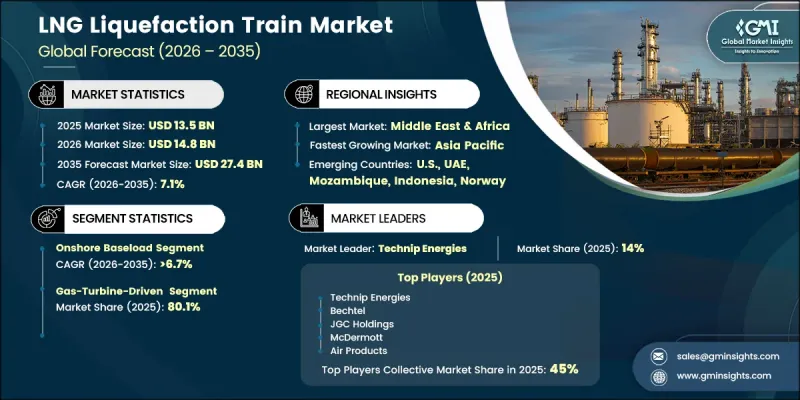
The Global LNG Liquefaction Train Market was valued at USD 13.5 billion in 2025 and is estimated to grow at a CAGR of 7.1% to reach USD 27.4 billion by 2035.
The upward movement is supported by rising investments in LNG export infrastructure across key regions, alongside a broader policy shift toward diversified energy sourcing strategies. Expanding demand for liquefied natural gas is being driven by its role as a transitional fuel, particularly in regions moving away from coal-based energy systems and reducing reliance on conventional pipeline gas networks. Additionally, continuous expansion in regasification capacity and long-term supply agreements are strengthening upstream project viability. Technological progress is also playing a central role, with advancements in liquefaction processes enhancing operational efficiency and environmental performance. The integration of modular systems, electrified train designs, and digital optimization tools is enabling higher capital intensity while improving plant reliability and lifecycle economics, positioning the market for sustained long-term growth.
| Market Scope | |
|---|---|
| Start Year | 2025 |
| Forecast Year | 2026-2035 |
| Start Value | $13.5 Billion |
| Forecast Value | $27.4 Billion |
| CAGR | 7.1% |
The LNG liquefaction train industry is evolving with increasing preference for advanced system configurations that enhance efficiency and reduce emissions. Strengthened global demand for LNG is being supported by consistent growth in international trade volumes, as more countries invest in infrastructure to import and process liquefied gas. Rising concerns over energy reliability and supply disruption have further reinforced the importance of LNG within national energy strategies. At the same time, innovation across core liquefaction technologies is improving plant output, extending maintenance cycles, and minimizing unexpected operational interruptions.
The onshore baseload systems segment accounted for 55.9% share in 2025 and is projected to grow at a CAGR of 6.7% through 2035. Their continued dominance is attributed to their ability to deliver high production capacity with operational efficiency. These large-scale configurations are widely adopted due to their scalability and relatively lower complexity when compared to distributed or smaller modular systems, making them suitable for high-volume liquefaction requirements.
The gas turbine-based systems segment held 80.1% share in 2025, maintaining their leadership due to their established global presence and operational reliability. These systems remain a preferred choice for developers, particularly in environments where access to stable electricity infrastructure is limited or where alternative power solutions are not economically feasible. Their adaptability and proven performance continue to support widespread deployment across major liquefaction projects.
North America LNG Liquefaction Train Market represented 34.1% share in 2025 and is anticipated to grow at a CAGR of 6.1% through 2035. The region's prominence is supported by a well-developed export ecosystem and ongoing capacity expansion initiatives. Increasing project activity, coupled with favorable regulatory and investment environments, continues to reinforce its position as a leading hub for LNG production and export infrastructure development.
Key companies operating in the LNG Liquefaction Train Market include Technip Energies, Bechtel, Saipem, JGC Corporation, McDermott International, Samsung Heavy Industries, Linde, Air Products, Siemens Energy, Baker Hughes, GE Vernova, Wartsila, and Honeywell. Market participants are strengthening their competitive positioning through strategic investments in technology development, project execution capabilities, and global expansion. Companies are focusing on enhancing process efficiency and reducing emissions through continuous innovation in liquefaction systems. Partnerships and long-term agreements across the value chain are helping secure project pipelines and stabilize revenue streams. Firms are also prioritizing modular construction approaches and digital integration to improve project timelines and operational performance. Expanding regional presence and aligning with evolving regulatory frameworks are additional strategies being adopted to capture emerging opportunities and reinforce market leadership in the LNG liquefaction train industry.
Table of Contents
Chapter 1 Methodology & Scope
- 1.1 Research approach
- 1.2 Quality commitments
- 1.2.1 GMI AI policy & data integrity commitment
- 1.2.1.1 Source consistency protocol
- 1.2.1 GMI AI policy & data integrity commitment
- 1.3 Research trail & confidence scoring
- 1.3.1 Research trail components
- 1.3.2 Scoring components
- 1.4 Data collection
- 1.4.1 Partial list of primary sources
- 1.5 Data mining sources
- 1.5.1 Paid sources
- 1.5.1.1 Sources, by region
- 1.5.1 Paid sources
- 1.6 Base estimates and calculations
- 1.6.1 Base year calculation for any one approach
- 1.7 Market estimates & forecasts parameters
- 1.8 Forecast model
- 1.8.1 Quantified market impact analysis
- 1.8.1.1 Mathematical impact of growth parameters on forecast
- 1.8.1 Quantified market impact analysis
- 1.9 Research transparency addendum
- 1.9.1 Source attribution framework
- 1.9.2 Quality assurance metrics
- 1.9.3 Our commitment to trust
- 1.10 Market definitions
Chapter 2 Executive Summary
- 2.1 Industry synopsis, 2022 - 2035
- 2.1.1 Business trends
- 2.1.2 Plant type trends
- 2.1.3 Drive & power architecture trends
- 2.1.4 Capacity trends
- 2.1.5 Developer trends
- 2.1.6 Regional trends
Chapter 3 Industry Insights
- 3.1 Industry ecosystem analysis
- 3.1.1 Raw material availability & sourcing analysis
- 3.1.2 Manufacturing capacity assessment
- 3.1.3 Supply chain resilience & risk factors
- 3.1.4 Distribution network analysis
- 3.2 Regulatory landscape
- 3.3 Industry impact forces
- 3.3.1 Growth drivers
- 3.3.2 Industry pitfalls & challenges
- 3.4 Growth potential analysis
- 3.5 Porter's analysis
- 3.5.1 Bargaining power of suppliers
- 3.5.2 Bargaining power of buyers
- 3.5.3 Threat of new entrants
- 3.5.4 Threat of substitutes
- 3.6 PESTEL analysis
- 3.6.1 Political factors
- 3.6.2 Economic factors
- 3.6.3 Social factors
- 3.6.4 Technological factors
- 3.6.5 Legal factors
- 3.6.6 Environmental factors
- 3.7 Impact of AI & Generative AI on the market
- 3.7.1 AI-Driven disruption of existing business models
- 3.7.2 GenAI use cases & adoption roadmap
- 3.7.3 Risks, limitations & regulatory considerations
- 3.8 Investment analysis & future prospects
- 3.9 Sustainability initiatives & industry 4.0 integration
- 3.10 Future outlook & opportunities
- 3.10.1 Emerging market opportunities
- 3.10.1.1 Stranded gas monetization via flng
- 3.10.1.2 Coal-to-gas switching in asia
- 3.10.1.3 Small-scale lng for remote applications
- 3.10.2 Technology evolution & roadmap
- 3.10.2.1 All-electric liquefaction trains
- 3.10.2.2 Carbon capture integration
- 3.10.2.3 Hydrogen co-production facilities
- 3.10.3 Investment hotspots
- 3.10.4 Disruptive trends & wild cards
- 3.10.1 Emerging market opportunities
Chapter 4 Competitive Landscape, 2026
- 4.1 Introduction
- 4.2 Company market share analysis, by region, 2025
- 4.2.1 North America
- 4.2.2 Europe
- 4.2.3 Asia Pacific
- 4.2.4 Middle East & Africa
- 4.2.5 Latin America
- 4.3 Key developments
- 4.3.1 Key partnerships & collaborations
- 4.3.2 Major M&A activities
- 4.3.3 Product innovations & launches
- 4.3.4 Market expansion strategies
- 4.4 Competitive positioning matrix
- 4.4.1 Tier classification criteria & qualifying thresholds
- 4.4.2 Tier positioning matrix by revenue, geography & innovation
Chapter 5 Market Size and Forecast, By Plant type, 2022 - 2035 (USD Million)
- 5.1 Key trends
- 5.2 Onshore baseload
- 5.3 Modular & mid-scale onshore
- 5.4 FLNG
Chapter 6 Market Size and Forecast, By Drive & Power Architecture, 2022 - 2035 (USD Million)
- 6.1 Key trends
- 6.2 Gas turbine driven
- 6.3 Electric motor driven
- 6.4 Hybrid & dual driven
Chapter 7 Market Size and Forecast, By Capacity, 2022 - 2035 (USD Million)
- 7.1 Key trends
- 7.2 Small scale
- 7.3 Mid scale
- 7.4 Large scale
Chapter 8 Market Size and Forecast, By Developer, 2022 - 2035 (USD Million)
- 8.1 Key trends
- 8.2 NOC
- 8.3 IOC
- 8.4 Independent developer
Chapter 9 Market Size and Forecast, By Region, 2022 - 2035 (USD Million)
- 9.1 Key trends
- 9.2 North America
- 9.2.1 U.S.
- 9.2.2 Canada
- 9.2.3 Mexico
- 9.3 Europe
- 9.3.1 Norway
- 9.3.2 UK
- 9.3.3 Netherlands
- 9.3.4 Russia
- 9.4 Asia Pacific
- 9.4.1 China
- 9.4.2 Australia
- 9.4.3 Malaysia
- 9.4.4 Papua New Guinea
- 9.5 Middle East & Africa
- 9.5.1 Qatar
- 9.5.2 UAE
- 9.5.3 Oman
- 9.5.4 Nigeria
- 9.5.5 Mozambique
- 9.6 Latin America
- 9.6.1 Brazil
- 9.6.2 Argentina
Chapter 10 Company Profiles
- 10.1 Air Products
- 10.2 Baker Hughes
- 10.3 Bechtel
- 10.4 Black & Veatch
- 10.5 Chiyoda Corporation
- 10.6 CTCI Corporation
- 10.7 ConocoPhillips
- 10.8 Fluor
- 10.9 GE Vernova
- 10.10 Honeywell
- 10.11 JGC Corporation
- 10.12 Linde
- 10.13 Technip Energies
- 10.14 McDermott
- 10.15 MODEC
- 10.16 Saipem
- 10.17 Siemens Energy
- 10.18 Samsung Heavy Industries (SHI)
- 10.19 Wartsila
- 10.20 Worley

