
PUBLISHER: Global Market Insights Inc. | PRODUCT CODE: 2071239

PUBLISHER: Global Market Insights Inc. | PRODUCT CODE: 2071239
Asia Pacific Operator Training Simulator (OTS) Market Opportunity, Growth Drivers, Industry Trend Analysis, and Forecast 2026 - 2035
Asia Pacific Operator Training Simulator Market was valued at USD 1.8 billion in 2025 and is estimated to grow at a CAGR of 7.9% to reach USD 4 billion by 2035.
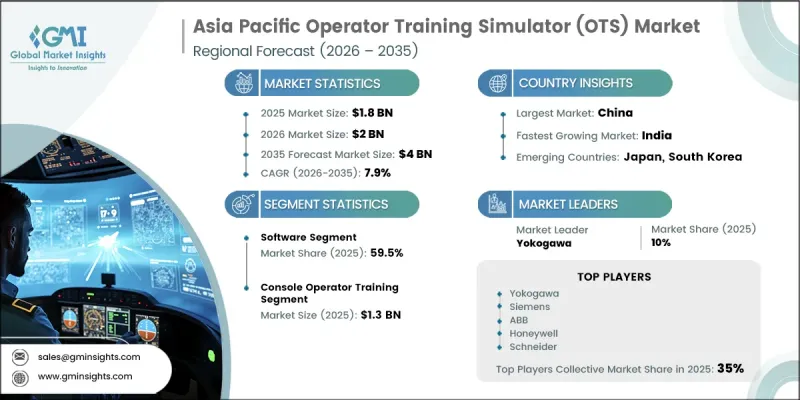
The growth of the Asia Pacific Operator Training Simulator Industry is driven by the increasing focus on workplace safety, workforce competency, and operational efficiency across industrial sectors throughout the region. Organizations are increasingly implementing structured operator development programs designed to enhance workforce readiness while minimizing risks associated with real-world training environments. Operator training simulators provide realistic virtual environments that allow personnel to gain practical experience, improve decision-making abilities, and develop operational confidence before engaging with live industrial systems. As industries continue to expand production capacity and modernize facilities, simulation-based training is becoming a fundamental component of workforce development strategies. The region is also witnessing substantial investments in industrial infrastructure and manufacturing projects, creating demand for skilled operators capable of managing sophisticated operational processes from the outset. At the same time, workforce transition challenges associated with the retirement of experienced professionals are encouraging companies to adopt technologies that facilitate effective knowledge transfer. By replicating actual operating conditions and enabling experiential learning, operator training simulators are helping organizations preserve critical expertise while accelerating employee readiness and performance.
| Market Scope | |
|---|---|
| Start Year | 2025 |
| Forecast Year | 2026-2035 |
| Start Value | $1.8 Billion |
| Forecast Value | $4 Billion |
| CAGR | 7.9% |
The Asia Pacific Operator Training Simulator Market is also benefiting from ongoing advancements in digital simulation technologies and the growing demand for immersive training experiences. Companies are increasingly seeking solutions that provide realistic operational environments and support comprehensive workforce preparation. As simulation platforms become more sophisticated, demand for advanced software capable of delivering highly interactive and accurate training experiences continues to rise. The need for enhanced engagement, operational realism, and improved learning outcomes is driving broader adoption of next-generation simulation technologies across a variety of industrial sectors throughout the region.
The software segment held a 59.5% share in 2025. Software remains the core component of modern training simulator platforms due to its ability to create highly detailed and dynamic virtual operating environments. Continuous technological innovation is enabling developers to enhance simulation accuracy, system responsiveness, and user engagement. As organizations place greater emphasis on practical and experience-based learning, demand for advanced simulation software is expected to remain strong. The growing adoption of immersive digital technologies is further contributing to the development of increasingly sophisticated software solutions that improve training effectiveness and operational preparedness.
The console operator training segment held a 71.3% share, generating USD 1.3 billion. The segment maintains a dominant position due to the critical role operators play in monitoring, controlling, and managing complex industrial processes from centralized operational environments. These professionals are responsible for overseeing multiple interconnected systems while responding rapidly to changing operating conditions. The need for accurate decision-making under demanding circumstances has significantly increased the demand for simulator-based training programs. Through realistic operational scenarios, console operator training enables personnel to strengthen procedural knowledge, improve response capabilities, and enhance overall operational efficiency while maintaining high safety standards.
China Operator Training Simulator Industry held a 39.8% share, generating USD 728.8 million in 2025. The country's leadership position is supported by continued industrial expansion, increasing manufacturing activity, and substantial investments across energy, process, and industrial sectors. Demand for operator training simulators continues to rise as organizations seek to improve workforce competency, strengthen operational safety, and reduce production disruptions. Rapid industrial development and growing emphasis on efficient plant operations have accelerated the adoption of advanced training technologies throughout the country. Similar trends are emerging across other Asia Pacific economies, further supporting regional market growth and technology adoption.
Major companies operating in the Asia Pacific Operator Training Simulator Market include ABB, Siemens, Schneider Electric, AVEVA, AspenTech, Honeywell, Emerson, Yokogawa, DNV, Kongsberg, MITS Solutions Asia, Tecknotrove Systems, Immersive Technologies, KBC, Tata Consulting Engineers (TCE), CAE, Andritz, FLSmidth, ETAP, ThoroughTec Simulation, and Triangle Simulation. Companies operating in the Asia Pacific Operator Training Simulator Market are focusing on technological innovation, strategic partnerships, and industry-specific solution development to strengthen their market presence. Significant investments are being made in advanced simulation software, digital modeling technologies, and immersive training platforms to enhance realism and training effectiveness. Vendors are expanding their product portfolios by integrating emerging technologies that improve user engagement and operational learning outcomes. Strategic collaborations with industrial enterprises, engineering firms, and training institutions are helping companies broaden their customer base and increase deployment opportunities.
Table of Contents
Chapter 1 Research Methodology
- 1.1 Research approach
- 1.2 Quality Commitments
- 1.2.1 GMI AI policy & data integrity commitment
- 1.2.1.1 Source consistency protocol
- 1.2.1 GMI AI policy & data integrity commitment
- 1.3 Research Trail & Confidence Scoring
- 1.3.1 Research Trail Components
- 1.3.2 Scoring Components
- 1.4 Data Collection
- 1.4.1 Partial list of primary sources
- 1.5 Data mining sources
- 1.5.1 Paid sources
- 1.5.1.1 Sources, by region
- 1.5.1 Paid sources
- 1.6 Base estimates and calculations
- 1.6.1 Base year calculation for any one approach
- 1.7 Forecast model
- 1.7.1 Quantified market impact analysis
- 1.7.1.1 Mathematical impact of growth parameters on forecast
- 1.7.1 Quantified market impact analysis
- 1.8 Research transparency addendum
- 1.8.1 Source attribution framework
- 1.8.2 Quality assurance metrics
- 1.8.3 Our commitment to trust
Chapter 2 Executive Summary
- 2.1 Industry 360° synopsis
- 2.2 Key market trends
- 2.2.1 Regional trends
- 2.2.2 Component trends
- 2.2.3 Simulation environment trends
- 2.2.4 End use trends
- 2.2.5 Distribution channel trends
Chapter 3 Industry Insights
- 3.1 Industry ecosystem analysis
- 3.1.1 Supplier landscape (hardware, software, component providers)
- 3.1.2 OTS developers & platform vendors
- 3.1.2.1 Global platform providers active in APAC
- 3.1.2.2 Regional & local APAC players
- 3.1.3 System integrators & implementation partners
- 3.1.3.1 APAC-based system integrators
- 3.1.4 End-user stakeholders
- 3.1.5 Profit margin analysis by value chain stage (driven by primary research)
- 3.1.6 Value addition at each stage
- 3.1.7 Factors affecting value chain efficiency
- 3.2 Industry impact forces
- 3.2.1 Growth drivers
- 3.2.2 Industry pitfalls & challenges
- 3.2.3 Opportunities
- 3.3 Technology/innovation landscape
- 3.3.1 VR/AR/MR integration in OTS
- 3.3.2 Cloud-based simulation platforms
- 3.3.3 Digital twin integration
- 3.3.4 Haptic feedback & immersive technologies
- 3.3.5 Real-time process modeling advancements
- 3.3.6 IoT integration for live data feeds
- 3.3.7 5G-enabled remote training & collaboration
- 3.4 Growth potential analysis
- 3.5 Future market trends
- 3.6 Price analysis (driven by primary research)
- 3.6.1 Pricing strategy by player type (driven by primary research)
- 3.6.2 Regional price variations
- 3.6.3 Component-wise pricing dynamics
- 3.6.4 Subscription vs perpetual license pricing models
- 3.6.5 Cloud subscription pricing trends in APAC
- 3.7 Regulatory framework
- 3.7.1 Safety & training standards by industry
- 3.7.1.1 APAC oil & gas training standards (OISD, local regulations)
- 3.7.1.2 Indonesia-specific certification requirements
- 3.7.2 Regional certification requirements
- 3.7.2.1 APAC certification landscape comparison
- 3.7.3 Compliance mandates for high-risk industries
- 3.7.3.1 Indonesia HSE compliance for oil & gas operators
- 3.7.4 International training standards (ISO, IEC)
- 3.7.1 Safety & training standards by industry
- 3.8 Supply chain analysis
- 3.8.1 Hardware components supply dynamics
- 3.8.2 Software development & licensing models
- 3.8.3 Service delivery infrastructure
- 3.8.4 Geographic sourcing patterns
- 3.8.5 Supply chain risk assessment
- 3.9 Porter's five forces analysis
- 3.10 PESTEL analysis
- 3.11 Impact of AI & generative AI on the market
- 3.11.1 AI-driven disruption of existing business models
- 3.11.2 GenAI use cases & adoption roadmap by segment
- 3.11.2.1 Automated scenario generation
- 3.11.2.2 Adaptive learning algorithms
- 3.11.2.3 Natural language interfaces for simulation control
- 3.11.2.4 Predictive failure modeling
- 3.11.3 Risks, limitations & regulatory considerations
- 3.12 Infrastructure & deployment landscape (driven by primary research)
- 3.12.1 Deployment penetration by region & buyer segment (driven by primary research)
- 3.12.2 Scalability constraints & infrastructure investment trends (driven by primary research)
Chapter 4 Competitive Landscape, 2025
- 4.1 Introduction
- 4.2 Company market share analysis
- 4.2.1 By Country
- 4.2.1.1 China
- 4.2.1.2 India
- 4.2.1.3 Japan
- 4.2.1.4 South Korea
- 4.2.1.5 Australia
- 4.2.1.6 Indonesia
- 4.2.1 By Country
- 4.3 Company matrix analysis
- 4.4 Competitive analysis of major market players
- 4.5 Competitive positioning matrix
- 4.6 Key developments
- 4.6.1 Mergers & acquisitions
- 4.6.2 Partnerships & collaborations
- 4.6.3 New product launches
- 4.6.4 Expansion Plans
Chapter 5 Market Estimates & Forecast, By Component, 2022 - 2035 (USD Billion)
- 5.1 Key trends
- 5.2 Hardware
- 5.2.1 Control panels & console stations
- 5.2.2 VR/AR headsets & immersive hardware
- 5.2.3 Haptic devices & tactile feedback systems
- 5.2.4 Display systems & visual interfaces
- 5.2.5 Networking & communication equipment
- 5.3 Software
- 5.3.1 Process simulation
- 5.3.1.1 Steady state process modeling
- 5.3.1.2 Dynamic process simulation
- 5.3.1.3 Multiphysics simulation platforms
- 5.3.2 Immersive simulation (VR/AR/MR)
- 5.3.3 AI-powered adaptive training modules
- 5.3.4 Cloud-based simulation platforms
- 5.3.1 Process simulation
- 5.4 Services
- 5.4.1 Consulting & training needs assessment
- 5.4.2 Installation & integration services
- 5.4.3 Customization & configuration
- 5.4.4 Maintenance & support
- 5.4.5 Managed training services
Chapter 6 Market Estimates & Forecast, By Simulation Environment, 2022 - 2035 (USD Billion)
- 6.1 Key trends
- 6.2 Console operator training
- 6.3 Field operator training
Chapter 7 Market Estimates & Forecast, By End Use, 2022 - 2035 (USD Billion)
- 7.1 Key trends
- 7.2 Aerospace & defence
- 7.3 Chemical
- 7.4 Energy & power
- 7.5 Healthcare
- 7.6 Industrial
- 7.7 Oil & gas
- 7.8 Pulp & paper
- 7.9 Others
Chapter 8 Market Estimates & Forecast, By Distribution Channel, 2022 - 2035, (USD Billion)
- 8.1 Key trends
- 8.2 Direct sales
- 8.3 Indirect sales
Chapter 9 Market Estimates & Forecast, By Country, 2022 - 2035, (USD Billion)
- 9.1 Key trends
- 9.2 China
- 9.3 India
- 9.4 Japan
- 9.5 South Korea
- 9.6 Australia
- 9.7 Philippines
- 9.8 Vietnam
- 9.9 Singapore
Chapter 10 Company Profiles (Business Overview, Financial Data, Product Landscape, Strategic Outlook, SWOT Analysis)
- 10.1 Global Players
- 10.1.1 ABB
- 10.1.2 Siemens
- 10.1.3 Schneider Electric
- 10.1.4 AVEVA
- 10.1.5 AspenTech
- 10.1.6 Honeywell
- 10.1.7 Emerson
- 10.2 Regional Champions
- 10.2.1 Yokogawa
- 10.2.2 DNV
- 10.2.3 Kongsberg
- 10.2.4 MITS Solutions Asia
- 10.2.5 Tecknotrove Systems
- 10.2.6 Immersive Technologies
- 10.2.7 KBC
- 10.2.8 Tata Consulting Engineers (TCE)
- 10.2.9 CAE
- 10.3 Niche/specialty players
- 10.3.1 Andritz
- 10.3.2 FLSmidth
- 10.3.3 ETAP
- 10.3.4 ThoroughTec Simulation
- 10.3.5 Triangle Simulation

