PUBLISHER: Global Market Insights Inc. | PRODUCT CODE: 2071252

PUBLISHER: Global Market Insights Inc. | PRODUCT CODE: 2071252
Automotive Computer Vision Market Opportunity, Growth Drivers, Industry Trend Analysis, and Forecast 2026 - 2035
The Global Automotive Computer Vision Market was valued at USD 10.4 billion in 2025 and is estimated to grow at a CAGR of 10.1% to reach USD 26.8 billion by 2035.
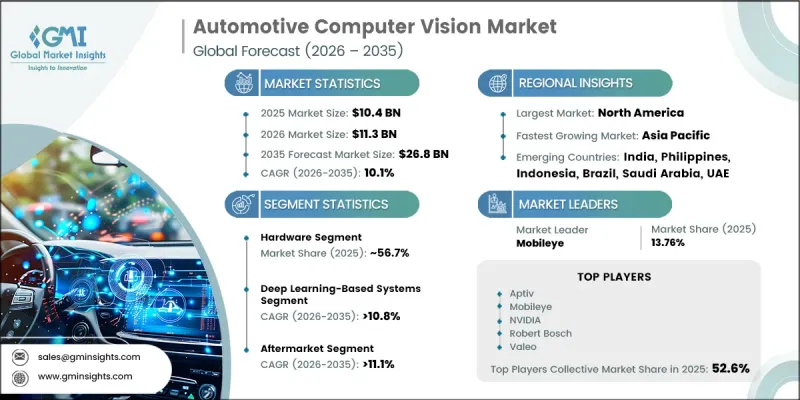
Growth is driven by the rising deployment of advanced driver assistance systems, autonomous driving capabilities, and intelligent safety technologies across passenger and commercial vehicles. Automotive manufacturers and technology providers are increasingly embedding AI-powered vision systems to enhance situational awareness, reduce collision risks, and improve real-time environmental perception. Regulatory pressure from transportation safety authorities is further accelerating adoption, as governments enforce stricter vehicle safety requirements and promote next-generation mobility standards. Expanding penetration of electric and connected vehicles is also reinforcing demand for high-performance vision systems capable of supporting semi-autonomous and autonomous driving functions. Continuous advancements in artificial intelligence, sensor fusion, and real-time data processing are reshaping automotive design priorities, making computer vision a core component of modern vehicle architecture across global automotive ecosystems.
| Market Scope | |
|---|---|
| Start Year | 2025 |
| Forecast Year | 2026-2035 |
| Start Value | $10.4 Billion |
| Forecast Value | $26.8 Billion |
| CAGR | 10.1% |
The hardware segment held 56.7% share in 2025 and is projected to grow at a CAGR of 9.2% through 2035. Its dominance is attributed to the increasing integration of advanced sensing and computing components required for real-time vehicle perception. Automotive vision systems rely heavily on high-performance imaging and detection technologies that support accurate environmental mapping and rapid decision-making. Rising deployment of intelligent safety and driver assistance features continues to drive demand for robust hardware systems capable of handling complex data processing requirements in dynamic driving environments.
The deep learning-based systems segment accounted for 49% share in 2025 and is expected to grow at a CAGR of 10.8% through 2035. This segment leads due to its ability to process vast volumes of visual data with high precision and adaptability. Deep learning technologies enhance object detection, classification, and recognition capabilities, allowing vehicles to interpret complex road environments under varying conditions. Continuous model training using large datasets enables performance improvements over time, making these systems highly suitable for advanced mobility applications.
United States Automotive Computer Vision Market held an 83.5% share, generating USD 3 billion in 2025. Market growth in the country is supported by the rapid integration of advanced driver assistance systems, autonomous driving technologies, and connected mobility platforms across vehicle categories. Strong participation from leading technology firms and automotive manufacturers is accelerating innovation in AI-driven perception systems, sensor integration, and real-time analytics. The presence of established innovation ecosystems continues to reinforce the country's leadership in automotive computer vision development.
Key companies operating in the global automotive computer vision market include Valeo, Robert Bosch, Renesas Electronics, Qualcomm Technologies, Onsemi, NXP Semiconductors, NVIDIA, Mobileye, Continental, and Aptiv. Market participants are focusing on strengthening their competitive positioning through continuous investment in artificial intelligence, machine learning, and high-performance computing technologies. Companies are enhancing their product portfolios with advanced vision sensors, AI-enabled processors, and integrated software platforms designed for real-time vehicle perception. Strategic collaborations with automotive OEMs and mobility service providers are accelerating deployment across next-generation vehicle platforms. Firms are also investing in research and development to improve object detection accuracy, system reliability, and processing speed under diverse driving conditions. Expansion of global manufacturing capabilities and localization of supply chains are further supporting scalability.
Table of Contents
Chapter 1 Methodology
- 1.1 Research approach
- 1.2 Quality Commitments
- 1.2.1 GMI AI policy & data integrity commitment
- 1.2.1.1 Source consistency protocol
- 1.2.1 GMI AI policy & data integrity commitment
- 1.3 Research Trail & Confidence Scoring
- 1.3.1 Research Trail Components
- 1.3.2 Scoring Components
- 1.4 Data Collection
- 1.4.1 Partial list of primary sources
- 1.5 Data mining sources
- 1.5.1 Paid sources
- 1.5.1.1 Sources, by region
- 1.5.1 Paid sources
- 1.6 Base estimates and calculations
- 1.6.1 Base year calculation
- 1.7 Forecast Model
- 1.7.1 Quantified market impact analysis
- 1.7.1.1 Mathematical impact of growth parameters on forecast
- 1.7.1 Quantified market impact analysis
- 1.8 Research transparency addendum
- 1.8.1 Source attribution framework
- 1.8.2 Quality assurance metrics
- 1.8.3 Our commitment to trust
Chapter 2 Executive Summary
- 2.1 Industry 360° synopsis, 2022 - 2035
- 2.2 Key market trends
- 2.2.1 Regional
- 2.2.2 Component
- 2.2.3 Sales channel
- 2.2.4 Technology
- 2.2.5 Application
- 2.2.6 Vehicle
- 2.3 TAM Analysis, 2026-2035
- 2.4 CXO perspectives: Strategic imperatives
Chapter 3 Industry Insights
- 3.1 Industry ecosystem analysis
- 3.1.1 Supplier landscape
- 3.1.2 Profit margin analysis
- 3.1.3 Cost structure
- 3.1.4 Value addition at each stage
- 3.1.5 Factor affecting the value chain
- 3.1.6 Disruptions
- 3.2 Industry impact forces
- 3.2.1 Growth drivers
- 3.2.1.1 Rising adoption of advanced driver assistance systems (ADAS)
- 3.2.1.2 Growing development of autonomous and semi-autonomous vehicles
- 3.2.1.3 Increasing government vehicle safety regulations and mandates
- 3.2.1.4 Expansion of electric and connected vehicle ecosystems
- 3.2.2 Industry pitfalls and challenges
- 3.2.2.1 High development and integration costs of vision systems
- 3.2.2.2 Complexity in real-time data processing and sensor calibration
- 3.2.3 Market opportunities
- 3.2.3.1 Growing demand for driver monitoring and in-cabin sensing systems
- 3.2.3.2 Expansion of robotaxi and autonomous mobility services
- 3.2.3.3 Increasing integration of Ai-powered vision systems in commercial vehicles
- 3.2.3.4 Emerging smart city and intelligent transportation infrastructure projects
- 3.2.1 Growth drivers
- 3.3 Growth potential analysis
- 3.4 Technology and Innovation landscape
- 3.4.1 Current technological trends
- 3.4.2 Emerging technologies
- 3.5 Pricing Analysis (Driven by Primary Research)
- 3.5.1 Historical Price Trend Analysis
- 3.5.2 Pricing Strategy by Player Type (Premium / Value / Cost-plus)
- 3.6 Cost breakdown analysis
- 3.7 Regulatory guidline
- 3.7.1 North America
- 3.7.1.1 U.S.: NHTSA Vehicle Safety Standards & FMVSS ADAS Compliance Regulations
- 3.7.1.2 Canada: Transport Canada Motor Vehicle Safety Regulations & Autonomous Vehicle Testing Frameworks.
- 3.7.2 Europe
- 3.7.2.1 Germany: EU General Safety Regulation (GSR) & KBA Autonomous Driving Compliance Standards
- 3.7.2.2 UK: Automated Vehicles Act & DVSA Vehicle Safety Compliance Framework
- 3.7.2.3 France: CNIL Automotive Data Protection Regulations & Intelligent Transport System Standards
- 3.7.2.4 Italy: EU ADAS Mandates & UNECE Vehicle Cybersecurity Regulations
- 3.7.3 Asia Pacific
- 3.7.3.1 China: Intelligent Connected Vehicle (ICV) Regulations & Automotive Data Security Laws
- 3.7.3.2 India: Bharat NCAP Safety Standards & AIS-140 Intelligent Transportation Regulations
- 3.7.3.3 Japan: MLIT Autonomous Driving Safety Guidelines & APPI Data Protection Framework
- 3.7.3.4 South Korea: KNCAP Vehicle Safety Standards & Personal Information Protection Act (PIPA)
- 3.7.3.5 Australia: Australian Design Rules (ADR) & Automated Vehicle Safety Frameworks
- 3.7.4 Latin America
- 3.7.4.1 Brazil: CONTRAN Vehicle Safety Regulations & Intelligent Mobility Compliance Standards
- 3.7.4.2 Mexico: NOM Vehicle Safety Standards & Connected Vehicle Regulatory Framework
- 3.7.4.3 Argentina: National Road Safety Agency (ANSV) ADAS Compliance Guidelines
- 3.7.5 MEA
- 3.7.5.1 UAE: UAE Autonomous Mobility Strategy & Smart Vehicle Safety Regulations
- 3.7.5.2 Saudi Arabia: SASO Vehicle Safety Standards & Smart Mobility Regulatory Framework
- 3.7.5.3 South Africa: National Road Traffic Act & Vehicle Safety Compliance Regulations
- 3.7.1 North America
- 3.8 Porter's analysis
- 3.9 PESTEL analysis
- 3.10 Patent Landscape (Driven by Primary Research)
- 3.11 Impact of AI & Generative AI on the Market (Driven by Primary Research)
- 3.11.1 AI-Driven Disruption of Existing Business Models
- 3.11.2 GenAI Use Cases & Adoption Roadmap by Segment
- 3.11.3 Risks, Limitations & Regulatory Considerations
- 3.12 Forecast assumptions & scenario analysis (Driven by Primary Research)
- 3.12.1 Base Case - Key Macro & Industry Variables Driving CAGR
- 3.12.2 Optimistic Scenarios - Favourable macro and industry tailwinds
- 3.12.3 Pessimistic Scenario - Macroeconomic slowdown or industry headwinds
Chapter 4 Competitive Landscape, 2025
- 4.1 Introduction
- 4.2 Company market share analysis
- 4.2.1 North America
- 4.2.2 Europe
- 4.2.3 Asia Pacific
- 4.2.4 Latin America
- 4.2.5 MEA
- 4.3 Competitive analysis of major market players
- 4.4 Competitive positioning matrix
- 4.5 Key developments
- 4.5.1 Mergers & acquisitions
- 4.5.2 Partnerships & collaborations
- 4.5.3 New Product Launches
- 4.5.4 Expansion Plans and funding
- 4.6 Company Tier Benchmarking
- 4.6.1 Tier Classification Criteria & Qualifying Thresholds
- 4.6.2 Tier Positioning Matrix by Revenue, Geography & Innovation
Chapter 5 Market Estimates & Forecast, By Component, 2022 - 2035 ($Bn)
- 5.1 Key trends
- 5.2 Hardware
- 5.3 Software
- 5.4 Services
Chapter 6 Market Estimates & Forecast, By Sales channel, 2022 - 2035 ($Bn)
- 6.1 Key trends
- 6.2 OEM
- 6.3 Aftermarket
Chapter 7 Market Estimates & Forecast, By Technology, 2022 - 2035 ($Bn, Units)
- 7.1 Key trends
- 7.2 Machine Vision-Based Systems
- 7.3 Deep Learning-Based Systems
- 7.4 Sensor Fusion-Based Systems
Chapter 8 Market Estimates & Forecast, By Application, 2022 - 2035 ($Bn)
- 8.1 Key trends
- 8.2 Advanced Driver Assistance Systems (ADAS)
- 8.3 Autonomous Driving
- 8.4 In-Cabin Monitoring
- 8.5 Traffic & Infrastructure Vision
- 8.6 Others
Chapter 9 Market Estimates & Forecast, By Vehicle, 2022 - 2035 ($Bn)
- 9.1 Key trends
- 9.2 Passenger Cars
- 9.2.1 Hatchbacks
- 9.2.2 Sedans
- 9.2.3 SUVs
- 9.3 Commercial Vehicles
- 9.3.1 Light Commercial Vehicles
- 9.3.2 Heavy Commercial Vehicles
- 9.4 Electric Vehicles (EVs)
- 9.4.1 Battery Electric Vehicles (BEV)
- 9.4.2 Plug-In Hybrid Electric Vehicles (PHEV)
- 9.5 Autonomous Vehicles
- 9.5.1 Robotaxis & Shared Autonomous Mobility
- 9.5.2 Self-Driving Trucks & Freight
Chapter 10 Market Estimates & Forecast, By Region, 2022 - 2035 ($Bn)
- 10.1 Key trends
- 10.2 North America
- 10.2.1 US
- 10.2.2 Canada
- 10.3 Europe
- 10.3.1 Germany
- 10.3.2 UK
- 10.3.3 France
- 10.3.4 Italy
- 10.3.5 Spain
- 10.3.6 Russia
- 10.3.7 Netherlands
- 10.3.8 Belgium
- 10.3.9 Sweden
- 10.4 Asia Pacific
- 10.4.1 China
- 10.4.2 India
- 10.4.3 Japan
- 10.4.4 Australia
- 10.4.5 South Korea
- 10.4.6 Philippines
- 10.4.7 Indonesia
- 10.5 Latin America
- 10.5.1 Brazil
- 10.5.2 Mexico
- 10.5.3 Argentina
- 10.6 MEA
- 10.6.1 South Africa
- 10.6.2 Saudi Arabia
- 10.6.3 UAE
Chapter 11 Company Profiles
- 11.1 Global Players
- 11.1.1 Aptiv
- 11.1.2 Continental
- 11.1.3 Mobileye
- 11.1.4 NVIDIA
- 11.1.5 NXP Semiconductors
- 11.1.6 Onsemi
- 11.1.7 Qualcomm Technologies
- 11.1.8 Renesas Electronics
- 11.1.9 Robert Bosch
- 11.1.10 Sony Semiconductor
- 11.1.11 Valeo
- 11.2 Regional Players
- 11.2.1 Black Sesame Technologies
- 11.2.2 Denso
- 11.2.3 FORVIA HELLA
- 11.2.4 Hikvision Automotive
- 11.2.5 Hitachi Astemo
- 11.2.6 Horizon Robotics
- 11.2.7 Hyundai Mobis
- 11.2.8 Magna International
- 11.2.9 ZF Friedrichshafen
- 11.3 Emerging Players
- 11.3.1 Ambarella
- 11.3.2 Autobrains Technologies
- 11.3.3 indie Semiconductor
- 11.3.4 STRADVision

