PUBLISHER: Global Market Insights Inc. | PRODUCT CODE: 2071257

PUBLISHER: Global Market Insights Inc. | PRODUCT CODE: 2071257
Asia Pacific Aromatherapy Diffusers Market Opportunity, Growth Drivers, Industry Trend Analysis, and Forecast 2026 - 2035
Asia Pacific Aromatherapy Diffusers Market was valued at USD 613.9 million in 2025 and is estimated to grow at a CAGR of 7.1% to reach USD 1.2 billion by 2035.
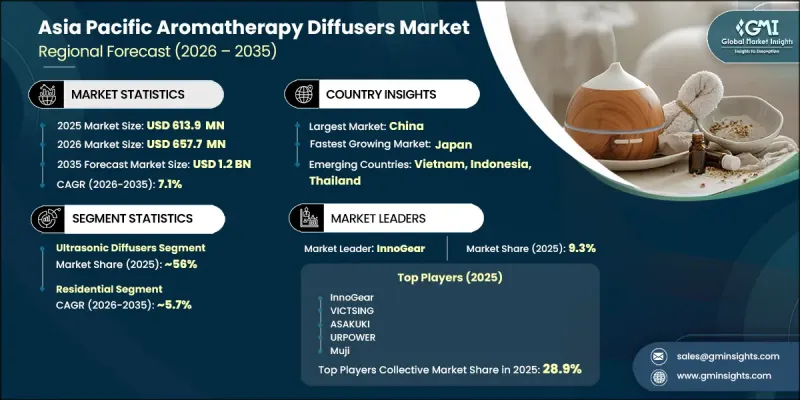
Market growth is driven by rising consumer interest in wellness-oriented home environments and increasing adoption of essential oil-based relaxation products across the region. Expanding disposable incomes across major Asia Pacific economies are widening the consumer base while also encouraging gradual premiumization within the product landscape. At the same time, growing awareness of mental well-being and preventive lifestyle practices is strengthening demand for at-home stress management solutions. Aromatherapy diffusers are increasingly being incorporated into everyday household routines, combining wellness benefits with interior enhancement functions. Expanding wellness tourism infrastructure and spa-related commercial applications are also contributing to broader institutional demand. In addition, the rapid expansion of online retail channels is improving product accessibility and accelerating adoption across emerging markets. As consumers place greater emphasis on home-based wellness and lifestyle comfort, aromatherapy diffusers are evolving into mainstream household products across Asia Pacific rather than remaining niche wellness devices.
| Market Scope | |
|---|---|
| Start Year | 2025 |
| Forecast Year | 2026-2035 |
| Start Value | $613.9 Million |
| Forecast Value | $1.2 Billion |
| CAGR | 7.1% |
The ultrasonic diffuser segment accounted for 56% share in 2025, generating USD 354.4 million. This segment continues to lead due to its strong alignment with modern consumer preferences for quiet operation, energy efficiency, and ease of use. Increasing integration with connected home ecosystems and rising demand for multifunctional wellness devices are further supporting segment expansion. Its combination of performance efficiency and contemporary design appeal continues to reinforce its dominant position within the regional market.
The residential segment held a 61.1% share, reaching USD 375.3 million in 2025. Growth in this segment is driven by the rising adoption of wellness-focused home products across urban households. Consumers are increasingly using diffusers to support relaxation, improve sleep quality, and enhance indoor ambiance. The integration of aromatherapy devices into daily lifestyle routines continues to support steady residential demand across the region.
China Aromatherapy Diffusers Market held a 48.3% share, generating USD 296.5 million in 2025. Market expansion in the country is supported by rising urbanization, increasing wellness-related spending, and a highly advanced digital retail ecosystem. Strong e-commerce penetration is significantly accelerating product availability and adoption cycles. Continued growth in the middle-income population and increasing preference for lifestyle wellness products are further strengthening China's dominant position in the regional aromatherapy diffusers market.
Key companies operating in the Asia Pacific aromatherapy diffusers market include Panasonic, Muji (Ryohin Keikaku Co., Ltd.), Coway, InnoGear, Young Living Essential Oils, doTERRA International, NOW Foods, VICTSING, Stadler Form, ECO. Modern Essentials, Perfect Potion, Jurlique, and TENSWALL. Companies in the Asia Pacific aromatherapy diffusers market are adopting multiple strategic approaches to strengthen their market position and expand consumer reach. Leading players are focusing on product innovation through the development of ultrasonic, smart-enabled, and energy-efficient diffuser technologies. Many companies are expanding product portfolios to include multifunctional devices that combine aromatherapy with humidification and air purification features. Strategic collaborations with e-commerce platforms and wellness retailers are improving distribution efficiency and brand visibility. Firms are also investing in premium design aesthetics and natural wellness branding to attract lifestyle-oriented consumers. Digital marketing campaigns, influencer partnerships, and targeted regional expansion strategies are further enhancing market penetration.
Table of Contents
Chapter 1 Research Methodology
- 1.1 Research approach
- 1.2 Quality Commitments
- 1.2.1 GMI AI policy & data integrity commitment
- 1.2.1.1 Source consistency protocol
- 1.2.1 GMI AI policy & data integrity commitment
- 1.3 Research Trail & Confidence Scoring
- 1.3.1 Research Trail Components
- 1.3.2 Scoring Components
- 1.4 Data Collection
- 1.4.1 Partial list of primary sources
- 1.5 Data mining sources
- 1.5.1 Paid sources
- 1.5.1.1 Sources, by region
- 1.5.1 Paid sources
- 1.6 Base estimates and calculations
- 1.6.1 Base year calculation for any one approach
- 1.7 Forecast model
- 1.7.1 Quantified market impact analysis
- 1.7.1.1 Mathematical impact of growth parameters on forecast
- 1.7.1 Quantified market impact analysis
- 1.8 Research transparency addendum
- 1.8.1 Source attribution framework
- 1.8.2 Quality assurance metrics
- 1.8.3 Our commitment to trust
Chapter 2 Executive Summary
- 2.1 Industry 360° synopsis, 2022 - 2035
- 2.2 Key market trends
- 2.2.1 Country
- 2.2.2 Product type
- 2.2.3 Application
- 2.2.4 Price range
- 2.2.5 Distribution channel
Chapter 3 Industry Insights
- 3.1 Industry ecosystem analysis
- 3.1.1 Factor affecting the value chain
- 3.1.2 Profit margin analysis
- 3.1.3 Disruptions
- 3.1.4 Future outlook
- 3.1.5 Manufacturers
- 3.1.6 Distributors
- 3.2 Supplier landscape
- 3.3 Key news & initiatives
- 3.4 Technology & innovation landscape
- 3.5 Regulatory landscape
- 3.6 Impact on forces
- 3.6.1 Growth drivers
- 3.6.1.1 Rising wellness awareness increases aromatherapy diffuser product demand
- 3.6.1.2 Growing disposable incomes support premium wellness appliance purchases
- 3.6.1.3 Expanding spa industry boosts commercial diffuser installations
- 3.6.2 Industry pitfalls & challenges
- 3.6.2.1 High premium diffuser costs limit mass-market adoption
- 3.6.2.2 Counterfeit products negatively affect branded diffuser sales
- 3.6.3 Opportunities
- 3.6.3.1 Smart diffusers create connected wellness product opportunities.
- 3.6.3.2 Sustainable materials strengthen eco-friendly diffuser product demand.
- 3.6.1 Growth drivers
- 3.7 Porter's analysis
- 3.8 PESTEL analysis
- 3.9 Pricing analysis (driven by primary research)
- 3.9.1 Historical price trend analysis (driven by primary research)
- 3.9.2 Pricing strategy by player type (premium / value / cost-plus) (driven by primary research)
- 3.9.3 Price variation by product type & distribution channel
- 3.9.4 Regional price benchmarking
- 3.10 Trade data analysis (HS code- 8509.80) (driven by paid database)
- 3.10.1 Import/export volume and value trends (driven by paid database)
- 3.10.2 Key trade corridors and tariff impact (driven by paid database)
- 3.10.3 Trade flow by product type
- 3.10.4 Regional trade dynamics and cross-border e-commerce
- 3.11 Impact of AI and generative AI on the market
- 3.11.1 AI-driven disruption of existing business models
- 3.11.2 GenAI use cases and adoption roadmap by segment
- 3.11.3 AI-powered personalization and consumer experience
- 3.11.4 Predictive maintenance and smart home integration
- 3.11.5 Risks, limitations and regulatory considerations
- 3.12 Distribution infrastructure and channel penetration landscape (driven by primary research)
- 3.12.1 Channel coverage by region and format (modern vs. traditional trade) (driven by primary research)
- 3.12.2 Last-mile infrastructure gaps and emerging channel shifts (driven by primary research)
- 3.12.3 E-commerce penetration and omnichannel strategy evolution
Chapter 4 Competitive Landscape, 2025
- 4.1 Introduction
- 4.2 Company market share analysis
- 4.3 By Country
- 4.3.1 China
- 4.3.2 India
- 4.3.3 Japan
- 4.3.4 Australia
- 4.3.5 South Korea
- 4.3.6 Philippines
- 4.3.7 Thailand
- 4.3.8 Vietnam
- 4.4 Company matrix analysis
- 4.5 Competitive positioning matrix
- 4.6 Key developments
- 4.6.1 Mergers & acquisitions
- 4.6.2 Partnerships & collaborations
- 4.6.3 New product launches
- 4.6.4 Expansion plans
Chapter 5 Market Estimates & Forecast, By Product Type, 2022 - 2035, (USD Billion)
- 5.1 Key trends
- 5.2 Ultrasonic diffusers
- 5.3 Nebulizing diffusers
- 5.4 Heat diffusers
- 5.5 Evaporative diffusers
- 5.6 Others
Chapter 6 Market Estimates & Forecast, By Application, 2022 - 2035, (USD Billion)
- 6.1 Key trends
- 6.2 Residential
- 6.3 Commercial
- 6.3.1 Spa & wellness centers
- 6.3.2 Hotels
- 6.3.3 Offices
- 6.3.4 Healthcare facilities
Chapter 7 Market Estimates & Forecast, By Price Range, 2022 - 2035, (USD Billion)
- 7.1 Key trends
- 7.2 Low (under USD 20)
- 7.3 Medium (USD 20 - USD 100)
- 7.4 High (above USD 100)
Chapter 8 Market Estimates & Forecast, By Distribution Channel, 2022 - 2035, (USD Billion)
- 8.1 Key trends
- 8.2 Online
- 8.2.1 E-commerce website
- 8.2.2 Company website
- 8.3 Offline
- 8.3.1 Hypermarkets and supermarkets
- 8.3.2 Specialty stores
- 8.3.3 Retail stores
- 8.3.4 Others
Chapter 9 Market Estimates & Forecast, By Region, 2022 - 2035, (USD Billion) (Million Units)
- 9.1 Key trends
- 9.2 China
- 9.3 India
- 9.4 Japan
- 9.5 Australia
- 9.6 South Korea
- 9.7 Philippines
- 9.8 Thailand
- 9.9 Vietnam
Chapter 10 Company Profiles (Business Overview, Financial Data, Product Landscape, Strategic Outlook, SWOT Analysis)
- 10.1 Global players
- 10.1.1 doTERRA International
- 10.1.2 Young Living Essential Oils
- 10.1.3 AromaTech
- 10.1.4 Stadler Form
- 10.1.5 InnoGear
- 10.1.6 Senovat
- 10.1.7 Youluxeo
- 10.2 Regional players
- 10.2.1 Vitruvi
- 10.2.2 Ellia (Homedics)
- 10.2.3 SpaRoom
- 10.2.4 Neom Organics (Neom Wellbeing)
- 10.2.5 Saje Wellness
- 10.2.6 ESCENTS
- 10.2.7 NOW Foods
- 10.3 Emerging players
- 10.3.1 Organic Aromas
- 10.3.2 GreenAir (New Green Air Inc.)
- 10.3.3 Edens Garden
- 10.3.4 Rocky Mountain Oils
- 10.3.5 Helias Oils
- 10.3.6 URPOWER
- 10.3.7 ASAKUKI

