PUBLISHER: Mordor Intelligence | PRODUCT CODE: 2124235

PUBLISHER: Mordor Intelligence | PRODUCT CODE: 2124235
North America Aromatherapy Diffuser - Market Share Analysis, Industry Trends & Statistics, Growth Forecasts (2026 - 2031)
According to Mordor Intelligence, the North America essential oil diffuser market size was valued at USD 490.41 million in 2025 and estimated to grow from USD 521.94 million in 2026 to reach USD 712.77 million by 2031, at a CAGR of 6.43% during the forecast period (2026-2031).
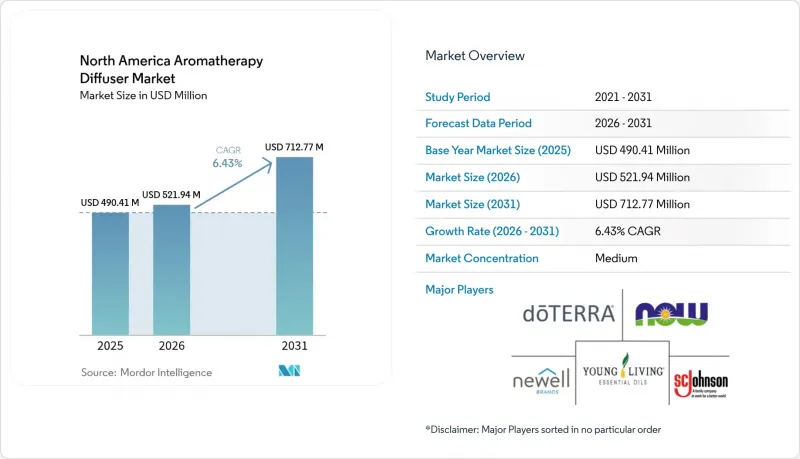
This report is Segmented by Product Type (Ultrasonic, Nebulizer, and Others), Distribution Channel (Supermarkets/Hypermarkets, Convenience Stores, Specialty Stores, Online Retail Stores, and Other Distribution Channels), and Geography (United States, Canada, Mexico, and Rest of North America). The Market Forecasts are Provided in Terms of Value (USD).
North America Aromatherapy Diffuser Market Trends and Insights
Proliferation of Smart-Home IoT-Enabled Diffusers
The growth of the North American aromatherapy diffuser market is driven by the increasing adoption of smart-home IoT-enabled diffusers. These devices enhance the aromatherapy experience by integrating with mobile apps and smart home systems, offering users improved control and customization options. For instance, companies like Pura Scents, Inc. exemplify this trend with their innovative Pura 4 smart home fragrance diffuser. This product incorporates a suite of smart features, including automatic vial detection, which recognizes the inserted fragrance vial without manual scanning, and adaptive diffusion technology that adjusts scent intensity based on room temperature to ensure a consistent and efficient aroma distribution. The integration of smart technology expands the market beyond traditional wellness consumers to include technology-focused customers seeking connected home devices. This market expansion supports higher product pricing and increased industry revenue. As consumers prioritize home comfort, personalization, and digital convenience, the demand for IoT-enabled diffusers continues to influence product development and market competition in the aromatherapy diffuser industry.
Product and Technology Innovation
Technological advancements and product innovations serve as fundamental growth drivers in the aromatherapy diffuser market. Manufacturing companies allocate substantial resources toward developing sophisticated diffuser models with enhanced functionalities to address consumer requirements for operational efficiency, customization capabilities, and technological integration. In April 2024, Saje Natural Wellness introduced the Aroma (Be) Free, a cordless, rechargeable ultrasonic diffuser that efficiently converts water and pure essential oils into a fine, cool mist. This product emphasizes operational mobility and safety protocols, enabling implementation across diverse environments. Market expansion is facilitated by technological integrations, including application-based controls, programmable timing mechanisms, and voice-activated functions, enabling users to regulate diffusion parameters and operational schedules. Contemporary diffuser systems incorporate resource-optimization features, including waterless operations and energy-efficient mechanisms to minimize consumption. These environmental sustainability features attract consumers who prioritize both therapeutic benefits and ecological responsibility.
High Competition from Substitutes
The North American aromatherapy diffuser market faces significant competition from substitute products. Candles, room sprays, and plug-in air fresheners provide immediate fragrance solutions at lower prices, creating downward pricing pressure on diffuser manufacturers and restricting market penetration among cost-conscious consumers. These alternatives are readily available across retail channels, including supermarkets, convenience stores, and e-commerce platforms. The competitive environment intensifies as fragrance companies develop aromatherapy-inspired products that deliver similar benefits to essential oils without requiring specialized equipment. Additionally, HVAC system-integrated scenting solutions compete with portable diffusers by offering building-wide coverage and centralized control. The increasing adoption of Heating, Ventilation, and Air Conditioning (HVAC) scenting technology serves environments requiring large-scale scent dispersion, capturing market share from the traditional portable diffuser segment.
Other drivers and restraints analyzed in the detailed report include:
- Growing Consumer Emphasis on Mental Health and Self-care
- Expansion of Wellness Tourism and Spa Chains
- High Initial Cost of Premium Diffuser Models Limiting Affordability
For complete list of drivers and restraints, kindly check the Table Of Contents.
Segment Analysis
Ultrasonic diffusers hold a dominant 63.02% share in the North America aromatherapy diffuser market in 2025. This market leadership stems from their water vapor-based diffusion method, which safely disperses essential oils into the air. The technology appeals to consumers due to its gentle approach that preserves essential oil properties without heat-induced alterations. Ultrasonic diffusers operate quietly, making them suitable for both residential and professional settings. Their competitive pricing compared to nebulizing models has enabled broad market penetration across various consumer segments, including wellness enthusiasts and first-time buyers.
Nebulizer technology is experiencing rapid growth in the North America aromatherapy diffuser market, with a projected CAGR of 6.88% through 2031. These devices deliver concentrated essential oil diffusion without water or heat, maintaining the oils' therapeutic properties. The technology's ability to atomize pure essential oils directly into the air provides immediate and intense aromatherapy benefits. This effectiveness has gained particular traction among wellness practitioners, spas, and consumers seeking specific therapeutic outcomes. Recent improvements in design have reduced operational noise and enhanced aesthetic appeal, expanding the consumer base for nebulizing diffusers.
Complete Report Scope:
- By Product Type
- Ultrasonic
- Nebulizer
- Others
- By Distribution Channel
- Supermarkets/Hypermarkets
- Convenience Stores
- Specialty Stores
- Online Retail Stores
- Other Distribution Channels
- By Geography
- United States
- Canada
- Mexico
- Rest of North America
List of Companies Covered in this Report:
- Young Living Essential Oils
- doTERRA International LLC
- Newell Brands Inc.
- Pura Scents Inc.
- S. C. Johnson & Son, Inc. (Glade)
- NOW Foods
- Organic Aromas
- Aromis Ltd.
- IRIS Home Fragrances
- Edens Garden
- Muji USA
- Vitruvi US Corp.
- Saje Natural Wellness
- Reckitt Benckiser Group plc
- SpaRoom
- InnoGear
- Scentsy Inc.
- Stadler Form
- Rocky Mountain Oils
- Aromatech Inc.
Additional Benefits:
- The market estimate (ME) sheet in Excel format
- 3 months of analyst support
TABLE OF CONTENTS
1 INTRODUCTION
- 1.1 Study Assumptions and Market Definition
- 1.2 Scope of the Study
2 RESEARCH METHODOLOGY
3 EXECUTIVE SUMMARY
4 MARKET LANDSCAPE
- 4.1 Market Overview
- 4.2 Market Drivers
- 4.2.1 Proliferation of smart-home IoT-enabled diffusers
- 4.2.2 Product and technology innovation
- 4.2.3 Growing consumer emphasis on mental health and self-care
- 4.2.4 Expansion of wellness tourism and spa chains
- 4.2.5 Growing demand for natural and sustainable fragrance diffusers
- 4.2.6 Growing demand for personalized wellness solutions
- 4.3 Market Restraints
- 4.3.1 High competition from substitutes
- 4.3.2 High initial cost of premium diffuser models limiting affordability
- 4.3.3 Safety concerns regarding use around children and pets
- 4.3.4 Regulatory challenges with therapeutic claims on essential oils
- 4.4 Consumer Behaviour Analysis
- 4.5 Regulatory Landscape
- 4.6 Technological Outlook
- 4.7 Porter's Five Forces Analysis
- 4.7.1 Threat of New Entrants
- 4.7.2 Bargaining Power of Buyers
- 4.7.3 Bargaining Power of Suppliers
- 4.7.4 Threat of Substitutes
- 4.7.5 Intensity of Competitive Rivalry
5 MARKET SIZE AND GROWTH FORECASTS (VALUE )
- 5.1 By Product Type
- 5.1.1 Ultrasonic
- 5.1.2 Nebulizer
- 5.1.3 Others
- 5.2 By Distribution Channel
- 5.2.1 Supermarkets/Hypermarkets
- 5.2.2 Convenience Stores
- 5.2.3 Specialty Stores
- 5.2.4 Online Retail Stores
- 5.2.5 Other Distribution Channels
- 5.3 By Geography
- 5.3.1 United States
- 5.3.2 Canada
- 5.3.3 Mexico
- 5.3.4 Rest of North America
6 COMPETITIVE LANDSCAPE
- 6.1 Market Concentration
- 6.2 Strategic Moves
- 6.3 Market Share Analysis
- 6.4 Company Profiles (includes Global level Overview, Market level overview, Core Segments, Financials as available, Strategic Information, Market Rank/Share for key companies, Products and Services, and Recent Developments)
- 6.4.1 Young Living Essential Oils
- 6.4.2 doTERRA International LLC
- 6.4.3 Newell Brands Inc.
- 6.4.4 Pura Scents Inc.
- 6.4.5 S. C. Johnson & Son, Inc. (Glade)
- 6.4.6 NOW Foods
- 6.4.7 Organic Aromas
- 6.4.8 Aromis Ltd.
- 6.4.9 IRIS Home Fragrances
- 6.4.10 Edens Garden
- 6.4.11 Muji USA
- 6.4.12 Vitruvi US Corp.
- 6.4.13 Saje Natural Wellness
- 6.4.14 Reckitt Benckiser Group plc
- 6.4.15 SpaRoom
- 6.4.16 InnoGear
- 6.4.17 Scentsy Inc.
- 6.4.18 Stadler Form
- 6.4.19 Rocky Mountain Oils
- 6.4.20 Aromatech Inc.
7 MARKET OPPORTUNITIES AND FUTURE OUTLOOK

