PUBLISHER: Global Market Insights Inc. | PRODUCT CODE: 2071259

PUBLISHER: Global Market Insights Inc. | PRODUCT CODE: 2071259
North America Tactical and Outdoor Self-Defense Equipment Market Opportunity, Growth Drivers, Industry Trend Analysis, and Forecast 2026 - 2035
North America Tactical & Outdoor Self-Defense Equipment Market was valued at USD 6.6 billion in 2025 and is estimated to grow at a CAGR of 6.2% to reach USD 12 billion by 2035.
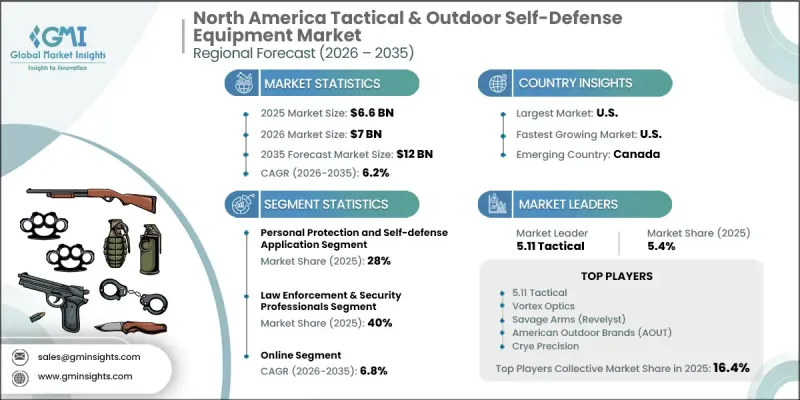
Market growth is supported by the continued expansion of institutional procurement activities, increasing consumer adoption of personal safety products, and ongoing innovation across tactical and outdoor protection equipment categories. Demand is strengthening as personal security awareness rises among a broader consumer base, extending market participation beyond traditional end users and creating new growth opportunities across residential and professional segments. At the same time, government and institutional purchasing programs continue to provide a stable foundation for long-term demand, supporting procurement activity across multiple operational applications. However, evolving regulatory requirements and policy changes continue to influence purchasing decisions and market accessibility in certain jurisdictions. These regulatory developments can create uncertainty for manufacturers, distributors, and retailers while affecting product availability in selected markets. In addition, procurement timelines for institutional contracts often extend over lengthy periods, creating fluctuations in revenue realization and production planning. As several mature product categories approach higher levels of market penetration among professional users, pricing pressures are expected to become more noticeable during the latter part of the forecast period. Despite these challenges, growing consumer interest in personal preparedness and outdoor safety continues to support positive long-term market expansion across North America.
| Market Scope | |
|---|---|
| Start Year | 2025 |
| Forecast Year | 2026-2035 |
| Start Value | $6.6 Billion |
| Forecast Value | $12 Billion |
| CAGR | 6.2% |
The personal protection and self-defense application segment accounted for 28% share in 2025 and is anticipated to grow at a CAGR of 6.6% through 2035. Growth is being fueled by increasing consumer focus on personal safety, rising adoption of non-lethal protection products, and growing participation in self-defense education and training activities. These trends are generating recurring demand for a broad range of protective equipment and related accessories. Greater awareness of personal security needs and increased consumer willingness to invest in preparedness solutions continue to strengthen the segment's outlook throughout the forecast period.
The law enforcement and security operations segment held a 32% share in 2025. The segment is projected to expand at a CAGR of 6.3% through 2035. Demand remains supported by ongoing procurement programs and budget allocations across government and public safety organizations. Institutional purchasing activities continue to drive substantial demand for tactical and protective equipment, creating stable revenue opportunities for industry participants. Long-term modernization initiatives and continued investment in operational readiness are expected to sustain growth within this segment over the forecast period.
United States Tactical & Outdoor Self-Defense Equipment Market held an 89% share in 2025 and is forecast to grow at a CAGR of 6.3% through 2035, maintaining its leading position across application categories, end-user groups, and distribution channels. Market leadership is supported by a combination of strong consumer demand and substantial institutional procurement activity. Multi-year purchasing agreements and ongoing investment programs continue to provide a dependable foundation for market expansion. In addition, widespread adoption of personal safety and outdoor preparedness products among consumers further reinforces the country's dominant position within the regional industry.
Major companies operating in the North America Tactical & Outdoor Self-Defense Equipment Market include 5.11 Tactical, Vortex Optics, Savage Arms (Revelyst), American Outdoor Brands (AOUT), and Crye Precision. Companies operating in the North America Tactical & Outdoor Self-Defense Equipment Market are focusing on product innovation, portfolio expansion, and strategic distribution initiatives to strengthen their market position. Manufacturers are investing in advanced materials, improved product performance, and enhanced durability to meet evolving customer requirements across both professional and consumer segments. Businesses are also expanding their product offerings to address a broader range of applications and end-user needs. Strengthening relationships with institutional buyers and distribution partners remains a key priority for securing long-term revenue opportunities. In addition, companies are increasing investments in brand development, digital sales channels, and customer engagement programs to improve market visibility and expand reach.
Table of Contents
Chapter 1 Methodology and scope
- 1.1 Research approach
- 1.2 Quality Commitments
- 1.2.1 GMI AI policy & data integrity commitment
- 1.2.1.1 Source consistency protocol
- 1.2.1 GMI AI policy & data integrity commitment
- 1.3 Research Trail & Confidence Scoring
- 1.3.1 Research Trail Components
- 1.3.2 Scoring Components
- 1.4 Data Collection
- 1.4.1 Partial list of primary sources
- 1.5 Data mining sources
- 1.5.1 Paid sources
- 1.5.1.1 Sources, by region
- 1.5.1 Paid sources
- 1.6 Base estimates and calculations
- 1.6.1 Base year calculation for any one approach
- 1.7 Forecast model
- 1.7.1 Quantified market impact analysis
- 1.7.1.1 Mathematical impact of growth parameters on forecast
- 1.7.1 Quantified market impact analysis
- 1.8 Research transparency addendum
- 1.8.1 Source attribution framework
- 1.8.2 Quality assurance metrics
- 1.8.3 Our commitment to trust
Chapter 2 Executive summary
- 2.1 Industry 360° synopsis
- 2.2 Key market trends
- 2.2.1 Regional
- 2.2.2 Product type
- 2.2.3 End users
- 2.2.4 Application
- 2.2.5 Distribution channel
Chapter 3 Industry insights
- 3.1 Industry ecosystem analysis
- 3.1.1 Supplier landscape
- 3.1.2 Profit margin
- 3.1.3 Value addition at each stage
- 3.1.4 Factor affecting the value chain
- 3.1.5 Disruptions
- 3.2 Industry impact forces
- 3.2.1 Growth drivers
- 3.2.2 Industry pitfalls & challenges
- 3.2.3 Opportunities
- 3.3 Growth potential analysis
- 3.4 Price trends
- 3.4.1 Historical price trend analysis
- 3.4.2 Pricing strategy by player type
- 3.5 Regulatory framework
- 3.5.1 United States
- 3.5.1.1 Federal Regulations & State-Level Variation
- 3.5.1.2 FTC/CPSC product safety standards; ATF-regulated categories
- 3.5.1.3 State-by-state restrictions on specific self-defense product categories
- 3.5.1.4 Online sales compliance requirements by state
- 3.5.2 Canada
- 3.5.2.1 Import Regulations & Prohibited/Restricted Categories
- 3.5.2.2 CBSA import controls; categories requiring special authorization
- 3.5.3 Cross-Border E-commerce Compliance: Customs, HS Codes & Duty Frameworks
- 3.5.1 United States
- 3.6 Porter's five forces analysis
- 3.7 PESTEL analysis
- 3.8 Trade Data Analysis (Based on Paid Database) (HS Code: 9301)
- 3.8.1 Import/export volume & value trends
- 3.8.2 Key trade corridors & tariff impact
- 3.9 Impact of AI & generative AI on the market
- 3.9.1 AI-driven disruption of traditional business models
- 3.9.2 GenAI use cases & adoption roadmap by customer segment
- 3.9.3 Risks, limitations & regulatory considerations
- 3.10 Future market trends
- 3.11 Technology and innovation landscape
- 3.11.1 Current technological trends
- 3.11.2 Emerging technologies
- 3.12 Consumer behavior analysis
- 3.12.1 Purchasing patterns
- 3.12.2 Preference analysis
- 3.12.3 Regional variations in consumer behavior
- 3.12.4 Impact of e-commerce on buying decisions
Chapter 4 Competitive landscape, 2025
- 4.1 Introduction
- 4.2 Company market share analysis
- 4.2.1 U.S.
- 4.2.2 Canada
- 4.3 Company matrix analysis
- 4.4 Competitive analysis of major market players
- 4.5 Competitive positioning matrix
- 4.6 Key developments
- 4.6.1 Mergers & acquisitions
- 4.6.2 Partnerships & collaborations
- 4.6.3 New product launches
- 4.6.4 Expansion plans
Chapter 5 Market Estimates & Forecast, By Product Type, 2022 - 2035 ($Billion, Thousand Units)
- 5.1 Key trends
- 5.2 Self-defense equipment
- 5.3 Protective equipment
- 5.4 Tactical gear & load-bearing equipment
- 5.5 Outdoor & survival equipment
- 5.6 Communication equipment
- 5.7 Vehicle accessories & mounted equipment
- 5.8 Optics & sighting systems
Chapter 6 Market Estimates & Forecast, By End Users, 2022 - 2035 ($Billion, Thousand Units)
- 6.1 Key trends
- 6.2 Civilian consumers
- 6.3 Law enforcement & security professionals
- 6.4 Military & defense personnel
Chapter 7 Market Estimates & Forecast, By Application, 2022 - 2035 ($Billion, Thousand Units)
- 7.1 Key trends
- 7.2 Personal protection & self-defense
- 7.3 Law enforcement & security operations
- 7.4 Outdoor recreation & survival activities
- 7.5 Sports, training & tactical simulation
- 7.6 Institutional emergency response & civil defense
Chapter 8 Market Estimates & Forecast, By Distribution Channel, 2022 - 2035 ($Billion, Thousand Units)
- 8.1 Key trends
- 8.2 Online
- 8.2.1 E-commerce
- 8.2.2 Company websites
- 8.3 Offline
- 8.3.1 Supermarkets/hypermarket
- 8.3.2 Specialty tactical & outdoor retail stores
- 8.3.3 Others (big-box retailers, etc.)
Chapter 9 Market Estimates & Forecast, By Country, 2022 - 2035 ($Billion, Thousand Units)
- 9.1 Key trends
- 9.2 U.S.
- 9.3 Canada
Chapter 10 Company Profiles
- 10.1 Global Key Players
- 10.1.1 5.11 Tactical
- 10.1.2 American Outdoor Brands (AOUT)
- 10.1.3 Crye Precision
- 10.1.4 O.F. Mossberg & Sons
- 10.1.5 Revision Military
- 10.1.6 Savage Arms (Revelyst)
- 10.1.7 Vortex Optics
- 10.2 Regional Players
- 10.2.1 Kel-Tec
- 10.2.2 LMT
- 10.2.3 Microtech Knives
- 10.2.4 Noveske Rifleworks
- 10.2.5 Taurus USA
- 10.2.6 Windham Weaponry
- 10.2.7 Zero Tolerance Knives (Kai USA)
- 10.3 Emerging / Niche Specialists
- 10.3.1 Aero Precision
- 10.3.2 Alien Gear Holsters
- 10.3.3 Dead Air Silencers
- 10.3.4 Kershaw Knives (Kai USA)
- 10.3.5 Phazzer Electronics
- 10.3.6 Tactical Tailor
- 10.3.7 Velocity Systems

