PUBLISHER: Mordor Intelligence | PRODUCT CODE: 2115213

PUBLISHER: Mordor Intelligence | PRODUCT CODE: 2115213
Europe Tactical UAV - Market Share Analysis, Industry Trends & Statistics, Growth Forecasts (2026 - 2031)
According to Mordor Intelligence, the Europe tactical UAV market size is expected to grow from USD 1.54 billion in 2025 to USD 1.73 billion in 2026 and is forecast to reach USD 3.07 billion by 2031 at 12.18% CAGR over 2026-2031.
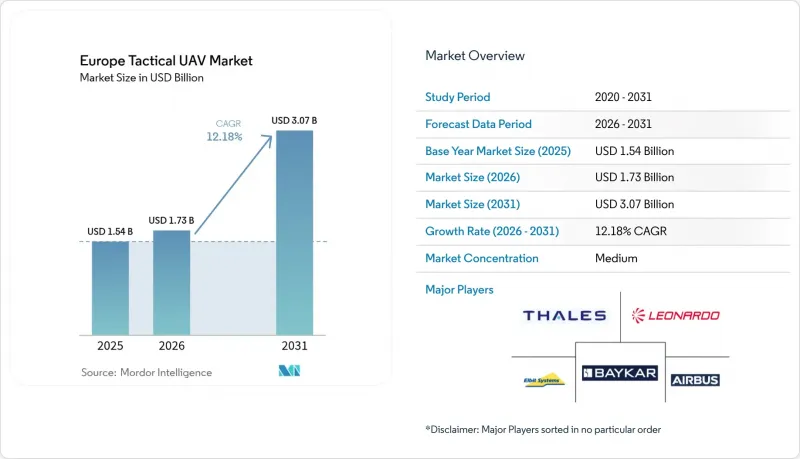
This report is Segmented by Platform Type (Fixed-Wing, Rotary-Wing, Hybrid VTOL), Weight Class (Micro/Nano Less Than 5 Kg, and More), Range Category (Short-Range Less Than 50 Km, and More), Propulsion Type (Electric, Hybrid, Conventional ICE), Application (Military, Law Enforcement, and More), and Geography (United Kingdom, France, and More). The Market Forecasts are Provided in Terms of Value (USD).
Europe Tactical UAV Market Trends and Insights
Rising Defense-Budget Allocations Drive ISR-Centric Procurement
Defense ministries boosted 2024 tactical-drone budgets at the fastest clip in two decades, led by Germany's 8.2% hike to EUR 52.1 billion (USD 55.7 billion) and France's 7.4% lift to EUR 47.2 billion (USD 50.5 billion). The UK locked in GBP 3.8 billion (USD 4.7 billion) for unmanned platforms through 2034, a 45% jump on the previous plan. Poland doubled its tactical-drone line to USD 890 million, underscoring frontline urgency. Funding streams are increasingly referencing multi-domain operations that integrate real-time data from air, land, and cyber assets. This budget momentum secures multi-year order visibility for the European tactical UAV market.
Urgent Tactical-Drone Demand Sparked by Ukraine Conflict
Combat footage from Ukraine showcased the versatility of small drones for reconnaissance, artillery cueing, and precision strikes, prompting NATO states to re-baseline their requirements. Germany rushed a EUR 340 million (USD 364 million) buy of 1,200 systems, while France fast-tracked 800 units to close battlefield gaps. Planners now specify GPS-denied navigation, hardening against electronic warfare, and autonomous swarm maneuvers. These criteria reshape supplier road maps and lift the European tactical UAV market trajectory.
Fragmented Industrial Base Hampers Joint Procurement Efficiency
Twenty-seven national defense bureaucracies still run more than 30 separate tactical-drone tenders, diluting economies of scale and prolonging unit fielding by an average of 18 months. Germany's preference for local primes clashes with France's 'buy European' clauses, forcing duplicate R&D lines. Without deeper integration, the European tactical UAV market faces a cost drag and interoperability friction that favors non-European imports.
Other drivers and restraints analyzed in the detailed report include:
- EU-Funded Eurodrone and PESCO Projects Accelerate Local Supply Chains
- Cross-Border U-Space Regulations Enable BVLOS Operations
- Export-Licence Regimes Constrain Cross-Border Sales Growth
For complete list of drivers and restraints, kindly check the Table Of Contents.
Segment Analysis
Fixed-wing aircraft generated 65.80% of Europe tactical UAV market revenue in 2025, buoyed by 18-hour endurance, 75 kg payload capacity, and lower lifecycle cost compared with rotary peers. The Europe tactical UAV market size for fixed-wing will still expand, albeit at single-digit CAGR as most Tier-1 forces already operate mature fleets. Hybrid VTOL models, however, are logging the segment's headline 15.88% CAGR because commanders increasingly demand runway-independent launch paired with 300 km range capability. Programs in Germany, Sweden, and the UK validate the concept, pushing vendors to refine tilt-wing and vectored-thrust designs.
Continuous miniaturization of electric motors and lightweight composite wings is shrinking logistics footprints, letting brigades air-lift pre-assembled VTOL drones directly to forward bases. Software-defined flight controllers further blur lines between platform categories, enabling quick re-role from ISR to electronic-attack or loitering-munition carriage. Collectively these traits will let VTOL contenders erode fixed-wing share slowly but steadily through 2031 as training curricula pivot to vertical launch-and-recover proficiency.
The 20-150 kg light segment accounted for 45.90% of Europe tactical UAV market size in 2025, sitting at the operational sweet spot between squad portability and sensor heft. Customers value its ability to haul multi-spectral gimbals, synthetic-aperture radar, or SIGINT pods without complex ground infrastructure. The micro/nano tier, though only 7.12% of revenue today, is outpacing all others at 18.12% CAGR as chipsets, micro-gimbals, and secure mesh radios shrink below 1 kg thresholds.
Urban counter-terror units favor palm-launched craft that stream 4K video through walls over 3 km, while artillery battalions adopt expendable micro-drones to verify strike results. To defend share, light-segment suppliers are adding modular plug-and-play bays so that a single airframe can toggle between ISR, electronic-warfare, or precision-strike payloads within minutes. Overall, technology spillovers ensure both tiers remain essential within the Europe tactical UAV market.
Complete Report Scope:
- By Platform Type
- Fixed-wing
- Rotary-wing
- Hybrid VTOL
- By Weight Class
- Micro/Nano (Less than 5 kg)
- Mini (5 to 20 kg)
- Light Tactical (20 to 150 kg)
- Medium Tactical (150 to 600 kg)
- Heavy Tactical (Greater than 600 kg)
- By Range Category
- Short-Range (Less than 50 km)
- Medium-Range (50 to 200 km)
- Extended-Range (Greater than 200 km)
- By Propulsion Type
- Electric
- Hybrid
- Conventional (ICE)
- By Application
- Military
- Law Enforcement
- Disaster and Emergency Response
- Environmental Monitoring
- Other Applications
- By Country
- United Kingdom
- France
- Germany
- Italy
- Spain
- Russia
- Rest of Europe
List of Companies Covered in this Report:
- Airbus SE
- Leonardo S.p.A.
- Safran SA
- Thales Group
- BAE Systems plc
- Rheinmetall AG
- Saab AB
- UMS Skeldar AG
- Quantum-Systems GmbH
- BlueBird Aero Systems
- BAYKAR MAKINA SANAYI VE TICARET A.S.
- Israel Aerospace Industries Ltd.
- Elbit Systems Ltd.
- AeroVironment Inc.
- General Atomics Aeronautical Systems, Inc.
- Northrop Grumman Corporation
- The Boeing Company
- Lockheed Martin Corporation
- Textron Inc.
- Schiebel Corporation
Additional Benefits:
- The market estimate (ME) sheet in Excel format
- 3 months of analyst support
TABLE OF CONTENTS
1 INTRODUCTION
- 1.1 Study Assumptions and Market Definition
- 1.2 Scope of the Study
2 RESEARCH METHODOLOGY
3 EXECUTIVE SUMMARY
4 MARKET LANDSCAPE
- 4.1 Market Overview
- 4.2 Market Drivers
- 4.2.1 Rising defence-budget allocations for ISR-centric UAV procurement
- 4.2.2 Urgent tactical drone demand driven by lessons from Ukraine conflict
- 4.2.3 EU-funded Eurodrone and PESCO projects accelerating local supply chains
- 4.2.4 Cross-border U-space rules enabling BVLOS operations
- 4.2.5 AI-enabled autonomous swarm concepts entering NATO experimentation
- 4.2.6 Combat-proven loitering munitions spur demand for launcher-ready tactical UAVs
- 4.3 Market Restraints
- 4.3.1 Fragmented industrial base and joint-procurement bottlenecks
- 4.3.2 Strict national export-licence regimes slowing cross-border sales
- 4.3.3 EW/cyber vulnerability of C2 links in contested theatres
- 4.3.4 EU public debate scrutinises lethal-autonomy rules
- 4.4 Value Chain Analysis
- 4.5 Regulatory Landscape
- 4.6 Technological Outlook
- 4.7 Porter's Five Forces Analysis
- 4.7.1 Threat of New Entrants
- 4.7.2 Threat of Substitute Products
- 4.7.3 Bargaining Power of Buyers
- 4.7.4 Bargaining Power of Suppliers
- 4.7.5 Intensity of Competitive Rivalry
5 MARKET SIZE AND GROWTH FORECASTS (VALUE)
- 5.1 By Platform Type
- 5.1.1 Fixed-wing
- 5.1.2 Rotary-wing
- 5.1.3 Hybrid VTOL
- 5.2 By Weight Class
- 5.2.1 Micro/Nano (Less than 5 kg)
- 5.2.2 Mini (5 to 20 kg)
- 5.2.3 Light Tactical (20 to 150 kg)
- 5.2.4 Medium Tactical (150 to 600 kg)
- 5.2.5 Heavy Tactical (Greater than 600 kg)
- 5.3 By Range Category
- 5.3.1 Short-Range (Less than 50 km)
- 5.3.2 Medium-Range (50 to 200 km)
- 5.3.3 Extended-Range (Greater than 200 km)
- 5.4 By Propulsion Type
- 5.4.1 Electric
- 5.4.2 Hybrid
- 5.4.3 Conventional (ICE)
- 5.5 By Application
- 5.5.1 Military
- 5.5.2 Law Enforcement
- 5.5.3 Disaster and Emergency Response
- 5.5.4 Environmental Monitoring
- 5.5.5 Other Applications
- 5.6 By Country
- 5.6.1 United Kingdom
- 5.6.2 France
- 5.6.3 Germany
- 5.6.4 Italy
- 5.6.5 Spain
- 5.6.6 Russia
- 5.6.7 Rest of Europe
6 COMPETITIVE LANDSCAPE
- 6.1 Market Concentration
- 6.2 Strategic Moves
- 6.3 Market Share Analysis
- 6.4 Company Profiles (includes Global level Overview, Market level overview, Core Segments, Financials as available, Strategic Information, Market Rank/Share for key companies, Products and Services, and Recent Developments)
- 6.4.1 Airbus SE
- 6.4.2 Leonardo S.p.A.
- 6.4.3 Safran SA
- 6.4.4 Thales Group
- 6.4.5 BAE Systems plc
- 6.4.6 Rheinmetall AG
- 6.4.7 Saab AB
- 6.4.8 UMS Skeldar AG
- 6.4.9 Quantum-Systems GmbH
- 6.4.10 BlueBird Aero Systems
- 6.4.11 BAYKAR MAKINA SANAYI VE TICARET A.S.
- 6.4.12 Israel Aerospace Industries Ltd.
- 6.4.13 Elbit Systems Ltd.
- 6.4.14 AeroVironment Inc.
- 6.4.15 General Atomics Aeronautical Systems, Inc.
- 6.4.16 Northrop Grumman Corporation
- 6.4.17 The Boeing Company
- 6.4.18 Lockheed Martin Corporation
- 6.4.19 Textron Inc.
- 6.4.20 Schiebel Corporation
7 MARKET OPPORTUNITIES AND FUTURE OUTLOOK
- 7.1 White-space and Unmet-Need Assessment

