PUBLISHER: Global Market Insights Inc. | PRODUCT CODE: 2071267

PUBLISHER: Global Market Insights Inc. | PRODUCT CODE: 2071267
Substation Automation Market Opportunity, Growth Drivers, Industry Trend Analysis, and Forecast 2026 - 2035
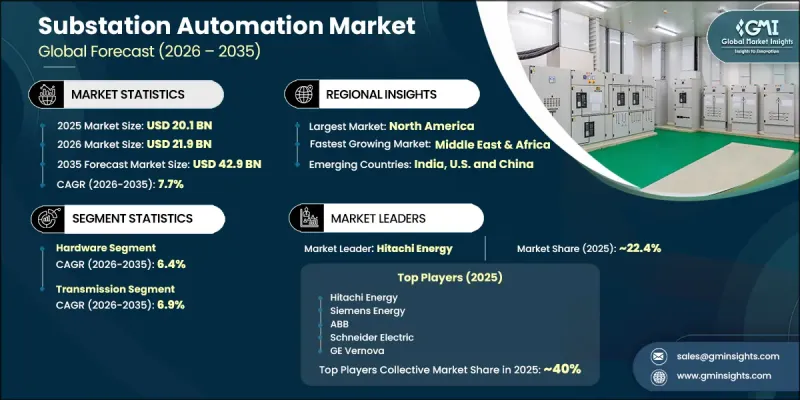
The Global Substation Automation Market was valued at USD 20.1 billion in 2025 and is estimated to grow at a CAGR of 7.7% to reach USD 42.9 billion by 2035.
Growth in the substation automation industry is fueled by the widespread transition toward digital grid infrastructure and increasing adoption of standardized automation architectures. Regulatory initiatives promoting grid modernization, rising integration of renewable energy sources, and stronger cybersecurity requirements are creating sustained demand for advanced automation technologies. Utilities are increasingly prioritizing intelligent monitoring, real-time system control, and automated grid management capabilities to improve operational efficiency and network reliability. At the same time, the expansion of distributed energy resources is reshaping power distribution frameworks and increasing the need for more sophisticated communication and control systems. The growing complexity of modern electricity networks requires highly responsive automation platforms that support dynamic power management, advanced operational visibility, and seamless coordination across grid assets. As utilities continue upgrading aging infrastructure, investment in substation automation solutions is expected to remain a key component of long-term grid transformation strategies worldwide.
| Market Scope | |
|---|---|
| Start Year | 2025 |
| Forecast Year | 2026-2035 |
| Start Value | $20.1 Billion |
| Forecast Value | $42.9 Billion |
| CAGR | 7.7% |
The hardware segment held a 44% share and is forecast to grow at a 6.4% CAGR through 2035. Hardware components form the foundation of substation automation systems by enabling monitoring, protection, communication, and control functions throughout electrical networks. The ongoing migration toward advanced digital communication architectures is generating consistent demand for intelligent field devices, high-performance communication equipment, and reliable networking infrastructure designed to operate in demanding utility environments. Increasing emphasis on system interoperability, operational reliability, and real-time data exchange continues to support investment in next-generation hardware technologies across utility networks.
By installation type, the transmission substations segment held a 54% share in 2025 and is projected to grow at a CAGR of 6.9% during 2026-2035. Automation systems deployed in transmission-level facilities require highly advanced protection, monitoring, and communication capabilities to support large-scale power transfer operations. These installations involve sophisticated network coordination requirements and demand high-performance software and hardware solutions capable of ensuring system stability, reliability, and operational security. Due to the scale and complexity of transmission infrastructure projects, investment levels remain substantially higher than those associated with other substation categories, contributing significantly to overall market revenue.
North America Substation Automation Market accounted for 32.6% share in 2025 and is expected to grow at a CAGR of 6.9% through 2035. Regional growth is being supported by extensive utility modernization initiatives, regulatory compliance requirements, and increasing investments aimed at improving grid resilience and reliability. The United States remains the primary contributor to market development, driven by ongoing infrastructure upgrades and stringent operational standards governing power system performance and security. In addition, evolving cybersecurity regulations are encouraging utilities to increase spending on advanced monitoring, communication, and automation technologies, further strengthening demand for substation automation solutions across the region.
Key participants operating in the global substation automation market include ABB, Arcteq Relays, Belden, Brush Group, Eaton, GE Vernova, Hitachi Energy, Hyosung Heavy Industries, INTECH Automation & Intelligence, Larsen & Toubro, Lauritz Knudsen Electrical & Automation, Mipro, NARI Technology, NovaTech Automation, Schneider Electric, Schweitzer Engineering Laboratories, Siemens Energy, TBEA, Trilliant Holdings, and Yokogawa Electric. Companies active in the substation automation industry are implementing a range of strategic initiatives to reinforce their competitive position and expand market presence. Leading organizations are investing heavily in research and development to enhance digital automation capabilities, improve cybersecurity features, and increase system interoperability. Strategic partnerships with utilities, technology providers, and infrastructure developers are helping companies broaden their customer reach and accelerate project deployment. Market participants are also focusing on portfolio expansion through product innovation, advanced software integration, and intelligent grid management solutions.
Table of Contents
Chapter 1 Methodology & Scope
- 1.1 Research approach
- 1.2 Quality commitment
- 1.2.1 GMI AI policy & data integrity commitment
- 1.2.1.1 Source consistency protocol
- 1.2.1 GMI AI policy & data integrity commitment
- 1.3 Research Trail & Confidence Scoring
- 1.3.1 Research Trail Components
- 1.3.2 Scoring Components
- 1.4 Data Collection
- 1.4.1 Partial list of primary sources
- 1.5 Data mining sources
- 1.5.1 Paid sources
- 1.5.1.1 Sources, by region
- 1.5.1 Paid sources
- 1.6 Base estimates and calculations
- 1.6.1 Base year calculation for any one approach
- 1.7 Forecast model
- 1.8 Research transparency addendum
- 1.8.1 Source attribution framework
- 1.8.2 Quality assurance metrics
- 1.8.3 Our commitment to trust
- 1.8.3.1 Market definitions
Chapter 2 Executive Summary
- 2.1 Industry synopsis, 2022 - 2035
- 2.2 Business trends
- 2.3 Component trends
- 2.4 Substation type trends
- 2.5 Installation type trends
- 2.6 End user trends
- 2.7 Regional trends
Chapter 3 Industry Insights
- 3.1 Industry ecosystem analysis
- 3.2 Regulatory landscape
- 3.3 Industry impact forces
- 3.3.1 Growth drivers
- 3.3.2 Industry pitfalls & challenges
- 3.4 Growth potential analysis
- 3.5 Technology & Innovation Landscape
- 3.5.1 Digital Substation Architecture (IEC 61850 Process Bus & Station Bus)
- 3.5.2 Merging Units & Sampled Value Technology
- 3.5.3 Wide Area Monitoring Systems (WAMS) & Synchrophasor Technology
- 3.6 Porter's analysis
- 3.6.1 Bargaining power of suppliers
- 3.6.2 Bargaining power of buyers
- 3.6.3 Threat of new entrants
- 3.6.4 Threat of substitutes
- 3.7 PESTEL analysis
- 3.8 Impact of AI & generative AI on the market
- 3.8.1 AI-driven disruption of existing business models
- 3.8.2 GenAI use cases & adoption roadmap by segment
- 3.8.2.1 Predictive maintenance & fault detection
- 3.8.3 Risks, limitations & regulatory considerations
- 3.9 Cybersecurity Landscape in Substation Automation
- 3.9.1 threat vector analysis - OT/IT convergence risks in substation environments
- 3.9.2 cybersecurity incident history & impact on grid operations
- 3.9.3 NERC CIP & IEC 62351 compliance gap analysis by region
- 3.9.4 cybersecurity solution adoption trends - firewalls, IDS/IPS, encryption in substations
- 3.9.5 vendor cybersecurity capability benchmarking
- 3.10 Emerging opportunities & trends
- 3.11 Investment analysis & future outlook
- 3.11.1 Global capital expenditure in grid modernization & substation upgrades
- 3.11.2 Venture capital & strategic investment in substation technology startups
- 3.11.3 Public funding - government infrastructure programs (IRA, EU green deal, etc.)
Chapter 4 Competitive Landscape, 2026
- 4.1 Introduction
- 4.2 Company market share analysis, by region, 2025
- 4.2.1 North America
- 4.2.2 Europe
- 4.2.3 Asia Pacific
- 4.2.4 Middle East & Africa
- 4.2.5 Latin America
- 4.3 Competitive positioning matrix
- 4.4 Key Developments
- 4.4.1 Mergers & acquisitions
- 4.4.2 Partnerships & collaborations
- 4.4.3 New product launches
- 4.4.4 Expansion plans and funding
Chapter 5 Market Size and Forecast, By Component, 2022 - 2035 (USD Million)
- 5.1 Key trends
- 5.2 Hardware
- 5.3 Software
- 5.4 Services
Chapter 6 Market Size and Forecast, By Substation Type, 2022 - 2035 (USD Million)
- 6.1 Key trends
- 6.2 Transmission
- 6.3 Distribution
Chapter 7 Market Size and Forecast, By Installation Type, 2022 - 2035 (USD Million)
- 7.1 Key trends
- 7.2 New
- 7.3 Retrofit
Chapter 8 Market Size and Forecast, By End User, 2022 - 2035 (USD Million)
- 8.1 Key trends
- 8.2 Utilities
- 8.3 Oil & Gas
- 8.4 Metals & Mining
- 8.5 Transportation
- 8.6 Others
Chapter 9 Market Size and Forecast, By Region, 2022 - 2035 (USD Million)
- 9.1 Key trends
- 9.2 North America
- 9.2.1 U.S.
- 9.2.2 Canada
- 9.2.3 Mexico
- 9.3 Europe
- 9.3.1 UK
- 9.3.2 France
- 9.3.3 Germany
- 9.3.4 Italy
- 9.3.5 Russia
- 9.3.6 Spain
- 9.4 Asia Pacific
- 9.4.1 China
- 9.4.2 Australia
- 9.4.3 India
- 9.4.4 Japan
- 9.4.5 South Korea
- 9.5 Middle East & Africa
- 9.5.1 Saudi Arabia
- 9.5.2 UAE
- 9.5.3 Turkey
- 9.5.4 South Africa
- 9.5.5 Egypt
- 9.6 Latin America
- 9.6.1 Brazil
- 9.6.2 Argentina
Chapter 10 Company Profiles
- 10.1 ABB
- 10.2 Arcteq Relays
- 10.3 Belden
- 10.4 Brush Group
- 10.5 Eaton
- 10.6 GE Vernova
- 10.7 Hitachi Energy
- 10.8 Hyosung Heavy Industries
- 10.9 INTECH Automation & Intelligence
- 10.10 Larsen & Toubro
- 10.11 Lauritz Knudsen Electrical & Automation
- 10.12 Mipro
- 10.13 NARI Technology
- 10.14 NovaTech Automation
- 10.15 Schneider Electric
- 10.16 Schweitzer Engineering Laboratories
- 10.17 Siemens Energy
- 10.18 TBEA
- 10.19 Trilliant Holdings
- 10.20 Yokogawa Electric

