PUBLISHER: Global Market Insights Inc. | PRODUCT CODE: 2071269

PUBLISHER: Global Market Insights Inc. | PRODUCT CODE: 2071269
North America Ink Cartridge Printer Market Opportunity, Growth Drivers, Industry Trend Analysis, and Forecast 2026 - 2035
North America Ink Cartridge Printer Market was valued at USD 20.6 billion in 2025 and is estimated to grow at a CAGR of 5.2% to reach USD 33.8 billion by 2035.
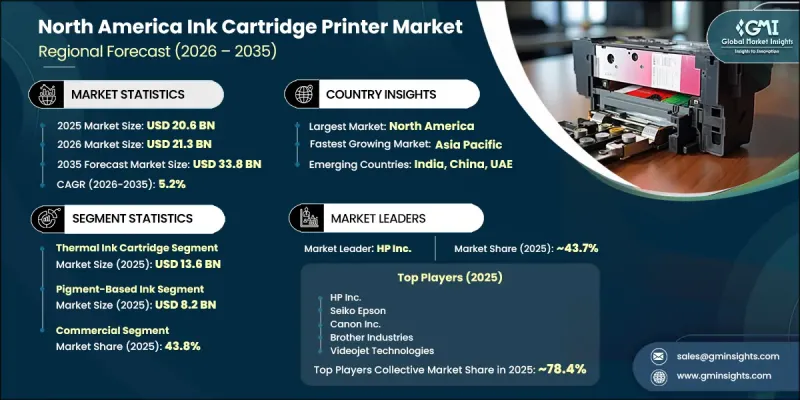
Consistent demand from households, educational institutions, and small enterprises continues to support market growth across the region. The increasing adoption of hybrid work models and the continued expansion of home-based workspaces have significantly strengthened demand for personal printing solutions. At the same time, academic printing requirements remain an important contributor to overall market consumption. Consumer preferences are gradually shifting toward printers that offer enhanced connectivity, wireless functionality, and higher cartridge yields, encouraging purchasing decisions based on long-term operating efficiency rather than initial hardware pricing. The growing residential printer installed base across North America continues to generate recurring demand for replacement cartridges, creating a stable revenue stream for both original equipment manufacturers and third-party suppliers. Additionally, the increasing presence of multiple printing devices within a single household is contributing to higher consumable usage, supporting sustained market expansion and reinforcing the long-term outlook for the North America ink cartridge printer industry.
| Market Scope | |
|---|---|
| Start Year | 2025 |
| Forecast Year | 2026-2035 |
| Start Value | $20.6 Billion |
| Forecast Value | $33.8 Billion |
| CAGR | 5.2% |
In 2025, the thermal ink cartridge segment accounted for 66% share, generating USD 13.6 billion. Thermal inkjet technology continues to maintain a leading market position due to its cost-efficient manufacturing processes, extensive hardware compatibility, and broad adoption across consumer and light-commercial printing applications. Strong market penetration and a substantial installed base of thermal inkjet printers continue to create recurring cartridge replacement demand, reinforcing revenue generation opportunities throughout the forecast period. The technology's reliability, accessibility, and suitability for a wide range of printing requirements remain key factors supporting its market leadership.
The pigment-based ink segment held a 39% share, generating USD 8.2 billion in 2025. Demand for pigment-based formulations remains strong because they offer enhanced resistance to moisture, superior color retention, and greater long-term print durability compared to alternative ink types. These performance characteristics have positioned pigment-based inks as the preferred choice for professional-grade printing applications, business documentation, and projects requiring extended archival life. Their ability to deliver consistent output quality across multiple print media further supports their widespread adoption throughout commercial and institutional printing environments.
United States Ink Cartridge Printer Market held a 90% share, reaching USD 18.7 billion in 2025. A large installed base of ink cartridge printers across residential, educational, and commercial sectors continues to support both hardware replacement cycles and recurring consumable demand. Ongoing digital-document printing requirements, combined with continued demand from home offices and institutional users, are expected to sustain market growth throughout the forecast period.
Key participants operating in the North America ink cartridge printer market include HP Inc., Seiko Epson Corporation, Canon Inc., Brother Industries Ltd., Xerox Corporation, Ricoh Company Ltd., Konica Minolta Inc., Kyocera Corporation, Mimaki Engineering Co., Ltd., SCREEN Graphic Solutions Co., Ltd., Durst Group, Swissqprint, and Agfa Graphics. Companies operating in the North America ink cartridge printer market are implementing a range of strategies to strengthen their market position and expand customer reach. Leading manufacturers are investing heavily in research and development to improve print quality, increase cartridge yield, and enhance printer connectivity features. Many market participants are expanding their portfolios with wireless and cloud-enabled printing solutions to address evolving consumer preferences. Strategic partnerships with distribution networks and e-commerce platforms are helping companies improve product accessibility and market penetration. Businesses are also focusing on subscription-based ink replenishment programs and customer retention initiatives to secure recurring revenue streams.
Table of Contents
Chapter 1 Research Methodology
- 1.1 Research approach
- 1.2 Quality Commitments
- 1.2.1 GMI AI policy & data integrity commitment
- 1.2.1.1 Source consistency protocol
- 1.2.1 GMI AI policy & data integrity commitment
- 1.3 Research Trail & Confidence Scoring
- 1.3.1 Research Trail Components
- 1.3.2 Scoring Components
- 1.4 Data Collection
- 1.4.1 Partial list of primary sources
- 1.5 Data mining sources
- 1.5.1 Paid sources
- 1.5.1.1 Sources, by region
- 1.5.1 Paid sources
- 1.6 Base estimates and calculations
- 1.6.1 Base year calculation for any one approach
- 1.7 Forecast model
- 1.7.1 Quantified market impact analysis
- 1.7.1.1 Mathematical impact of growth parameters on forecast
- 1.7.1 Quantified market impact analysis
- 1.8 Research transparency addendum
- 1.8.1 Source attribution framework
- 1.8.2 Quality assurance metrics
- 1.8.3 Our commitment to trust
Chapter 2 Executive Summary
- 2.1 Industry 360° synopsis, 2022 - 2035
- 2.2 Key market trends
- 2.2.1 Country
- 2.2.2 Product type
- 2.2.3 Ink formulation
- 2.2.4 Application
- 2.2.5 End user
- 2.2.6 Distribution channel
Chapter 3 Industry Insights
- 3.1 Industry ecosystem analysis
- 3.1.1 Factor affecting the value chain
- 3.1.2 Profit margin analysis
- 3.1.3 Disruptions
- 3.1.4 Future outlook
- 3.1.5 Manufacturers
- 3.1.6 Distributors
- 3.2 Industry impact forces
- 3.2.1 Growth drivers
- 3.2.1.1 Rising home office adoption increases ink cartridge printer demand
- 3.2.1.2 Growing educational activities support residential printing equipment purchases.
- 3.2.1.3 Expanding small businesses boost commercial printer installations
- 3.2.2 Pitfalls & Challenges
- 3.2.2.1 Rising digitalization reduces dependence on physical document printing
- 3.2.2.2 High ink replacement costs discourage frequent printer usage
- 3.2.3 Opportunities
- 3.2.3.1 Subscription-based ink services create recurring revenue opportunities
- 3.2.3.2 Eco-friendly cartridges support sustainable printing market expansion
- 3.2.1 Growth drivers
- 3.3 Porter's analysis
- 3.4 PESTEL analysis
- 3.5 Pricing analysis (driven by primary research)
- 3.5.1 Historical price trend analysis (driven by primary research)
- 3.5.2 Pricing strategy by player type (OEM premium vs aftermarket value) (driven by primary research)
- 3.5.3 Price-to-print cost economics
- 3.6 Trade data analysis (HS code - 84439951) (driven by paid database)
- 3.6.1 Import/export volume and value trends (driven by paid database)
- 3.6.2 Key trade corridors and tariff impact (driven by paid database)
- 3.6.3 Regional trade flow patterns
- 3.7 Impact of AI and generative AI on the market
- 3.7.1 AI-driven disruption of existing business models
- 3.7.2 GenAI use cases and adoption roadmap by segment
- 3.7.3 Risks, limitations and regulatory considerations
- 3.8 Capacity and production landscape (driven by primary research)
- 3.8.1 Installed capacity by region and key producer (driven by primary research)
- 3.8.2 Capacity utilization rates and expansion pipelines (driven by primary research)
Chapter 4 Competitive Landscape, 2025
- 4.1 Introduction
- 4.2 Company market share analysis
- 4.3 Competitive positioning matrix
- 4.4 Strategic outlook matrix
- 4.5 Competitive analysis of major market players
- 4.6 Key developments
- 4.6.1 Mergers & acquisitions
- 4.6.2 Partnerships & collaborations
- 4.6.3 New product launches
- 4.6.4 Expansion plans
Chapter 5 Market Estimates & Forecast, By Product Type, 2022 - 2035, (USD Billion) (Thousand Units)
- 5.1 Key trends
- 5.2 Thermal ink cartridge
- 5.3 Piezoelectric ink cartridge
Chapter 6 Market Estimates & Forecast, By Ink Formulation, 2022 - 2035, (USD Billion) (Thousand Units)
- 6.1 Key trends
- 6.2 Dye-based ink
- 6.3 Pigment-based ink
- 6.4 Solvent-based ink
- 6.5 UV-curable ink
- 6.6 Sublimation ink
Chapter 7 Market Estimates & Forecast, By Application, 2022 - 2035, (USD Billion) (Thousand Units)
- 7.1 Key trends
- 7.2 Office document printing
- 7.3 Photo printing
- 7.4 Label & packaging
- 7.5 Graphics & signage
- 7.6 Coding & marking
- 7.7 Textile & specialty
Chapter 8 Market Estimates & Forecast, By End User, 2022 - 2035, (USD Billion) (Thousand Units)
- 8.1 Key trends
- 8.2 Residential
- 8.3 Commercial
- 8.4 Industrial
- 8.5 Government
- 8.6 Educational institutions
Chapter 9 Market Estimates & Forecast, By Distribution Channel, 2022 - 2035, (USD Billion) (Thousand Units)
- 9.1 Key trends
- 9.2 Online
- 9.3 Offline
Chapter 10 Market Estimates & Forecast, By Country, 2022 - 2035, (USD Billion) (Thousand Units)
- 10.1 Key trends
- 10.2 U.S.
- 10.3 Canada
Chapter 11 Company Profiles (Business Overview, Financial Data, Product Landscape, Strategic Outlook, SWOT Analysis)
- 11.1 Global players
- 11.1.1 HP Inc.
- 11.1.2 Canon Inc.
- 11.1.3 Seiko Epson Corporation
- 11.1.4 Brother Industries Ltd.
- 11.1.5 Xerox Corporation
- 11.1.6 Ricoh Company Ltd.
- 11.1.7 Fujifilm Holdings Corporation
- 11.2 Regional players
- 11.2.1 Konica Minolta Inc.
- 11.2.2 Kyocera Corporation
- 11.2.3 Primera Technology, Inc.
- 11.2.4 Roland DG Corporation
- 11.2.5 Mutoh Industries Ltd.
- 11.2.6 Screen (SCREEN Graphic Solutions Co., Ltd.)
- 11.2.7 Mimaki Engineering Co., Ltd.
- 11.3 Emerging players
- 11.3.1 EFI (Electronics For Imaging)
- 11.3.2 Durst Group
- 11.3.3 Domino Printing Sciences
- 11.3.4 Videojet Technologies
- 11.3.5 Swissqprint
- 11.3.6 Agfa Graphics
- 11.3.7 Kornit Digital

