PUBLISHER: Global Market Insights Inc. | PRODUCT CODE: 2071282

PUBLISHER: Global Market Insights Inc. | PRODUCT CODE: 2071282
Distribution Automation Market Opportunity, Growth Drivers, Industry Trend Analysis, and Forecast 2026 - 2035
The Global Distribution Automation Market was valued at USD 23 billion in 2025 and is estimated to grow at a CAGR of 10.5% to reach USD 63 billion by 2035.
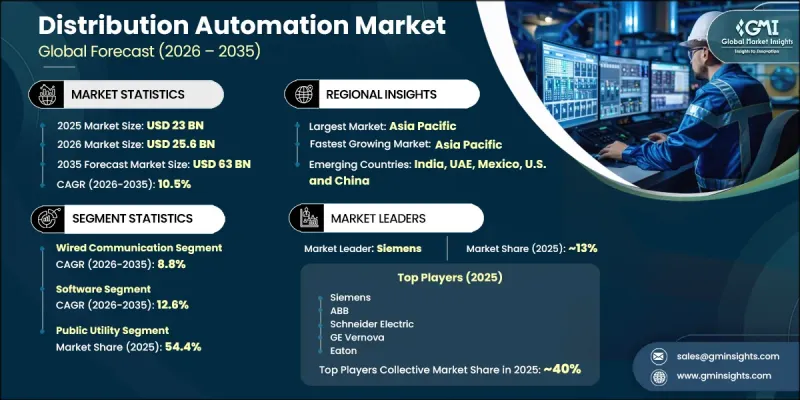
Market expansion is driven by large-scale utility modernization programs, increasing integration of renewable energy sources that require real-time distribution balancing, and growing regulatory expectations aimed at reducing outage frequency and improving grid reliability. The demand outlook is further strengthened by three long-term structural shifts, including the aging nature of legacy grid infrastructure, the increasing penetration of distributed energy resources, and rising economic penalties associated with power interruptions across industrial, commercial, and digital infrastructure users. These factors are reshaping the design and operation of electricity distribution systems worldwide. Utilities are increasingly transitioning from manual control frameworks to automated, software-enabled grid architectures that rely on intelligent switching, advanced monitoring, and real-time analytics. This transformation is accelerating investments in modern grid technologies capable of supporting flexible, resilient, and digitally coordinated distribution networks.
| Market Scope | |
|---|---|
| Start Year | 2025 |
| Forecast Year | 2026-2035 |
| Start Value | $23 Billion |
| Forecast Value | $63 Billion |
| CAGR | 10.5% |
The wired communication segment accounted for 62% share in 2025 and is projected to grow at a CAGR of 8.8% through 2035. This segment continues to dominate due to its reliability, low latency, and suitability for mission-critical grid operations. Wired systems, including fiber-based networks, Ethernet communication frameworks, and power line carrier technologies, are widely deployed in substations and dense urban grid environments. These communication systems play a vital role in enabling high-speed data exchange and ensuring synchronized protection and control across distribution networks.
The software segment represented 29.2% share in 2025 and is expected to grow at the CAGR of 12.6% through 2035. Growth in this segment is driven by increasing adoption of advanced grid management platforms that enable real-time monitoring, outage management, distributed energy coordination, and spatial data integration. Software solutions are becoming central to utility operations as grid management shifts toward data-driven decision-making and automated control systems. The rising focus on interoperability, predictive analytics, and artificial intelligence-enabled grid optimization is further strengthening the importance of software platforms within the distribution automation ecosystem.
North America Distribution Automation Market held 31.1% share in 2025 and is projected to grow at a CAGR of 10.3% through 2035. Regional growth is supported by large-scale utility investments in grid modernization, renewable energy integration, and digital infrastructure upgrades. Utilities across the region are increasingly deploying automated distribution systems to enhance grid reliability, reduce outage durations, and improve operational efficiency. The shift toward resilient and intelligent grid architectures continues to drive sustained investment across transmission and distribution networks.
Key companies operating in the Global Distribution Automation Market include Siemens, Schneider Electric, ABB, GE Vernova, Hitachi Energy, Eaton, Honeywell International Inc., Cisco, Emerson Electric Co., Huawei Technologies Co., Ltd., Mitsubishi Electric Corporation, Itron, Landis+Gyr, NovaTech, Hubbell, S&C Electric Company, G&W Electric, Schweitzer Engineering Laboratories, Trilliant Holdings, Oracle, Toshiba Energy Systems & Solutions, and Xylem. Companies in the distribution automation market are adopting strategies centered on digital transformation, platform integration, and advanced grid intelligence to strengthen their market position. Leading players are investing in artificial intelligence-driven grid analytics, predictive maintenance tools, and automated control systems to improve operational efficiency and grid reliability. Strategic collaborations with utility providers are enabling large-scale deployment of integrated distribution management platforms. Companies are also focusing on expanding software capabilities that support real-time decision-making, DER coordination, and outage response optimization. Geographic expansion into emerging energy markets is being prioritized alongside localized service and support infrastructure development.
Table of Contents
Chapter 1 Methodology & Scope
- 1.1 Research approach
- 1.2 Quality commitment
- 1.2.1 GMI AI policy & data integrity commitment
- 1.2.1.1 Source consistency protocol
- 1.2.1 GMI AI policy & data integrity commitment
- 1.3 Research Trail & Confidence Scoring
- 1.3.1 Research Trail Components
- 1.3.2 Scoring Components
- 1.4 Data Collection
- 1.4.1 Partial list of primary sources
- 1.5 Data mining sources
- 1.5.1 Paid sources
- 1.5.1.1 Sources, by region
- 1.5.1 Paid sources
- 1.6 Base estimates and calculations
- 1.6.1 Base year calculation for any one approach
- 1.7 Forecast model
- 1.8 Research transparency addendum
- 1.8.1 Source attribution framework
- 1.8.2 Quality assurance metrics
- 1.8.3 Our commitment to trust
- 1.8.3.1 Market definitions
Chapter 2 Executive Summary
- 2.1 Industry synopsis, 2022 - 2035
- 2.2 Business trends
- 2.3 Communication trends
- 2.4 Component trends
- 2.5 Application trends
- 2.6 Regional trends
Chapter 3 Industry Insights
- 3.1 Industry ecosystem analysis
- 3.1.1 Ecosystem structure and value chain
- 3.1.2 Hardware and field device manufacturers
- 3.1.3 Software and grid management platform providers
- 3.1.4 Communication technology providers
- 3.1.5 System integrators and EPC contractors
- 3.1.6 Utilities and distribution network operators
- 3.1.7 Strategic implications for market participants
- 3.2 Industry impact forces
- 3.2.1 Growth drivers
- 3.2.2 Industry pitfalls & challenges
- 3.3 Growth potential analysis
- 3.4 Regulatory landscape
- 3.5 Porter's analysis
- 3.5.1 Bargaining power of suppliers
- 3.5.2 Bargaining power of buyers
- 3.5.3 Threat of new entrants
- 3.5.4 Threat of substitutes
- 3.6 PESTEL analysis
- 3.7 Impact of AI & generative AI on the market
- 3.7.1 AI-driven disruption of existing business models
- 3.7.2 GenAI use cases & adoption roadmap by segment
- 3.7.2.1 Predictive maintenance & fault detection
- 3.7.3 Risks, limitations & regulatory considerations
- 3.8 Emerging opportunities & trends
- 3.9 Investment analysis & future outlook
Chapter 4 Competitive Landscape, 2026
- 4.1 Introduction
- 4.2 Company market share analysis, by region, 2025
- 4.2.1 North America
- 4.2.2 Europe
- 4.2.3 Asia Pacific
- 4.2.4 Middle East & Africa
- 4.2.5 Latin America
- 4.3 Competitive positioning matrix
- 4.4 Key Developments
- 4.4.1 Mergers & acquisitions
- 4.4.2 Partnerships & collaborations
- 4.4.3 New product launches
- 4.4.4 Expansion plans and funding
Chapter 5 Market Size and Forecast, By Communication, 2022 - 2035 (USD Billion)
- 5.1 Key trends
- 5.2 Wired
- 5.3 Wireless
Chapter 6 Market Size and Forecast, By Components, 2022 - 2035 (USD Billion)
- 6.1 Key trends
- 6.2 Software
- 6.2.1 ADMS
- 6.2.2 DERMS
- 6.2.3 SCADA extensions
- 6.2.4 Others
- 6.3 Hardware
- 6.3.1 Protection relays
- 6.3.2 Smart meters
- 6.3.3 Automated switchgear
- 6.3.4 Sensors
- 6.3.5 Others
- 6.4 Services
Chapter 7 Market Size and Forecast, By Application, 2022 - 2035 (USD Billion)
- 7.1 Key trends
- 7.2 Public utility
- 7.3 Private utility
Chapter 8 Market Size and Forecast, By Region, 2022 - 2035 (USD Billion)
- 8.1 Key trends
- 8.2 North America
- 8.2.1 U.S.
- 8.2.2 Canada
- 8.2.3 Mexico
- 8.3 Europe
- 8.3.1 UK
- 8.3.2 Germany
- 8.3.3 France
- 8.3.4 Spain
- 8.3.5 Italy
- 8.4 Asia Pacific
- 8.4.1 China
- 8.4.2 Australia
- 8.4.3 Japan
- 8.4.4 South Korea
- 8.4.5 India
- 8.5 Middle East & Africa
- 8.5.1 Saudi Arabia
- 8.5.2 UAE
- 8.5.3 South Africa
- 8.6 Latin America
- 8.6.1 Brazil
- 8.6.2 Chile
Chapter 9 Company Profiles
- 9.1 ABB
- 9.2 Cisco
- 9.3 Eaton
- 9.4 Emerson Electric Co.
- 9.5 GE Vernova
- 9.6 G&W Electric
- 9.7 Honeywell International Inc.
- 9.8 Hitachi Energy
- 9.9 Huawei Technologies Co., Ltd.
- 9.10 Hubbell
- 9.11 Itron
- 9.12 Landis+Gyr
- 9.13 Mitsubishi Electric Corporation
- 9.14 NovaTech
- 9.15 Oracle
- 9.16 Schneider Electric
- 9.17 Schweitzer Engineering Laboratories
- 9.18 S&C Electric Company
- 9.19 Siemens
- 9.20 Toshiba Energy Systems & Solutions
- 9.21 Trilliant Holdings
- 9.22 Xylem

