PUBLISHER: Mordor Intelligence | PRODUCT CODE: 2115923

PUBLISHER: Mordor Intelligence | PRODUCT CODE: 2115923
Distribution Feeder Automation System - Market Share Analysis, Industry Trends & Statistics, Growth Forecasts (2026 - 2031)
According to Mordor Intelligence, the distribution feeder automation system market size is expected to grow from USD 5.18 billion in 2025 to USD 5.56 billion in 2026 and is forecast to reach USD 7.92 billion by 2031 at 7.32% CAGR over 2026-2031.
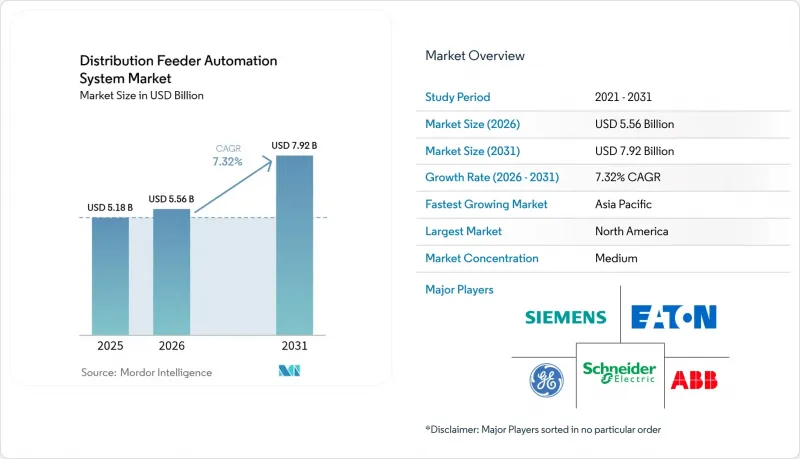
This report is Segmented by Component (Protection Relays and Controllers, Sensors and Intelligent Electronic Devices, Communication Infrastructure, and SCADA/HMI Platforms), Application (Software and Hardware), and Geography (North America, Europe, Asia-Pacific, South America, and Middle East and Africa). The Market Sizes and Forecasts are Provided in Terms of Value (USD).
Global Distribution Feeder Automation System Market Trends and Insights
Rapid Grid-Modernization Mandates
Federal and multilateral programs now channel record sums into grid resilience, providing utilities with budget certainty to invest in distribution feeder automation system projects. The U.S. Grid Resilience State and Tribal Formula Grant program alone disbursed USD 1.3 billion in 2024 to harden distribution networks against extreme weather. European utilities face binding decarbonization targets that require annual distribution spending to double to EUR 67 billion (USD 73.7 billion) by 2050. Early adopters in both regions demonstrate fewer outages and lower operating costs, motivating lagging peers to accelerate procurement. Mandated spending translates into multi-year revenue visibility for suppliers and compresses utilities' deferral options. Hardware vendors that bundle software analytics are more likely to qualify for competitive funding, as regulators increasingly measure reliability outcomes.
Rising Penetration of Distributed Generation (DER)
Solar, wind, and behind-the-meter storage are turning formerly passive distribution circuits into dynamic, two-way networks. California projects USD 4.28 billion in annual utility savings once its Integrated DER Management System scales statewide. The variability of DER output forces utilities to adopt advanced coordination algorithms that conventional automation cannot handle. As a result, software-driven schedulers and real-time optimizers gain traction across the distribution feeder automation system market. Suppliers capable of orchestrating thousands of inverters simultaneously win contracts in solar-rich regions, while hardware-only vendors risk commoditization.
Inter-operability Challenges Across Legacy Protocols
Utilities often operate DNP3, IEC 61850, and proprietary protocols on the same circuit, doubling system-integration spend and slowing deployments. North American grids are most affected because of the historical reliance on DNP3, which complicates migration. Compatibility gaps increase vendor lock-in and hinder the distribution feeder automation system market from reaching full competitive tendering, adding up to 20 months to average project timelines.
Other drivers and restraints analyzed in the detailed report include:
- Ageing Feeder Infrastructure Replacement Cycles
- Utility-Led Digital-Substation Retrofit Programs (OT-IT Convergence)
- High Capex for Rural Feeder Automation
For complete list of drivers and restraints, kindly check the Table Of Contents.
Segment Analysis
The protection relays and controllers accounted for 36.15% of the market size in 2025, while the communication infrastructure is forecast to grow at a 10.6% CAGR through 2031. Utilities are increasingly viewing bandwidth and latency as strategic levers that unlock, which allow utilities to blanket circuits without triggering major capital budget expenditures, thereby leveraging the potential of software applications. Hitachi Energy's private LTE and mesh-radio portfolios illustrate how dedicated networks ensure deterministic performance even during massive outage events. In parallel, 5G pilots by Honeywell and Verizon validate that public networks can securely carry supervisory traffic at scale. The competitive field, therefore, spans telecom carriers, industrial-wireless specialists, and traditional automation OEMs racing to bundle connectivity with edge devices.
Despite sustained relay demand tied to mandatory protection standards, price competition and long replacement cycles cap growth. Sensors and intelligent electronic devices benefit from falling unit costs that let utilities blanket circuits without triggering major capital-budget approvals.
Complete Report Scope:
- By Component
- Protection Relays and Controllers
- Sensors and Intelligent Electronic Devices
- Communication Infrastructure
- SCADA/HMI Platforms
- By Application
- Software
- Hardware
- By Geography
- North America
- United States
- Canada
- Mexico
- Europe
- Germany
- United Kingdom
- France
- Italy
- NORDIC Countries
- Russia
- Rest of Europe
- Asia-Pacific
- China
- India
- Japan
- South Korea
- ASEAN Countries
- Rest of Asia-Pacific
- South America
- Brazil
- Argentina
- Rest of South America
- Middle East and Africa
- Saudi Arabia
- United Arab Emirates
- South Africa
- Egypt
- Rest of Middle East and Africa
- North America
Geography Analysis
North America generated 31.75% of global revenue in 2025, driven by the USD 2.2 billion Grid Resilience and Innovation Partnerships awards, which increased automation expenditures in 18 states. Canadian provinces add momentum through aggressive wildfire-mitigation investments, while Mexico upgrades feeders to accommodate cross-border solar exports. Regulatory frameworks that permit performance-based returns encourage utilities to pilot AI diagnostics and adaptive protection logic earlier than other regions.
The Asia-Pacific represents the fastest-growing distribution feeder automation system market, advancing at a 10.1% CAGR, as China, India, and Japan collectively outspend their developed peers. China's State Grid committed 600 billion yuan (USD 84 billion) in 2024 for ultra-high voltage and distribution intelligence, dwarfing any single-country program. India's USD 478.58 billion power-sector pipeline, along with 1.25 trillion rupees (USD 15 billion) earmarked for smart meters, creates a sustained order volume for at least five years. Meanwhile, Japanese utilities have pledged nearly EUR 1 trillion (USD 1.1 trillion) under the Green Transformation Plan to strengthen networks supporting data center growth. Such scale advantages lower component costs globally.
Europe maintains steady adoption on the back of binding climate directives. The requirement to double annual distribution spending to EUR 67 billion secures demand even if regional economies slow. Projects such as Hitachi Energy's collaboration with TransnetBW in Germany and its € 80 million transformer expansion in Spain underscore supplier confidence. Dynamic Line Rating pilots demonstrate that grids can gain 20-40% extra capacity without requiring new conductors, making advanced sensors an attractive option for cost-constrained regulators.
South America and the Middle East & Africa display emerging potential; however, currency risks and limited sovereign credit profiles slow large-scale rollouts. Localized manufacturing incentives in Brazil and Saudi Arabia aim to cut equipment costs by up to 25%, improving project viability.
- ABB Ltd
- Schneider Electric SE
- Siemens AG
- Eaton Corporation plc
- General Electric Co.
- Schweitzer Engineering Laboratories Inc.
- G&W Electric Company
- Moxa Inc.
- Trilliant Holdings Inc.
- Cisco Systems Inc.
- S&C Electric Company
- Toshiba Energy Systems & Solutions
- Hitachi Energy Ltd.
- Landis+Gyr AG
- Itron Inc.
- Advanced Control Systems (Indra)
- Arteche Group
- NOJA Power Switchgear Pty Ltd
- Mitsubishi Electric Corporation
- Honeywell Process Solutions
Additional Benefits:
- The market estimate (ME) sheet in Excel format
- 3 months of analyst support
TABLE OF CONTENTS
1 Introduction
- 1.1 Study Assumptions & Market Definition
- 1.2 Scope of the Study
2 Research Methodology
3 Executive Summary
4 Market Landscape
- 4.1 Market Overview
- 4.2 Market Drivers
- 4.2.1 Rapid grid-modernization mandates
- 4.2.2 Rising penetration of distributed generation (DER)
- 4.2.3 Ageing feeder infrastructure replacement cycles
- 4.2.4 Utility-led digital-substation retrofit programs (OT-IT convergence)
- 4.2.5 Surge in climate-resilient grid investment funds
- 4.2.6 AI-driven fault-prediction analytics adoption
- 4.3 Market Restraints
- 4.3.1 Inter-operability challenges across legacy protocols
- 4.3.2 High capex for rural feeder automation
- 4.3.3 Cyber-security liability & compliance costs
- 4.3.4 Prolonged utility procurement cycles in developing economies
- 4.4 Supply-Chain Analysis
- 4.5 Regulatory Landscape
- 4.6 Technological Outlook
- 4.7 Porter's Five Forces Analysis
- 4.7.1 Bargaining Power of Suppliers
- 4.7.2 Bargaining Power of Consumers
- 4.7.3 Threat of New Entrants
- 4.7.4 Threat of Substitute Products & Services
- 4.7.5 Intensity of Competitive Rivalry
5 Market Size & Growth Forecasts
- 5.1 By Component
- 5.1.1 Protection Relays and Controllers
- 5.1.2 Sensors and Intelligent Electronic Devices
- 5.1.3 Communication Infrastructure
- 5.1.4 SCADA/HMI Platforms
- 5.2 By Application
- 5.2.1 Software
- 5.2.2 Hardware
- 5.3 By Geography
- 5.3.1 North America
- 5.3.1.1 United States
- 5.3.1.2 Canada
- 5.3.1.3 Mexico
- 5.3.2 Europe
- 5.3.2.1 Germany
- 5.3.2.2 United Kingdom
- 5.3.2.3 France
- 5.3.2.4 Italy
- 5.3.2.5 NORDIC Countries
- 5.3.2.6 Russia
- 5.3.2.7 Rest of Europe
- 5.3.3 Asia-Pacific
- 5.3.3.1 China
- 5.3.3.2 India
- 5.3.3.3 Japan
- 5.3.3.4 South Korea
- 5.3.3.5 ASEAN Countries
- 5.3.3.6 Rest of Asia-Pacific
- 5.3.4 South America
- 5.3.4.1 Brazil
- 5.3.4.2 Argentina
- 5.3.4.3 Rest of South America
- 5.3.5 Middle East and Africa
- 5.3.5.1 Saudi Arabia
- 5.3.5.2 United Arab Emirates
- 5.3.5.3 South Africa
- 5.3.5.4 Egypt
- 5.3.5.5 Rest of Middle East and Africa
- 5.3.1 North America
6 Competitive Landscape
- 6.1 Market Concentration
- 6.2 Strategic Moves (M&A, Partnerships, PPAs)
- 6.3 Market Share Analysis (Market Rank/Share for key companies)
- 6.4 Company Profiles (includes Global level Overview, Market level overview, Core Segments, Financials as available, Strategic Information, Products & Services, and Recent Developments)
- 6.4.1 ABB Ltd
- 6.4.2 Schneider Electric SE
- 6.4.3 Siemens AG
- 6.4.4 Eaton Corporation plc
- 6.4.5 General Electric Co.
- 6.4.6 Schweitzer Engineering Laboratories Inc.
- 6.4.7 G&W Electric Company
- 6.4.8 Moxa Inc.
- 6.4.9 Trilliant Holdings Inc.
- 6.4.10 Cisco Systems Inc.
- 6.4.11 S&C Electric Company
- 6.4.12 Toshiba Energy Systems & Solutions
- 6.4.13 Hitachi Energy Ltd.
- 6.4.14 Landis+Gyr AG
- 6.4.15 Itron Inc.
- 6.4.16 Advanced Control Systems (Indra)
- 6.4.17 Arteche Group
- 6.4.18 NOJA Power Switchgear Pty Ltd
- 6.4.19 Mitsubishi Electric Corporation
- 6.4.20 Honeywell Process Solutions
7 Market Opportunities & Future Outlook
- 7.1 White-space & Unmet-need Assessment

