PUBLISHER: Global Market Insights Inc. | PRODUCT CODE: 2071290

PUBLISHER: Global Market Insights Inc. | PRODUCT CODE: 2071290
Utility Energy as a Service (EaaS) Market Opportunity, Growth Drivers, Industry Trend Analysis, and Forecast 2026 - 2035
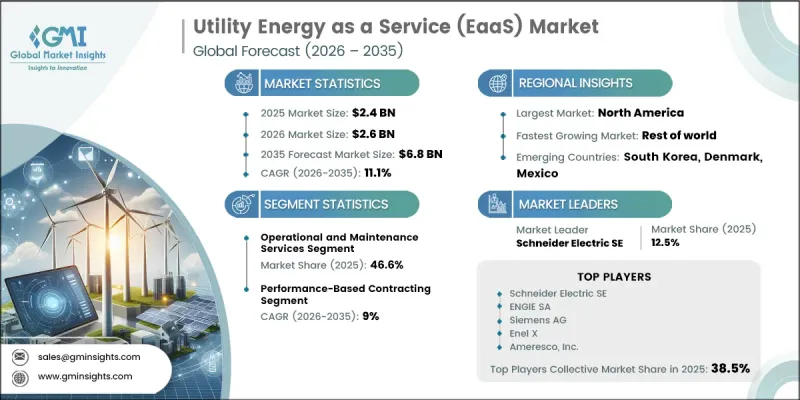
The Global Utility Energy as a Service Market was valued at USD 2.4 billion in 2025 and is estimated to grow at a CAGR of 11.1% to reach USD 6.8 billion by 2035.
Market expansion is driven by the global shift toward sustainable energy consumption, rising emphasis on carbon reduction, and growing adoption of energy-efficient operational models across utility and commercial sectors. Organizations are increasingly turning to EaaS frameworks to reduce upfront capital expenditure while gaining access to advanced energy infrastructure and renewable energy systems. These service-based models are enabling end users to deploy modern energy technologies without significant initial investment, improving affordability and accelerating adoption rates. At the same time, the modernization of aging utility infrastructure is playing a critical role in market growth, as utilities seek more flexible, outsourced, and performance-driven solutions to enhance grid reliability and operational efficiency. The integration of distributed energy resources, smart grids, and battery storage systems is further transforming utility operations. Increasing digitalization across the energy sector, supported by IoT-enabled devices, predictive analytics, and smart metering systems, is improving real-time energy monitoring and system optimization capabilities. These advancements are collectively reshaping utility operations and creating a strong foundation for long-term EaaS adoption across global markets.
| Market Scope | |
|---|---|
| Start Year | 2025 |
| Forecast Year | 2026-2035 |
| Start Value | $2.4 Billion |
| Forecast Value | $6.8 Billion |
| CAGR | 11.1% |
The operations and maintenance services segment held a 46.6% share and is projected to grow at a CAGR of 10.8% through 2035. This segment continues to expand due to rising demand for specialized expertise in managing energy-efficient and renewable energy systems. Service-based operational models help reduce unexpected costs, improve system performance, and ensure continuous energy system reliability, thereby supporting long-term efficiency improvements and cost optimization across utility operations.
The performance-based contracting segment accounted for 37.7% share in 2025 and is expected to grow at a CAGR of 9% through 2035. Growth in this segment is being driven by increasing emphasis on measurable energy savings and efficiency outcomes. Utilities are increasingly adopting contract structures that align service provider compensation with performance outcomes, reducing financial risk while improving operational efficiency. This approach supports better resource utilization and encourages service providers to achieve higher performance standards, strengthening long-term adoption of performance-linked energy service models.
United States Utility Energy as a Service Market held an 83.7% share in 2025 and is projected to generate USD 1.9 billion by 2035. Market growth in the country is supported by increasing regulatory pressure to reduce carbon emissions and accelerate the transition toward renewable energy systems. Rising investments in smart grid infrastructure, advanced energy management systems, and digital utility technologies are further strengthening market expansion. The growing integration of IoT-enabled energy solutions and real-time monitoring systems is improving operational efficiency and enhancing demand for EaaS offerings across utility and commercial sectors.
Major companies operating in the global utility energy as a service (EaaS) market include ABB, Ameresco, Inc., Budderfly, Centrica Business Solutions, ENGIE SA, Enel X, ENFRA, Honeywell International, Jakson Group, Johnson Controls International, Keppel Corporation, Metrus Energy, NextEra Energy Resources, Noresco LLC, Redaptive, Inc., Schneider Electric SE, Siemens AG, Tata Power, Trane Technologies, and Veregy. Companies operating in the utility energy as a service (EaaS) market are focusing on strategic initiatives aimed at strengthening their market position and expanding service capabilities. Key strategies include investing in advanced digital energy platforms that incorporate artificial intelligence, IoT integration, and predictive analytics to improve energy efficiency and system performance. Market participants are also developing integrated service models that combine energy supply, infrastructure management, and maintenance under long-term contractual frameworks. Partnerships with utilities, commercial enterprises, and government bodies are enabling broader deployment of EaaS solutions across multiple sectors.
Table of Contents
Chapter 1 Methodology & Scope
- 1.1 Research design
- 1.2 Quality commitment
- 1.2.1 GMI AI policy & data integrity commitment
- 1.2.1.1 Source consistency protocol
- 1.2.1 GMI AI policy & data integrity commitment
- 1.3 Research trail & confidence scoring
- 1.3.1 Research trail components
- 1.3.2 Scoring components
- 1.4 Data Collection
- 1.4.1 Partial list of primary sources
- 1.5 Data mining sources
- 1.5.1 Paid sources
- 1.5.1.1 Sources, by region
- 1.5.1 Paid sources
- 1.6 Base estimates and calculations
- 1.6.1 Base year calculation for any one approach
- 1.7 Forecast model
- 1.8 Research transparency addendum
- 1.8.1 Source attribution framework
- 1.8.2 Quality assurance metrics
- 1.8.3 Our commitment to trust
- 1.9 Market definitions
Chapter 2 Executive Summary
- 2.1 Industry synopsis, 2022 - 2035
- 2.2 Business trends
- 2.3 Type trends
- 2.4 Business model trends
- 2.5 Regional trends
Chapter 3 Industry Insights
- 3.1 Industry ecosystem
- 3.2 Regulatory landscape
- 3.2.1 North America
- 3.2.2 Europe
- 3.2.3 Asia Pacific
- 3.2.4 Rest of world
- 3.3 Industry impact forces
- 3.3.1 Growth drivers
- 3.3.2 Industry pitfalls & challenges
- 3.4 Growth potential analysis
- 3.5 Porter's analysis
- 3.5.1 Bargaining power of suppliers
- 3.5.2 Bargaining power of buyers
- 3.5.3 Threat of new entrants
- 3.5.4 Threat of substitutes
- 3.6 PESTEL analysis
- 3.6.1 Political factors
- 3.6.2 Economic factors
- 3.6.3 Social factors
- 3.6.4 Technological factors
- 3.6.5 Legal factors
- 3.6.6 Environmental factors
- 3.7 Cost structure analysis of utility energy as a service
- 3.8 Impact of AI & Generative AI on the market (Driven by Primary Research)
- 3.8.1 AI-Driven disruption of existing business models (Driven by Primary Research)
- 3.8.2 GenAI use cases & adoption roadmap by segment (Driven by Primary Research)
- 3.8.3 Risks, limitations & regulatory considerations (Driven by Primary Research)
- 3.9 Emerging opportunities & trends
- 3.10 Digitalization & IoT integration
- 3.11 Investment analysis & future outlook
Chapter 4 Competitive landscape, 2026
- 4.1 Introduction
- 4.2 Company market share analysis, by region, 2025
- 4.2.1 North America
- 4.2.2 Europe
- 4.2.3 Asia Pacific
- 4.2.4 Rest of world
- 4.3 Competitive analysis of major market players
- 4.4 Competitive positioning matrix
- 4.5 Key developments
- 4.5.1 Mergers & acquisitions
- 4.5.2 Partnerships & collaborations
- 4.5.3 New product launches
- 4.5.4 Expansion plans & funding
- 4.6 Company tier benchmarking
- 4.6.1 Tier classification criteria & qualifying thresholds
- 4.6.2 Tier positioning matrix by revenue, geography & innovation
Chapter 5 Market Size and Forecast, By Type, 2022 - 2035 (USD Billion)
- 5.1 Key trends
- 5.2 Energy supply service
- 5.3 Operational and maintenance services
- 5.4 Energy efficiency and optimization services
Chapter 6 Market Size and Forecast, By Business model, 2022 - 2035 (USD Billion)
- 6.1 Key trends
- 6.2 Power purchase agreement model
- 6.3 Subscription-based model
- 6.4 Performance-based contracting
- 6.5 Others
Chapter 7 Market Size and Forecast, By Region, 2022 - 2035 (USD Billion)
- 7.1 Key trends
- 7.2 North America
- 7.2.1 U.S.
- 7.2.2 Canada
- 7.2.3 Mexico
- 7.3 Europe
- 7.3.1 Germany
- 7.3.2 Italy
- 7.3.3 UK
- 7.3.4 France
- 7.3.5 Denmark
- 7.4 Asia Pacific
- 7.4.1 China
- 7.4.2 South Korea
- 7.4.3 India
- 7.4.4 Japan
- 7.5 Rest of World
Chapter 8 Company Profiles
- 8.1 ABB
- 8.2 Ameresco, Inc.
- 8.3 Budderfly
- 8.4 Centrica Business Solutions
- 8.5 ENGIE SA
- 8.6 Enel X
- 8.7 ENFRA
- 8.8 Honeywell International
- 8.9 Jakson Group
- 8.10 Johnson Controls International
- 8.11 Keppel Corporation
- 8.12 Metrus Energy
- 8.13 NextEra Energy Resources
- 8.14 Noresco LLC
- 8.15 Redaptive, Inc.
- 8.16 Schneider Electric SE
- 8.17 Siemens AG
- 8.18 Tata Power
- 8.19 Trane Technologies
- 8.20 Veregy

