PUBLISHER: Global Market Insights Inc. | PRODUCT CODE: 2071295

PUBLISHER: Global Market Insights Inc. | PRODUCT CODE: 2071295
Modular Fitness Furniture Market Opportunity, Growth Drivers, Industry Trend Analysis, and Forecast 2026 - 2035
The Global Modular Fitness Furniture Market was valued at USD 2.4 billion in 2025 and is estimated to grow at a CAGR of 8.3% to reach USD 5.5 billion by 2035.
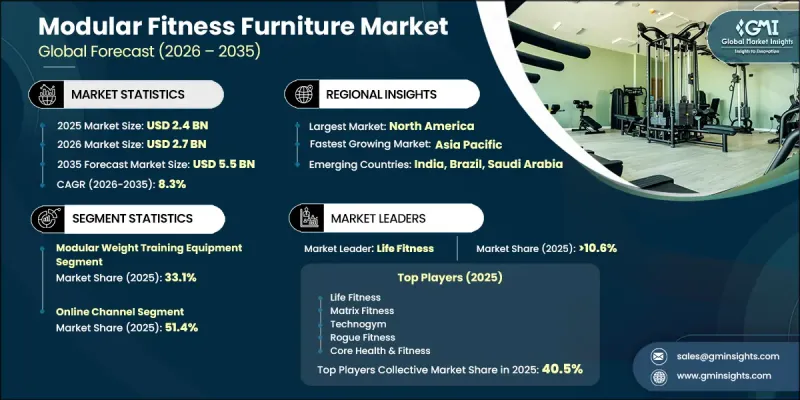
Market growth is driven by the increasing adoption of home-based fitness routines, rising space constraints in urban housing, and a broader shift in consumer spending toward wellness-focused lifestyle products. Demand is further strengthened by long-term behavioral changes in fitness habits, where home exercise has become a permanent component of modern living rather than a temporary trend. Hybrid work models have reinforced this transition by increasing time spent at home and encouraging investment in residential fitness infrastructure. Consumers are increasingly combining home-based workout systems with gym memberships, creating sustained demand for modular and space-efficient fitness furniture solutions. Premiumization trends are also shaping the market, as users prefer customizable, multifunctional, and design-integrated fitness setups that fit within compact living spaces. As a result, modular fitness furniture is evolving into a mainstream wellness category that integrates functionality, aesthetics, and flexibility for modern households across global urban markets.
| Market Scope | |
|---|---|
| Start Year | 2025 |
| Forecast Year | 2026-2035 |
| Start Value | $2.4 Billion |
| Forecast Value | $5.5 Billion |
| CAGR | 8.3% |
Modular weight training equipment accounted for a share of 33.1% in 2025 and is projected to grow at a CAGR of 7.2% through 2035. This segment leads due to the strong emphasis on strength training within home fitness adoption. Consumers increasingly prioritize compact yet versatile weight systems that allow progressive training within limited residential space. Demand remains concentrated around integrated strength solutions that combine durability, adaptability, and multi-functionality for long-term home use.
The online distribution channel held a share of 51.4% share in 2025 and is expected to grow at a CAGR of 10.4% through 2035. Growth in this channel is driven by the convenience of direct purchasing, wider product accessibility, and the increasing preference for digital-first shopping experiences. Online platforms enable brands to engage directly with consumers, streamline pricing structures, and offer personalized product configurations. This channel continues to benefit from rising digital adoption and the growing influence of e-commerce-driven fitness retail ecosystems.
North America accounted for 40.9% of global modular fitness furniture revenue in 2025 and is projected to grow at a CAGR of 7.1% over the forecast period. The United States remains the primary contributor within the region, supported by strong consumer purchasing power and widespread adoption of home fitness systems. The continued prevalence of hybrid work arrangements has reinforced investment in residential workout infrastructure. Growing awareness of health and wellness, combined with lifestyle-oriented fitness consumption patterns, continues to support sustained regional demand.
Key companies operating in the global modular fitness furniture market include Life Fitness, Peloton, Matrix Fitness, Force USA, Eleiko, HOIST Fitness, Core Health & Fitness, Inspire Fitness, BodyCraft, Escape Fitness, Panatta, Major Fitness, and Bells of Steel. Companies in the modular fitness furniture market are focusing on product innovation, modular design flexibility, and digital integration to strengthen their competitive position. Manufacturers are developing compact, multifunctional systems that combine strength training, storage efficiency, and aesthetic adaptability for modern residential spaces. Expansion of direct-to-consumer sales channels is enabling stronger customer engagement and improved pricing control. Brands are also investing in premium materials and ergonomic engineering to enhance product durability and user experience. Strategic partnerships with fitness influencers and digital training platforms are supporting brand visibility and consumer acquisition.
Table of Contents
Chapter 1 Methodology & Scope
- 1.1 Research approach
- 1.2 Quality Commitments
- 1.2.1 GMI AI policy & data integrity commitment
- 1.2.1.1 Source consistency protocol
- 1.2.1 GMI AI policy & data integrity commitment
- 1.3 Research Trail & Confidence Scoring
- 1.3.1 Research Trail Components
- 1.3.2 Scoring Components
- 1.4 Data Collection
- 1.4.1 Partial list of primary sources
- 1.5 Data mining sources
- 1.5.1 Paid sources
- 1.5.1.1 Sources, by region
- 1.5.1 Paid sources
- 1.6 Base estimates and calculations
- 1.6.1 Base year calculation for any one approach
- 1.7 Forecast model
- 1.7.1 Quantified market impact analysis
- 1.7.1.1 Mathematical impact of growth parameters on forecast
- 1.7.1 Quantified market impact analysis
- 1.8 Research transparency addendum
- 1.8.1 Source attribution framework
- 1.8.2 Quality assurance metrics
- 1.8.2.1 Our commitment to trust
Chapter 2 Executive Summary
- 2.1 Industry 360° synopsis, 2022 - 2035
- 2.2 Key market trends
- 2.2.1 Region
- 2.2.2 By product type
- 2.2.3 By material
- 2.2.4 By price
- 2.2.5 By end use
- 2.2.6 By distribution channel
Chapter 3 Industry Insights
- 3.1 Industry ecosystem analysis
- 3.1.1 Supplier landscape
- 3.1.2 Profit margin
- 3.1.3 Value addition at each stage
- 3.1.4 Factor affecting the value chain
- 3.2 Industry impact forces
- 3.2.1 Growth drivers
- 3.2.1.1 Rising demand for home fitness solutions post-pandemic
- 3.2.1.2 Growing urbanization & space constraints driving compact furniture demand
- 3.2.1.3 Increased consumer spending on health & wellness
- 3.2.1.4 Proliferation of hybrid work models fueling home gym investments
- 3.2.2 Industry pitfalls & challenges
- 3.2.2.1 Intense price competition from low-cost generic manufacturers
- 3.2.2.2 Supply chain disruptions affecting raw material availability
- 3.2.3 Opportunities
- 3.2.3.1 Expansion into commercial fitness & corporate wellness segment
- 3.2.3.2 Integration of smart technology & connected fitness features
- 3.2.1 Growth drivers
- 3.3 Growth potential analysis
- 3.4 Regulatory framework
- 3.4.1 Standards & compliance requirements
- 3.4.2 Regional regulatory frameworks
- 3.4.3 Certification standards
- 3.5 Major market trends and disruptions
- 3.6 Technology/innovation landscape
- 3.6.1 Current trends
- 3.6.2 Emerging trends
- 3.7 Pricing Analysis (driven by primary research)
- 3.7.1 Historical price trend analysis (driven by primary research)
- 3.7.2 Pricing strategy by player type (premium / value / cost- plus) (driven by primary research)
- 3.8 Future market trends
- 3.9 Trade data analysis (driven by paid database) (HS Code- 9403)
- 3.9.1 Import/export volume & value trends (driven by primary research)
- 3.9.2 Key trade corridors & tariff impact (driven by primary research)
- 3.10 Impact of AI & Generative AI on the Market
- 3.10.1 AI- driven disruption of existing business models
- 3.10.2 Gen- AI use cases & adoption roadmap by segment
- 3.10.3 Risks, limitations & regulatory considerations
- 3.11 Porter's analysis
- 3.12 PESTEL analysis
- 3.13 Distribution infrastructure & channel penetration landscape (driven by primary research)
- 3.13.1 Channel coverage by region & format (modern vs. Traditional trade) (driven by primary research)
- 3.13.2 Last- mile infrastructure gaps & emerging channel shifts (driven by primary research)
- 3.14 Consumer behavior analysis
- 3.14.1 Purchasing patterns
- 3.14.2 Preference analysis
- 3.14.3 Regional variations in consumer behavior
- 3.14.4 Impact of e- commerce on buying decisions
Chapter 4 Competitive Landscape, 2025
- 4.1 Introduction
- 4.2 Company market share analysis
- 4.2.1 By Region
- 4.2.1.1 North America
- 4.2.1.2 Europe
- 4.2.1.3 Asia Pacific
- 4.2.1.4 Latin America
- 4.2.1.5 Middle East and Africa
- 4.2.1 By Region
- 4.3 Company matrix analysis
- 4.4 Competitive analysis of major market players
- 4.5 Competitive positioning matrix
- 4.6 Key developments
- 4.6.1 Mergers & acquisitions
- 4.6.2 Partnerships & collaborations
- 4.6.3 New product launches
- 4.6.4 Expansion plans
Chapter 5 Market Estimates & Forecast, By Product Type, 2022 - 2035 (USD Billion, Thousand Units)
- 5.1 Key trends
- 5.2 Modular weight training equipment
- 5.2.1 Modular racks & power cages
- 5.2.2 Adjustable bench systems
- 5.2.3 Cable & pulley modular units
- 5.3 Adaptable home gym stations
- 5.3.1 All-in-one configurable home gym systems
- 5.3.2 Wall-mounted adaptable stations
- 5.4 Transformable cardio furniture
- 5.4.1 Convertible treadmill desks & cycling furniture
- 5.4.2 Foldable rowing & elliptical furniture
- 5.5 Multi-purpose fitness platforms
- 5.5.1 Bodyweight training platforms
- 5.5.2 Mixed-modality base structures (HILT, yoga, Pilates)
- 5.6 Compact exercise furniture
- 5.7 Others
Chapter 6 Market Estimates & Forecast, By Material, 2022 - 2035 (USD Billion, Thousand Units)
- 6.1 Key trends
- 6.2 Wood
- 6.3 Metal
- 6.4 Plastic
- 6.5 Composite materials
Chapter 7 Market Estimates & Forecast, By Price, 2022 - 2035 (USD Billion, Thousand Units)
- 7.1 Key trends
- 7.2 Low
- 7.3 Medium
- 7.4 High
Chapter 8 Market Estimates & Forecast, By End use, 2022 - 2035 (USD Billion, Thousand Units)
- 8.1 Key trends
- 8.2 Residential
- 8.3 Commercial (gyms, fitness studios, offices)
Chapter 9 Market Estimates & Forecast, By Distribution Channel, 2022 - 2035 (USD Billion, Thousand Units)
- 9.1 Key trends
- 9.2 Online
- 9.2.1 E- commerce
- 9.2.2 Company websites
- 9.3 Offline
- 9.3.1 Supermarkets/hypermarket
- 9.3.2 Specialty retail stores
- 9.3.3 Others (independent retailer etc.)
Chapter 10 Market Estimates & Forecast, By Region, 2022 - 2035, (USD Billion) (Thousand Units)
- 10.1 Key trends
- 10.2 North America
- 10.2.1 U.S.
- 10.2.2 Canada
- 10.3 Europe
- 10.3.1 Germany
- 10.3.2 U.K.
- 10.3.3 France
- 10.3.4 Italy
- 10.3.5 Spain
- 10.4 Asia Pacific
- 10.4.1 China
- 10.4.2 India
- 10.4.3 Japan
- 10.4.4 South Korea
- 10.4.5 Australia
- 10.5 Latin America
- 10.5.1 Brazil
- 10.5.2 Mexico
- 10.5.3 Argentina
- 10.6 MEA
- 10.6.1 UAE
- 10.6.2 Saudi Arabia
- 10.6.3 South Africa
Chapter 11 Company Profiles
- 11.1 Global Companies
- 11.1.1 Core Health & Fitness
- 11.1.1.1 Business Overview
- 11.1.1.2 Financial Data
- 11.1.1.3 Product Landscape
- 11.1.1.4 Strategic Outlook
- 11.1.1.5 SWOT Analysis
- 11.1.2 Eleiko
- 11.1.3 Life Fitness
- 11.1.4 Matrix Fitness
- 11.1.5 Peloton
- 11.1.6 Rogue Fitness
- 11.1.7 Technogym
- 11.1.1 Core Health & Fitness
- 11.2 Regional Champions
- 11.2.1 BodyCraft
- 11.2.2 Escape Fitness
- 11.2.3 HOIST Fitness Systems
- 11.2.4 Inspire Fitness
- 11.2.5 Panatta
- 11.2.6 Power Lift
- 11.2.7 YR Fitness
- 11.3 Emerging Players
- 11.3.1 Bells of Steel
- 11.3.2 Force USA
- 11.3.3 Major Fitness
- 11.3.4 PRx Performance
- 11.3.5 REP Fitness
- 11.3.6 Titan Fitness
- 11.3.7 Torque Fitness

