PUBLISHER: Global Market Insights Inc. | PRODUCT CODE: 2071312

PUBLISHER: Global Market Insights Inc. | PRODUCT CODE: 2071312
Faucets Market Opportunity, Growth Drivers, Industry Trend Analysis, and Forecast 2026 - 2035
The Global Faucets Market was valued at USD 14.7 billion in 2025 and is estimated to grow at a CAGR of 7.2% to reach USD 28.9 billion by 2035.
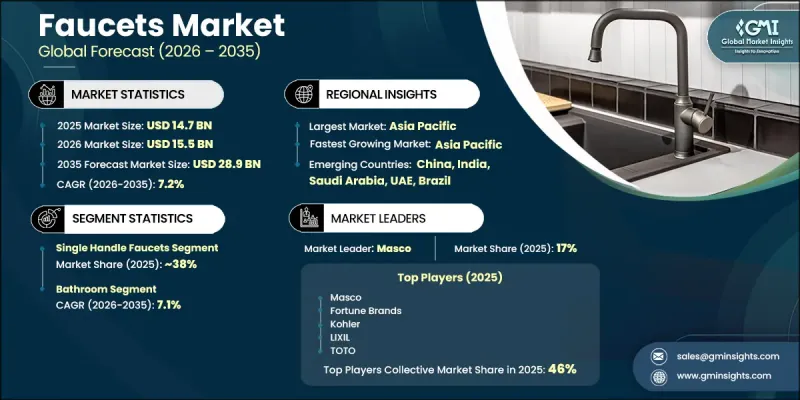
Market expansion is being supported by a combination of long-term growth drivers, including rapid urban development in emerging economies, sustained remodeling activity across mature housing markets, increasing consumer spending on premium kitchen and bathroom upgrades, and rising compliance requirements related to water conservation and efficiency standards. A notable trend shaping industry performance is the increasing shift toward higher-value product categories. Consumers are showing stronger preference for technologically advanced and premium faucet solutions, resulting in a steady increase in average selling prices across residential and commercial applications. On the manufacturing side, Asia Pacific remains the leading production hub, supported by expanding industrial capabilities and growing domestic demand. Increasing investments in organized manufacturing infrastructure and modernization initiatives continue to strengthen regional production capacity while supporting both domestic consumption and international trade activities.
| Market Scope | |
|---|---|
| Start Year | 2025 |
| Forecast Year | 2026-2035 |
| Start Value | $14.7 Billion |
| Forecast Value | $28.9 Billion |
| CAGR | 7.2% |
The single-handle faucets segment held a 38% share in 2025. Their strong market position is attributed to ease of operation, space-efficient design, and compatibility with a wide range of plumbing systems. The ability to control water temperature and flow through a single mechanism continues to make these products highly attractive across residential and commercial installations. Furthermore, manufacturers offer single-handle models across diverse pricing tiers, enabling widespread adoption among both budget-conscious and premium consumers.
The bathroom faucets segment is projected to grow at a CAGR of 7.1% through 2035. The segment benefits from consistent demand generated by both new construction projects and renovation activities. Every residential and commercial property requires bathroom fixture installations, while recurring replacement demand is supported by changing consumer preferences, modernization initiatives, and the need to improve water efficiency. As homeowners increasingly invest in enhancing interior aesthetics and functionality, bathroom faucet upgrades continue to remain a significant source of market revenue.
North America Faucets Market accounted for 29% share in 2025 and is expected to grow at a CAGR of 7.1% through 2035. Regional growth is primarily supported by a strong home renovation and remodeling culture, particularly in kitchen and bathroom improvement projects. Consumers continue to prioritize investments that enhance property value, functionality, and visual appeal, creating favorable conditions for faucet replacement and upgrade activities. Ongoing residential improvement spending and demand for modern plumbing fixtures are expected to sustain market growth across the region through 2035.
Major companies operating in the global faucets market include LIXIL Corporation, TOTO Ltd., Kohler Co., Hansgrohe SE, Masco Corporation, Roca Sanitario S.A., Fortune Brands Innovations, Arrow Home Group, and Bravat. Companies operating in the faucets market are focusing on product innovation, premiumization, and geographic expansion to strengthen their competitive position. Manufacturers are investing heavily in smart faucet technologies, touchless functionality, water-saving features, and connected solutions that align with evolving consumer preferences and sustainability goals. Product portfolio diversification remains a key strategy, enabling companies to address residential, commercial, and luxury market segments simultaneously. Many industry participants are also expanding manufacturing capabilities and strengthening supply chain networks to improve operational efficiency and meet growing global demand.
Table of Contents
Chapter 1 Methodology and scope
- 1.1 Research approach
- 1.2 Quality Commitments
- 1.2.1 GMI AI policy & data integrity commitment
- 1.2.1.1 Source consistency protocol
- 1.2.1 GMI AI policy & data integrity commitment
- 1.3 Research Trail & Confidence Scoring
- 1.3.1 Research Trail Components
- 1.3.2 Scoring Components
- 1.4 Data Collection
- 1.4.1 Partial list of primary sources
- 1.5 Data mining sources
- 1.5.1 Paid sources
- 1.5.1.1 Sources, by region
- 1.5.1 Paid sources
- 1.6 Base estimates and calculations
- 1.6.1 Base year calculation for any one approach
- 1.7 Forecast model
- 1.7.1 Quantified market impact analysis
- 1.7.1.1 Mathematical impact of growth parameters on forecast
- 1.7.1 Quantified market impact analysis
- 1.8 Research transparency addendum
- 1.8.1 Source attribution framework
- 1.8.2 Quality assurance metrics
- 1.8.3 Our commitment to trust
Chapter 2 Executive summary
- 2.1 Industry 360° synopsis
- 2.2 Key market trends
- 2.2.1 Regional
- 2.2.2 Product type
- 2.2.3 Valve mechanism
- 2.2.4 Technology
- 2.2.5 Application
- 2.2.6 Price range
- 2.2.7 End users
- 2.2.8 Distribution channel
Chapter 3 Industry insights
- 3.1 Industry ecosystem analysis
- 3.1.1 Supplier landscape
- 3.1.2 Profit margin
- 3.1.3 Value addition at each stage
- 3.1.4 Factor affecting the value chain
- 3.1.5 Disruptions
- 3.2 Industry impact forces
- 3.2.1 Growth drivers
- 3.2.2 Industry pitfalls & challenges
- 3.2.3 Opportunities
- 3.3 Growth potential analysis
- 3.4 Price trends
- 3.4.1 Historical price trend analysis
- 3.4.2 Pricing strategy by player type
- 3.5 Regulatory framework
- 3.5.1 US Regulations: WaterSense Program, Lead-Free Mandates (Safe Drinking Water Act)
- 3.5.2 European Regulations: EU Construction Products Regulation, REACH (Hexavalent Chromium)
- 3.5.3 Asia Pacific Regulations: BIS (India), China GB Standards, Japan JIS
- 3.5.4 Water Efficiency Standards & Certifications by Region (WaterSense, WELS, WRAS, EU Ecolabel)
- 3.5.5 Building Codes & Plumbing Standards Impact on Product Design (IPC, UPC, EN 817)
- 3.6 Porter's five forces analysis
- 3.7 PESTEL analysis
- 3.8 Trade data analysis (based on paid database) (HS Code: 8481.80)
- 3.8.1 Import/export volume & value trends
- 3.8.2 Key trade corridors & tariff impact
- 3.9 Impact of AI & generative AI on the market
- 3.9.1 AI-driven disruption of traditional business models
- 3.9.2 GenAI use cases & adoption roadmap by customer segment
- 3.9.3 Risks, limitations & regulatory considerations
- 3.10 Future market trends
- 3.11 Technology and innovation landscape
- 3.11.1 Current technological trends
- 3.11.2 Emerging technologies
- 3.12 Consumer behavior analysis
- 3.12.1 Purchasing patterns
- 3.12.2 Preference analysis
- 3.12.3 Regional variations in consumer behavior
- 3.12.4 Impact of e-commerce on buying decisions
Chapter 4 Competitive landscape, 2025
- 4.1 Introduction
- 4.2 Company market share analysis
- 4.2.1 North America
- 4.2.2 Europe
- 4.2.3 Asia Pacific
- 4.2.4 Latin America
- 4.2.5 MEA
- 4.3 Company matrix analysis
- 4.4 Competitive analysis of major market players
- 4.5 Competitive positioning matrix
- 4.6 Key developments
- 4.6.1 Mergers & acquisitions
- 4.6.2 Partnerships & collaborations
- 4.6.3 New product launches
- 4.6.4 Expansion plans
Chapter 5 Market Estimates & Forecast, By Product Type, 2022 - 2035 ($Billion, Thousand Units)
- 5.1 Key trends
- 5.2 Single handle faucets
- 5.2.1 Single hole
- 5.2.2 Center set
- 5.3 Double handle faucets
- 5.3.1 Widespread
- 5.3.2 Mini widespread
- 5.3.3 Bridge style
- 5.4 Pull-down faucets
- 5.5 Pull-out faucets
- 5.6 Others (pot filler faucets etc.)
Chapter 6 Market Estimates & Forecast, By Valve Mechanism, 2022 - 2035 ($Billion, Thousand Units)
- 6.1 Key trends
- 6.2 Ball faucets
- 6.3 Ceramic disc faucets
- 6.4 Cartridge faucets
- 6.5 Compression faucets
Chapter 7 Market Estimates & Forecast, By Technology, 2022 - 2035 ($Billion, Thousand Units)
- 7.1 Key trends
- 7.2 Manual faucets
- 7.3 Electronic/automatic faucets
- 7.3.1 Sensor/infrared-activated (touchless) faucets
- 7.3.2 Touch-activated faucets
- 7.3.3 Voice-activated faucets
Chapter 8 Market Estimates & Forecast, By Application, 2022 - 2035 ($Billion, Thousand Units)
- 8.1 Key trends
- 8.2 Kitchen
- 8.3 Bathroom
- 8.4 Others (utility/laundry room etc.)
Chapter 9 Market Estimates & Forecast, By Price Range, 2022 - 2035 ($Billion, Thousand Units)
- 9.1 Key trends
- 9.2 Low (under US$ 50)
- 9.3 Medium (US$ 50 - US$ 199)
- 9.4 High (US$ 200 - US$ 499)
- 9.5 Premium (US$ 500 and above)
Chapter 10 Market Estimates & Forecast, By End Users, 2022 - 2035 ($Billion, Thousand Units)
- 10.1 Key trends
- 10.2 Residential
- 10.3 Commercial
- 10.3.1 Hospitality
- 10.3.2 Healthcare
- 10.3.3 Office & corporate buildings
- 10.3.4 Retail & food service establishments
- 10.3.5 Educational institutions
- 10.4 Industrial
Chapter 11 Market Estimates & Forecast, By Distribution Channel, 2022 - 2035 ($Billion, Thousand Units)
- 11.1 Key trends
- 11.2 Online
- 11.2.1 E-commerce
- 11.2.2 Company websites
- 11.3 Offline
- 11.3.1 Supermarkets/hypermarket
- 11.3.2 Specialty retail stores
- 11.3.3 Others (independent retailers, etc.)
Chapter 12 Market Estimates & Forecast, By Region, 2022 - 2035 ($Billion, Thousand Units)
- 12.1 Key trends
- 12.2 North America
- 12.2.1 U.S.
- 12.2.2 Canada
- 12.3 Europe
- 12.3.1 Germany
- 12.3.2 UK
- 12.3.3 France
- 12.3.4 Spain
- 12.3.5 Italy
- 12.3.6 Netherlands
- 12.4 Asia Pacific
- 12.4.1 China
- 12.4.2 Japan
- 12.4.3 India
- 12.4.4 Australia
- 12.4.5 South Korea
- 12.5 Latin America
- 12.5.1 Brazil
- 12.5.2 Mexico
- 12.5.3 Argentina
- 12.6 MEA
- 12.6.1 South Africa
- 12.6.2 Saudi Arabia
- 12.6.3 UAE
Chapter 13 Company Profiles
- 13.1 Global Key Players
- 13.1.1 Fortune Brands
- 13.1.2 Hansgrohe
- 13.1.3 Kohler
- 13.1.4 LIXIL
- 13.1.5 Masco
- 13.1.6 Roca
- 13.1.7 TOTO
- 13.2 Regional Players
- 13.2.1 Arrow Home Group
- 13.2.2 Cera Sanitaryware
- 13.2.3 FM Mattsson
- 13.2.4 Helvex
- 13.2.5 Huida
- 13.2.6 Jaquar
- 13.2.7 JOMOO Kitchen & Bath
- 13.3 Emerging/Niche Specialists
- 13.3.1 Bravat
- 13.3.2 Chicago Faucets
- 13.3.3 Gessi
- 13.3.4 Sloan Valve
- 13.3.5 T&S Brass and Bronze Works
- 13.3.6 THG Paris
- 13.3.7 Zucchetti Rubinetteria

