
PUBLISHER: Global Market Insights Inc. | PRODUCT CODE: 2071323

PUBLISHER: Global Market Insights Inc. | PRODUCT CODE: 2071323
Ink Cartridge Printer Market Opportunity, Growth Drivers, Industry Trend Analysis, and Forecast 2026 - 2035
The Global Ink Cartridge Printer Market was valued at USD 20.6 billion in 2025 and is estimated to grow at a CAGR of 5.2% to reach USD 33.8 billion by 2035.
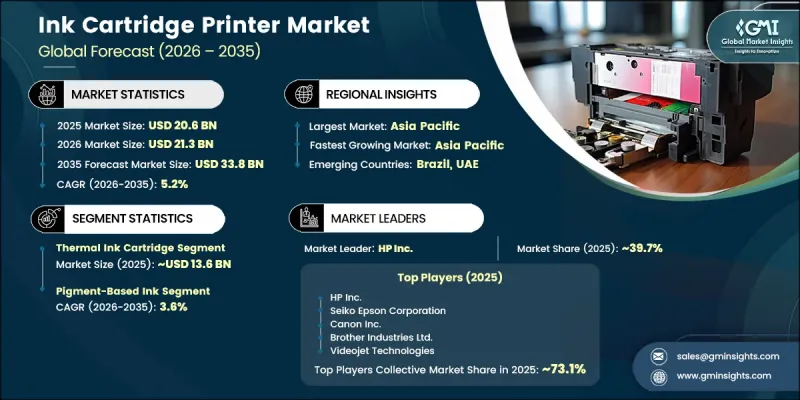
The market is witnessing growth driven by increasing demand for reliable and high-quality printing solutions across corporate offices, educational environments, industrial operations, and commercial facilities. The growing adoption of inkjet printing technologies for document production, visual graphics, signage, and coding and marking applications is significantly boosting global demand. Businesses are increasingly prioritizing cost-effective, high-speed, and efficient printing systems to support day-to-day operations. Expansion in e-commerce activities is also contributing to the rising demand for packaging labels, product identification, and customized branding solutions. Industries across logistics, retail, and manufacturing are integrating advanced printing technologies for barcode generation, shipping documentation, and packaging workflows. In addition, digital transformation across packaging and industrial sectors is strengthening the need for modern ink cartridge-based printing systems. Continuous advancements in printing technologies such as piezoelectric mechanisms, wireless connectivity, and UV-curable ink solutions are improving print accuracy, operational efficiency, and compatibility with diverse substrates. Manufacturers are focusing on developing energy-efficient printers with improved color precision, faster output rates, and optimized ink usage to enhance product competitiveness. The increasing use of industrial textile printing and specialty printing applications is further supporting sustained market expansion.
| Market Scope | |
|---|---|
| Start Year | 2025 |
| Forecast Year | 2026-2035 |
| Start Value | $20.6 Billion |
| Forecast Value | $33.8 Billion |
| CAGR | 5.2% |
The ink cartridge printer market is experiencing notable transformation due to rising integration of advanced printing technologies across multiple end-use industries. The growing demand for automated and high-performance printing systems is encouraging manufacturers to enhance product innovation and operational efficiency. The shift toward digital printing solutions is enabling faster production cycles, reduced waste, and improved customization capabilities. Businesses are increasingly investing in modern printing infrastructure to improve productivity and reduce operational costs. Technological progress in connectivity and printhead design is further strengthening product performance and reliability. These developments are collectively supporting long-term market growth across global regions.
The thermal ink cartridge segment generated USD 13.6 billion in 2025 and is expected to grow at a CAGR of 4.5% from 2026 to 2035. This segment holds a dominant position in the market due to its widespread use in home printing, office environments, and commercial operations. Thermal ink cartridge printers are widely preferred for their affordability, fast output capabilities, compact structure, and suitability for large-volume printing tasks. Strong adoption across educational institutions, small businesses, and remote working environments continues to support the steady growth of this segment globally.
The pigment-based ink segment held a share of 39.9% in 2025 and is projected to grow at a CAGR of 3.6% from 2026 to 2035. This segment maintains its dominance due to its excellent durability, resistance to water, and long-lasting color performance in demanding printing applications. Pigment-based inks are extensively used in office documentation, packaging, professional graphics, and high-quality photo printing, where fade resistance and clarity are essential. Increasing demand for long-lasting and archival-grade printing solutions is further reinforcing the adoption of pigment-based ink technologies across commercial and industrial applications.
China Ink Cartridge Printer Market generated USD 3.5 billion in 2025 and is expected to grow at a CAGR of 9.4% from 2026 to 2035. Market growth in the country is supported by a strong manufacturing base, rapid expansion of packaging and logistics operations, and rising demand for advanced printing technologies. Increasing use of digital printing solutions across industrial coding, textile production, and packaging applications is further accelerating market development. Growth in smart office infrastructure, coupled with expanding e-commerce and labeling industries, is strengthening the adoption of modern printing systems. Rising investments in UV-curable and piezoelectric printing technologies are also contributing to improved efficiency and product innovation across the country.
Key companies operating in the Global Ink Cartridge Printer Market include HP Inc., Canon Inc., Seiko Epson Corporation, Brother Industries Ltd., Xerox Corporation, Ricoh Company Ltd., Fujifilm Holdings Corporation, Konica Minolta Inc., Kyocera Corporation, Pantum International Group, Roland DG Corporation, Mutoh Industries Ltd., SCREEN Graphic Solutions Co., Ltd., Mimaki Engineering Co., Ltd., EFI (Electronics For Imaging), Durst Group, Domino Printing Sciences, Videojet Technologies, Swissqprint, Agfa Graphics, and Kornit Digital. Companies operating in the ink cartridge printer market are focusing on strengthening their competitive position through continuous innovation, technological advancement, and strategic expansion initiatives. Investment in research and development is enabling manufacturers to introduce high-performance printers with improved speed, precision, and energy efficiency. The adoption of advanced connectivity features such as wireless integration and cloud-based printing solutions is enhancing operational convenience and workflow efficiency. Manufacturers are also emphasizing sustainable printing technologies that reduce ink consumption and environmental impact. Expanding product portfolios to cater to diverse commercial, industrial, and specialty printing applications is further supporting market competitiveness. Strategic partnerships with distributors and technology providers are helping companies expand their global reach and improve customer accessibility.
Table of Contents
Chapter 1 Methodology & Scope
- 1.1 Market scope and definition
- 1.2 Research design
- 1.2.1 Research approach
- 1.2.2 Data collection methods
- 1.3 Data mining sources
- 1.3.1 Global
- 1.3.2 Regional/Country
- 1.4 Base estimates and calculations
- 1.4.1 Base year calculation
- 1.4.2 Key trends for market estimation
- 1.5 Primary research and validation
- 1.5.1 Primary sources
- 1.6 Forecast model
- 1.7 Research assumptions and limitations
Chapter 2 Executive Summary
- 2.1 Industry 360° synopsis
- 2.2 Key market trends
- 2.2.1 Regional
- 2.2.2 Product type
- 2.2.3 Ink formulation
- 2.2.4 Application
- 2.2.5 End user
- 2.2.6 Distribution channel
Chapter 3 Industry Insights
- 3.1 Industry ecosystem analysis
- 3.1.1 Supplier landscape
- 3.1.2 Profit margin
- 3.1.3 Value addition at each stage
- 3.1.4 Factor affecting the value chain
- 3.2 Industry impact forces
- 3.2.1 Growth drivers
- 3.2.1.1 Rising demand for office document printing and commercial printing solutions
- 3.2.1.2 Growth in packaging, labeling, and coding applications
- 3.2.1.3 Increasing adoption of UV-curable and piezoelectric printing technologies
- 3.2.2 Pitfalls & Challenges
- 3.2.2.1 Rising competition from laser printers and digital paperless workflows
- 3.2.2.2 High operational and cartridge replacement costs
- 3.2.3 Opportunities
- 3.2.3.1 Growing demand for textile and specialty printing applications
- 3.2.3.2 Expansion of wireless, smart, and energy-efficient printing systems
- 3.2.1 Growth drivers
- 3.3 Growth potential analysis
- 3.4 Future market trends
- 3.5 Technology and innovation landscape
- 3.5.1 Current technological trends
- 3.5.2 Emerging technologies
- 3.6 Regulatory landscape
- 3.6.1 Standards and compliance requirements
- 3.6.2 Regional regulatory frameworks
- 3.6.3 Certification standards
- 3.7 Porter's analysis
- 3.7.1 PESTEL analysis
- 3.7.2 Pricing analysis (driven by primary research)
- 3.7.3 Historical price trend analysis (driven by primary research)
- 3.7.4 Pricing strategy by player type (OEM premium vs aftermarket value) (driven by primary research)
- 3.7.5 Price-to-print cost economics
- 3.8 Trade data analysis (HS code - 84439951) (driven by paid database)
- 3.8.1 Import/export volume and value trends (driven by paid database)
- 3.8.2 Key trade corridors and tariff impact (driven by paid database)
- 3.8.3 Regional trade flow patterns
- 3.9 Impact of AI and generative AI on the market
- 3.9.1 AI-driven disruption of existing business models
- 3.9.2 GenAI use cases and adoption roadmap by segment
- 3.9.3 Risks, limitations and regulatory considerations
- 3.10 Capacity and production landscape (driven by primary research)
- 3.10.1 Installed capacity by region and key producer (driven by primary research)
- 3.10.2 Capacity utilization rates and expansion pipelines (driven by primary research)
Chapter 4 Competitive Landscape, 2025
- 4.1 Introduction
- 4.2 Company market share analysis
- 4.2.1 By Region
- 4.2.1.1 North America
- 4.2.1.2 Europe
- 4.2.1.3 Asia Pacific
- 4.2.1.4 Latin America
- 4.2.1.5 Middle East & Africa
- 4.2.1 By Region
- 4.3 Company matrix analysis
- 4.4 Competitive analysis of major market players
- 4.5 Competitive positioning matrix
- 4.6 Key developments
- 4.6.1 Mergers & acquisitions
- 4.6.2 Partnerships & collaborations
- 4.6.3 New product launches
- 4.6.4 Expansion plans
Chapter 5 Market Estimates & Forecast, By Product Type, 2022 - 2035, (USD Billion) (Thousand Units)
- 5.1 Key trends
- 5.2 Thermal ink cartridge
- 5.3 Piezoelectric ink cartridge
Chapter 6 Market Estimates & Forecast, By Ink Formulation, 2022 - 2035, (USD Billion) (Thousand Units)
- 6.1 Key trends
- 6.2 Dye-based ink
- 6.3 Pigment-based ink
- 6.4 Solvent-based ink
- 6.5 UV-curable ink
- 6.6 Sublimation ink
Chapter 7 Market Estimates & Forecast, By Application, 2022 - 2035, (USD Billion) (Thousand Units)
- 7.1 Key trends
- 7.2 Office document printing
- 7.3 Photo printing
- 7.4 Label & packaging
- 7.5 Graphics & signage
- 7.6 Coding & marking
- 7.7 Textile & specialty
Chapter 8 Market Estimates & Forecast, By End User, 2022 - 2035, (USD Billion) (Thousand Units)
- 8.1 Key trends
- 8.2 Residential
- 8.3 Commercial
- 8.4 Industrial
- 8.5 Government
- 8.6 Educational Institutions
Chapter 9 Market Estimates & Forecast, By Distribution Channel, 2022 - 2035, (USD Billion) (Thousand Units)
- 9.1 Key trends
- 9.2 Online
- 9.3 Offline
Chapter 10 Market Estimates & Forecast, By Region, 2022 - 2035, (USD Billion) (Thousand Units)
- 10.1 Key trends
- 10.2 North America
- 10.2.1 U.S.
- 10.2.2 Canada
- 10.3 Europe
- 10.3.1 Germany
- 10.3.2 UK
- 10.3.3 France
- 10.3.4 Italy
- 10.3.5 Spain
- 10.4 Asia Pacific
- 10.4.1 China
- 10.4.2 India
- 10.4.3 Japan
- 10.4.4 South Korea
- 10.4.5 Australia
- 10.5 Latin America
- 10.5.1 Brazil
- 10.5.2 Mexico
- 10.5.3 Argentina
- 10.6 MEA
- 10.6.1 Saudi Arabia
- 10.6.2 UAE
- 10.6.3 South Africa
Chapter 11 Company Profiles
- 11.1 Top Global Players
- 11.1.1 HP Inc.
- 11.1.2 Canon Inc.
- 11.1.3 Seiko Epson Corporation
- 11.1.4 Brother Industries Ltd.
- 11.1.5 Xerox Corporation
- 11.1.6 Ricoh Company Ltd.
- 11.1.7 Fujifilm Holdings Corporation
- 11.2 Regional Champions
- 11.2.1 Konica Minolta Inc.
- 11.2.2 Kyocera Corporation
- 11.2.3 Pantum International Group
- 11.2.4 Roland DG Corporation
- 11.2.5 Mutoh Industries Ltd.
- 11.2.6 SCREEN Graphic Solutions Co., Ltd.
- 11.2.7 Mimaki Engineering Co., Ltd.
- 11.3 Emerging & Specialized Players
- 11.3.1 EFI (Electronics For Imaging)
- 11.3.2 Durst Group
- 11.3.3 Domino Printing Sciences
- 11.3.4 Videojet Technologies
- 11.3.5 Swissqprint
- 11.3.6 Agfa Graphics
- 11.3.7 Kornit Digital

