PUBLISHER: Global Market Insights Inc. | PRODUCT CODE: 2071330

PUBLISHER: Global Market Insights Inc. | PRODUCT CODE: 2071330
U.S. Mobile Generators Market Opportunity, Growth Drivers, Industry Trend Analysis, and Forecast 2026 - 2035
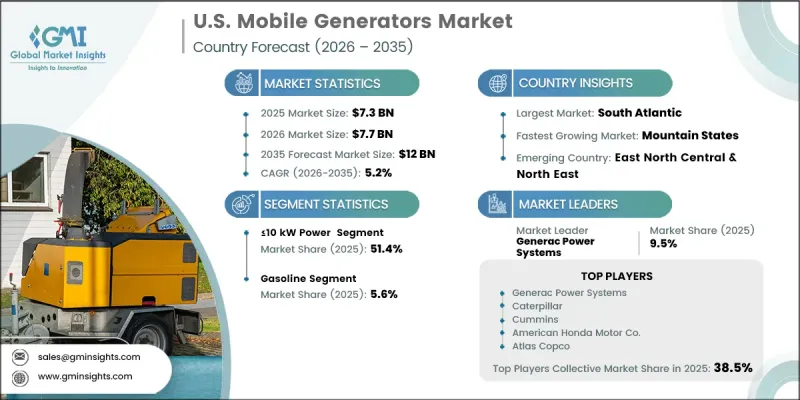
U.S. Mobile Generators Market was valued at USD 7.3 billion in 2025 and is estimated to grow at a CAGR of 5.2% to reach USD 12 billion by 2035.
Growth in the U.S. mobile generators industry is supported by rising dependence on reliable backup power across residential, commercial, industrial, and emergency applications. Increasing concerns around grid reliability, combined with rising electricity demand, are strengthening the role of mobile generators as a critical power backup solution. Aging transmission infrastructure and the growing frequency of extreme weather disruptions are exposing vulnerabilities in centralized power supply systems, further driving adoption. At the same time, expanding electrification across transport and industrial sectors is adding pressure on existing grid capacity. Large-scale infrastructure development, industrial expansion, and the rapid growth of data-driven technologies are also influencing demand patterns. Mobile generators are increasingly used to ensure uninterrupted power supply in locations with limited or unstable grid access. The market is also shaped by evolving regulatory expectations and emission standards, which are influencing product innovation and design improvements. As power reliability continues to remain a key operational priority across sectors, demand for mobile generators is expected to remain strong throughout the forecast period.
| Market Scope | |
|---|---|
| Start Year | 2025 |
| Forecast Year | 2026-2035 |
| Start Value | $7.3 Billion |
| Forecast Value | $12 Billion |
| CAGR | 5.2% |
The <=10 kW segment accounted for 51.4% share, growing at a CAGR of 4.7% through 2035. This segment continues to lead due to strong demand from residential users and small-scale commercial applications that require compact and portable backup power solutions. These generators are widely used for home backup power needs and small operational requirements where affordability, portability, and ease of use are key considerations. Their versatility and accessibility have reinforced their dominant position within the overall market structure.
The gasoline-powered mobile generators segment held a 53% share in 2025, growing at a CAGR of 5.6 through 2035. Their dominance is largely attributed to widespread fuel availability and convenient refueling infrastructure, making them suitable for residential and light commercial applications. The ease of access to fuel sources and relatively simple operational requirements continue to support strong adoption across end users who prioritize convenience and immediate usability over long-term fuel logistics considerations.
South Atlantic Mobile Generators Market accounted for 21.3% share in 2025, supported by recurring demand for backup power solutions in weather-prone and high-risk operational zones. Market activity in this region is strongly influenced by the need for reliable emergency power systems across critical facilities and residential areas. The combination of climatic vulnerability and regulatory emphasis on backup preparedness continues to drive consistent adoption of mobile generator systems.
Key companies operating in the U.S. mobile generators market include Generac Power Systems, Caterpillar, Cummins Inc., Briggs & Stratton, Atlas Copco, American Honda Motor Co., Inc., Champion Power Equipment, Wacker Neuson SE, Baker Hughes Company, DEWALT, EcoFlow, FIRMAN Power Equipment, Westinghouse Electric Corporation, DuroMax Power Equipment, WEN Products, Powermate, HIMOINSA POWER SYSTEMS, GENLITEC POWER, Alliance North America, and Rehlko. Companies operating in the U.S. mobile generators industry are adopting multiple strategies to strengthen their market position and enhance competitiveness. A primary focus is on product innovation, with manufacturers developing fuel-efficient, low-emission, and digitally enabled generator systems to meet evolving regulatory and customer requirements. Businesses are also expanding their product portfolios to include a wider range of power capacities tailored to residential, commercial, and industrial applications. Strategic investments in distribution networks and aftersales service capabilities are helping companies improve customer reach and retention. In addition, firms are increasingly focusing on hybrid and alternative fuel technologies to align with sustainability goals and regulatory standards.
Table of Contents
Chapter 1 Methodology & Scope
- 1.1 Research approach
- 1.2 Quality commitments
- 1.2.1 GMI AI policy & data integrity commitment
- 1.2.1.1 Source consistency protocol
- 1.2.1 GMI AI policy & data integrity commitment
- 1.3 Research trail & confidence scoring
- 1.3.1 Research trail components
- 1.3.2 Scoring components
- 1.4 Data collection
- 1.4.1 Partial list of primary sources
- 1.5 Data mining sources
- 1.5.1 Paid sources
- 1.5.1.1 Sources, by region
- 1.5.1 Paid sources
- 1.6 Base estimates and calculations
- 1.6.1 Base year calculation for any one approach
- 1.7 Market estimates & forecasts parameters
- 1.8 Forecast model
- 1.8.1 Quantified market impact analysis
- 1.8.1.1 Mathematical impact of growth parameters on forecast
- 1.8.1 Quantified market impact analysis
- 1.9 Research transparency addendum
- 1.9.1 Source attribution framework
- 1.9.2 Quality assurance metrics
- 1.9.3 Our commitment to trust
- 1.10 Market definitions
Chapter 2 Executive Summary
- 2.1 Industry synopsis, 2022 - 2035
- 2.1.1 Business trends
- 2.1.2 Capacity trends
- 2.1.3 Fuel trends
- 2.1.4 End use trends
- 2.1.5 Application trends
- 2.1.6 Phase trends
- 2.1.7 Product trends
- 2.1.8 Regional trends
Chapter 3 Industry Insights
- 3.1 Industry ecosystem analysis
- 3.1.1 Raw material availability & sourcing analysis
- 3.1.2 Manufacturing capacity assessment
- 3.1.3 Supply chain resilience & risk factors
- 3.1.4 Distribution network analysis
- 3.2 Industry impact forces
- 3.2.1 Growth drivers
- 3.2.2 Industry pitfalls & challenges
- 3.3 Regulatory landscape
- 3.4 Growth potential analysis
- 3.5 Porter's analysis
- 3.5.1 Bargaining power of suppliers
- 3.5.2 Bargaining power of buyers
- 3.5.3 Threat of new entrants
- 3.5.4 Threat of substitutes
- 3.6 PESTEL analysis
- 3.6.1 Political factors
- 3.6.2 Economic factors
- 3.6.3 Social factors
- 3.6.4 Technological factors
- 3.6.5 Legal factors
- 3.6.6 Environmental factors
- 3.7 Cost structure analysis of mobile generators
- 3.8 Emerging opportunities & trends
- 3.9 Digitalization & IoT integration
- 3.10 Investment analysis & future prospects
- 3.11 Price trend analysis (USD/Unit) (Driven by Primary Research)
- 3.11.1 By capacity (Driven by Primary Research)
- 3.11.2 By fuel (Driven by Primary Research)
- 3.12 Trade data analysis (Driven by Primary Research)
- 3.12.1 Import/export value trends (Driven by Primary Research)
- 3.12.2 Key trade corridors & tariff impact (Driven by Primary Research)
- 3.13 Capacity & production landscape (Driven by Primary Research)
- 3.13.1 Capacity by region & key producer (Driven by Primary Research)
- 3.13.2 Capacity utilization rates & expansion pipelines (Driven by Primary Research)
- 3.14 Impact of AI & Generative AI on the market (Driven by Primary Research)
- 3.14.1 AI-Driven production optimization (Driven by Primary Research)
- 3.14.2 Predictive maintenance & fault detection (Driven by Primary Research)
Chapter 4 Competitive Landscape, 2026
- 4.1 Introduction
- 4.2 Company market share analysis, by region, 2025
- 4.2.1 East North Central
- 4.2.2 West South Central
- 4.2.3 South Atlantic
- 4.2.4 North East
- 4.2.5 East South Central
- 4.2.6 West North Central
- 4.2.7 Pacific States
- 4.2.8 Mountain States
- 4.3 Competitive analysis of major market players
- 4.4 Competitive positioning matrix
- 4.5 Key developments
- 4.5.1 Mergers & acquisitions
- 4.5.2 Partnerships & collaborations
- 4.5.3 New product launches
- 4.5.4 Expansion plans & funding
- 4.6 Company tier benchmarking
- 4.6.1 Tier classification criteria & qualifying thresholds
- 4.6.2 Tier positioning matrix by revenue, geography & innovation
Chapter 5 Market Size and Forecast, By Capacity, 2022 - 2035 (USD Million & '000 Units)
- 5.1 Key trends
- 5.2 ≤ 10 kW
- 5.3 > 10 - 50 kW
- 5.4 > 50 - 100 kW
- 5.5 > 100 - 250 kW
- 5.6 > 250 - 500 kW
- 5.7 > 500 kW
Chapter 6 Market Size and Forecast, By Fuel, 2022 - 2035 (USD Million & '000 Units)
- 6.1 Key trends
- 6.2 Diesel
- 6.3 Gasoline
- 6.4 Hybrid
- 6.5 Others
Chapter 7 Market Size and Forecast, By End Use, 2022 - 2035 (USD Million & '000 Units)
- 7.1 Key trends
- 7.2 Construction
- 7.3 Mining & metals
- 7.4 Oil & gas
- 7.5 Military
- 7.6 Residential
- 7.7 Marine
- 7.8 Manufacturing
- 7.9 Healthcare & pharmaceutical
- 7.10 Commercial
- 7.11 Telecom
- 7.12 Utilities / power generation
- 7.13 Data centers
- 7.14 IT
- 7.15 Chemicals & petrochemicals
- 7.16 Emergency response
- 7.17 Entertainment / events
- 7.18 Others
Chapter 8 Market Size and Forecast, By Application, 2022 - 2035 (USD Million & '000 Units)
- 8.1 Key trends
- 8.2 Primary
- 8.3 Standby/ backup
- 8.4 Peak shaving
Chapter 9 Market Size and Forecast, By Phase, 2022 - 2035 (USD Million & '000 Units)
- 9.1 Key trends
- 9.2 Single phase
- 9.3 Three phase
Chapter 10 Market Size and Forecast, By Product, 2022 - 2035 (USD Million & '000 Units)
- 10.1 Key trends
- 10.2 Conventional portable
- 10.3 Inverter portable
Chapter 11 Market Size and Forecast, By Region, 2022 - 2035 (USD Million & '000 Units)
- 11.1 Key trends
- 11.2 East North Central
- 11.3 West South Central
- 11.4 South Atlantic
- 11.5 North East
- 11.6 East South Central
- 11.7 West North Central
- 11.8 Pacific States
- 11.9 Mountain States
Chapter 12 Company Profiles
- 12.1 Alliance North America
- 12.2 American Honda Motor Co., Inc.
- 12.3 Atlas Copco
- 12.4 Baker Hughes Company
- 12.5 Briggs & Stratton
- 12.6 Caterpillar
- 12.7 Champion Power Equipment
- 12.8 Cummins, Inc.
- 12.9 DEWALT
- 12.10 DuroMax Power Equipment
- 12.11 EcoFlow
- 12.12 FIRMAN Power Equipment
- 12.13 Generac Power Systems
- 12.14 GENLITEC POWER
- 12.15 HIMOINSA POWER SYSTEMS
- 12.16 Powermate
- 12.17 Rehlko
- 12.18 Wacker Neuson SE
- 12.19 WEN Products
- 12.20 Westinghouse Electric Corporation

