PUBLISHER: Global Market Insights Inc. | PRODUCT CODE: 2071349

PUBLISHER: Global Market Insights Inc. | PRODUCT CODE: 2071349
Cladding Systems Market Opportunity, Growth Drivers, Industry Trend Analysis, and Forecast 2026 - 2035
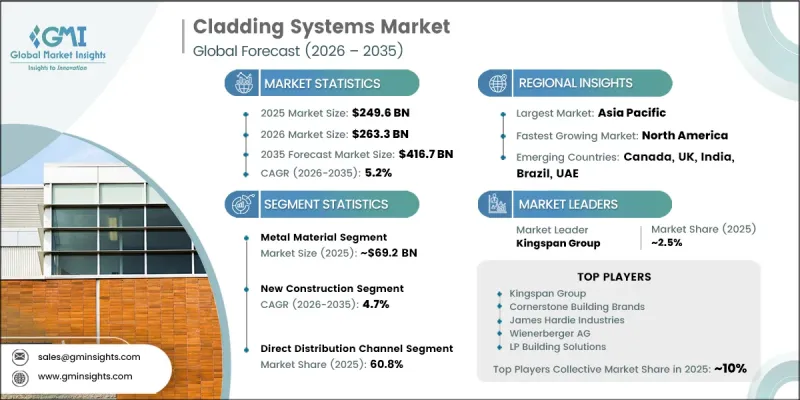
The Global Cladding Systems Market was valued at USD 249.6 billion in 2025 and is estimated to grow at a CAGR of 5.2% to reach USD 416.7 billion by 2035.
Market expansion is fueled by rapid urbanization and large-scale infrastructure development across emerging economies, which are driving strong demand for advanced exterior building solutions. Developers are increasingly selecting high-performance cladding materials that support faster installation, improved structural protection, and long-term durability to accommodate growing urban populations. At the same time, rising emphasis on energy-efficient building envelopes is significantly influencing market trends, as stakeholders prioritize materials that enhance insulation, reduce energy consumption, and support sustainability goals. Renovation and retrofit activities across mature markets are also contributing to demand, as aging structures are upgraded with modern cladding systems to improve performance, safety, and longevity. The global focus on sustainable construction practices and visually appealing architectural designs is further encouraging the adoption of advanced cladding technologies that deliver both functionality and aesthetic value.
| Market Scope | |
|---|---|
| Start Year | 2025 |
| Forecast Year | 2026-2035 |
| Start Value | $249.6 Billion |
| Forecast Value | $416.7 Billion |
| CAGR | 5.2% |
The metal cladding materials generated USD 69.2 billion in 2025 and is expected to grow at a CAGR of 5.5% through 2035. These materials are widely utilized due to their strong resistance to environmental conditions, durability, and long lifecycle performance, making them suitable for both new construction and refurbishment projects. Growing demand for sustainable construction solutions is also supporting this segment, as metal cladding is recyclable and compatible with advanced facade systems designed to improve thermal performance and energy efficiency.
The new construction segment accounted for 67.6% share in 2025 and is projected to grow at a CAGR of 4.7% over the forecast period. Increasing population growth, urban expansion, and the development of modern infrastructure are driving strong demand for newly built structures where cladding systems are incorporated during the design phase. Architects and developers are increasingly adopting advanced materials that enhance insulation, improve building performance, and deliver long-term operational savings while meeting evolving regulatory and sustainability requirements.
United States Cladding Systems Market accounted for USD 51.7 billion in 2025 and is expected to grow at a CAGR of 4.6% through 2035. The country benefits from a well-established construction industry supported by consistent demand across residential, commercial, and institutional sectors. Strong focus on energy-efficient building practices and regulatory standards is accelerating the adoption of modern cladding solutions designed to reduce energy consumption and environmental impact. Additionally, strict building safety requirements encourage the use of high-performance, non-combustible materials in construction projects.
Major players operating in the global cladding systems industry include Kingspan Group, Compagnie de Saint-Gobain SA, Tata Steel Limited, Arconic Corporation, Etex Group, Rockwool International, James Hardie Industries PLC, Nichiha Corporation, Louisiana Pacific Corporation, Swisspearl Group AG, Trespa International B.V., FunderMax, Reynaers Aluminium, Everest Industries Ltd, Avenere Cladding LLC, Aludecor, 3A Composites, Alpolic (Mitsubishi Chemical), Sto Corporation, Centria, and NBK Terracotta. Companies in the cladding systems market are focusing on innovation and sustainability to strengthen their competitive position. Leading players are investing in advanced materials that improve energy efficiency, durability, and fire resistance. Strategic partnerships with construction firms and architects are enabling the development of customized facade solutions tailored to modern building requirements. Manufacturers are also expanding their product portfolios to include eco-friendly and recyclable materials that align with global sustainability goals. Increasing emphasis on automation and efficient installation techniques is helping reduce project timelines and costs.
Table of Contents
Chapter 1 Methodology & Scope
- 1.1 Market scope and definition
- 1.2 Research design
- 1.2.1 Research approach
- 1.2.2 Data collection methods
- 1.3 Data mining sources
- 1.3.1 Global
- 1.3.2 Regional/Country
- 1.4 Base estimates and calculations
- 1.4.1 Base year calculation
- 1.4.2 Key trends for market estimation
- 1.5 Primary research and validation
- 1.5.1 Primary sources
- 1.6 Forecast model
- 1.7 Research assumptions and limitations
Chapter 2 Executive Summary
- 2.1 Industry 360° synopsis
- 2.2 Key market trends
- 2.2.1 Regional
- 2.2.2 Material type
- 2.2.3 System type
- 2.2.4 Installation type
- 2.2.5 Application
- 2.2.6 Distribution channel
Chapter 3 Industry Insights
- 3.1 Industry ecosystem analysis
- 3.1.1 Supplier landscape
- 3.1.2 Profit margin
- 3.1.3 Value addition at each stage
- 3.1.4 Factor affecting the value chain
- 3.2 Industry impact forces
- 3.2.1 Growth drivers
- 3.2.1.1 Rapid urbanization & infrastructure development
- 3.2.1.2 Growing emphasis on energy-efficient building envelopes
- 3.2.1.3 Renovation & retrofit activities in developed markets
- 3.2.1.4 Aesthetic preferences & architectural trends
- 3.2.2 Industry pitfalls & challenges
- 3.2.2.1 High initial costs of premium cladding materials
- 3.2.2.2 Fire safety concerns & regulatory tightening post-Grenfell
- 3.2.2.3 Inadequate fire performance testing standards
- 3.2.3 Opportunities
- 3.2.3.1 Lightweight & modular cladding systems
- 3.2.3.2 Advanced materials (self-cleaning, photocatalytic, smart coatings)
- 3.2.1 Growth drivers
- 3.3 Growth potential analysis
- 3.4 Future market trends
- 3.5 Technology and innovation landscape
- 3.5.1 Current technological trends
- 3.5.2 Emerging technologies
- 3.6 Regulatory landscape
- 3.6.1 Standards and compliance requirements
- 3.6.2 Regional regulatory frameworks
- 3.6.3 Certification standards
- 3.7 Trade data analysis (HS Code 7308)
- 3.7.1 Import/export volume & value trends
- 3.7.2 Key trade corridors & tariff impact
- 3.8 Pricing analysis
- 3.8.1 Historical price trend analysis (driven by primary research)
- 3.8.2 Pricing strategy by player type (premium / value / mass market)
- 3.9 Impact of AI & generative AI on the market
- 3.9.1 AI-driven disruption of existing business models
- 3.9.2 GenAI use cases & adoption roadmap by segment
- 3.9.3 Risks, limitations & regulatory considerations
- 3.10 Porter's analysis
- 3.11 PESTEL analysis
- 3.12 Consumer buying behavior analysis
- 3.12.1 Demographic trends
- 3.12.2 Factors affecting buying decisions
- 3.12.3 Consumer product adoption
- 3.12.4 Preferred distribution channel
Chapter 4 Competitive Landscape, 2025
- 4.1 Introduction
- 4.2 Company market share analysis
- 4.2.1 By Region
- 4.2.1.1 North America
- 4.2.1.2 Europe
- 4.2.1.3 Asia Pacific
- 4.2.1.4 Latin America
- 4.2.1.5 Middle East & Africa
- 4.2.1 By Region
- 4.3 Company matrix analysis
- 4.4 Competitive analysis of major market players
- 4.5 Competitive positioning matrix
- 4.6 Key developments
- 4.6.1 Mergers & acquisitions
- 4.6.2 Partnerships & collaborations
- 4.6.3 New product launches
- 4.6.4 Expansion plans
Chapter 5 Market Estimates & Forecast, By Material Type, 2022 - 2035, (USD Billion) (Million Units)
- 5.1 Key trends
- 5.2 Metal
- 5.3 Ceramic
- 5.4 Brick & stone
- 5.5 Wood
- 5.6 Vinyl (Plastics)
- 5.7 Stucco & EIFS
- 5.8 Fiber cement
- 5.9 Other
Chapter 6 Market Estimates & Forecast, By System type, 2022 - 2035, (USD Billion) (Million Units)
- 6.1 Key trends
- 6.2 Wall cladding
- 6.3 Roof cladding
- 6.4 Windows & doors
- 6.5 Others
Chapter 7 Market Estimates & Forecast, By Installation Type, 2022 - 2035, (USD Billion) (Million Units)
- 7.1 Key trends
- 7.2 New construction
- 7.3 Renovation & retrofit
Chapter 8 Market Estimates & Forecast, By Application, 2022 - 2035, (USD Billion) (Million Units)
- 8.1 Key trends
- 8.2 Residential
- 8.2.1 Single-family homes
- 8.2.2 Multi-family housing
- 8.2.3 Apartments & condominiums
- 8.3 Non-residential
- 8.3.1 Commercial
- 8.3.2 Industrial
- 8.3.3 Institutional
Chapter 9 Market Estimates & Forecast, By Distribution Channel, 2022 - 2035, (USD Billion) (Million Units)
- 9.1 Key trends
- 9.2 Direct sales
- 9.3 Indirect sales
Chapter 10 Market Estimates & Forecast, By Region, 2022 - 2035, (USD Billion) (Million Units)
- 10.1 Key trends
- 10.2 North America
- 10.2.1 U.S.
- 10.2.2 Canada
- 10.3 Europe
- 10.3.1 Germany
- 10.3.2 UK
- 10.3.3 France
- 10.3.4 Italy
- 10.3.5 Spain
- 10.4 Asia Pacific
- 10.4.1 China
- 10.4.2 India
- 10.4.3 Japan
- 10.4.4 South Korea
- 10.4.5 Australia
- 10.4.6 Indonesia
- 10.4.7 Malaysia
- 10.5 Latin America
- 10.5.1 Brazil
- 10.5.2 Mexico
- 10.5.3 Argentina
- 10.6 MEA
- 10.6.1 Saudi Arabia
- 10.6.2 UAE
- 10.6.3 South Africa
Chapter 11 Company Profiles
- 11.1 Top Global Players
- 11.1.1 Kingspan Group
- 11.1.2 Compagnie de Saint-Gobain SA
- 11.1.3 Tata Steel Limited
- 11.1.4 Arconic Corporation
- 11.1.5 Etex Group
- 11.1.6 Rockwool International
- 11.1.7 James Hardie Industries PLC
- 11.2 Regional Players
- 11.2.1 Nichiha Corporation (Asia Pacific)
- 11.2.2 Louisiana Pacific Corporation (North America)
- 11.2.3 Swisspearl Group AG
- 11.2.4 Trespa International B.V.
- 11.2.5 FunderMax
- 11.2.6 Reynaers Aluminium
- 11.2.7 Everest Industries Ltd
- 11.3 Emerging Players
- 11.3.1 Avenere Cladding LLC
- 11.3.2 Aludecor
- 11.3.3 3A Composites
- 11.3.4 Alpolic (Mitsubishi Chemical)
- 11.3.5 Sto Corporation
- 11.3.6 Centria
- 11.3.7 NBK Terracotta

