PUBLISHER: Global Market Insights Inc. | PRODUCT CODE: 2071361

PUBLISHER: Global Market Insights Inc. | PRODUCT CODE: 2071361
Body Tape Market Opportunity, Growth Drivers, Industry Trend Analysis, and Forecast 2026 - 2035
The Global Body Tape Market was valued at USD 2.5 billion in 2025 and is estimated to grow at a CAGR of 6.8% to reach USD 4.7 billion by 2035.
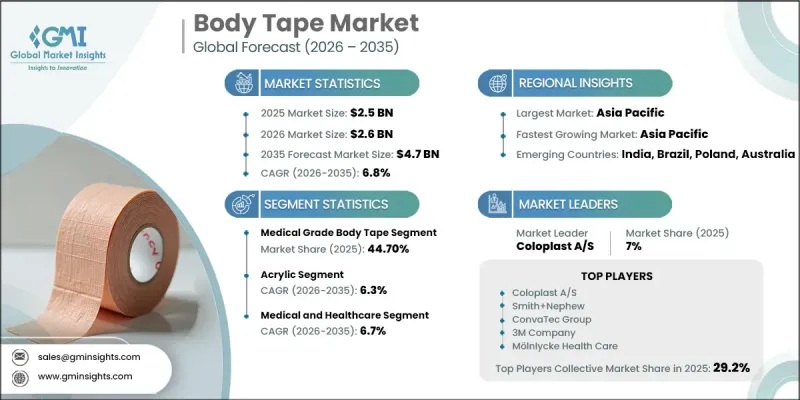
Market expansion is driven by increasing demand for functional adhesive solutions that provide support, fixation, and aesthetic enhancement across both clinical and consumer environments. The medical segment remains the core demand driver due to strong institutional purchasing patterns across hospitals, rehabilitation facilities, and home-based care services, supported by ongoing investments in healthcare infrastructure across North America and Asia Pacific. At the same time, advancements in adhesive chemistry are reshaping product performance standards, with a gradual shift toward silicone-based formulations that offer improved skin compatibility and reduced irritation compared to traditional acrylic-based options. The market is also benefiting from growing consumer acceptance of body tape in beauty and fashion applications, where it is increasingly used for garment support and styling purposes. The rapid rise of digital commerce and social media-driven beauty trends has significantly shortened product adoption cycles, enabling body tape to transition from niche usage to mainstream acceptance. Increasing material innovation, expanding geographic penetration in emerging economies, and rising integration into online retail ecosystems collectively support long-term market growth potential across global regions.
| Market Scope | |
|---|---|
| Start Year | 2025 |
| Forecast Year | 2026-2035 |
| Start Value | $2.5 Billion |
| Forecast Value | $4.7 Billion |
| CAGR | 6.8% |
The medical-grade body tape segment is projected to hold a 44.70% share by 2035 and is expected to grow at a CAGR of 7%. This segment's leadership is driven by its strong alignment with clinical procurement systems, where hospitals, long-term care institutions, rehabilitation centers, and home healthcare providers prioritize certified and dermatologically tested adhesive solutions. Regulatory compliance requirements and standardized purchasing frameworks continue to reinforce demand stability within this category.
The acrylic-based adhesives segment is expected to hold 32.90% share by 2035, growing at a CAGR of 6.3%. This dominance is primarily attributed to cost efficiency, widespread manufacturing availability, and established supply chain networks rather than premium performance positioning. Acrylic formulations are widely used across mid-range and value-oriented products, particularly in cost-sensitive markets where affordability plays a critical role in purchasing decisions. These materials provide adaptable adhesion strength and flexibility characteristics suitable for a wide range of applications, including general-purpose fashion and basic medical fixation uses.
North America Body Tape Market accounted for a 31% share in 2025, supported by a well-developed healthcare procurement ecosystem and strong consumer demand across fashion and personal care segments. The United States remains the primary contributor to regional demand, backed by structured regulatory approval systems that govern medical-grade adhesive products and establish performance standards influencing global product development and innovation trends.
Key companies operating in the Global Body Tape Market include Smith+Nephew, 3M Company, Coloplast A/S, ConvaTec Group plc, and Smith+Nephew. Companies in the body tape market are actively focusing on product innovation, material advancement, and expansion of application-specific portfolios to strengthen their competitive position. Leading players are investing in silicone-based adhesive technologies to enhance skin compatibility, reduce irritation risks, and improve product performance across medical and cosmetic uses. Strategic collaborations with healthcare providers, beauty brands, and retail distributors are enabling wider market penetration and improved product accessibility. Manufacturers are also expanding into emerging economies where rising healthcare infrastructure and increasing consumer awareness are driving new demand opportunities. Digital marketing strategies and influencer-led promotional campaigns are accelerating adoption in the fashion and beauty segment by improving product visibility and consumer engagement. Additionally, companies are strengthening supply chain integration and manufacturing scalability to maintain cost efficiency while supporting rising global demand.
Table of Contents
Chapter 1 Research Methodology
- 1.1 Research approach
- 1.2 Quality Commitments
- 1.2.1 GMI AI policy & data integrity commitment
- 1.2.1.1 Source consistency protocol
- 1.2.1 GMI AI policy & data integrity commitment
- 1.3 Research Trail & Confidence Scoring
- 1.3.1 Research Trail Components
- 1.3.2 Scoring Components
- 1.4 Data Collection
- 1.4.1 Partial list of primary sources
- 1.5 Data mining sources
- 1.5.1 Paid sources
- 1.5.1.1 Sources, by region
- 1.5.1 Paid sources
- 1.6 Base estimates and calculations
- 1.6.1 Base year calculation for any one approach
- 1.7 Forecast model
- 1.7.1 Quantified market impact analysis
- 1.7.1.1 Mathematical impact of growth parameters on forecast
- 1.7.1 Quantified market impact analysis
- 1.8 Research transparency addendum
- 1.8.1 Source attribution framework
- 1.8.2 Quality assurance metrics
- 1.8.3 Our commitment to trust
Chapter 2 Executive Summary
- 2.1 Industry 360° synopsis, 2022 - 2035
- 2.2 Key market trends
- 2.2.1 Regional
- 2.2.2 Type
- 2.2.3 Material
- 2.2.4 Application
- 2.2.5 Price
- 2.2.6 End User
- 2.2.7 Distribution Channel
Chapter 3 Industry Insights
- 3.1 Industry ecosystem analysis
- 3.1.1 Factor affecting the value chain
- 3.1.2 Profit margin analysis
- 3.1.3 Disruptions
- 3.1.4 Future outlook
- 3.1.5 Manufacturers
- 3.1.6 Distributors
- 3.2 Supplier landscape
- 3.3 Key news & initiatives
- 3.4 Technology & Innovation Landscape
- 3.5 Regulatory landscape
- 3.6 Impact on forces
- 3.6.1 Growth drivers
- 3.6.2 Industry pitfalls & challenges
- 3.6.3 Opportunities
- 3.7 Pricing analysis, 2025 (driven by primary research)
- 3.7.1 Historical price trend analysis (2022-2025)
- 3.7.2 Pricing strategy by player type (premium/value/cost-plus)
- 3.7.3 Regional price variation analysis
- 3.8 Growth potential analysis
- 3.9 Porter's analysis
- 3.10 PESTEL analysis
- 3.11 Consumer buying behavior analysis
- 3.11.1 Demographic trends
- 3.11.2 Factors affecting buying decisions
- 3.11.3 Consumer product adoption
- 3.11.4 Preferred distribution channel
- 3.12 Trade data analysis (driven by paid database)
- 3.12.1 Import/export volume & value trends (Driven by Primary Research)
- 3.12.2 Key trade corridors & tariff impact (Driven by Primary Research)
- 3.12.3 Export destination analysis
- 3.12.4 Import source analysis for raw materials
- 3.13 Impact of AI & generative AI on the market
- 3.13.1 AI-driven disruption of existing business models
- 3.13.2 GenAI use cases & adoption roadmap by segment
- 3.13.3 Risks, limitations & regulatory considerations
- 3.14 Capacity & Production Landscape (Driven by Primary Research)
- 3.14.1 Installed Capacity by Region & Key Producer (Driven by Primary Research)
- 3.14.2 Capacity Utilization Rates & Expansion Pipelines (Driven by Primary Research)
Chapter 4 Competitive Landscape, 2025
- 4.1 Introduction
- 4.2 Company market share analysis
- 4.3 Competitive positioning matrix
- 4.4 Strategic outlook matrix
- 4.5 Competitive analysis of major market players
- 4.6 Key developments
- 4.6.1 Mergers & acquisitions
- 4.6.2 Partnerships & collaborations
- 4.6.3 New product launches
- 4.6.4 Expansion plans
Chapter 5 Market Estimates & Forecast, By Type, 2022-2035 (USD Million) (Million Units)
- 5.1 Key Trends
- 5.2 Medical-grade Body Tape
- 5.3 Double-sided Body Tape
- 5.4 Single-sided Body Tape
Chapter 6 Market Estimates & Forecast, By Material, 2022-2035 (USD Million) (Million Units)
- 6.1 Key Trends
- 6.2 Acrylic
- 6.3 Silicone
- 6.4 Cotton
- 6.5 Synthetic
- 6.6 Others
Chapter 7 Market Estimates & Forecast, By Application, 2022-2035 (USD Million) (Million Units)
- 7.1 Key Trends
- 7.2 Medical & Healthcare
- 7.3 Fashion & Apparel
- 7.4 Cosmetics & Beauty
- 7.5 Others
Chapter 8 Market Estimates & Forecast, By Price, 2022 - 2035, (USD Million) (Million Units)
- 8.1 Key Trends
- 8.2 Low
- 8.3 Medium
- 8.4 High
Chapter 9 Market Estimates & Forecast, By End User, 2022 - 2035, (USD Million) (Million Units)
- 9.1 Key Trends
- 9.2 Individual
- 9.3 Commercial
Chapter 10 Market Estimates & Forecast, By Distribution Channel, 2022 - 2035, (USD Million) (Million Units)
- 10.1 Key Trends
- 10.2 Online
- 10.2.1 E-commerce site
- 10.2.2 Company website
- 10.3 Offline
- 10.3.1 Specialty stores
- 10.3.2 Others
Chapter 11 & Forecast, By Region, 2022 - 2035, (USD Million) (Million Units)
- 11.1 Key trends
- 11.2 North America
- 11.2.1 U.S.
- 11.2.2 Canada
- 11.3 Europe
- 11.3.1 Germany
- 11.3.2 U.K.
- 11.3.3 France
- 11.3.4 Italy
- 11.3.5 Spain
- 11.4 Asia Pacific
- 11.4.1 China
- 11.4.2 India
- 11.4.3 Japan
- 11.4.4 South Korea
- 11.4.5 Australia
- 11.5 Latin America
- 11.5.1 Brazil
- 11.5.2 Mexico
- 11.5.3 Argentina
- 11.6 MEA
- 11.6.1 UAE
- 11.6.2 Saudi Arabia
- 11.6.3 South Africa
Chapter 12 Company Profiles (Business Overview, Financial Data, Product Landscape, Strategic Outlook, SWOT Analysis)
- 12.1 Global players
- 12.1.1 3M
- 12.1.2 Avery Dennison
- 12.1.3 Nitto Denko
- 12.1.4 Berry Global
- 12.1.5 Coloplast A/S
- 12.1.6 Smith+Nephew
- 12.1.7 Molnlycke Health Care
- 12.1.8 ConvaTec Group
- 12.1.9 Scapa Group
- 12.2 Regional players
- 12.2.1 Adhex Technologies
- 12.2.2 DermaMed Coatings
- 12.2.3 Kinesio
- 12.2.4 Fashion Forms
- 12.2.5 Hollywood Fashion Secrets
- 12.3 Emerging players
- 12.3.1 Booby Tape
- 12.3.2 Brazabra Corp
- 12.3.3 Fearless Tape
- 12.3.4 EasyTape
- 12.3.5 Maidenform

