PUBLISHER: Global Market Insights Inc. | PRODUCT CODE: 2071400

PUBLISHER: Global Market Insights Inc. | PRODUCT CODE: 2071400
Skincare Products Market Opportunity, Growth Drivers, Industry Trend Analysis, and Forecast 2026 - 2035
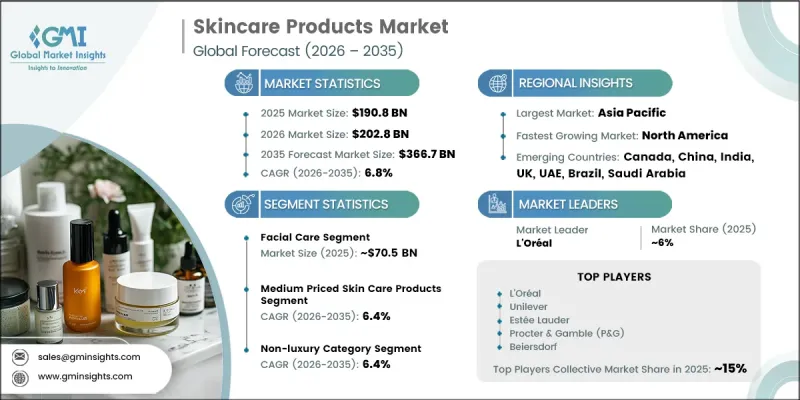
The Global Skincare Products Market was valued at USD 190.8 billion in 2025 and is estimated to grow at a CAGR of 6.8% to reach USD 366.7 billion by 2035.
The market is advancing steadily as awareness around skincare and personal maintenance continues to rise across varied consumer groups. Skincare is increasingly viewed as a core component of hygiene, wellness, and preventive care rather than a purely aesthetic choice. Digital platforms and educational content have significantly improved consumer knowledge regarding skin health, ingredient functionality, and targeted treatments. This evolving awareness is encouraging more informed purchasing decisions and consistent product use. At the same time, rising disposable income across developing and urban regions is enabling consumers to shift toward higher-quality and branded skincare offerings. Greater financial flexibility is allowing individuals to explore a wider range of solutions, contributing to increased product adoption and higher spending per person. The skincare products market is therefore benefiting from a combination of economic growth, changing lifestyle patterns, and a stronger focus on long-term skin health.
| Market Scope | |
|---|---|
| Start Year | 2025 |
| Forecast Year | 2026-2035 |
| Start Value | $190.8 Billion |
| Forecast Value | $366.7 Billion |
| CAGR | 6.8% |
The facial care segment accounted for USD 70.5 billion in 2025. Demand in this segment remains strong as facial skin requires more attention due to continuous exposure to environmental and external stressors. Consumers are increasingly investing in targeted formulations designed to address a wide range of skin-related concerns. The growing acceptance of ingredient-focused skincare and scientifically developed formulations is further strengthening this segment, making it one of the most innovation-driven areas within the skincare products market.
The non-luxury segment held a 64.1% share in 2025 and is expected to grow at a CAGR of 6.5% through 2035. As skincare becomes part of everyday health and maintenance routines, consumers are placing greater emphasis on effectiveness and affordability rather than premium positioning. Economic conditions and cautious spending behavior are reinforcing the demand for cost-effective solutions that deliver consistent performance. Additionally, increasing awareness across broader consumer groups and expanding access to skincare products are contributing to sustained growth in this segment.
United States Skincare Products Market captured USD 40.7 billion in 2025. Consumers in the country demonstrate strong awareness and engagement with skincare routines, leading to steady demand for a variety of daily-use formulations. Growing concerns related to skin health are encouraging the adoption of advanced and clinically developed products. The expansion of digital retail channels and evolving purchasing behaviors are also supporting increased product accessibility and repeat consumption.
Key players operating in the Global Skincare Products Market include Amorepacific Corporation, Beiersdorf AG, CeraVe, Chanel S.A., Coty Inc., Drunk Elephant, Estee Lauder Companies Inc., Glossier, Johnson & Johnson, L'Oreal S.A., LVMH, Procter & Gamble Co., Shiseido Company, Limited, The Ordinary, and Unilever PLC. Companies in the Skincare Products Market are enhancing their market position by investing in research and development to introduce advanced and high-performance formulations. Many are focusing on ingredient transparency and product safety to align with evolving consumer expectations. Strategic partnerships and collaborations are being used to strengthen distribution networks and improve global reach. Brands are also leveraging digital marketing and direct-to-consumer channels to engage with customers and build loyalty. Expansion into emerging markets and localization of product offerings are helping companies tap into new demand.
Table of Contents
Chapter 1 Methodology & Scope
- 1.1 Market scope and definition
- 1.2 Research design
- 1.2.1 Research approach
- 1.2.2 Data collection methods
- 1.3 Data mining sources
- 1.3.1 Global
- 1.3.2 Regional/Country
- 1.4 Base estimates and calculations
- 1.4.1 Base year calculation
- 1.4.2 Key trends for market estimation
- 1.5 Primary research and validation
- 1.5.1 Primary sources
- 1.6 Forecast model
- 1.7 Research assumptions and limitations
Chapter 2 Executive Summary
- 2.1 Industry 360° synopsis
- 2.2 Key market trends
- 2.2.1 Regional
- 2.2.2 Product type
- 2.2.3 Skin type
- 2.2.4 Category
- 2.2.5 Ingredients
- 2.2.6 Price
- 2.2.7 Consumer group
- 2.2.8 Distribution channel
Chapter 3 Industry Insights
- 3.1 Industry ecosystem analysis
- 3.1.1 Supplier landscape
- 3.1.2 Profit margin
- 3.1.3 Value addition at each stage
- 3.1.4 Factor affecting the value chain
- 3.2 Industry impact forces
- 3.2.1 Growth drivers
- 3.2.1.1 Growing awareness about skincare and personal grooming
- 3.2.1.2 The rising disposable income
- 3.2.1.3 Innovation in product formulations
- 3.2.2 Industry pitfalls & challenges
- 3.2.2.1 Regulatory compliance and product safety concerns
- 3.2.2.2 Intense competition and market saturation
- 3.2.3 Opportunities
- 3.2.3.1 Rising demand for clean, natural, and sustainable skincare
- 3.2.3.2 Growth of dermatology-backed and cosmeceutical products
- 3.2.1 Growth drivers
- 3.3 Growth potential analysis
- 3.4 Future market trends
- 3.5 Technology and innovation landscape
- 3.5.1 Current technological trends
- 3.5.2 Emerging technologies
- 3.6 Regulatory landscape
- 3.6.1 Standards and compliance requirements
- 3.6.2 Regional regulatory frameworks
- 3.6.3 Certification standards
- 3.7 Trade data analysis (HS Code 3304)
- 3.7.1 Import/export volume & value trends
- 3.7.2 Key trade corridors & tariff impact
- 3.8 Pricing analysis
- 3.8.1 Historical price trend analysis (driven by primary research)
- 3.8.2 Pricing strategy by player type (premium / value / mass market)
- 3.8.3 Price positioning of technology vs traditional products
- 3.8.4 Regional price variations
- 3.9 Impact of AI & generative AI on the market
- 3.9.1 AI-driven disruption of existing business models
- 3.9.2 GenAI use cases & adoption roadmap by segment
- 3.9.3 Risks, limitations & regulatory considerations
- 3.10 Porter's analysis
- 3.11 PESTEL analysis
- 3.12 Consumer behavior analysis
- 3.12.1 Purchasing patterns
- 3.12.2 Preference analysis
- 3.12.3 Regional variations in consumer behavior
- 3.12.4 Impact of e-commerce on buying decisions
Chapter 4 Competitive Landscape, 2025
- 4.1 Introduction
- 4.2 Company market share analysis
- 4.2.1 By Region
- 4.2.1.1 North America
- 4.2.1.2 Europe
- 4.2.1.3 Asia Pacific
- 4.2.1.4 Latin America
- 4.2.1.5 Middle East & Africa
- 4.2.1 By Region
- 4.3 Company matrix analysis
- 4.4 Competitive analysis of major market players
- 4.5 Competitive positioning matrix
- 4.6 Key developments
- 4.6.1 Mergers & acquisitions
- 4.6.2 Partnerships & collaborations
- 4.6.3 New product launches
- 4.6.4 Expansion plans
Chapter 5 Market Estimates & Forecast, By Product Type, 2022 - 2035, (USD Billion) (Million Units)
- 5.1 Key trends
- 5.2 Facial care
- 5.2.1 Cleansers and toners
- 5.2.2 Moisturizers and creams
- 5.2.3 Face masks and serums
- 5.2.4 Sunscreen and suncare products
- 5.2.5 Others
- 5.3 Lip care
- 5.3.1 Lip balms
- 5.3.2 Lip scrubs
- 5.3.3 Lip masks
- 5.3.4 Others
- 5.4 Body care
- 5.4.1 Body lotions & moisturizer
- 5.4.2 Body washes and shower gels
- 5.4.3 Body scrubs and exfoliants
- 5.4.4 Body oils and serums
- 5.4.5 Body butters and creams
- 5.4.6 Others
- 5.5 Others (Nailcare, Fragrances, etc.)
Chapter 6 Market Estimates & Forecast, By Skin Type, 2022 - 2035, (USD Billion) (Million Units)
- 6.1 Key trends
- 6.2 Normal skin
- 6.3 Dry/sensitive skin
- 6.4 Oily/acne-prone skin
- 6.5 Combination skin
- 6.6 Mature/anti-aging
Chapter 7 Market Estimates & Forecast, By Category, 2022 - 2035, (USD Billion) (Million Units)
- 7.1 Key trends
- 7.2 Luxury
- 7.3 Non-Luxury
Chapter 8 Market Estimates & Forecast, By Ingredients, 2022 - 2035, (USD Billion) (Million Units)
- 8.1 Key trends
- 8.2 Chemical
- 8.3 Natural
Chapter 9 Market Estimates & Forecast, By Price, 2022 - 2035, (USD Billion) (Million Units)
- 9.1 Key trends
- 9.2 Low
- 9.3 Medium
- 9.4 High
Chapter 10 Market Estimates & Forecast, By Consumer Group, 2022 - 2035, (USD Billion) (Million Units)
- 10.1 Key trends
- 10.2 Women
- 10.3 Men
- 10.4 Unisex
Chapter 11 Market Estimates & Forecast, By Distribution Channel, 2022 - 2035, (USD Billion) (Million Units)
- 11.1 Key trends
- 11.2 Online
- 11.2.1 E-commerce website
- 11.2.2 Company websites
- 11.3 Offline
- 11.3.1 Retail stores
- 11.3.2 Supermarkets/Hypermarkets
- 11.3.3 Others (specialty stores, etc.)
Chapter 12 Market Estimates & Forecast, By Region, 2022 - 2035, (USD Billion) (Million Units)
- 12.1 Key trends
- 12.2 North America
- 12.2.1 U.S.
- 12.2.2 Canada
- 12.3 Europe
- 12.3.1 Germany
- 12.3.2 UK
- 12.3.3 France
- 12.3.4 Italy
- 12.3.5 Spain
- 12.4 Asia Pacific
- 12.4.1 China
- 12.4.2 India
- 12.4.3 Japan
- 12.4.4 South Korea
- 12.4.5 Australia
- 12.4.6 Indonesia
- 12.4.7 Malaysia
- 12.5 Latin America
- 12.5.1 Brazil
- 12.5.2 Mexico
- 12.5.3 Argentina
- 12.6 MEA
- 12.6.1 Saudi Arabia
- 12.6.2 UAE
- 12.6.3 South Africa
Chapter 13 Company Profiles
- 13.1 Amorepacific Corporation
- 13.2 Beiersdorf AG
- 13.3 CeraVe
- 13.4 Chanel S.A.
- 13.5 Coty Inc.
- 13.6 Drunk Elephant
- 13.7 Estee Lauder Companies Inc.
- 13.8 Glossier
- 13.9 Johnson & Johnson
- 13.10 L'Oreal S.A.
- 13.11 LVMH
- 13.12 Procter & Gamble Co.
- 13.13 Shiseido Company, Limited
- 13.14 The Ordinary
- 13.15 Unilever PLC

