PUBLISHER: Global Market Insights Inc. | PRODUCT CODE: 2061374

PUBLISHER: Global Market Insights Inc. | PRODUCT CODE: 2061374
Personalized Skin Care Market Opportunity, Growth Drivers, Industry Trend Analysis, and Forecast 2026 - 2035
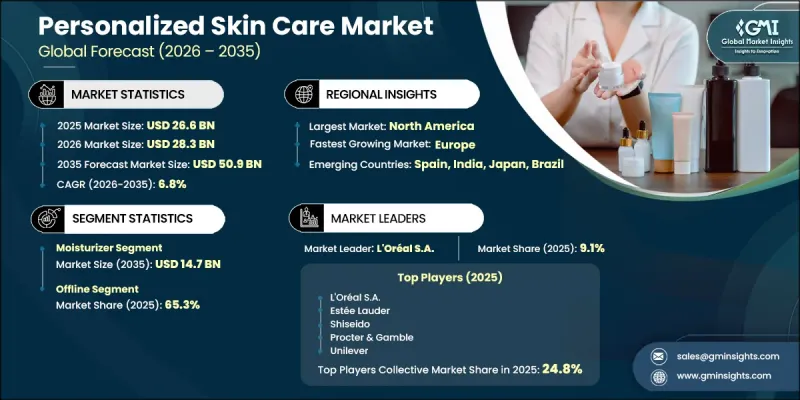
The Global Personalized Skin Care Market was valued at USD 26.6 billion in 2025 and is estimated to grow at a CAGR of 6.8% to reach USD 50.9 billion by 2035.
The market is undergoing a significant transformation as consumers increasingly move away from standardized skincare products toward highly tailored solutions based on individual biological and environmental data. Demand for hyper-personalized skincare is rising as users seek products that deliver more accurate, targeted, and clinically relevant outcomes for daily skin health management. Rapid advancements in artificial intelligence, diagnostic imaging tools, and digital skin analysis technologies are enabling more precise at-home skin assessments, making professional-grade evaluation more accessible to consumers. Integration of genomic insights and microbiome profiling is further reshaping product development, allowing brands to design formulations that address root causes of skin concerns rather than surface-level symptoms. The shift toward clean beauty and minimalist ingredient formulations is also influencing product innovation, supported by small-batch production models and growing consumer preference for transparency and safer ingredient profiles. Expanding use of data analytics is enabling brands to identify evolving skin needs, refine personalization algorithms, and continuously improve product recommendations over time. Rising digital engagement and increasing adoption of technology-driven skincare solutions continue to accelerate market expansion across global beauty and personal care industries.
| Market Scope | |
|---|---|
| Start Year | 2025 |
| Forecast Year | 2026-2035 |
| Start Value | $26.6 Billion |
| Forecast Value | $50.9 Billion |
| CAGR | 6.8% |
The moisturizer category generated USD 7.3 billion in 2025 and is expected to reach USD 14.7 billion by 2035. Moisturizers continue to represent a foundational product in personalized skincare routines, serving as the entry point for most consumers adopting customized beauty regimens. Their widespread usage is driven by essential hydration needs that vary depending on climate conditions, age, and skin barrier health. Increasing awareness of skin barrier protection and long-term skin health continues to support strong demand for personalized moisturizer formulations tailored to individual requirements.
The offline distribution channel accounted for 65.3% in 2025, maintaining its dominant position. Physical retail environments continue to play a critical role due to the availability of advanced diagnostic tools such as skin scanning systems and hydration analysis equipment. These technologies provide highly accurate skin assessments that enhance personalization outcomes and support premium product recommendations. Consumers also place strong value on expert consultations provided by trained professionals, dermatologists, and skincare advisors. The presence of expert validation and hands-on evaluation builds trust, particularly for high-value customized skincare products, reinforcing the strength of offline channels.
U.S. Personalized Skin Care Market held a 78.3% share in 2025. The country's market is characterized by strong consumer awareness, high discretionary spending, and rapid adoption of advanced beauty technologies. Demand is strongly supported by AI-powered diagnostics, dermatologist-guided customization, and digitally enabled skincare solutions. Increasing penetration of e-commerce platforms and data-driven consumer engagement models continues to reshape purchasing behavior. Brands are also expanding investment in connected skincare devices and mobile-based skin analysis platforms to enhance personalization capabilities. Subscription-based customized skincare offerings are gaining momentum as consumers seek ongoing product optimization. Continuous innovation and strong technology adoption continue to reinforce the leadership position of the U.S. market.
Major companies operating in the Global Personalized Skin Care Market include Shiseido, L'Oreal S.A., Estee Lauder, Unilever, Procter & Gamble, Johnson & Johnson, Beiersdorf, Amorepacific, Kao Corporation, Kose Corporation, LG H&H, Coty, Henkel, Natura & Co, Pola Orbis, Sisley-Paris, Clarins Group, Bioeffect, Proya, Chanel, and Colgate-Palmolive. Companies operating in the personalized skin care market are adopting several strategic initiatives to strengthen their competitive position and expand consumer reach. Leading brands are heavily investing in artificial intelligence, skin diagnostic technologies, and data analytics platforms to enhance personalization accuracy and product effectiveness. Businesses are also focusing on integrating genomic and microbiome insights into product development to create highly targeted skincare formulations. Expansion of digital ecosystems, including mobile applications and connected skincare devices, is helping companies improve consumer engagement and retention. Strategic partnerships with dermatologists, technology providers, and beauty retailers are further strengthening product credibility and distribution networks.
Table of Contents
Chapter 1 Methodology & Scope
- 1.1 Research approach
- 1.2 Quality Commitments
- 1.2.1 GMI AI policy & data integrity commitment
- 1.2.1.1 Source consistency protocol
- 1.2.1 GMI AI policy & data integrity commitment
- 1.3 Research Trail & Confidence Scoring
- 1.3.1 Research Trail Components
- 1.3.2 Scoring Components
- 1.4 Data Collection
- 1.4.1 Partial list of primary sources
- 1.5 Data mining sources
- 1.5.1 Paid sources
- 1.5.1.1 Sources, by region
- 1.5.1 Paid sources
- 1.6 Base estimates and calculations
- 1.6.1 Base year calculation for any one approach
- 1.7 Forecast model
- 1.7.1 Quantified market impact analysis
- 1.7.1.1 Mathematical impact of growth parameters on forecast
- 1.7.1 Quantified market impact analysis
- 1.8 Research transparency addendum
- 1.8.1 Source attribution framework
- 1.8.2 Quality assurance metrics
- 1.9 Our commitment to trust
Chapter 2 Executive Summary
- 2.1 Industry 360° synopsis
- 2.2 Key market trends
- 2.2.1 Regional
- 2.2.2 Product Type
- 2.2.3 Technology
- 2.2.4 Skin Condition
- 2.2.5 Category
- 2.2.6 Price
- 2.2.7 Consumer Group
- 2.2.8 Distribution Channel
Chapter 3 Industry Insights
- 3.1 Industry ecosystem analysis
- 3.1.1 Supplier landscape
- 3.1.2 Profit margin
- 3.1.3 Value addition at each stage
- 3.1.4 Factor affecting the value chain
- 3.2 Industry impact forces
- 3.2.1 Growth drivers
- 3.2.1.1 Demand for individualized skin care solutions
- 3.2.1.2 Advancements in AI-based skin diagnostics and data analytics
- 3.2.1.3 Rising consumer focus on ingredient transparency and efficacy
- 3.2.2 Industry pitfalls & challenges
- 3.2.2.1 High formulation, technology, and operational costs
- 3.2.2.2 Regulatory complexity and data privacy compliance risks
- 3.2.3 Opportunities
- 3.2.3.1 Growth of direct-to-consumer and digital personalization platforms
- 3.2.3.2 Adoption of biotech, clean-label, and microbiome-based formulations
- 3.2.1 Growth drivers
- 3.3 Growth potential analysis
- 3.4 Regulatory framework
- 3.5 Major market trends and disruptions
- 3.6 Technology/innovation landscape
- 3.7 Pricing Analysis (driven by primary research)
- 3.7.1 Historical price trend analysis (driven by primary research)
- 3.7.2 Pricing strategy by player type (premium / value / cost-plus) (driven by primary research)
- 3.8 Future market trends
- 3.9 Trade data analysis (driven by paid database) (HS code- 330499)
- 3.9.1 Import/export volume & value trends (driven by primary research)
- 3.9.2 Key trade corridors & tariff impact (driven by primary research)
- 3.10 Impact of AI & Generative AI on the Market
- 3.10.1 AI-driven disruption of existing business models
- 3.10.2 Gen-AI use cases & adoption roadmap by segment
- 3.10.3 Risks, limitations & regulatory considerations
- 3.11 Porter’s analysis
- 3.12 PESTEL analysis
- 3.13 Distribution infrastructure & channel penetration landscape (driven by primary research)
- 3.13.1 Channel coverage by region & format (modern vs. Traditional trade) (driven by primary research)
- 3.13.2 Last-mile infrastructure gaps & emerging channel shifts (driven by primary research)
Chapter 4 Competitive landscape, 2025
- 4.1 Introduction
- 4.2 Company market share analysis
- 4.2.1 By region
- 4.2.1.1 North America
- 4.2.1.2 Europe
- 4.2.1.3 Asia Pacific
- 4.2.1.4 Latin America
- 4.2.1.5 MEA
- 4.2.1 By region
- 4.3 Company matrix analysis
- 4.4 Competitive analysis of major market players
- 4.5 Competitive positioning matrix
- 4.6 Key developments
- 4.6.1 Mergers & acquisitions
- 4.6.2 Partnerships & collaborations
- 4.6.3 New product launches
- 4.6.4 Expansion plans
Chapter 5 Market Estimates & Forecast, By Product Type, 2022 - 2035 (USD Billion) (Thousand Units)
- 5.1 Key trends
- 5.2 Cleanser
- 5.2.1 Gel-based cleansers
- 5.2.2 Foam cleansers
- 5.2.3 Oil-based cleansers
- 5.3 Micellar water
- 5.4 Face serum
- 5.4.1 Hydrating serums
- 5.4.2 Brightening serums
- 5.4.3 Anti-aging serums
- 5.4.4 Acne treatment serums
- 5.5 Moisturizer
- 5.5.1 Day moisturizers
- 5.5.2 Night creams
- 5.5.3 Lightweight gels
- 5.5.4 Rich creams for dry skin
- 5.6 Active
- 5.6.1 Retinol/retinoid treatments
- 5.6.2 Vitamin C treatments
- 5.6.3 AHA/BHA exfoliants
- 5.6.4 Niacinamide treatments
- 5.7 Body lotion
- 5.7.1 Hydrating body lotions
- 5.7.2 Firming & anti-aging body treatments
- 5.7.3 Targeted body treatments (keratosis pilaris, hyperpigmentation)
- 5.8 Body duo
- 5.9 Sunscreen & sun care
- 5.9.1 Mineral/physical sunscreens
- 5.9.2 Chemical sunscreens
- 5.9.3 Tinted sunscreens
- 5.10 Others
- 5.10.1 Sheet & cream masks
- 5.10.2 Eye creams & serums
- 5.10.3 Lip treatments
Chapter 6 Market Estimates & Forecast, By Technology, 2022 - 2035 (USD Billion) (Thousand Units)
- 6.1 Key trends
- 6.2 AI & machine learning analysis
- 6.3 Genetic testing & genomics-based
- 6.4 Microbiome profiling
- 6.5 3D skin mapping & imaging
- 6.6 Others (blood tests, dermatologist consultations, hybrid models)
Chapter 7 Market Estimates & Forecast, By Skin Condition, 2022 - 2035 (USD Billion) (Thousand Units)
- 7.1 Key trends
- 7.2 Anti-aging (wrinkles, firmness, elasticity)
- 7.3 Acne & blemishes
- 7.4 Hyperpigmentation & dark spots
- 7.5 Sensitivity & redness
- 7.6 Dryness & hydration
- 7.7 Others
Chapter 8 Market Estimates & Forecast, By Category, 2022 - 2035 (USD Billion) (Thousand Units)
- 8.1 Key trends
- 8.2 Face care
- 8.3 Body care
Chapter 9 Market Estimates & Forecast, By Price Range, 2022 - 2035 (USD Billion) (Thousand Units)
- 9.1 Key trends
- 9.2 Low
- 9.3 Medium
- 9.4 High
Chapter 10 Market Estimates & Forecast, By Consumer Group, 2022 - 2035 (USD Billion) (Thousand Units)
- 10.1 Key trends
- 10.2 Men
- 10.3 Women
- 10.4 Kid
Chapter 11 Market Estimates & Forecast, By Distribution Channel, 2022 - 2035 (USD Billion) (Thousand Units)
- 11.1 Key trends
- 11.2 Offline
- 11.3 Online
Chapter 12 Market Estimates & Forecast, By Region, 2022 - 2035 (USD Billion) (Thousand Units)
- 12.1 Key trends
- 12.2 North America
- 12.2.1 U.S.
- 12.2.2 Canada
- 12.3 Europe
- 12.3.1 Germany
- 12.3.2 UK
- 12.3.3 France
- 12.3.4 Spain
- 12.3.5 Italy
- 12.4 Asia Pacific
- 12.4.1 China
- 12.4.2 Japan
- 12.4.3 India
- 12.4.4 Australia
- 12.4.5 South Korea
- 12.5 Latin America
- 12.5.1 Brazil
- 12.5.2 Mexico
- 12.5.3 Argentina
- 12.6 MEA
- 12.6.1 South Africa
- 12.6.2 Saudi Arabia
- 12.6.3 UAE
Chapter 13 Company Profiles
- 13.1 Global Company
- 13.1.1 Beiersdorf
- 13.1.2 Estee Lauder
- 13.1.3 Johnson & Johnson
- 13.1.4 L'Oreal S.A.
- 13.1.5 Procter & Gamble
- 13.1.6 Shiseido
- 13.1.7 Unilever
- 13.2 Regional Company
- 13.2.1 Amorepacific
- 13.2.2 Clarins Group
- 13.2.3 Coty
- 13.2.4 Henkel
- 13.2.5 Kao Corporation
- 13.2.6 Kose Corporation
- 13.2.7 LG H&H
- 13.3 Emerging Companies
- 13.3.1 Bioeffect
- 13.3.2 Chanel
- 13.3.3 Colgate-Palmolive
- 13.3.4 Natura & Co
- 13.3.5 Pola Orbis
- 13.3.6 Proya
- 13.3.7 Sisley-Paris

