PUBLISHER: Global Market Insights Inc. | PRODUCT CODE: 2071405

PUBLISHER: Global Market Insights Inc. | PRODUCT CODE: 2071405
Herpes Simplex Virus Treatment Market Opportunity, Growth Drivers, Industry Trend Analysis, and Forecast 2026 - 2035
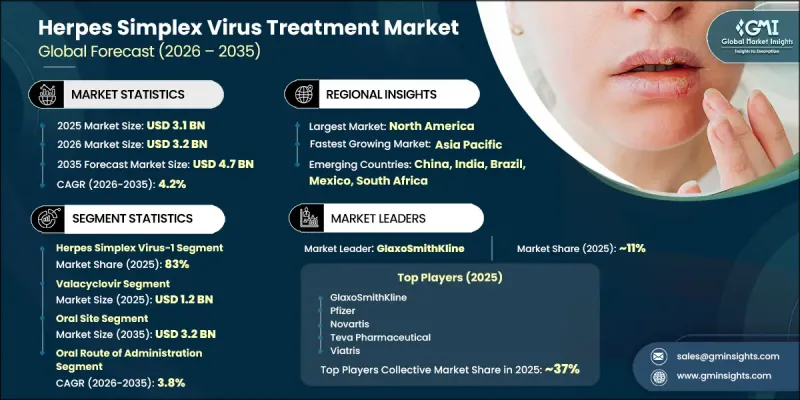
The Global Herpes Simplex Virus Treatment Market was valued at USD 3.1 billion in 2025 and is estimated to grow at a CAGR of 4.2% to reach USD 4.7 billion by 2035.
Market expansion is supported by the rising global incidence of herpes simplex virus infections, higher investments in pharmaceutical research and development, increasing government-led awareness initiatives, and growing international mobility that contributes to faster disease transmission. In addition, expanding healthcare expenditure across both developed and emerging economies continues to reinforce demand for effective antiviral therapies. The persistent burden of HSV infections remains a key structural driver of market growth. Herpes simplex virus treatment focuses on managing HSV-1 and HSV-2 infections, reducing the intensity of symptoms, lowering recurrence rates, and minimizing viral transmission risk. Current therapeutic standards are largely based on antiviral agents such as acyclovir, valacyclovir, and famciclovir, which suppress viral replication and control episodic flare-ups. Long-term suppressive therapy is increasingly being adopted to reduce outbreak frequency and viral shedding, while improving patient outcomes. There is also a growing shift toward patient-friendly and long-acting oral formulations designed to improve adherence and enhance quality of life in chronic HSV management.
| Market Scope | |
|---|---|
| Start Year | 2025 |
| Forecast Year | 2026-2035 |
| Start Value | $3.1 Billion |
| Forecast Value | $4.7 Billion |
| CAGR | 4.2% |
The HSV-1 segment accounted for an 83% share in 2025. HSV-1 is mainly linked to oral herpes infections, although it is also contributing to a rising number of genital cases in several regions. Its widespread prevalence creates sustained demand for antiviral medications, diagnostic testing, and long-term disease control solutions. The recurring nature of HSV-1 outbreaks further ensures continuous treatment usage across patient populations. Market growth in this segment is also supported by the availability of oral antivirals, topical therapies, and symptom-relief options, along with increasing awareness regarding early detection and timely intervention.
The oral site segment is projected to reach USD 3.2 billion by 2035, driven largely by the high global incidence of HSV-1-related oral herpes. Visible lesions associated with oral infections often lead to cosmetic concerns and social discomfort, encouraging earlier medical consultation and treatment adoption compared to other infection sites. Rising public awareness, improved health education, and better understanding of disease management practices are further strengthening diagnosis rates and treatment uptake within this segment.
North America Herpes Simplex Virus Treatment Market held a 43.5% share in 2025. The region's dominance is supported by a high prevalence of HSV-1 and HSV-2 infections, creating a large and consistently treated patient base. A well-established healthcare system, advanced diagnostic infrastructure, strong pharmaceutical manufacturing capabilities, and favorable reimbursement structures continue to support market expansion. In addition, sustained investment in infectious disease research, high healthcare spending, and growing awareness of sexually transmitted infections contribute to the region's strong market position.
Major players operating in the global herpes simplex virus treatment market include Pfizer, AbbVie, Novartis, GlaxoSmithKline, Cipla, Sun Pharmaceutical, Viatris, Teva Pharmaceutical, Amneal Pharmaceuticals, Aurobindo Pharma, Dr. Reddy's Laboratories, Glenmark Pharmaceuticals, Zydus Lifesciences, Emcure Pharmaceuticals, Abbott Laboratories, Fresenius Kabi, and Takeda Pharmaceutical. Companies in the herpes simplex virus treatment market are focusing on expanding antiviral drug pipelines through sustained R&D investment in next-generation therapies with improved efficacy and reduced resistance potential. Many players are strengthening their presence by developing long-acting and patient-friendly formulations that improve adherence and treatment convenience. Strategic collaborations with research institutions and biotech firms are accelerating innovation in antiviral mechanisms and delivery systems. Firms are also pursuing geographic expansion into emerging healthcare markets through partnerships and distribution agreements. In addition, competitive strategies include lifecycle management of existing antiviral drugs, introduction of combination therapies, and regulatory filings for broader treatment indications. Companies are also investing in awareness initiatives and physician education programs to improve early diagnosis rates and expand treatment adoption globally.
Table of Contents
Chapter 1 Methodology and Scope
- 1.1 Market scope and definition
- 1.2 Research approach
- 1.3 Quality commitments
- 1.3.1 GMI AI policy and data integrity commitment
- 1.3.1.1 Source consistency protocol
- 1.3.1 GMI AI policy and data integrity commitment
- 1.4 Research trail and confidence scoring
- 1.4.1 Research trail components
- 1.4.2 Scoring components
- 1.5 Data collection
- 1.5.1 Partial list of primary sources
- 1.6 Data mining sources
- 1.6.1 Paid sources
- 1.6.1.1 Sources, by region
- 1.6.1 Paid sources
- 1.7 Base estimates and calculations
- 1.7.1 Revenue share analysis
- 1.7.2 Base year calculation
- 1.8 Forecast model
- 1.9 Research transparency addendum
- 1.9.1 Source attribution framework
- 1.9.2 Quality assurance metrics
- 1.9.3 Our commitment to trust
Chapter 2 Executive Summary
- 2.1 Industry 360° synopsis
- 2.2 Key market trends
- 2.2.1 Regional trends
- 2.2.2 Virus type trends
- 2.2.3 Drug type trends
- 2.2.4 Site trends
- 2.2.5 Route of administration trends
- 2.2.6 Distribution channel trends
- 2.3 CXO perspectives: Strategic imperatives
Chapter 3 Industry Insights
- 3.1 Industry ecosystem analysis
- 3.2 Industry impact forces
- 3.2.1 Growth drivers
- 3.2.1.1 Increasing prevalence of herpes infection
- 3.2.1.2 Rising research and development
- 3.2.1.3 Increasing government funding and awareness
- 3.2.1.4 Growing adoption of telemedicine and digital healthcare platforms
- 3.2.2 Industry pitfalls and challenges
- 3.2.2.1 Increasing product recalls
- 3.2.2.2 Unavailability of vaccines
- 3.2.3 Market opportunities
- 3.2.3.1 Development of long-acting and novel antiviral formulations
- 3.2.3.2 Expansion in emerging and underserved markets
- 3.2.1 Growth drivers
- 3.3 Growth potential analysis
- 3.4 Regulatory landscape (Driven by Primary Research)
- 3.4.1 North America
- 3.4.2 Europe
- 3.4.3 Asia Pacific
- 3.4.4 Latin America
- 3.4.5 MEA
- 3.5 Technological and innovation landscape
- 3.5.1 Current technological trends
- 3.5.2 Emerging technologies (Driven by Primary Research)
- 3.6 Impact of AI and generative AI on the market (Driven by Primary Research)
- 3.7 Future market trends (Driven by Primary Research)
- 3.8 Pricing analysis (Driven by Primary Research)
- 3.9 Investment and funding landscape (Driven by Primary Research)
- 3.10 Porter's analysis
- 3.11 PESTEL analysis
Chapter 4 Competitive Landscape, 2025
- 4.1 Introduction
- 4.2 Company market share analysis
- 4.2.1 North America
- 4.2.2 Europe
- 4.2.3 Asia Pacific
- 4.3 Company matrix analysis
- 4.4 Competitive analysis of major market players
- 4.5 Competitive positioning matrix
- 4.6 Key developments
- 4.6.1 Merger and acquisition
- 4.6.2 Partnership and collaboration
- 4.6.3 New product launches
- 4.6.4 Expansion plans
Chapter 5 Market Estimates and Forecast, By Virus Type, 2022 - 2035 ($ Mn)
- 5.1 Key trends
- 5.2 Herpes simplex virus 1
- 5.3 Herpes simplex virus 2
Chapter 6 Market Estimates and Forecast, By Drug Type, 2022 - 2035 ($ Mn)
- 6.1 Key trends
- 6.2 Acyclovir
- 6.3 Valacyclovir
- 6.4 Famciclovir
- 6.5 Other drug types
Chapter 7 Market Estimates and Forecast, By Site, 2022 - 2035 ($ Mn)
- 7.1 Key trends
- 7.2 Oral
- 7.3 Genital
- 7.4 Other sites
Chapter 8 Market Estimates and Forecast, By Route of Administration, 2022 - 2035 ($ Mn)
- 8.1 Key trends
- 8.2 Oral
- 8.3 Injectable
- 8.4 Topical
Chapter 9 Market Estimates and Forecast, By Distribution Channel, 2022 - 2035 ($ Mn)
- 9.1 Key trends
- 9.2 Hospital pharmacies
- 9.3 Retail pharmacies
- 9.4 Online pharmacies
Chapter 10 Market Estimates and Forecast, By Region, 2022 - 2035 ($ Mn)
- 10.1 Key trends
- 10.2 North America
- 10.2.1 U.S.
- 10.2.2 Canada
- 10.3 Europe
- 10.3.1 Germany
- 10.3.2 UK
- 10.3.3 France
- 10.3.4 Spain
- 10.3.5 Italy
- 10.3.6 Netherlands
- 10.4 Asia Pacific
- 10.4.1 China
- 10.4.2 India
- 10.4.3 Japan
- 10.4.4 Australia
- 10.4.5 South Korea
- 10.5 Latin America
- 10.5.1 Brazil
- 10.5.2 Mexico
- 10.5.3 Argentina
- 10.6 Middle East and Africa
- 10.6.1 South Africa
- 10.6.2 GCC Countries
- 10.6.3 Israel
Chapter 11 Company Profiles
- 11.1 Abbott Laboratories
- 11.2 Amneal Pharmaceuticals
- 11.3 Aurobindo Pharma
- 11.4 Cipla
- 11.5 Dr. Reddy’s Laboratories
- 11.6 Emcure Pharmaceuticals
- 11.7 Fresenius Kabi
- 11.8 GlaxoSmithKline
- 11.9 Glenmark Pharmaceuticals
- 11.10 Novartis
- 11.11 Pfizer
- 11.12 Sun Pharmaceutical
- 11.13 Teva Pharmaceutical
- 11.14 Viatris
- 11.15 Zydus Lifesciences

