PUBLISHER: Global Market Insights Inc. | PRODUCT CODE: 2071409

PUBLISHER: Global Market Insights Inc. | PRODUCT CODE: 2071409
Insulin Pump Market Opportunity, Growth Drivers, Industry Trend Analysis, and Forecast 2026 - 2035
The Global Insulin Pump Market was valued at USD 6.6 billion in 2025 and is estimated to grow at a CAGR of 12.7% to reach USD 21.5 billion by 2035.
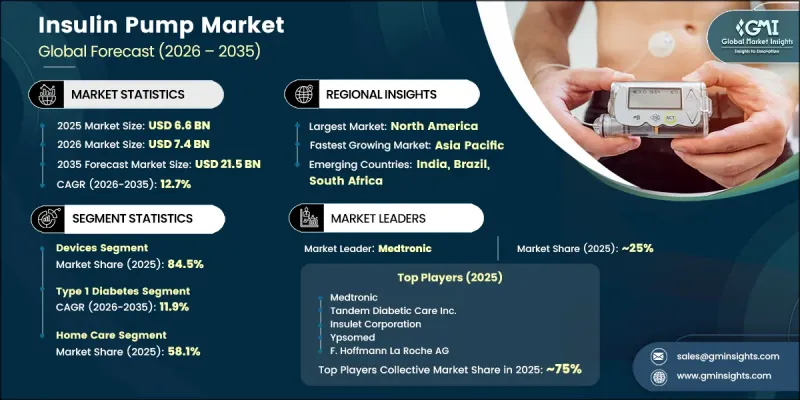
Growth is shaped by the intersection of an expanding diabetic population, rapid advancement in automated insulin delivery technologies, and increasing reimbursement coverage across major healthcare systems in North America, Europe, and parts of the Asia Pacific. The market has evolved into a highly differentiated ecosystem where competitive positioning is defined by algorithm performance, device interoperability, and user-centric design rather than basic drug delivery functionality. While Type 1 diabetes patients remain the core user base for insulin pump therapy, adoption among Type 2 diabetes patients requiring intensive insulin regimens is steadily increasing, particularly where reimbursement frameworks support broader access. Rising disease prevalence across key regions continues to expand the overall addressable population faster than demographic growth trends, reinforcing long-term market expansion.
| Market Scope | |
|---|---|
| Start Year | 2025 |
| Forecast Year | 2026-2035 |
| Start Value | $6.6 Billion |
| Forecast Value | $21.5 Billion |
| CAGR | 12.7% |
The device segment accounted for 84.5% share in 2025 and is expected to grow at a CAGR of 12.4% through 2035. This category includes both traditional tubed pumps and tubeless patch-based systems, with patch devices gaining stronger adoption due to improved comfort, discretion, and ease of use. Growth in this segment is supported by both new patient uptake and replacement cycles, as users increasingly transition toward automated insulin delivery systems with advanced digital control features and improved clinical performance.
The home care segment held a 58.1% share in 2025 and is projected to grow at a CAGR of 13% through 2035, maintaining its leading position across the forecast period. This dominance reflects the design direction of modern insulin pump technologies, which are built to support independent patient use outside clinical settings. Improved automation, intuitive interfaces, and continuous glucose integration have enabled patients to manage therapy effectively at home, reducing dependency on hospital-based administration and supporting long-term outpatient adoption.
North America Insulin Pump Market accounted for 42.7% share, growing at a CAGR of 11.7% through 2035. The United States represents the largest contributor within the region, supported by high insulin pump penetration among Type 1 diabetes patients and strong insurance coverage across public and private healthcare programs. Established reimbursement structures and advanced diabetes management infrastructure continue to reinforce regional dominance.
Major players operating in the global insulin pump market include Medtronic plc, Insulet Corporation, Tandem Diabetes Care Inc., Ypsomed, F. Hoffmann-La Roche AG, CamDiab, Terumo Corporation, ViCentra B.V., SOOIL, Debiotech S.A., Lenomed Medical, MicroPort Scientific Corporation, Beta Bionics, EOFlow, CeQur, Medtrum, and MannKind Corporation. Companies in the insulin pump market are strengthening their competitive position through continuous innovation in automated insulin delivery algorithms that improve glycemic control and reduce user intervention. They are investing heavily in connected ecosystems that integrate pumps with continuous glucose monitoring systems and mobile applications for real-time data tracking. Strategic partnerships with digital health platforms and healthcare providers are expanding patient engagement and improving treatment adherence. Manufacturers are also focusing on expanding reimbursement approvals across new geographies and diabetes segments to widen patient access. Product miniaturization and comfort-driven design improvements are being prioritized to enhance user adoption and retention.
Table of Contents
Chapter 1 Research Methodology
- 1.1 Research approach
- 1.2 Quality commitments
- 1.2.1 GMI AI policy & data integrity commitment
- 1.2.1.1 Source consistency protocol
- 1.2.1 GMI AI policy & data integrity commitment
- 1.3 Research trail & confidence scoring
- 1.3.1 Research trail components
- 1.3.2 Scoring components
- 1.4 Data collection
- 1.4.1 Partial list of primary sources
- 1.5 Data mining sources
- 1.5.1 Paid sources
- 1.5.1.1 Sources, by region
- 1.5.1 Paid sources
- 1.6 Base estimates and calculations
- 1.6.1 Base year calculation
- 1.7 Forecast model
- 1.7.1 Quantified market impact analysis
- 1.7.1.1 Mathematical impact of growth parameters on forecast
- 1.7.1 Quantified market impact analysis
- 1.8 Research transparency addendum
- 1.8.1 Source attribution framework
- 1.8.2 Quality assurance metrics
- 1.8.3 Our commitment to trust
Chapter 2 Executive Summary
- 2.1 Industry 360° synopsis
- 2.2 Key market trends
- 2.2.1 Regional trends
- 2.2.2 Product trends
- 2.2.3 Indication trends
- 2.2.4 End use trends
- 2.3 CXO perspectives: Strategic imperatives
Chapter 3 Industry Insights
- 3.1 Industry ecosystem analysis
- 3.2 Industry impact forces
- 3.2.1 Growth drivers
- 3.2.1.1 Rising Prevalence of Diabetes
- 3.2.1.2 Technological Advancements in Insulin Pumps
- 3.2.1.3 Favourable Device Insurance and Reimbursement Policies
- 3.2.1.4 Increasing Healthcare Expenditure
- 3.2.2 Industry pitfalls and challenges
- 3.2.2.1 High Cost of Insulin Pumps
- 3.2.2.2 Stringent Government Regulations
- 3.2.3 Opportunities
- 3.2.3.1 AI/ML integration and predictive analytics
- 3.2.3.2 Emerging markets expansion
- 3.2.1 Growth drivers
- 3.3 Growth potential analysis
- 3.4 Regulatory landscape
- 3.5 Pricing analysis, 2025
- 3.6 Technology and innovation landscape (Driven by Primary Research)
- 3.6.1 Current technological trends
- 3.6.2 Emerging technologies
- 3.7 Investment landscape
- 3.8 Reimbursement scenario
- 3.9 Future market trends (Driven by Primary Research)
- 3.10 Impact of AI & Generative AI on the Market (Driven by Primary Research)
- 3.11 Porter's analysis
- 3.12 PESTEL analysis
Chapter 4 Competitive Landscape, 2025
- 4.1 Introduction
- 4.2 Company matrix analysis
- 4.3 Company market share analysis (Driven by Primary Research)
- 4.3.1 Global
- 4.3.2 North America
- 4.3.3 Europe
- 4.3.4 Asia Pacific
- 4.3.5 LAMEA
- 4.4 Competitive analysis of major market players
- 4.5 Competitive positioning matrix
- 4.6 Key developments
- 4.6.1 Mergers & acquisitions
- 4.6.2 Partnerships & collaborations
- 4.6.3 New product launches
- 4.6.4 Expansion plans
Chapter 5 Market Estimates and Forecast, By Product, 2022 - 2035 ($ Mn)
- 5.1 Key trends
- 5.2 Devices
- 5.2.1 Conventional devices
- 5.2.1.1 Tubed/tethered
- 5.2.1.2 Tubeless
- 5.2.2 Automated insulin delivery (AID) system/ hybrid closed loop
- 5.2.1 Conventional devices
- 5.3 Accessories
- 5.3.1 Battery
- 5.3.2 Insulin reservoir or cartridges
- 5.3.3 Insulin set insertion devices
Chapter 6 Market Estimates and Forecast, By Indication, 2022 - 2035 ($ Mn)
- 6.1 Key trends
- 6.2 Type 1 diabetes
- 6.3 Type 2 diabetes
Chapter 7 Market Estimates and Forecast, By End Use, 2022 - 2035 ($ Mn)
- 7.1 Key trends
- 7.2 Home care
- 7.3 Hospitals and clinics
- 7.4 Other end users
Chapter 8 Market Estimates and Forecast, By Region, 2022 - 2035 ($ Mn)
- 8.1 Key trends
- 8.2 North America
- 8.2.1 U.S.
- 8.2.2 Canada
- 8.3 Europe
- 8.3.1 Germany
- 8.3.2 UK
- 8.3.3 France
- 8.3.4 Spain
- 8.3.5 Italy
- 8.3.6 Netherlands
- 8.4 Asia Pacific
- 8.4.1 China
- 8.4.2 Japan
- 8.4.3 India
- 8.4.4 Australia
- 8.4.5 South Korea
- 8.5 Latin America
- 8.5.1 Brazil
- 8.5.2 Mexico
- 8.5.3 Argentina
- 8.6 MEA
- 8.6.1 South Africa
- 8.6.2 Saudi Arabia
- 8.6.3 UAE
Chapter 9 Company Profiles
- 9.1 Beta Bionics
- 9.2 CeQur
- 9.3 Debiotech S.A.
- 9.4 EOFLOW
- 9.5 F. Hoffmann La Roche AG
- 9.6 Insulet Corporation
- 9.7 Lenomed Medical
- 9.8 MannKind Corporation
- 9.9 Medtronic plc
- 9.10 Medtrum
- 9.11 MicroPort Scientific Corporation
- 9.12 SOOIL
- 9.13 Tandem Diabetic Care Inc.
- 9.14 Terumo Corporation
- 9.15 ViCentra B.V.
- 9.16 Ypsomed

