PUBLISHER: Global Market Insights Inc. | PRODUCT CODE: 2071410

PUBLISHER: Global Market Insights Inc. | PRODUCT CODE: 2071410
Crop Monitoring Market Opportunity, Growth Drivers, Industry Trend Analysis, and Forecast 2026 - 2035
The Global Crop Monitoring Market was valued at USD 3.3 billion in 2025 and is estimated to grow at a CAGR of 14.1% to reach USD 12.2 billion by 2035.
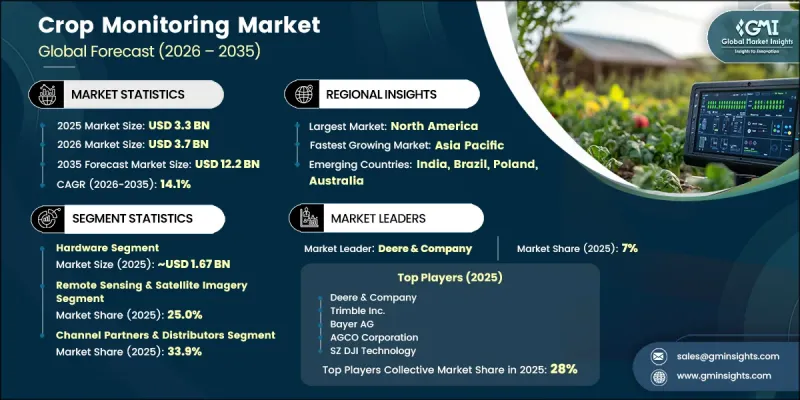
Market growth is fueled by the rapid adoption of precision agriculture practices across both developed and emerging agricultural economies. Increasing accessibility of satellite-based data, expanding deployment of Internet of Things (IoT) sensors, and rising demand for data-driven farming decisions are creating substantial opportunities throughout the industry. Farmers and agricultural enterprises are increasingly investing in technologies that help optimize resource utilization, improve crop productivity, reduce operational costs, and enhance yield predictability. A major transformation shaping the crop monitoring market is the transition from standalone hardware systems toward integrated digital platforms that combine data collection, analytics, and decision-support capabilities. Cloud-based agricultural solutions are becoming increasingly important as they enable scalable deployment, faster data processing, improved accessibility, and recurring service-based revenue models. Supportive agricultural policies and sustainability-focused initiatives are further accelerating technology adoption, strengthening the long-term growth outlook for the crop monitoring industry.
| Market Scope | |
|---|---|
| Start Year | 2025 |
| Forecast Year | 2026-2035 |
| Start Value | $3.3 Billion |
| Forecast Value | $12.2 Billion |
| CAGR | 14.1% |
The hardware segment held a 50.5% share, generating USD 1.67 billion in 2025. Although hardware is expected to experience a gradual decline in overall market share to approximately 45%, this shift reflects the faster expansion of software and service offerings rather than reduced demand for hardware solutions. Continued investments in advanced monitoring equipment, connected field devices, remote sensing technologies, and agricultural data collection infrastructure remain key drivers supporting segment growth across global farming markets.
The remote sensing and satellite imagery segment accounted for 25% share in 2025, generating USD 830 million. Growing availability of high-resolution agricultural imagery and improvements in remote sensing technologies are expanding access to advanced monitoring capabilities across a wider range of agricultural operations. Declining costs associated with data acquisition and image analysis have increased adoption among commercial farms, agricultural organizations, and public-sector stakeholders. As a result, remote sensing technologies are becoming an increasingly important component of precision agriculture strategies aimed at improving crop performance, resource management, and operational efficiency.
North America Crop Monitoring Market held 38% share in 2025, equivalent to USD 1.3 billion. The region's leadership position is supported by the presence of large-scale commercial farming operations, advanced agricultural infrastructure, and widespread adoption of digital farming technologies. High levels of technology integration, strong connectivity infrastructure, and a well-established ecosystem of agricultural technology providers continue to drive demand for crop monitoring solutions. The region also benefits from increasing investments in precision agriculture and farm management technologies, which support the adoption of integrated monitoring platforms and advanced data analytics tools across the agricultural sector.
Major companies operating in the global crop monitoring market include Aerobotics, AGCO Corporation, Bayer AG, CNH Industrial, Corteva Agriscience, Cropin Technology Solutions, CropX Technologies, Deere & Company, Farmers Edge Inc., Hummingbird Technologies, Pessl Instruments GmbH, Planet Labs PBC, SatSure Analytics, Semios, Sentera Inc., SZ DJI Technology, Topcon Corporation, Trimble Inc., XAG Co. Ltd., and Yara International. Companies operating in the crop monitoring market are implementing a variety of strategic initiatives to strengthen their competitive position and expand market share. Investment in research and development remains a top priority as organizations focus on enhancing data analytics, artificial intelligence capabilities, predictive modeling, and precision agriculture technologies. Many market participants are expanding their software platforms to provide integrated solutions that combine remote sensing, IoT connectivity, and real-time farm intelligence. Strategic partnerships, acquisitions, and collaborations are helping companies broaden their geographic reach and strengthen technology portfolios. Businesses are also investing in cloud-based infrastructure and subscription-based service models to create recurring revenue streams and improve customer retention.
Table of Contents
Chapter 1 Research Methodology
- 1.1 Research approach
- 1.2 Quality Commitments
- 1.2.1 GMI AI policy & data integrity commitment
- 1.2.1.1 Source consistency protocol
- 1.2.1 GMI AI policy & data integrity commitment
- 1.3 Research Trail & Confidence Scoring
- 1.3.1 Research Trail Components
- 1.3.2 Scoring Components
- 1.4 Data Collection
- 1.4.1 Partial list of primary sources
- 1.5 Data mining sources
- 1.5.1 Paid sources
- 1.5.1.1 Sources, by region
- 1.5.1 Paid sources
- 1.6 Base estimates and calculations
- 1.6.1 Base year calculation for any one approach
- 1.7 Forecast model
- 1.7.1 Quantified market impact analysis
- 1.7.1.1 Mathematical impact of growth parameters on forecast
- 1.7.1 Quantified market impact analysis
- 1.8 Research transparency addendum
- 1.8.1 Source attribution framework
- 1.8.2 Quality assurance metrics
- 1.8.3 Our commitment to trust
Chapter 2 Executive Summary
- 2.1 Industry 360° synopsis, 2022 - 2035
- 2.2 Key market trends
- 2.2.1 Regional
- 2.2.2 Type
- 2.2.3 Technology
- 2.2.4 Application
- 2.2.5 Crop Type
- 2.2.6 Distribution Channel
Chapter 3 Industry Insights
- 3.1 Industry ecosystem analysis
- 3.1.1 Factor affecting the value chain
- 3.1.2 Profit margin analysis
- 3.1.3 Disruptions
- 3.1.4 Future outlook
- 3.1.5 Manufacturers
- 3.1.6 Distributors
- 3.2 Supplier landscape
- 3.3 Key news & initiatives
- 3.4 Technology & Innovation Landscape
- 3.5 Regulatory landscape
- 3.6 Impact on forces
- 3.6.1 Growth drivers
- 3.6.2 Industry pitfalls & challenges
- 3.6.3 Opportunities
- 3.7 Pricing analysis, 2025 (driven by primary research)
- 3.7.1 Historical price trend analysis (2022-2025)
- 3.7.2 Pricing strategy by player type (premium/value/cost-plus)
- 3.7.3 Regional price variation analysis
- 3.8 Growth potential analysis
- 3.9 Porter's analysis
- 3.10 PESTEL analysis
- 3.11 Trade data analysis (driven by paid database)
- 3.11.1 Import/export volume & value trends (Driven by Primary Research)
- 3.11.2 Key trade corridors & tariff impact (Driven by Primary Research)
- 3.12 Impact of AI & generative AI on the market
- 3.12.1 AI-driven disruption of existing business models
- 3.12.2 GenAI use cases & adoption roadmap by segment
- 3.12.3 Risks, limitations & regulatory considerations
- 3.13 Capacity & Production Landscape (Driven by Primary Research)
- 3.13.1 Installed Capacity by Region & Key Producer (Driven by Primary Research)
- 3.13.2 Capacity Utilization Rates & Expansion Pipelines (Driven by Primary Research)
Chapter 4 Competitive Landscape, 2025
- 4.1 Introduction
- 4.2 Company market share analysis
- 4.3 Competitive positioning matrix
- 4.4 Strategic outlook matrix
- 4.5 Competitive analysis of major market players
- 4.6 Key developments
- 4.6.1 Mergers & acquisitions
- 4.6.2 Partnerships & collaborations
- 4.6.3 New product launches
- 4.6.4 Expansion plans
Chapter 5 Market Estimates & Forecast, By Type, 2022 - 2035, (USD Billion) (Thousand Units)
- 5.1 Key trends
- 5.2 Hardware
- 5.3 Software
- 5.4 Services
Chapter 6 Market Estimates & Forecast, By Technology, 2022 - 2035, (USD Billion) (Thousand Units)
- 6.1 Key trends
- 6.2 Remote Sensing & Satellite Imagery
- 6.3 UAV / Drone-Based Monitoring
- 6.4 IoT & Ground Sensors
- 6.5 AI & Machine Learning Analytics
- 6.6 Variable Rate Technology (VRT)
- 6.7 Others (GPS/GIS, Cloud, Blockchain)
Chapter 7 Market Estimates & Forecast, By Application, 2022 - 2035, (USD Billion) (Thousand Units)
- 7.1 Key trends
- 7.2 Crop Health Monitoring
- 7.3 Soil Monitoring
- 7.4 Yield Monitoring & Forecasting
- 7.5 Pest & Disease Detection
- 7.6 Field Mapping
- 7.7 Irrigation Management
- 7.8 Weather Tracking & Forecasting
- 7.9 Others (VRA, Carbon Credit)
Chapter 8 Market Estimates & Forecast, By Crop Type, 2022 - 2035, (USD Billion) (Thousand Units)
- 8.1 Key trends
- 8.2 Cereals & Grains
- 8.3 Oilseeds & Pulses
- 8.4 Fruits & Flowers
- 8.5 Stem & Tubers
- 8.6 Other (Plantation Crops, Forestry, etc.)
Chapter 9 Market Estimates & Forecast, By Distribution Channel, 2022 - 2035, (USD Billion) (Thousand Units)
- 9.1 Key trends
- 9.2 Direct Sales
- 9.3 Channel Partners & Distributors
- 9.4 Online / E-Commerce
- 9.5 OEM & System Integrators
Chapter 10 Estimates & Forecast, By Region, 2022 - 2035, (USD Billion) (Million Units)
- 10.1 Key trends
- 10.2 North America
- 10.2.1 U.S.
- 10.2.2 Canada
- 10.3 Europe
- 10.3.1 Germany
- 10.3.2 U.K.
- 10.3.3 France
- 10.3.4 Italy
- 10.3.5 Spain
- 10.4 Asia Pacific
- 10.4.1 China
- 10.4.2 India
- 10.4.3 Japan
- 10.4.4 South Korea
- 10.4.5 Australia
- 10.5 Latin America
- 10.5.1 Brazil
- 10.5.2 Mexico
- 10.5.3 Argentina
- 10.6 MEA
- 10.6.1 UAE
- 10.6.2 Saudi Arabia
- 10.6.3 South Africa
Chapter 11 Company Profiles (Business Overview, Financial Data, Product Landscape, Strategic Outlook, SWOT Analysis)
- 11.1 Global players
- 11.1.1 Deere & Company
- 11.1.2 Trimble Inc.
- 11.1.3 Bayer AG
- 11.1.4 AGCO Corporation
- 11.1.5 SZ DJI Technology
- 11.1.6 Corteva Agriscience
- 11.1.7 Topcon Corporation
- 11.1.8 Planet Labs PBC
- 11.2 Regional players
- 11.2.1 CNH Industrial
- 11.2.2 Yara International
- 11.2.3 XAG Co. Ltd.
- 11.2.4 Pessl Instruments GmbH
- 11.2.5 Cropin Technology Solutions
- 11.2.6 Farmers Edge Inc.
- 11.2.7 CropX Technologies
- 11.3 Emerging players
- 11.3.1 Sentera Inc.
- 11.3.2 Hummingbird Technologies
- 11.3.3 Semios
- 11.3.4 Aerobotics
- 11.3.5 SatSure Analytics

