PUBLISHER: Global Market Insights Inc. | PRODUCT CODE: 2071420

PUBLISHER: Global Market Insights Inc. | PRODUCT CODE: 2071420
Floating Solar PV Market Opportunity, Growth Drivers, Industry Trend Analysis, and Forecast 2026 - 2035
The Global Floating Solar PV Market was valued at USD 1.4 billion in 2025 and is estimated to grow at a CAGR of 14.1% to reach USD 6.6 billion by 2035.
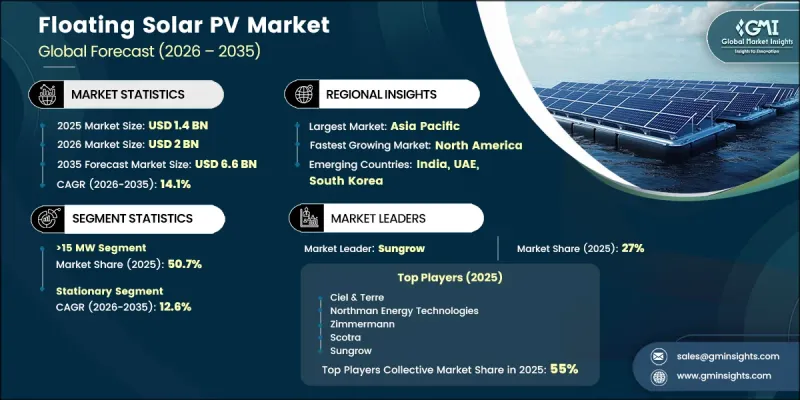
Floating solar photovoltaic systems consist of solar arrays installed on water surfaces such as reservoirs, oceans, and lakes, where panels rest on buoyant structures instead of occupying land. This configuration enables power generation without competing for terrestrial space while making use of underutilized water areas. Strong adoption is emerging from the growing integration of floating solar with hydropower facilities and the ongoing improvements in material engineering, including durable floating structures and enhanced anchoring technology. These advancements support better installation stability and longer system life. Higher energy efficiency achieved through natural cooling on water and reduced evaporation rates encourages deployment in regions with elevated temperatures or limited freshwater resources. Increasing utilization in island communities and coastal territories with minimal available land further strengthens the market outlook. New platforms made with high-density polyethylene and other resistant materials are engineered to withstand UV exposure, fluctuating weather, and marine conditions, ensuring more reliable system performance across demanding environments.
| Market Scope | |
|---|---|
| Start Year | 2025 |
| Forecast Year | 2026-2035 |
| Start Value | $1.4 Billion |
| Forecast Value | $6.6 Billion |
| CAGR | 14.1% |
The capacity category above 15 MW held 50.7% share in 2025, fueled by expanding large-scale project activity, new technical capabilities, and policy-driven support. Growing adoption in nations such as China, South Korea, and India continues to elevate utility-scale floating systems that contribute substantial power to national grids. These installations often benefit from shared infrastructure with hydropower facilities, reducing integration costs and improving financial feasibility, which has encouraged broader investor participation.
The tracking technology segment is projected to grow at a CAGR of 18.9% through 2035. Rising emphasis on maximizing solar yield is strengthening demand for advanced tracking configurations suitable for water-based projects. Countries, including Portugal and Spain, are focusing on improving renewable energy output while balancing land constraints, contributing to increased installations. Enhancements in tracking design tailored for floating environments continue to improve system adaptability and long-term reliability.
North America Floating Solar PV Market is expected to grow at a CAGR of 30.2% by 2035. Regional growth is tied to state-level renewable initiatives and incentives that encourage the adoption of innovative solar technologies. Manufacturers such as Sungrow Group and others are developing customized floating modules capable of withstanding varying climate conditions across the region.
Key participants in the Global Floating Solar PV Market include Amoy Solar Tech, Ciel & Terre International, China Three Gorges New Energy, Floatex Solar, Intech Clean Energy, First Solar, Kyocera Corporation, Jinko Solar, Longi Solar, Ocean Sun, Scotra, SolarDeck, Swimsol, Sharp Corporation, Statkraft, Sungrow Group, Vikram Solar, Zimmermann PV, Eni Energy Solutions, and Yingli Solar. Key strategies adopted by companies in the Floating Solar PV Market aim to enhance performance, reduce installation complexities, and broaden global project footprints. Many firms are investing heavily in advanced float materials designed to improve durability and resistance in marine and freshwater environments. Companies are also focusing on modular system designs that simplify assembly and reduce construction timelines. Partnerships with utilities and government agencies help accelerate deployment across hydropower reservoirs and water treatment facilities.
Table of Contents
Chapter 1 Methodology & Scope
- 1.1 Research design
- 1.2 Quality commitment
- 1.2.1 GMI AI policy & data integrity commitment
- 1.2.1.1 Source consistency protocol
- 1.2.1 GMI AI policy & data integrity commitment
- 1.3 Research Trail & Confidence Scoring
- 1.3.1 Research trail components
- 1.3.2 Scoring components
- 1.4 Data Collection
- 1.4.1 Partial list of primary sources
- 1.5 Data mining sources
- 1.5.1 Paid sources
- 1.5.1.1 Sources, by region
- 1.5.1 Paid sources
- 1.6 Base estimates and calculations
- 1.6.1 Base year calculation for any one approach
- 1.7 Forecast model
- 1.8 Research transparency addendum
- 1.8.1 Source attribution framework
- 1.8.2 Quality assurance metrics
- 1.8.3 Our commitment to trust
- 1.9 Market definitions
Chapter 2 Executive Summary
- 2.1 Industry 360-degree synopsis, 2022 - 2035
- 2.2 Business trends
- 2.3 Capacity trends
- 2.4 Product trends
- 2.5 Location trends
- 2.6 Regional trends
Chapter 3 Industry Insights
- 3.1 Industry ecosystem
- 3.2 Regulatory landscape
- 3.2.1 Inland water body regulations
- 3.2.2 Near-shore & coastal zone regulations
- 3.2.3 Cross-jurisdictional compliance
- 3.3 Major floating solar PV projects
- 3.3.1 Operational
- 3.3.2 Upcoming
- 3.4 Industry impact forces
- 3.4.1 Growth drivers
- 3.4.2 Industry pitfalls & challenges
- 3.5 Growth potential analysis
- 3.6 Cost structure analysis
- 3.7 Price trend analysis
- 3.7.1 Historic price trend analysis by segment
- 3.7.2 Pricing strategy by player type
- 3.8 Porter's analysis
- 3.8.1 Bargaining power of suppliers
- 3.8.2 Bargaining power of buyers
- 3.8.3 Threat of new entrants
- 3.8.4 Threat of substitutes
- 3.9 PESTEL analysis
- 3.9.1 Political factors
- 3.9.2 Economic factors
- 3.9.3 Social factors
- 3.9.4 Technological factors
- 3.9.5 Legal factors
- 3.9.6 Environmental factors
- 3.10 Emerging opportunities & trends
- 3.11 Digitalization & IoT integration
- 3.12 Investment analysis and future outlook
Chapter 4 Competitive landscape, 2026
- 4.1 Introduction
- 4.2 Company market share analysis, by region, 2025
- 4.2.1 North America
- 4.2.2 Europe
- 4.2.3 Asia Pacific
- 4.2.4 Middle East & Africa
- 4.2.5 Latin America
- 4.3 Competitive analysis of major market players
- 4.4 Competitive positioning matrix
- 4.5 Key developments
- 4.5.1 Mergers & acquisitions
- 4.5.2 Partnerships & collaborations
- 4.5.3 New product launches
- 4.5.4 Expansion plans & funding
- 4.6 Company tier benchmarking
- 4.6.1 Tier classification criteria & qualifying thresholds
- 4.6.2 Tier positioning matrix by revenue, geography & innovation
Chapter 5 Market Size and Forecast, By Capacity, 2022 - 2035 (USD Billion & MW)
- 5.1 Key trends
- 5.2 <5 MW
- 5.3 5-15 MW
- 5.4 >15 MW
Chapter 6 Market Size and Forecast, By Product, 2022 - 2035 (USD Billion & MW)
- 6.1 Key trends
- 6.2 Stationary
- 6.3 Tracking
Chapter 7 Market Size and Forecast, By Location, 2022 - 2035 (USD Billion & MW)
- 7.1 Key trends
- 7.2 Inland
- 7.3 Near Shore
Chapter 8 Market Size and Forecast, By Region, 2022 - 2035 (USD Billion & MW)
- 8.1 Key trends
- 8.2 North America
- 8.2.1 U.S.
- 8.2.2 Canada
- 8.3 Europe
- 8.3.1 Germany
- 8.3.2 France
- 8.3.3 Netherlands
- 8.3.4 Italy
- 8.3.5 Norway
- 8.4 Asia Pacific
- 8.4.1 China
- 8.4.2 Japan
- 8.4.3 South Korea
- 8.4.4 India
- 8.4.5 Indonesia
- 8.5 Middle East & Africa
- 8.5.1 Morocco
- 8.5.2 UAE
- 8.6 Latin America
- 8.6.1 Brazil
- 8.6.2 Chile
Chapter 9 Company Profiles
- 9.1 Amoy Solar Tech
- 9.2 China Three Gorges New Energy
- 9.3 Ciel & Terre International
- 9.4 Eni Energy Solutions
- 9.5 First Solar
- 9.6 Floatex Solar
- 9.7 Intech Clean Energy
- 9.8 Jinko Solar
- 9.9 Kyocera Corporation
- 9.10 Longi Solar
- 9.11 Ocean Sun
- 9.12 Scotra
- 9.13 SolarDeck
- 9.14 Sungrow Power Supply
- 9.15 Statkraft
- 9.16 Swimsol
- 9.17 Sharp Corporation
- 9.18 Vikram Solar
- 9.19 Yingli Solar
- 9.20 Zimmermann PV

