PUBLISHER: Global Market Insights Inc. | PRODUCT CODE: 2083058

PUBLISHER: Global Market Insights Inc. | PRODUCT CODE: 2083058
North America Industrial Fans and Blowers Market Opportunity, Growth Drivers, Industry Trend Analysis, and Forecast 2026 - 2035
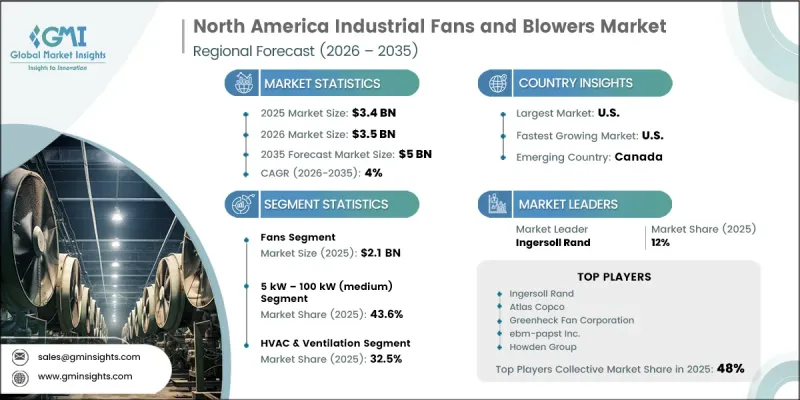
North America Industrial Fans and Blowers Market was valued at USD 3.4 billion in 2025 and is estimated to grow at a CAGR of 4% to reach USD 5 billion by 2035.
The market benefits from a well-established industrial base, widespread adoption of energy-efficient technologies, and increasing emphasis on maintaining air quality standards across industrial and commercial environments. Demand is being supported by ongoing investments in modern ventilation and air movement systems designed to improve operational performance while reducing energy consumption. Industrial facilities across North America are increasingly prioritizing solutions that support regulatory compliance, optimize environmental conditions, and enhance overall productivity. The market also continues to benefit from technological advancements that improve system reliability, performance monitoring, and operational efficiency. Growing awareness of lifecycle costs and long-term energy savings is encouraging end users to invest in upgraded equipment that delivers sustainable performance. As industries continue to modernize infrastructure and improve facility operations, demand for advanced industrial fans and blowers is expected to remain consistently strong throughout the forecast period.
| Market Scope | |
|---|---|
| Start Year | 2025 |
| Forecast Year | 2026-2035 |
| Start Value | $3.4 Billion |
| Forecast Value | $5 Billion |
| CAGR | 4% |
Industrial fans and blowers have become integral components within a wide range of industrial and commercial applications, supporting airflow management, environmental control, and operational efficiency objectives. Modern systems increasingly incorporate advanced technologies that enhance performance, improve energy utilization, and provide greater operational visibility. The market is being driven by the need to reduce operating expenses, meet environmental requirements, and maintain optimal conditions within industrial facilities. Purchasing decisions are increasingly influenced by factors such as energy efficiency, lifecycle value, maintenance requirements, and overall ownership costs. At the same time, organizations across the United States and Canada are recognizing these systems as critical investments that contribute directly to productivity, reliability, and long-term operational sustainability.
The fans segment held a 61.4% share, generating USD 2.1 billion in 2025. Strong demand for dependable airflow solutions continues to support segment growth across industrial, commercial, and institutional facilities. The widespread use of fan systems for ventilation, temperature management, and air circulation applications has reinforced their dominant market position. Continued investments in building infrastructure and industrial modernization projects are further contributing to demand. The segment's sustained growth is also supported by the need for versatile and energy-efficient solutions capable of addressing a broad range of airflow requirements across different operating environments.
The 5 kW-100 kW medium-power segment represented 43.6% share in 2025. Equipment within this power range provides an effective combination of airflow performance, energy efficiency, and cost optimization, making it suitable for a wide variety of industrial and commercial applications. The segment continues to gain traction due to its ability to meet the operational requirements of many facilities while maintaining favorable economics. As organizations seek solutions that balance performance with energy management objectives, medium-capacity systems remain a preferred choice across numerous end-use sectors.
United States Industrial Fans and Blowers Market captured USD 2.9 billion in 2025 and projected to grow at a CAGR of 3.1% through 2035. Market growth is supported by strong awareness of energy conservation, increasing demand for dependable equipment, and an established distribution and service infrastructure. End users are placing greater emphasis on energy performance, compliance with operational standards, long-term ownership value, and access to comprehensive technical support. These considerations continue to influence purchasing behavior across industrial facilities, commercial properties, and institutional organizations, reinforcing the country's position as the leading regional market.
Key companies operating in the Global North America Industrial Fans and Blowers Market include Aerzen USA Corporation, AirPro Fan & Blower Company, Atlas Copco, Chicago Blower Corporation, ebm-papst Inc., FlaktGroup, Greenheck Fan Corporation, Hartzell Air Movement, Howden Group, IB International Inc., Ingersoll Rand, Loren Cook Company, Moffitt Corporation, New York Blower Company, Northern Blower Inc., Patterson Fan Company Inc., ProcessBarron, Robinson Fans Inc., SPX Technologies, Triangle Engineering of Arkansas Inc., and Twin City Fan Companies Ltd. Companies operating in the The market are focusing on innovation, strategic collaborations, and platform expansion to strengthen their market position. Investments in artificial intelligence, advanced analytics, soil monitoring technologies, and carbon measurement capabilities are helping companies deliver more comprehensive solutions to agricultural stakeholders. Many market participants are establishing partnerships with growers, agribusinesses, food companies, and sustainability-focused organizations to accelerate adoption and expand market reach.
Table of Contents
Chapter 1 Methodology & Scope
- 1.1 Market scope & definitions
- 1.2 Research design
- 1.2.1 Research approach
- 1.2.2 Data collection methods
- 1.3 Base estimates and calculations
- 1.3.1 Base year calculation
- 1.3.2 Market estimates & forecasts parameters
- 1.4 Forecast Model
- 1.4.1 Key trends for market estimates
- 1.4.2 Quantified market impact analysis
- 1.4.2.1 Mathematical impact of growth parameters on forecast
- 1.4.3 Scenario analysis framework
- 1.5 Primary research and validation
- 1.5.1 Some of the primary sources (but not limited to)
- 1.6 Data mining sources
- 1.6.1 Paid Sources
- 1.7 Primary research and validation
- 1.7.1 Primary sources
- 1.8 Research Trail & confidence scoring
- 1.8.1 Research trail components
- 1.8.2 Scoring components
- 1.9 Research transparency addendum
- 1.9.1 Source attribution framework
- 1.9.2 Quality assurance metrics
- 1.9.3 Our commitment to trust
- 1.10 Market Definitions
Chapter 2 Executive Summary
- 2.1 Industry snapshot
- 2.2 Business trends
- 2.2.1 Product type
- 2.2.2 Power
- 2.2.3 Application
- 2.2.4 End User
- 2.2.5 Distribution Channel
Chapter 3 Industry Insights
- 3.1 Industry ecosystem analysis
- 3.1.1 Supplier landscape
- 3.1.2 Profit margin
- 3.1.3 Value addition at each stage
- 3.1.4 Factor affecting the value chain
- 3.2 Industry impact forces
- 3.2.1 Growth drivers
- 3.2.2 Industry pitfalls & challenges
- 3.2.3 Opportunities
- 3.3 Growth potential analysis
- 3.4 Future market trends
- 3.5 Technology and innovation landscape
- 3.5.1 Current technological trends
- 3.5.2 Emerging technologies
- 3.6 Price trends (Driven by Primary Research)
- 3.6.1 Historical Price Trend Analysis, 2019-2024 (Driven by Primary Research)
- 3.6.2 Pricing Strategy by Player Type (Driven by Primary Research)
- 3.7 Regulatory framework
- 3.8 Major market trends and disruptions
- 3.9 Future market trend
- 3.10 Technology disruption assessment
- 3.11 Porter's five forces analysis
- 3.12 PESTEL analysis
- 3.13 Trade Data Analysis (Driven by Primary Research - ITC Trade Map, USITC)
- 3.13.1 Import/Export Volume & Value Trends - North America (HS Code 8414) (Driven by Primary Research)
- 3.13.2 Key Trade Corridors & Tariff Impact (Driven by Primary Research)
- 3.14 Impact of AI & Generative AI on the Industrial Fans & Blowers Market
- 3.14.1 AI-Driven Disruption of Existing Business Models
- 3.14.2 GenAI Use Cases & Adoption Roadmap by Segment
- 3.14.3 Risks, Limitations & Regulatory Considerations
- 3.15 Capacity & Production Landscape (Driven by Primary Research)
- 3.15.1 Manufacturing Capacity Installed by Region & Key Producer (Driven by Primary Research)
- 3.15.2 Capacity Utilization Rates & Expansion Pipelines
Chapter 4 Competitive Landscape, 2025
- 4.1 Introduction
- 4.2 North America market share Breakdown by Player, 2025
- 4.3 Company Tier Benchmarking
- 4.4 Competitive Positioning Matrix analysis
- 4.5 Competitive analysis of major market players
- 4.6 Key developments
- 4.6.1 Mergers & acquisitions
- 4.6.2 Partnerships & collaborations
- 4.6.3 New product launches
- 4.6.4 Market entry and expansion plans
Chapter 5 Market Estimates and Forecast, By Product type, 2022 - 2035 (USD Billion, Thousand Units)
- 5.1 Key trends
- 5.2 Fans
- 5.2.1 Axial Fans
- 5.2.1.1 Propeller Fans
- 5.2.1.2 Tube Axial Fans
- 5.2.1.3 Vane Axial Fans
- 5.2.2 Centrifugal Fans
- 5.2.2.1 Forward-Curved Blade Fans
- 5.2.2.2 Backward-Curved / Backward-Inclined Blade Fans
- 5.2.2.3 Radial Blade Fans
- 5.2.3 Mixed Flow Fans
- 5.2.4 Cross Flow Fans
- 5.2.1 Axial Fans
- 5.3 Blowers
- 5.3.1 Centrifugal Blowers
- 5.3.2 Positive Displacement Blowers
- 5.3.2.1 Roots / Lobe Blowers
- 5.3.2.2 Screw Blowers
- 5.3.2.3 Sliding Vane Blowers
Chapter 6 Market Estimates and Forecast, By Power, 2022 - 2035 (USD Billion, Thousand Units)
- 6.1 Key trends
- 6.2 Up to 5 kW (Small Capacity)
- 6.3 5 kW - 100 kW (Medium Capacity)
- 6.4 100 kW - 500 kW (Large Capacity)
- 6.5 Above 500 kW (Heavy Industrial / Mission-Critical)
Chapter 7 Market Estimates and Forecast, By Application, 2022 - 2035 (USD Billion, Thousand Units)
- 7.1 Key trends
- 7.2 HVAC & Ventilation
- 7.2.1 Commercial Buildings
- 7.2.2 Industrial Facilities
- 7.2.3 Data Centers & Clean Rooms
- 7.3 Power Generation
- 7.3.1 Thermal Power
- 7.3.2 Nuclear power
- 7.3.3 Renewable Energy
- 7.4 Oil, Gas & Petrochemical
- 7.4.1 Upstream
- 7.4.2 Midstream
- 7.4.3 Downstream
- 7.5 Mining & Minerals Processing
- 7.5.1 Underground Mine Ventilation & Cooling
- 7.5.2 Surface Mining & Minerals Processing
- 7.6 Chemical Processing
- 7.7 Water & Wastewater Treatment
- 7.8 Cement & Construction Materials
- 7.9 Food & Beverage
- 7.10 Pulp, Paper & Printing
- 7.11 Others (Textile, Rubber, Plastics, Agriculture)
Chapter 8 Market Estimates and Forecast, By End User, 2022 - 2035 (USD Billion, Thousand Units)
- 8.1 Key trends
- 8.2 Industrial
- 8.2.1 Heavy Industry - Steel, Aluminum, Metals
- 8.2.2 Process Industry - Chemical, Pharma, Food Production
- 8.2.3 Energy & Utilities - Power Plants, Refineries, LNG Terminals
- 8.3 Commercial
- 8.3.1 Office and retail buildings
- 8.3.2 Hospitality and healthcare facilities
- 8.4 Municipality and infrastructure
- 8.4.1 Waste water treatment plant
- 8.4.2 Tunnel, subway and public infrastructure
Chapter 9 Market Estimates and Forecast, By Distribution Channel, 2022 - 2035 (USD Billion, Thousand Units)
- 9.1 Key trends
- 9.2 Direct
- 9.3 Indirect
Chapter 10 Market Estimates and Forecast, By Country, 2022 - 2035 (USD Billion, Thousand Units)
- 10.1 Key trends
- 10.2 North America
- 10.2.1 US
- 10.2.2 Canada
Chapter 11 Company Profiles
- 11.1 Global Player
- 11.1.1 Ingersoll Rand
- 11.1.2 Atlas Copco
- 11.1.3 Greenheck Fan Corporation
- 11.1.4 ebm-papst Inc.
- 11.1.5 Howden Group
- 11.1.6 SPX Technologies
- 11.1.7 FlaktGroup
- 11.1.8 Aerzen USA Corporation
- 11.2 Regional players
- 11.2.1 Twin City Fan Companies Ltd.
- 11.2.2 New York Blower Company
- 11.2.3 Loren Cook Company
- 11.2.4 Chicago Blower Corporation
- 11.2.5 Hartzell Air Movement
- 11.2.6 AirPro Fan & Blower Company
- 11.2.7 Robinson Fans Inc.
- 11.2.8 ProcessBarron
- 11.3 Emerging players
- 11.3.1 IB International Inc.
- 11.3.2 Patterson Fan Company Inc.
- 11.3.3 Triangle Engineering of Arkansas Inc.
- 11.3.4 Moffitt Corporation
- 11.3.5 Northern Blower Inc.

