PUBLISHER: Global Market Insights Inc. | PRODUCT CODE: 2083066

PUBLISHER: Global Market Insights Inc. | PRODUCT CODE: 2083066
Photodynamic Pesticides Market Opportunity, Growth Drivers, Industry Trend Analysis, and Forecast 2026 - 2035
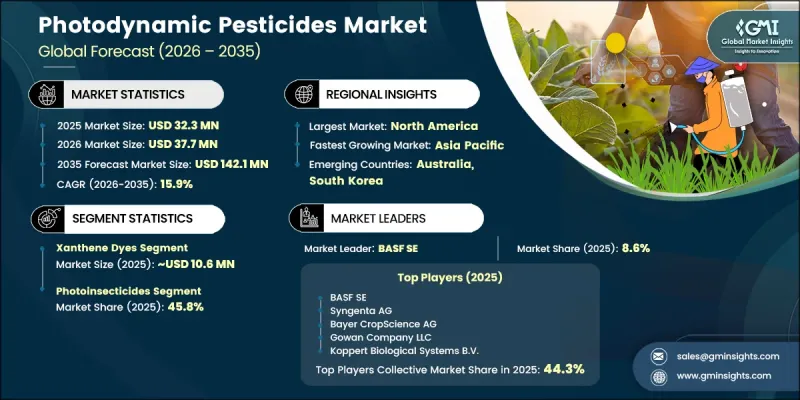
The Global Photodynamic Pesticides Market was valued at USD 32.3 million in 2025 and is estimated to grow at a CAGR of 15.9% to reach USD 142.1 million by 2035.
Market growth is driven by increasing adoption of sustainable crop protection solutions, expanding investment in bio-based agrochemicals, and accelerating technological advancements in photosensitizer development. Industry consolidation is also playing a major role, as leading agrochemical firms actively acquire biotechnology companies and license advanced photodynamic technologies to accelerate product innovation and offset challenges related to patent expirations. Growing demand for environmentally safe pesticide alternatives is further supporting market penetration, particularly as plant- and algae-derived photosensitizers improve compatibility with organic farming systems and enhance access to premium agricultural markets. Advancements in smart light activation systems, including LED-based solutions combined with improved delivery mechanisms, are further increasing treatment efficiency and extending application potential across protected cultivation systems. Additionally, expanding use of photodynamic agents in public health pest control programs is contributing to broader adoption. Overall, the market continues to evolve through strong collaboration between biotechnology developers and established agrochemical players, resulting in faster commercialization cycles and broader product availability.
| Market Scope | |
|---|---|
| Start Year | 2025 |
| Forecast Year | 2026-2035 |
| Start Value | $32.3 Million |
| Forecast Value | $142.1 Million |
| CAGR | 15.9% |
Xanthene dyes segment held a 32.8% share, generating USD 10.6 million, and is expected to grow at a CAGR of 13.6% through 2035. This segment maintains strong adoption due to its established use base, compatibility with existing agricultural spraying systems, and widespread application in horticultural production environments. Porphyrins and chlorins represent another key segment, supported by their higher photosensitizing efficiency and lower dosage requirements per application area compared to other alternatives.
The photoinsecticides segment accounted for 45.8% share in 2025. This dominance is attributed to their proven effectiveness against a broad range of agricultural pests and their increasing adoption as part of integrated pest management programs. Their commercial viability has been reinforced by growing acceptance among growers seeking sustainable pest control solutions that reduce chemical dependency while maintaining crop productivity.
North America Photodynamic Pesticides Market represented 36.2% share in 2025. Regional expansion is supported by a streamlined regulatory environment that accelerates the approval and commercialization of biopesticide products containing photosensitizing compounds. This regulatory efficiency has encouraged the introduction of multiple photodynamic formulations, strengthening product availability and driving adoption across agricultural applications.
Key companies operating in the Global Photodynamic Pesticides Market include Syngenta AG, BASF SE, Bayer CropScience AG, Koppert Biological Systems B.V., Gowan Company LLC, Certis USA LLC, AgriTitan LLC, Andermatt Group AG, and Vestaron Corporation. Companies operating in the Photodynamic Pesticides Market are focusing on strategic acquisitions, technology partnerships, and product innovation to strengthen their competitive position. A key strategy involves acquiring biotechnology firms and licensing proprietary photosensitizer technologies to accelerate research and shorten product development cycles. Manufacturers are also investing heavily in sustainable formulation development, emphasizing plant- and algae-based inputs to align with organic farming requirements and regulatory expectations. Expanding collaborations between agrochemical leaders and biotech innovators are enabling faster commercialization and broader technology integration. Companies are further enhancing product efficiency through advancements in light-activation systems and precision delivery mechanisms that improve field performance.
Table of Contents
Chapter 1 Methodology & Scope
- 1.1 Research approach
- 1.2 Quality Commitments
- 1.2.1 GMI AI policy & data integrity commitment
- 1.2.1.1 Source consistency protocol
- 1.2.1 GMI AI policy & data integrity commitment
- 1.3 Research Trail & Confidence Scoring
- 1.3.1 Research Trail Components
- 1.3.2 Scoring Components
- 1.4 Data Collection
- 1.4.1 Partial list of primary sources
- 1.5 Data mining sources
- 1.5.1 Paid sources
- 1.5.1.1 Sources, by region
- 1.5.1 Paid sources
- 1.6 Base estimates and calculations
- 1.6.1 Base year calculation for any one approach
- 1.7 Forecast model
- 1.7.1 Quantified market impact analysis
- 1.7.1.1 Mathematical impact of growth parameters on forecast
- 1.7.1 Quantified market impact analysis
- 1.8 Research transparency addendum
- 1.8.1 Source attribution framework
- 1.8.2 Quality assurance metrics
- 1.8.3 Our commitment to trust
Chapter 2 Executive Summary
- 2.1 Industry 360° synopsis
- 2.2 Key market trends
- 2.2.1 Regional
- 2.2.2 Photosensitizer type
- 2.2.3 Application
- 2.2.4 End-user
Chapter 3 Industry Insights
- 3.1 Industry ecosystem analysis
- 3.1.1 Supplier landscape
- 3.1.2 Profit margin
- 3.1.3 Value addition at each stage
- 3.1.4 Factor affecting the value chain
- 3.1.5 Disruptions
- 3.2 Industry impact forces
- 3.2.1 Growth drivers
- 3.2.1.1 Rising resistance to conventional chemical pesticides driving adoption of novel alternatives
- 3.2.1.2 Growing global demand for residue-free & environmentally benign crop protection solutions
- 3.2.1.3 Expanding regulatory approvals & government incentives for biopesticides & green chemistry
- 3.2.2 Industry pitfalls and challenges
- 3.2.2.1 Light dependency limiting efficacy under low-irradiance conditions & night-time applications
- 3.2.2.2 Limited commercial scale-up infrastructure & high production costs of purified photosensitizers
- 3.2.3 Market opportunities
- 3.2.3.1 Untapped potential in post-harvest treatment & food safety applications
- 3.2.3.2 Integration with nano-delivery systems for targeted, controlled & sustained release
- 3.2.1 Growth drivers
- 3.3 Growth potential analysis
- 3.4 Regulatory landscape
- 3.4.1 North America
- 3.4.2 Europe
- 3.4.3 Asia Pacific
- 3.4.4 Latin America
- 3.4.5 Middle East & Africa
- 3.5 Porter’s analysis
- 3.6 PESTEL analysis
- 3.7 Price trends
- 3.7.1 By region
- 3.7.2 By feedstock type
- 3.8 Future market trends
- 3.9 Technology and innovation landscape
- 3.9.1 Current technological trends
- 3.9.2 Emerging technologies
- 3.10 Patent Landscape
- 3.11 Trade statistics (HS code)
- 3.11.1 Major importing countries
- 3.11.2 Major exporting countries
- 3.12 Sustainability and environmental aspects
- 3.12.1 Sustainable practices
- 3.12.2 Waste reduction strategies
- 3.12.3 Energy efficiency in production
- 3.12.4 Eco-friendly initiatives
- 3.13 Carbon footprint consideration
Chapter 4 Competitive Landscape, 2025
- 4.1 Introduction
- 4.2 Company market share analysis
- 4.2.1 By region
- 4.2.1.1 North America
- 4.2.1.2 Europe
- 4.2.1.3 Asia Pacific
- 4.2.1.4 LATAM
- 4.2.1.5 MEA
- 4.2.1 By region
- 4.3 Competitive analysis of major market players
- 4.4 Competitive positioning matrix
- 4.5 Key developments
- 4.5.1 Mergers & acquisitions
- 4.5.2 Partnerships & collaborations
- 4.5.3 New Product Launches
- 4.5.4 Expansion Plans
Chapter 5 Market Estimates and Forecast, By Photosensitizer Type, 2022-2035 (USD Million) (Kilo Tons)
- 5.1 Key trends
- 5.2 Porphyrins & chlorins
- 5.3 Phenothiazinium dyes
- 5.4 Xanthene dyes
- 5.5 Phthalocyanines
- 5.6 Natural/bio-derived photosensitizers
- 5.7 Others
Chapter 6 Market Estimates and Forecast, By Application, 2022-2035 (USD Million) (Kilo Tons)
- 6.1 Key trends
- 6.2 Photoinsecticides
- 6.3 Photofungicides
- 6.4 Photobactericides
- 6.5 Photoherbicides
- 6.6 Others
Chapter 7 Market Estimates and Forecast, By End-User, 2022-2035 (USD Million) (Kilo Tons)
- 7.1 Key trends
- 7.2 Commercial agriculture
- 7.3 Horticulture & protected cultivation
- 7.4 Forestry & turfgrass
- 7.5 Public health & vector control
- 7.6 Others
Chapter 8 Market Estimates and Forecast, By Region, 2022-2035 (USD Million) (Kilo Tons)
- 8.1 Key trends
- 8.2 North America
- 8.2.1 U.S.
- 8.2.2 Canada
- 8.3 Europe
- 8.3.1 Germany
- 8.3.2 UK
- 8.3.3 France
- 8.3.4 Spain
- 8.3.5 Italy
- 8.3.6 Rest of Europe
- 8.4 Asia Pacific
- 8.4.1 China
- 8.4.2 India
- 8.4.3 Japan
- 8.4.4 Australia
- 8.4.5 South Korea
- 8.4.6 Rest of Asia Pacific
- 8.5 Latin America
- 8.5.1 Brazil
- 8.5.2 Mexico
- 8.5.3 Argentina
- 8.5.4 Rest of Latin America
- 8.6 Middle East and Africa
- 8.6.1 Saudi Arabia
- 8.6.2 South Africa
- 8.6.3 UAE
- 8.6.4 Rest of Middle East and Africa
Chapter 9 Company Profiles
- 9.1 BASF SE
- 9.2 AgriTitan LLC
- 9.3 Andermatt Group AG
- 9.4 Bayer CropScience AG
- 9.5 Certis USA LLC
- 9.6 Gowan Company LLC
- 9.7 Koppert Biological Systems B.V.
- 9.8 Syngenta AG
- 9.9 Vestaron Corporation

