PUBLISHER: Mordor Intelligence | PRODUCT CODE: 2114608

PUBLISHER: Mordor Intelligence | PRODUCT CODE: 2114608
Global Photodynamic Therapy - Market Share Analysis, Industry Trends & Statistics, Growth Forecasts (2026 - 2031)
According to Mordor Intelligence, the photodynamic therapy market size in 2026 is estimated at USD 5.48 billion, growing from 2025 value of USD 5.11 billion with 2031 projections showing USD 7.79 billion, growing at 7.31% CAGR over 2026-2031.
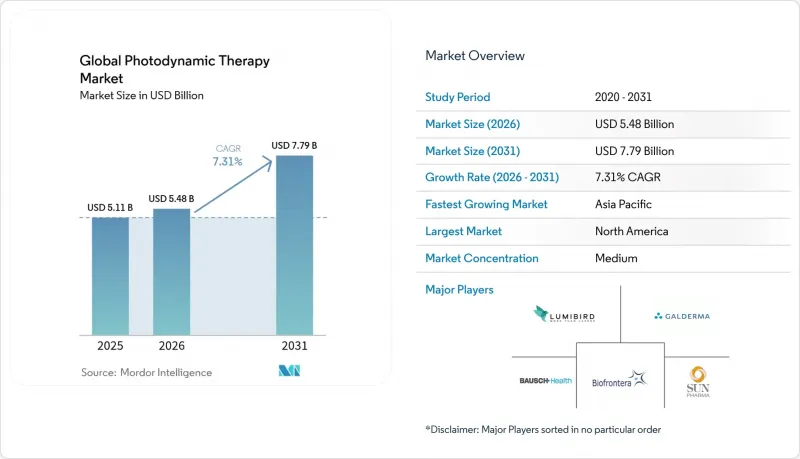
This report is Segmented by Product Type (Photosensitizer Drugs, Photodynamic Therapy Devices), by Applications (Oncology, Dermatology and More), by End-User (Hospitals, Dermatology & Skin-Cancer Clinics and More) and Geography (North America, Europe, Asia-Pacific and More). The Market Forecasts are Provided in Terms of Value (USD).
Global Photodynamic Therapy Market Trends and Insights
Rising Incidence of Non-Melanoma Skin Cancer
Basal and squamous cell carcinoma prevalence is pushing clinicians toward less invasive care options with superior cosmetic outcomes. Photodynamic therapy can achieve 90% complete clearance in superficial basal cell carcinoma while avoiding tissue loss, which appeals to patients with lesions on cosmetically sensitive areas. Organ-transplant recipients and Gorlin syndrome patients benefit from repeatable, non-scarring treatments, creating steady demand in specialist centers. As field cancerization prevention gains traction, proactive protocols amplify procedure volumes across dermatology networks.
Regulatory Approvals of Next-Generation Photosensitizers
The FDA's flexible review standards have shortened approval cycles for advanced nano-formulations that cut photosensitivity duration without sacrificing depth of action. Biofrontera's larger Ameluz dose authorization demonstrates regulators' willingness to support broader lesion coverage. Natural agents such as hypericin and curcumin move through late-stage trials, promising lower manufacturing costs that could open price-sensitive markets across Asia-Pacific.
High Capital Cost of PDT Laser Equipment
Initial outlays of USD 50,000-150,000 limit adoption among independent dermatologists, who comprise the bulk of potential sites. Leasing programs ease cash burdens but compress margins and spark obsolescence fears amid rapid device refresh cycles. Until lower-priced LED systems reach parity in all indications, the photodynamic therapy market may struggle to penetrate community practices at scale.
Other drivers and restraints analyzed in the detailed report include:
- Expanding Reimbursement for Actinic Keratosis Treatment
- Cost Decline in Diode Laser & LED Light Sources
- Patient Non-Compliance Due to Prolonged Photosensitivity
For complete list of drivers and restraints, kindly check the Table Of Contents.
Segment Analysis
Photosensitizer drugs dominated revenue with 53.02% share in 2025 and are expected to advance at an 7.85% CAGR through 2031. Third-generation formulations employing nanoparticle carriers improve tumor selectivity and shave photosensitivity windows, reinforcing leadership of this segment within the photodynamic therapy market size. Natural agents in late-stage trials may cut production expenses, supporting broader payer adoption and regional market entry in Asia-Pacific.
In contrast, light sources are evolving toward high-output LEDs that decrease procedure time and improve patient comfort. FDA clearance of the RhodoLED XL lamp, which covers wider treatment fields, indicates the pace of device innovation. AI-enabled dosimetry modules now refine fluence delivery in real time, allowing clinicians to tailor sessions, reduce retreatments, and elevate outcomes across the photodynamic therapy market.
Complete Report Scope:
- By Product Type
- Photosensitizer Drugs
- First Generation
- Second Generation
- Third-generation / targeted nano Generation / Targeted Nano
- Devices & Light Sources
- Diode Lasers
- LED Array
- Lamps Other
- Photosensitizer Drugs
- By Application
- Oncology
- Non Melanoma Skin cancer
- Actinic Keratosis
- Head & Neck / Oral Cavity Cancer
- Lung & Esophageal Cancer
- Dermatology
- Ophthalmology
- Actimicrobial/Aesthetics
- Oncology
- By End-User (Value)
- Hospitals
- Dermatology & Skin-Cancer Clinics
- Ambulatory Surgical Centers
- Research & Academic Institutes
- By Geography
- North America
- United States
- Canada
- Mexico
- Europe
- Germany
- United Kingdom
- France
- Italy
- Spain
- Rest of Europe
- Asia-Pacific
- China
- India
- Japan
- South Korea
- Australia
- Rest of Asia-Pacific
- South America
- Brazil
- Argentina
- Rest of South America
- Middle East and Africa
- GCC
- South Africa
- Rest of Middle East and Africa
- North America
Geography Analysis
North America commanded 41.88% of global sales in 2025 as favorable reimbursement and the world's highest skin cancer incidence sustained steady procedural volumes. Multiple FDA clearances in 2024, including Valeda for dry AMD, reinforced clinical confidence while Medicare coverage removed cost barriers modernretina.com. Provincial health agencies such as Alberta's technology assessment office confirm PDT's cost-effectiveness, hinting at future funding expansions across Canada open.alberta.ca. Cross-border medical tourism from Mexico adds incremental demand at specialized U.S. centers, solidifying the photodynamic therapy market's regional base.
Asia-Pacific is projected to post a rapid 8.74% CAGR between 2026 and 2031. China's December 2024 expert consensus on aminolevulinic acid established unified protocols that lower clinical adoption friction . Japan's aging population fuels macular degeneration procedures, and its stringent device standards boost trust in locally cleared systems. South Korea's export-oriented medical device sector offers cost-competitive LED units, enhancing affordability for regional providers. India's large unmet oncologic need presents a long-range opportunity once infrastructure and reimbursement frameworks mature, adding depth to the photodynamic therapy market.
Europe sustains moderate growth under harmonized device regulations that simplify multi-country launches. Daylight-PDT, pioneered in Nordic clinics, addresses photosensitivity compliance and now spreads across Mediterranean nations. Germany and the United Kingdom operate flagship academic programs that test nano-formulations and AI dosimetry, strengthening evidence for broader reimbursement. Cosmetic outcome priorities resonate with PDT's tissue-sparing profile, driving steady referrals for facial lesion management and reinforcing the photodynamic therapy market's resilience across the continent.
- Sun Pharmaceuticals Industries
- Bausch Health
- Galderma S.A
- Biofrontera
- Modulight Corp
- Theralase Technologies Inc
- Lumibird (Quantel Medical)
- Lumenis
- AngioDynamics Inc
- Johnson & Johnson (ViaVisia)
- DUSA Pharmaceuticals Inc
- Cynosure LLC
- Bio-Litec AG
- Quest PharmaTech Inc
- OncoSec Medical Inc
- PhotoMedex Inc
- Sciton
- Vascular Solutions LLC
- Acceledent Inc
- TopLight Photonics Co. Ltd
Additional Benefits:
- The market estimate (ME) sheet in Excel format
- 3 months of analyst support
TABLE OF CONTENTS
1 Introduction
- 1.1 Study Assumptions & Market Defination
- 1.2 Scope of Study
2 Research Methodology
3 Executive Summary
4 Market Landscape
- 4.1 Market Overview
- 4.2 Market Drivers
- 4.2.1 Rising incidence of non-melanoma skin cancer
- 4.2.2 Regulatory approvals of next-generation phot
- 4.2.3 Expanding reimbursement for actinic-keratosi
- 4.2.4 Cost decline in diode-laser & LED light-sour
- 4.2.5 Daylight-PDT deployment in primary-care sett
- 4.2.6 AI-guided real-time dosimetry optimization
- 4.3 Market Restraints
- 4.3.1 High capital cost of PDT laser equipment
- 4.3.2 Patient non-compliance due to prolonged photosensitivity
- 4.3.3 Limited reimbursement for non-oncology indications
- 4.3.4 Cold-chain gaps for liposomal photosensitizer drugs
- 4.4 Value / Supply-Chain Analysis
- 4.5 Regulatory Landscape
- 4.6 Technological Outlook
- 4.7 Porter's Five Forces
- 4.7.1 Threat of New Entrants
- 4.7.2 Bargaining Power - Suppliers
- 4.7.3 Bargaining Power - Buyers
- 4.7.4 Threat of Substitutes
- 4.7.5 Competitive Rivalry
5 Market Size & Growth Forecasts (Value, USD Million)
- 5.1 By Product Type
- 5.1.1 Photosensitizer Drugs
- 5.1.1.1 First Generation
- 5.1.1.2 Second Generation
- 5.1.1.3 Third-generation / targeted nano Generation / Targeted Nano
- 5.1.2 Devices & Light Sources
- 5.1.2.1 Diode Lasers
- 5.1.2.2 LED Array
- 5.1.2.3 Lamps Other
- 5.1.1 Photosensitizer Drugs
- 5.2 By Application
- 5.2.1 Oncology
- 5.2.1.1 Non Melanoma Skin cancer
- 5.2.1.2 Actinic Keratosis
- 5.2.1.3 Head & Neck / Oral Cavity Cancer
- 5.2.1.4 Lung & Esophageal Cancer
- 5.2.2 Dermatology
- 5.2.3 Ophthalmology
- 5.2.4 Actimicrobial/Aesthetics
- 5.2.1 Oncology
- 5.3 By End-User (Value)
- 5.3.1 Hospitals
- 5.3.2 Dermatology & Skin-Cancer Clinics
- 5.3.3 Ambulatory Surgical Centers
- 5.3.4 Research & Academic Institutes
- 5.4 By Geography
- 5.4.1 North America
- 5.4.1.1 United States
- 5.4.1.2 Canada
- 5.4.1.3 Mexico
- 5.4.2 Europe
- 5.4.2.1 Germany
- 5.4.2.2 United Kingdom
- 5.4.2.3 France
- 5.4.2.4 Italy
- 5.4.2.5 Spain
- 5.4.2.6 Rest of Europe
- 5.4.3 Asia-Pacific
- 5.4.3.1 China
- 5.4.3.2 India
- 5.4.3.3 Japan
- 5.4.3.4 South Korea
- 5.4.3.5 Australia
- 5.4.3.6 Rest of Asia-Pacific
- 5.4.4 South America
- 5.4.4.1 Brazil
- 5.4.4.2 Argentina
- 5.4.4.3 Rest of South America
- 5.4.5 Middle East and Africa
- 5.4.5.1 GCC
- 5.4.5.2 South Africa
- 5.4.5.3 Rest of Middle East and Africa
- 5.4.1 North America
6 Competitive Landscape
- 6.1 Market Concentration
- 6.2 Market Share Analysis
- 6.3 Company Profiles (includes Global level Overview, Market level overview, Core Segments, Financials as available, Strategic Information, Market Rank/Share for key companies, Products & Services, and Recent Developments)
- 6.3.1 Sun Pharmaceutical Industries Ltd
- 6.3.2 Bausch Health Companies Inc
- 6.3.3 Galderma S.A
- 6.3.4 Biofrontera AG
- 6.3.5 Modulight Corp
- 6.3.6 Theralase Technologies Inc
- 6.3.7 Lumibird (Quantel Medical)
- 6.3.8 Lumenis Be Ltd
- 6.3.9 AngioDynamics Inc
- 6.3.10 Johnson & Johnson (ViaVisia)
- 6.3.11 DUSA Pharmaceuticals Inc
- 6.3.12 Cynosure LLC
- 6.3.13 Bio-Litec AG
- 6.3.14 Quest PharmaTech Inc
- 6.3.15 OncoSec Medical Inc
- 6.3.16 PhotoMedex Inc
- 6.3.17 Sciton Inc
- 6.3.18 Vascular Solutions LLC
- 6.3.19 Acceledent Inc
- 6.3.20 TopLight Photonics Co. Ltd
7 Market Opportunities & Future Outlook
- 7.1 White-space & Unmet-Need Assessment

