PUBLISHER: Global Market Insights Inc. | PRODUCT CODE: 2083076

PUBLISHER: Global Market Insights Inc. | PRODUCT CODE: 2083076
North America AI-Powered Industrial Robot Market Opportunity, Growth Drivers, Industry Trend Analysis, and Forecast 2026 - 2035
North America AI-Powered Industrial Robot Market was valued at USD 1.6 billion in 2025 and is estimated to grow at a CAGR of 12.2% to reach USD 5.6 billion by 2035.
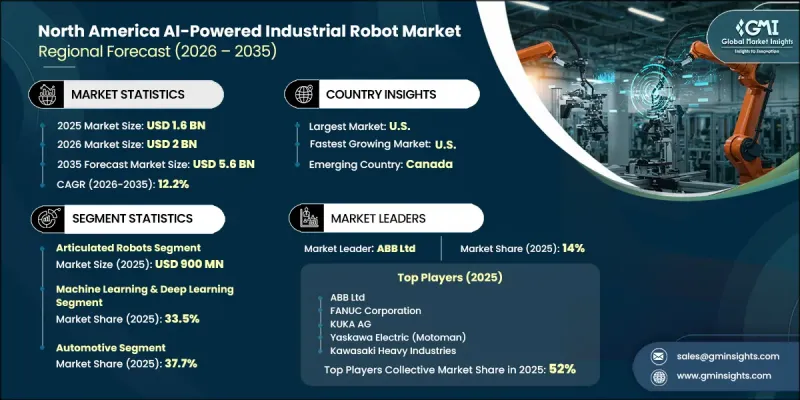
The region's strong focus on industrial digitalization, widespread implementation of Industry 4.0 technologies, and ongoing efforts to improve operational efficiency are creating substantial opportunities for AI-enabled robotics. Manufacturers across North America are increasingly integrating intelligent robotic systems into production environments to address labor shortages, enhance productivity, maintain product quality, and improve responsiveness to changing market conditions. AI-powered industrial robots are becoming a core component of modern manufacturing strategies due to their ability to perform complex tasks while supporting data-driven decision-making processes. Advanced capabilities such as machine learning, computer vision, predictive maintenance, adaptive programming, and real-time analytics are enabling manufacturers to optimize operations and improve overall equipment effectiveness. Demand is further supported by growing interest in flexible automation solutions that can adapt to evolving production requirements. Despite relatively high upfront investment costs, businesses across the U.S. and Canada increasingly view AI-powered robotics as a long-term strategic asset capable of delivering measurable operational benefits. Rising emphasis on cybersecurity, workforce enablement, interoperability, cloud connectivity, and scalable automation platforms is also accelerating market adoption.
| Market Scope | |
|---|---|
| Start Year | 2025 |
| Forecast Year | 2026-2035 |
| Start Value | $1.6 Billion |
| Forecast Value | $5.6 Billion |
| CAGR | 12.2% |
The articulated robots segment held a 54.4% share, generating USD 900 million in 2025. Demand for articulated robotic systems remains strong due to their superior flexibility, extensive range of motion, and high payload capabilities, making them suitable for a broad range of industrial applications. These robots continue to gain traction across multiple manufacturing sectors as organizations seek automation solutions capable of handling increasingly sophisticated production processes. Their ability to perform diverse operational tasks while adapting to evolving manufacturing requirements has reinforced their position as the leading robot category within the market.
The machine learning and deep learning segment held a 33.5% share in 2025. The integration of advanced AI algorithms enables industrial robots to continuously improve performance through data analysis and operational learning. These intelligent systems can adapt to changing production conditions, optimize workflows, and enhance decision-making capabilities without extensive manual intervention. The growing adoption of predictive analytics, neural network technologies, reinforcement learning, and adaptive control systems is supporting greater automation efficiency while improving productivity and operational accuracy across manufacturing environments.
United States AI-Powered Industrial Robot Market reached USD 1.3 billion in 2025 and is projected to grow at a CAGR of 12.2% through 2035. Market growth is supported by extensive adoption of advanced automation technologies, a mature industrial ecosystem, and strong collaboration between robotics suppliers, technology providers, and manufacturing organizations. Purchasing decisions increasingly prioritize technology sophistication, cybersecurity readiness, proven return on investment, and comprehensive lifecycle support services. Continued investments in intelligent manufacturing infrastructure and digital transformation initiatives are expected to further strengthen the country's leadership position in the AI-powered industrial robot market.
Key participants operating in the Global North America AI-powered industrial robot market include NVIDIA Corporation, FANUC Corporation, ABB Ltd, Yaskawa Electric, KUKA SE & Co. KGaA, Kawasaki Heavy Industries, Omron Corporation, Denso Corporation, Comau S.p.A., Epson America Inc., Boston Dynamics, Inc., Agility Robotics, Inc., Figure AI, Inc., Flexiv, Standard Bots, Neura Robotics, Keyence Corporation, Symbotic Inc., and Teradyne/Universal Robots. Companies operating in the North America AI-powered industrial robot market are focusing on technological innovation, strategic partnerships, and portfolio expansion to strengthen their competitive position. Manufacturers are investing heavily in artificial intelligence, machine learning, computer vision, and autonomous decision-making capabilities to enhance robot performance and differentiation. Many companies are developing modular and scalable robotic platforms that allow customers to customize automation deployments according to operational requirements. Strategic collaborations with software developers, cloud service providers, and manufacturing technology firms are helping accelerate product development and ecosystem integration. Market participants are also expanding after-sales services, training programs, and predictive maintenance offerings to improve customer retention.
Table of Contents
Chapter 1 Methodology and Scope
- 1.1 Market scope and definition
- 1.2 Research design
- 1.2.1 Research approach
- 1.2.2 Data collection methods
- 1.3 Data mining sources
- 1.3.1 Country
- 1.3.2 Regional/Country
- 1.4 Base estimates and calculations
- 1.4.1 Base year calculation
- 1.4.2 Key trends for market estimation
- 1.5 Primary research and validation
- 1.5.1 Primary sources
- 1.6 Forecast model
- 1.7 Research assumptions and limitations
Chapter 2 Executive Summary
- 2.1 Industry 360° synopsis
- 2.2 Key market trends
- 2.2.1 Country
- 2.2.2 Robot Type
- 2.2.3 Technology
- 2.2.4 Application
- 2.2.5 End User
Chapter 3 Industry Insights
- 3.1 Industry ecosystem analysis
- 3.1.1 Supplier landscape
- 3.1.2 Profit margin
- 3.1.3 Value addition at each stage
- 3.1.4 Factor affecting the value chain
- 3.2 Industry impact forces
- 3.2.1 Growth drivers
- 3.2.2 Industry pitfalls & challenges
- 3.2.3 Opportunities
- 3.3 Growth potential analysis
- 3.4 Future market trends
- 3.5 Technology and innovation landscape
- 3.5.1 Current technological trends
- 3.5.2 Emerging technologies
- 3.6 Pricing Analysis (Driven by Primary Research)
- 3.6.1 Midwest Average Selling Price (ASP) by Robot Type (Driven by Primary Research)
- 3.6.2 State-Level Price Variations (Driven by Primary Research)
- 3.6.3 Pricing Strategy by Player Type in Midwest (Driven by Primary Research)
- 3.6.4 Total Cost of Ownership (TCO) Analysis for Midwest Buyers
- 3.7 Regulatory landscape
- 3.7.1 U.S. Federal Standards (ANSI/RIA, OSHA)
- 3.7.2 State-Level Regulatory Variations
- 3.7.3 Regional regulatory frameworks
- 3.7.4 Certification standards
- 3.8 Supply Chain Analysis
- 3.9 Porter's analysis
- 3.10 PESTEL analysis
- 3.11 Trade Data Analysis (Driven by Primary Research)
- 3.11.1 Midwest Import Volume & Value of Industrial Robots (HS Code-Level) (Driven by Primary Research)
- 3.11.2 Taiwan-Midwest Bilateral Trade Flows (Components & Systems) (Driven by Primary Research)
- 3.12 Impact of AI & Generative AI on Midwest Manufacturing
- 3.12.1 AI-Driven Disruption of Midwest Manufacturing Business Models
- 3.12.2 GenAI Use Cases & Adoption Roadmap by Midwest Industry
- 3.12.3 Large Language Model (LLM) Integration in Midwest Factories
- 3.12.4 Agentic AI Decision-Making Pilots in Midwest
- 3.12.5 Risks, Limitations & Regulatory Considerations (Midwest Context)
- 3.13 Capacity & Production Landscape (Driven by Primary Research)
- 3.13.1 Manufacturing Capacity Installed by State (Driven by Primary Research)
- 3.13.2 Capacity Utilization Rates & Expansion Pipelines (State-Level) (Driven by Primary Research)
Chapter 4 Competitive Landscape, 2025
- 4.1 Introduction
- 4.2 Company market share analysis
- 4.2.1 North America
- 4.2.1.1 U.S.
- 4.2.1.2 Canada
- 4.2.1 North America
- 4.3 Company matrix analysis
- 4.4 Competitive analysis of major market players
- 4.5 Competitive positioning matrix
- 4.6 Key developments
- 4.6.1 Mergers & acquisitions
- 4.6.2 Partnerships & collaborations
- 4.6.3 New product launches
- 4.6.4 Expansion plans
Chapter 5 Market Estimates and Forecast, By Robot Type, 2022 - 2035 (USD Billion) (Thousand Units)
- 5.1 Key trends
- 5.2 Articulated Robots
- 5.3 SCARA Robots
- 5.4 Delta Robots
- 5.5 Others
Chapter 6 Market Estimates and Forecast, By Technology, 2022 - 2035 (USD Billion) (Thousand Units)
- 6.1 Key trends
- 6.2 Machine Learning & Deep Learning
- 6.3 Computer Vision & Imaging
- 6.4 Natural Language Processing (NLP)
- 6.5 Others
Chapter 7 Market Estimates and Forecast, By Application, 2022 - 2035 (USD Billion) (Thousand Units)
- 7.1 Key trends
- 7.2 Assembly & Material Handling
- 7.3 Welding & Machining
- 7.4 Packaging & Palletizing
- 7.5 Quality Inspection & Vision Systems
- 7.6 Logistics & Warehousing
- 7.7 Painting & Coating
- 7.8 Others
Chapter 8 Market Estimates and Forecast, By End User, 2022 - 2035 (USD Billion) (Thousand Units)
- 8.1 Key trends
- 8.2 Automotive
- 8.3 Electronics & Electrical
- 8.4 Food & Beverage
- 8.5 Pharmaceuticals & Healthcare
- 8.6 Consumer Goods
- 8.7 Logistics & Warehousing
- 8.8 Others
Chapter 9 Market Estimates and Forecast, By Region, 2022 - 2035 (USD Billion) (Thousand Units)
- 9.1 Key trends
- 9.2 North America
- 9.2.1 U.S.
- 9.2.2 Canada
Chapter 10 Company Profiles
- 10.1 Global players
- 10.1.1 ABB Ltd
- 10.1.2 FANUC Corporation
- 10.1.3 KUKA SE & Co. KGaA
- 10.1.4 Yaskawa Electric
- 10.1.5 Kawasaki Heavy Industries
- 10.1.6 Omron Corporation
- 10.1.7 NVIDIA Corporation
- 10.2 Regional players
- 10.2.1 Denso Corporation
- 10.2.2 Comau S.p.A.
- 10.2.3 Keyence Corporation
- 10.2.4 Epson America Inc.
- 10.2.5 Teradyne/Universal Robots
- 10.3 Emerging players
- 10.3.1 Figure AI, Inc.
- 10.3.2 Boston Dynamics, Inc.
- 10.3.3 Standard Bots
- 10.3.4 Agility Robotics, Inc.
- 10.3.5 Symbiotic Inc.
- 10.3.6 Neura Robotics
- 10.3.7 Flexiv

