PUBLISHER: Global Market Insights Inc. | PRODUCT CODE: 2121187

PUBLISHER: Global Market Insights Inc. | PRODUCT CODE: 2121187
AI-Powered Industrial Robot Market Opportunity, Growth Drivers, Industry Trend Analysis, and Forecast 2026 - 2035
The Global AI-Powered Industrial Robot Market was valued at USD 7.9 billion in 2025 and is estimated to grow at a CAGR of 12.2% to reach USD 27.9 billion by 2035.
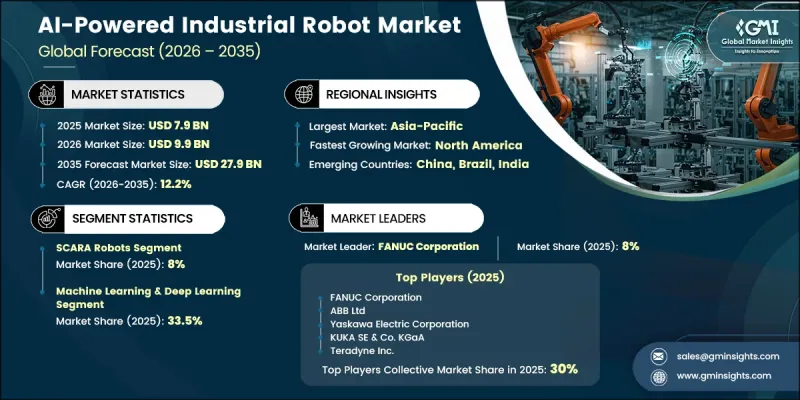
The market continues to gain momentum as manufacturers increasingly adopt software-defined automation to improve production efficiency and operational flexibility. Growing investments in intelligent automation solutions are encouraging companies to deploy advanced AI-powered industrial robots capable of supporting faster and more adaptive manufacturing environments. Rising merger and acquisition activity across the robotics industry is also accelerating technology development, enabling companies to broaden their product portfolios and strengthen their competitive positions. As a result, AI-powered industrial robots are steadily replacing conventional automation technologies with more intelligent systems that deliver greater precision, scalability, and operational performance. Advanced AI capabilities enable these robots to analyze production data and continuously optimize manufacturing workflows in real time, supporting the growing demand for customized and high-mix production. Increasing investments in smart factories, expanding automation budgets across Europe and Asia-Pacific, and the continued reshoring of manufacturing activities in North America are further improving the commercial viability of AI-powered industrial robots and driving long-term market expansion across multiple industrial sectors.
| Market Scope | |
|---|---|
| Start Year | 2025 |
| Forecast Year | 2026-2035 |
| Start Value | $7.9 Billion |
| Forecast Value | $27.9 Billion |
| CAGR | 12.2% |
AI-powered industrial robots equipped with agentic AI and generative AI models enable manufacturers to monitor production conditions and operational data continuously while improving manufacturing efficiency through intelligent decision-making. These advanced robotic systems support real-time process optimization, helping production facilities respond more effectively to changing manufacturing requirements. Their ability to improve operational visibility and accelerate production optimization aligns with the industry's increasing emphasis on flexible manufacturing, making AI-powered industrial robots an important contributor to overall market growth.
The SCARA robots segment is expected to grow at a CAGR of 8% through 2035, reflecting steady demand from electronics assembly and food packaging applications. AI-powered industrial robots in these categories continue to gain wider adoption because they deliver fast, accurate, and highly efficient movement during repetitive production tasks. Manufacturers increasingly prefer AI-enabled robotic systems for applications requiring consistent performance, intelligent monitoring, and enhanced productivity throughout high-volume manufacturing operations.
The machine learning & deep learning segment accounted for 33.5% share in 2025, generating USD 2.6 billion. This segment represented the largest share of the market as manufacturers increasingly adopted intelligent algorithms to enable autonomous decision-making and predictive maintenance capabilities within modern manufacturing facilities. The growing implementation of AI-driven analytics continues to strengthen demand for machine learning and deep learning technologies across industrial robotics applications.
North America AI-Powered Industrial Robot Market generated USD 1.3 billion in 2025. The United States accounted for more than 84% of the regional market value, supported by a well-established manufacturing industry and increasing investments aimed at reshoring production activities to strengthen supply chain resilience and expand domestic manufacturing capabilities.
Major companies operating in the global AI-powered industrial robot market include ABB Ltd, Agility Robotics, Inc., Boston Dynamics, Inc., Epson America Inc., FANUC Corporation, Flexiv, Figure AI, Inc., Kawasaki Heavy Industries Ltd., Keyence Corporation, KUKA SE & Co. KGaA, Neura Robotics, NVIDIA Corporation, Omron Corporation, Standard Bots, Symbiotic Inc., Teradyne, Inc., Tesla, Inc., and Yaskawa Electric Corporation. Companies operating in the AI-powered industrial robot market are strengthening their market positions through continuous investments in artificial intelligence, robotics software, and intelligent automation technologies. Many organizations are expanding their product portfolios by developing advanced robotic platforms with enhanced autonomy, predictive capabilities, and flexible deployment options. Strategic mergers, acquisitions, and technology partnerships remain key approaches for accelerating innovation, improving engineering expertise, and expanding global market reach. Manufacturers are also increasing research and development spending to improve robot intelligence, software integration, and operational efficiency. In addition, companies are focusing on regional expansion, strengthening distribution networks, and collaborating with manufacturing customers to deliver customized automation solutions.
Table of Contents
Chapter 1 Methodology and Scope
- 1.1 Market scope and definition
- 1.2 Research design
- 1.2.1 Research approach
- 1.2.2 Data collection methods
- 1.3 Data mining sources
- 1.3.1 Global
- 1.3.2 Regional/Country
- 1.4 Base estimates and calculations
- 1.4.1 Base year calculation
- 1.4.2 Key trends for market estimation
- 1.5 Primary research and validation
- 1.5.1 Primary sources
- 1.6 Forecast model
- 1.7 Research assumptions and limitations
Chapter 2 Executive Summary
- 2.1 Industry 360° synopsis
- 2.2 Key market trends
- 2.2.1 Regional
- 2.2.2 Robot Type
- 2.2.3 Technology
- 2.2.4 Application
- 2.2.5 End User
Chapter 3 Industry Insights
- 3.1 Industry ecosystem analysis
- 3.1.1 Supplier landscape
- 3.1.2 Profit margin
- 3.1.3 Value addition at each stage
- 3.1.4 Factor affecting the value chain
- 3.2 Industry impact forces
- 3.2.1 Growth drivers
- 3.2.1.1 Rising Participation Among Youth & Women
- 3.2.1.2 Labor shortages & reshoring
- 3.2.1.3 Generative AI & LLM Integration
- 3.2.1.4 IT/OT Convergence
- 3.2.2 Industry pitfalls & challenges
- 3.2.2.1 High Integration Complexity
- 3.2.2.2 Data Privacy & Cybersecurity
- 3.2.3 Opportunities
- 3.2.3.1 Robot-as-a-Service (RaaS)
- 3.2.3.2 Humanoid General-Purpose Robots
- 3.2.1 Growth drivers
- 3.3 Growth potential analysis
- 3.4 Future market trends
- 3.5 Technology and innovation landscape
- 3.5.1 Current technological trends
- 3.5.2 Emerging technologies
- 3.6 Price trends
- 3.6.1 Global Average Selling Price (ASP) by Robot Type (Driven by Primary Research)
- 3.6.2 Regional Price Benchmarking (APAC vs. North America vs. Europe) (Driven by Primary Research)
- 3.6.3 Historical Global Price Trend Analysis (2018–2025) (Driven by Primary Research)
- 3.6.4 Pricing Strategy by Player Type — Global (Premium / Value / Cost-plus) (Driven by Primary Research)By region
- 3.7 Regulatory landscape
- 3.7.1 Standards and compliance requirements
- 3.7.2 Regional regulatory frameworks
- 3.7.3 Certification standards
- 3.8 Porter’s analysis
- 3.9 PESTEL analysis
- 3.10 Trade Data Analysis (Driven by Primary Research)
- 3.10.1 Key Importing Nations & Growth Markets (Driven by Primary Research)
- 3.10.2 Taiwan's Global Robot & Component Export Intelligence (Driven by Primary Research)
- 3.10.3 CPTPP Trade Flows Taiwan's Preferential Access to Member Markets (Driven by Primary Research)
- 3.10.4 RCEP Impact on China-Centered vs. Taiwan-Centered Supply Chains (Driven by Primary Research)
- 3.10.5 Key Global Port & Logistics Hub Analysis (Driven by Primary Research)
- 3.11 Impact of AI & Generative AI on Midwest Manufacturing
- 3.11.1 AI-Driven Disruption of Midwest Manufacturing Business Models
- 3.11.2 GenAI Use Cases & Adoption Roadmap
- 3.11.3 Large Language Model (LLM) Integration
- 3.11.4 Agentic AI Decision-Making Pilots
- 3.11.5 Risks, Limitations & Regulatory Considerations
- 3.12 Capacity & Production Landscape (Driven by Primary Research)
- 3.12.1 Manufacturing Capacity Installed by State (Driven by Primary Research)
- 3.12.2 Capacity Utilization Rates & Expansion Pipelines (State-Level) (Driven by Primary Research)
Chapter 4 Competitive Landscape, 2025
- 4.1 Introduction
- 4.2 Company market share analysis
- 4.2.1 By region
- 4.2.1.1 North America
- 4.2.1.2 Europe
- 4.2.1.3 Asia Pacific
- 4.2.1.4 Latin America
- 4.2.1.5 Middle East and Africa
- 4.2.1 By region
- 4.3 Company matrix analysis
- 4.4 Competitive analysis of major market players
- 4.5 Competitive positioning matrix
- 4.6 Key developments
- 4.6.1 Mergers & acquisitions
- 4.6.2 Partnerships & collaborations
- 4.6.3 New product launches
- 4.6.4 Expansion plans
Chapter 5 Market Estimates and Forecast, By Robot Type, 2022 – 2035 (USD Billion) (Thousand Units)
- 5.1 Key trends
- 5.2 Articulated Robots
- 5.3 SCARA Robots
- 5.4 Delta Robots
- 5.5 Others
Chapter 6 Market Estimates and Forecast, By Technology, 2022 – 2035 (USD Billion) (Thousand Units)
- 6.1 Key trends
- 6.2 Machine Learning & Deep Learning
- 6.3 Computer Vision & Imaging
- 6.4 Natural Language Processing (NLP)
- 6.5 Others
Chapter 7 Market Estimates and Forecast, By Application, 2022 – 2035 (USD Billion) (Thousand Units)
- 7.1 Key trends
- 7.2 Assembly & Material Handling
- 7.3 Welding & Machining
- 7.4 Packaging & Palletizing
- 7.5 Quality Inspection & Vision Systems
- 7.6 Logistics & Warehousing
- 7.7 Painting & Coating
- 7.8 Others
Chapter 8 Market Estimates and Forecast, By End User, 2022 – 2035 (USD Billion) (Thousand Units)
- 8.1 Key trends
- 8.2 Automotive
- 8.3 Electronics & Electrical
- 8.4 Food & Beverage
- 8.5 Pharmaceuticals & Healthcare
- 8.6 Consumer Goods
- 8.7 Logistics & Warehousing
- 8.8 Others
Chapter 9 Market Estimates and Forecast, By Region, 2022 – 2035 (USD Billion) (Thousand Units)
- 9.1 Key trends
- 9.2 North America
- 9.2.1 U.S.
- 9.2.2 Canada
- 9.3 Europe
- 9.3.1 Germany
- 9.3.2 UK
- 9.3.3 France
- 9.3.4 Italy
- 9.3.5 Spain
- 9.4 Asia Pacific
- 9.4.1 China
- 9.4.2 Japan
- 9.4.3 India
- 9.4.4 Australia
- 9.4.5 South Korea
- 9.5 Latin America
- 9.5.1 Brazil
- 9.5.2 Mexico
- 9.5.3 Argentina
- 9.6 Middle East and Africa
- 9.6.1 South Africa
- 9.6.2 Saudi Arabia
- 9.6.3 UAE
Chapter 10 Company Profiles
- 10.1 Global players
- 10.1.1 ABB Ltd
- 10.1.2 Agility Robotics, Inc.
- 10.1.3 Boston Dynamics, Inc.
- 10.1.4 FANUC Corporation
- 10.1.5 Figure AI, Inc.
- 10.1.6 Kawasaki Heavy Industries Ltd.
- 10.2 Regional players
- 10.2.1 Keyence Corporation
- 10.2.2 KUKA SE & Co. KGaA
- 10.2.3 NVIDIA Corporation
- 10.2.4 Omron Corporation
- 10.2.5 Standard Bots
- 10.2.6 Symbiotic Inc.
- 10.3 Emerging players
- 10.3.1 Teradyne, Inc.
- 10.3.2 Tesla, Inc.
- 10.3.3 Yaskawa Electric Corporation
- 10.3.4 Epson America Inc.
- 10.3.5 Neura Robotics
- 10.3.6 Flexiv

