
PUBLISHER: Global Market Insights Inc. | PRODUCT CODE: 2083087

PUBLISHER: Global Market Insights Inc. | PRODUCT CODE: 2083087
Asia-Pacific Kids Sports Equipment and Accessories Market Opportunity, Growth Drivers, Industry Trend Analysis, and Forecast 2026 - 2035
Asia-Pacific Kids Sports Equipment and Accessories Market was valued at USD 1.9 billion in 2025 and is estimated to grow at a CAGR of 6.6% to reach USD 3.6 billion by 2035.
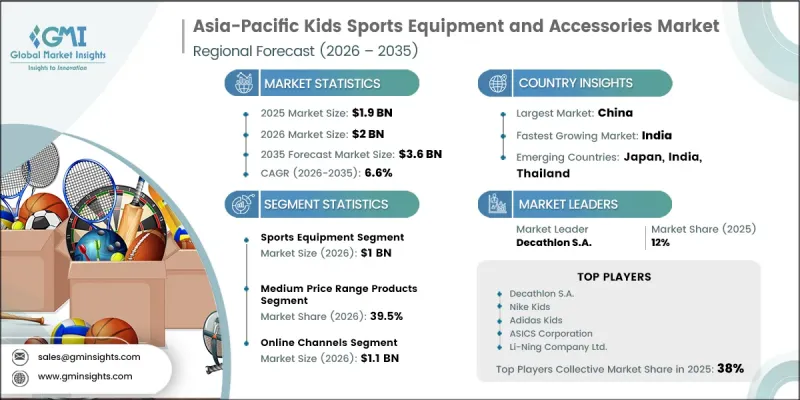
The Asia-Pacific kids sports equipment and accessories market is experiencing steady growth as awareness of children's health, fitness, and physical development continues to increase across the region. Parents, schools, and educational institutions are placing greater emphasis on encouraging active lifestyles by investing in quality sports equipment and accessories designed specifically for children. Rising concerns regarding declining physical activity among younger populations have also prompted greater participation in organized sports and recreational activities. Governments and educational organizations continue to promote sports programs that support physical well-being, creating sustained demand for age-appropriate sporting products. In addition, the expansion of youth sports academies, training facilities, and organized recreational programs is contributing to higher equipment purchases across multiple sports categories. Rising disposable income, improving living standards, and a growing middle-income population are further encouraging families to invest in quality sports products that support skill development and long-term participation. Increasing interest in structured sports training and specialized athletic development is also driving demand for sport-specific equipment and accessories, creating favorable opportunities for manufacturers throughout the Asia-Pacific kids sports equipment and accessories market.
| Market Scope | |
|---|---|
| Start Year | 2025 |
| Forecast Year | 2026-2035 |
| Start Value | $1.9 Billion |
| Forecast Value | $3.6 Billion |
| CAGR | 6.6% |
In 2026, the sports equipment segment accounted for 48.9% share, generating USD 1 billion. The segment continues to dominate because of rising demand for essential sporting products that support children's participation across a wide range of athletic activities. Parents increasingly prefer durable, high-quality equipment that promotes skill development, safety, and long-term performance. Continuous product improvements, child-focused designs, and enhanced safety standards further strengthen the segment's leading market position.
The medium price range segment held 39.5% share, generating USD 800 million in 2025. Products within this category remain highly popular because they offer an effective balance between affordability, product quality, and performance. The segment appeals to a broad consumer base seeking dependable sports equipment that delivers long-term value while remaining accessible for regular equipment replacement as children grow. Strong consumer confidence in product durability and overall value continues to support demand within this pricing category.
China Kids Sports Equipment and Accessories Market held 38% share, generating USD 660 million in 2025. The country's leadership is supported by its large youth population, growing emphasis on organized sports participation, expanding middle-income consumer base, and continuous investment in sports infrastructure. Rising household spending on children's development and increasing preference for quality sporting products continue to strengthen market demand across the country.
Major companies operating in the Asia-Pacific kids sports equipment and accessories market include Adidas Kids, Anta Kids, Nike Kids, Li-Ning Company Ltd., Yonex Co. Ltd., ASICS Corporation, Decathlon S.A., Wilson / Amer Sports, Head N.V., Mikasa Corporation, Molten Corporation, Victor Rackets Industrial Corp., SSK Co., Ltd., Kookaburra Sport, Nivia Sports, Cosco Sports, 361 Degrees Kids, moodytiger, DHS / Double Happiness, and Speedo (ABG). Companies operating in the Asia-Pacific kids sports equipment and accessories market are strengthening their competitive position through continuous product innovation, expansion of child-focused product portfolios, and investment in advanced materials that improve product durability, comfort, and safety. Manufacturers are expanding their retail presence through both online and offline channels while strengthening partnerships with schools, sports academies, distributors, and specialty retailers to improve market reach. Businesses are also emphasizing product quality, brand recognition, and safety certifications to build consumer confidence and encourage repeat purchases.
Table of Contents
Chapter 1 Methodology & Scope
- 1.1 Market scope and definition
- 1.2 Research design
- 1.2.1 Research approach
- 1.2.2 Data collection methods
- 1.3 Data mining sources
- 1.3.1 Global
- 1.3.2 Regional/Country
- 1.4 Base estimates and calculations
- 1.4.1 Base year calculation
- 1.4.2 Key trends for market estimation
- 1.5 Primary research and validation
- 1.5.1 Primary sources
- 1.6 Forecast model
- 1.7 Research assumptions and limitations
Chapter 2 Executive Summary
- 2.1 Industry 360° synopsis
- 2.2 Key market trends
- 2.2.1 By Type
- 2.2.2 By Sport Type
- 2.2.3 By Age Group
- 2.2.4 By Price Range
- 2.2.5 By Distribution Channel
Chapter 3 Industry Insights
- 3.1 Industry ecosystem analysis
- 3.1.1 Supplier landscape
- 3.1.2 Profit margin
- 3.1.3 Value addition at each stage
- 3.1.4 Factor affecting the value chain
- 3.2 Industry impact forces
- 3.2.1 Growth drivers
- 3.2.2 Industry pitfalls & challenges
- 3.2.3 Opportunities
- 3.3 Growth potential analysis
- 3.3.1 Price volatility and market unpredictability
- 3.3.2 Quality assurance and equipment reliability concerns
- 3.4 Future market trends
- 3.5 Technology and innovation landscape
- 3.5.1 Current technological trends
- 3.5.2 Emerging technologies
- 3.6 Regulatory landscape
- 3.6.1 Standards and compliance requirements
- 3.6.2 Regional regulatory frameworks
- 3.6.3 Certification standards
- 3.7 Porter’s analysis
- 3.8 PESTEL analysis
- 3.9 Price trends
- 3.9.1 Historical Price Trend Analysis (Driven by Primary Research)
- 3.9.2 Pricing Strategy by Player Type (Driven by Primary Research)
- 3.10 Trade Data Analysis (Driven by Primary Research)
- 3.10.1 Import/Export Volume & Value Trends (Driven by Primary Research)
- 3.10.2 Key Trade Corridors & Tariff Impact (Driven by Primary Research)
- 3.10.3 Major Importing Countries
- 3.10.4 Major Exporting Countries
- 3.10.5 Trade Flow Dynamics by Region
- 3.11 Impact of AI & Generative AI on the Market
- 3.11.1 AI-Driven Disruption of Existing Business Models
- 3.11.2 GenAI Use Cases & Adoption Roadmap by Segment
- 3.11.3 Risks, Limitations & Regulatory Considerations
- 3.12 Consumer behaviour analysis
- 3.12.1 Purchasing patterns
- 3.12.2 Preference analysis
- 3.12.3 Regional variations in consumer behaviour
- 3.12.4 Impact of e-commerce on buying decisions
- 3.13 Distribution Infrastructure & Channel Penetration Landscape (Driven by Primary Research)
- 3.13.1 Channel Coverage by Country & Format (Modern vs. Traditional Trade) (Driven by Primary Research)
- 3.13.2 Last-Mile Infrastructure Gaps & Emerging Channel Shifts (Driven by Primary Research)
Chapter 4 Competitive Landscape, 2025
- 4.1 Introduction
- 4.2 Company market share analysis
- 4.3 Company matrix analysis
- 4.4 Competitive analysis of major market players
- 4.5 Competitive positioning matrix
- 4.6 Key developments
- 4.6.1 Mergers & acquisitions
- 4.6.2 Partnerships & collaborations
- 4.6.3 New product launches
- 4.6.4 Expansion plans
Chapter 5 Market Estimates & Forecast, By Type, 2022-2035 (USD Billion) (Thousand Units)
- 5.1 Key trends
- 5.2 Sports equipment
- 5.2.1 Protective gears
- 5.2.2 Nets & goals
- 5.2.3 Bats & sticks
- 5.2.4 Balls
- 5.2.5 Others (dumbbells, training equipment, etc.)
- 5.3 Accessories
- 5.3.1 Gloves
- 5.3.2 Bags & backpacks
- 5.3.3 Headbands & wristbands
- 5.3.4 Fitness trackers & wearables
- 5.3.5 Others (training aids, water bottles, etc.)
Chapter 6 Market Estimates & Forecast, By Sport Type, 2022-2035 (USD Billion) (Thousand Units)
- 6.1 Key trends
- 6.2 Team sports
- 6.3 Individual sports
- 6.4 Adventure/outdoor activities
- 6.5 Fitness activities
Chapter 7 Market Estimates & Forecast, By Age Group, 2022-2035 (USD Billion) (Thousand Units)
- 7.1 Key trends
- 7.2 Toddlers (1-4 years)
- 7.3 Early childhood (5-8 years)
- 7.4 Pre-teens (9-12 years)
Chapter 8 Market Estimates & Forecast, By Price Range, 2022-2035 (USD Billion) (Thousand Units)
- 8.1 Key trends
- 8.2 Low/economy
- 8.3 Medium
- 8.4 High
Chapter 9 Market Estimates & Forecast, By Distribution Channel, 2022-2035 (USD Billion) (Thousand Units)
- 9.1 Key trends
- 9.2 Online
- 9.2.1 E-commerce websites
- 9.2.2 Company websites
- 9.3 Offline
- 9.3.1 Sports retail stores
- 9.3.2 Departmental stores
- 9.3.3 Supermarkets/hypermarkets
- 9.3.4 Other retail stores
Chapter 10 Market Estimates and Forecast, By Country, 2022 - 2035 (USD Billion) (Thousand Units)
- 10.1 Key trends
- 10.2 China
- 10.3 India
- 10.4 Japan
- 10.5 South Korea
- 10.6 Taiwan
- 10.7 Indonesia
- 10.8 Thailand
- 10.9 Singapore
- 10.10 Australia
Chapter 11 Company Profiles
- 11.1 Top Global Player
- 11.1.1 Decathlon S.A.
- 11.1.2 Nike Kids
- 11.1.3 Adidas Kids
- 11.1.4 Yonex Co. Ltd.
- 11.1.5 Speedo (ABG)
- 11.1.6 Wilson / Amer Sports
- 11.1.7 ASICS Corporation
- 11.1.8 Head N.V.
- 11.2 Regional Player
- 11.2.1 Anta Kids
- 11.2.2 Mikasa Corporation
- 11.2.3 Molten Corporation
- 11.2.4 Victor Rackets Industrial Corp.
- 11.2.5 Kookaburra Sport
- 11.2.6 Li-Ning Company Ltd.
- 11.2.7 DHS / Double Happiness
- 11.2.8 Nivia Sports
- 11.3 Emerging Players
- 11.3.1 moodytiger
- 11.3.2 361 Degrees Kids
- 11.3.3 Cosco Sports
- 11.3.4 SSK Co., Ltd

