
PUBLISHER: Global Market Insights Inc. | PRODUCT CODE: 2083331

PUBLISHER: Global Market Insights Inc. | PRODUCT CODE: 2083331
Kids Sports Equipment and Accessories Market Opportunity, Growth Drivers, Industry Trend Analysis, and Forecast 2026 - 2035
The Global Kids Sports Equipment and Accessories Market was valued at USD 5.1 billion in 2025 and is estimated to grow at a CAGR of 5.7% to reach USD 8.9 billion by 2035.
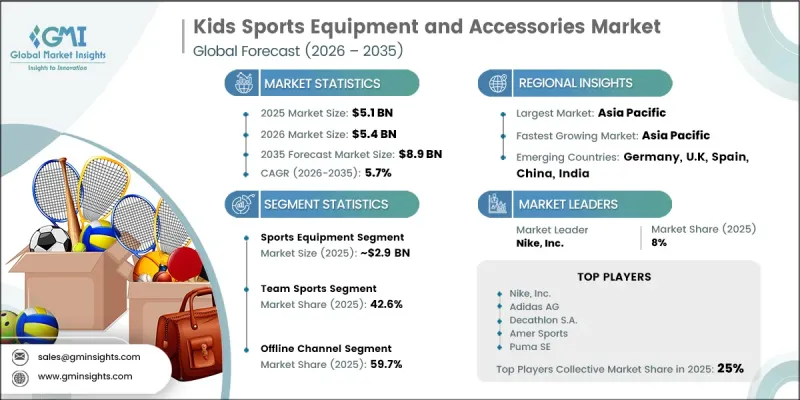
The market is experiencing steady growth as parents increasingly encourage children to participate in sports activities at younger ages to support physical development, skill enhancement, and long-term athletic potential. Growing awareness of childhood fitness, the importance of active lifestyles, and the benefits of structured sports participation are driving demand for age-appropriate equipment and accessories. As children progress from recreational activities to specialized training, demand is increasing for products designed specifically for young athletes, including customized gear, safety equipment, and sport-focused accessories. The rising influence of youth sports programs, school athletics, and organized recreational activities is further strengthening market expansion. Parents are showing greater interest in investing in durable, safe, and ergonomically designed products that help children participate comfortably while improving their abilities. This market continues to benefit from the intersection of health awareness, youth development, and increasing participation in sports-related activities.
| Market Scope | |
|---|---|
| Start Year | 2025 |
| Forecast Year | 2026-2035 |
| Start Value | $5.1 Billion |
| Forecast Value | $8.9 Billion |
| CAGR | 5.7% |
The growing emphasis on children's physical well-being is encouraging families to invest in sports equipment that supports regular exercise and active routines. Increased awareness about the role of physical activity in childhood development has strengthened demand for products that make sports participation safer and more engaging. Educational institutions and youth sports organizations are also contributing to market growth by encouraging participation in athletic programs. As children take part in organized activities, parents are purchasing essential sports gear and protective accessories to support their involvement. The market is being shaped by rising fitness awareness, structured youth programs, and stronger parental commitment toward active lifestyles.
The sports equipment segment generated USD 2.9 billion in 2025 and is expected to reach USD 4.8 billion by 2035. This segment maintains a strong position as parents continue to prioritize products that support children's athletic growth and physical fitness. High-quality youth sports equipment is increasingly designed with appropriate sizing, enhanced safety elements, and child-friendly features to improve comfort and performance. These factors make sports equipment a fundamental requirement for both organized competitions and recreational activities among children.
The team sports segment held 42.6% share in 2025. The segment's leadership is supported by increasing participation in organized team-based activities that promote cooperation, discipline, and skill development among children. Parents often prefer team sports equipment because it supports social interaction, structured learning, and physical development. Growth in school athletic programs, community sports leagues, and youth training initiatives continues to drive demand for team-oriented products as families seek activities that provide both educational and developmental benefits.
Asia Pacific Kids Sports Equipment and Accessories Market is expected to grow at a CAGR of 6.6% during 2026-2035. Growth across Asia Pacific is supported by increasing disposable income levels, expanding urban populations, and rising awareness of childhood health and wellness. Parents in the region are increasingly adopting organized sports activities and showing greater interest in international sporting trends, which contributes to higher spending on quality youth sports equipment and accessories.
Major players operating in the global kids sports equipment and accessories industry are Nike, Inc., Adidas AG, Decathlon S.A., Puma SE, Amer Sports Corporation, ASICS Corporation, Li-Ning Company Ltd., Under Armour, Inc., Anta Sports Products Ltd., Columbia Sportswear Co., New Balance Athletics, Inc., Lululemon Athletica Inc., Skechers U.S.A., Inc., Hoka (Deckers Brands), On Holding AG, Gymshark Ltd., Hummel International A/S, Mizuno Corporation, VF Corporation, Alo Yoga, and Vuori, Inc. Companies operating in the kids sports equipment and accessories market are focusing on product innovation, brand expansion, digital strategies, and partnerships with sports organizations to strengthen their market presence. Leading companies are developing safer, more comfortable, and performance-oriented products designed specifically for young athletes. Businesses are also investing in sustainable materials, advanced manufacturing techniques, and personalized product offerings to attract modern consumers. Expanding online distribution channels, strengthening retail networks, and promoting youth sports initiatives are helping brands increase customer engagement and improve their competitive position in the growing market.
Table of Contents
Chapter 1 Methodology & Scope
- 1.1 Market scope and definition
- 1.2 Research design
- 1.2.1 Research approach
- 1.2.2 Data collection methods
- 1.3 Data mining sources
- 1.3.1 Global
- 1.3.2 Regional/Country
- 1.4 Base estimates and calculations
- 1.4.1 Base year calculation
- 1.4.2 Key trends for market estimation
- 1.5 Primary research and validation
- 1.5.1 Primary sources
- 1.6 Forecast model
- 1.7 Research assumptions and limitations
Chapter 2 Executive Summary
- 2.1 Industry 360° synopsis
- 2.2 Key market trends
- 2.2.1 Regional
- 2.2.2 By Type
- 2.2.3 By Sport Type
- 2.2.4 By Age Group
- 2.2.5 By Price Range
- 2.2.6 By Distribution Channel
Chapter 3 Industry Insights
- 3.1 Industry ecosystem analysis
- 3.1.1 Supplier landscape
- 3.1.2 Profit margin
- 3.1.3 Value addition at each stage
- 3.1.4 Factor affecting the value chain
- 3.2 Industry impact forces
- 3.2.1 Growth drivers
- 3.2.2 Industry pitfalls & challenges
- 3.2.3 Opportunities
- 3.3 Growth potential analysis
- 3.4 Future market trends
- 3.5 Technology and innovation landscape
- 3.5.1 Current technological trends
- 3.5.2 Emerging technologies
- 3.6 Price trends
- 3.6.1 Historical Price Trend Analysis (Driven by Primary Research)
- 3.6.2 Pricing Strategy by Player Type (Driven by Primary Research)
- 3.7 Regulatory landscape
- 3.7.1 Standards and compliance requirements
- 3.7.2 Regional regulatory frameworks
- 3.7.3 Certification standards
- 3.8 Porter's analysis
- 3.9 PESTEL analysis
- 3.10 Trade Data Analysis (Driven by Primary Research)
- 3.10.1 Import/Export Volume & Value Trends (Driven by Primary Research)
- 3.10.2 Key Trade Corridors & Tariff Impact (Driven by Primary Research)
- 3.10.3 Major Importing Countries
- 3.10.4 Major Exporting Countries
- 3.10.5 Trade Flow Dynamics by Region
- 3.11 Impact of AI & Generative AI on the Market
- 3.11.1 AI-Driven Disruption of Existing Business Models
- 3.11.2 GenAI Use Cases & Adoption Roadmap by Segment
- 3.11.3 Risks, Limitations & Regulatory Considerations
- 3.12 Consumer behaviour analysis
- 3.12.1 Purchasing patterns
- 3.12.2 Preference analysis
- 3.12.3 Regional variations in consumer behaviour
- 3.12.4 Impact of e-commerce on buying decisions
- 3.13 Distribution Infrastructure & Channel Penetration Landscape (Driven by Primary Research)
- 3.13.1 Channel Coverage by Country & Format (Modern vs. Traditional Trade) (Driven by Primary Research)
- 3.13.2 Last-Mile Infrastructure Gaps & Emerging Channel Shifts (Driven by Primary Research)
Chapter 4 Competitive Landscape, 2025
- 4.1 Introduction
- 4.2 Company market share analysis
- 4.2.1 By region
- 4.2.1.1 North America
- 4.2.1.2 Europe
- 4.2.1.3 Asia Pacific
- 4.2.1.4 Latin America
- 4.2.1.5 Middle East and Africa
- 4.2.1 By region
- 4.3 Company matrix analysis
- 4.4 Competitive analysis of major market players
- 4.5 Competitive positioning matrix
- 4.6 Key developments
- 4.6.1 Mergers & acquisitions
- 4.6.2 Partnerships & collaborations
- 4.6.3 New product launches
- 4.6.4 Expansion plans
Chapter 5 Market Estimates & Forecast, By Type, 2022-2035 (USD Billion) (Thousand Units)
- 5.1 Key trends
- 5.2 Sports equipment
- 5.2.1 Protective gears
- 5.2.2 Nets & goals
- 5.2.3 Bats & sticks
- 5.2.4 Balls
- 5.2.5 Others (dumbbells, training equipment, etc.)
- 5.3 Accessories
- 5.3.1 Gloves
- 5.3.2 Bags & backpacks
- 5.3.3 Headbands & wristbands
- 5.3.4 Fitness trackers & wearables
- 5.3.5 Others (training aids, water bottles, etc.)
Chapter 6 Market Estimates & Forecast, By Sport Type, 2022-2035 (USD Billion) (Thousand Units)
- 6.1 Key trends
- 6.2 Team sports
- 6.3 Individual sports
- 6.4 Adventure/outdoor activities
- 6.5 Fitness activities
Chapter 7 Market Estimates & Forecast, By Age Group, 2022-2035 (USD Billion) (Thousand Units)
- 7.1 Key trends
- 7.2 Toddlers (1-4 years)
- 7.3 Early childhood (5-8 years)
- 7.4 Pre-teens (9-12 years)
Chapter 8 Market Estimates & Forecast, By Price Range, 2022-2035 (USD Billion) (Thousand Units)
- 8.1 Key trends
- 8.2 Low/economy
- 8.3 Medium
- 8.4 High
Chapter 9 Market Estimates & Forecast, By Distribution Channel, 2022-2035 (USD Billion) (Thousand Units)
- 9.1 Key trends
- 9.2 Online
- 9.2.1 E-commerce websites
- 9.2.2 Company websites
- 9.3 Offline
- 9.3.1 Sports retail stores
- 9.3.2 Departmental stores
- 9.3.3 Supermarkets/hypermarkets
- 9.3.4 Other retail stores
Chapter 10 Market Estimates & Forecast, By Region, 2022-2035 (USD Billion) (Thousand Units)
- 10.1 Key trends
- 10.2 North America
- 10.2.1 U.S.
- 10.2.2 Canada
- 10.3 Europe
- 10.3.1 Germany
- 10.3.2 France
- 10.3.3 UK
- 10.3.4 Italy
- 10.3.5 Spain
- 10.4 Asia Pacific
- 10.4.1 China
- 10.4.2 India
- 10.4.3 Japan
- 10.4.4 South Korea
- 10.4.5 Australia
- 10.5 Latin America
- 10.5.1 Brazil
- 10.5.2 Mexico
- 10.5.3 Argentina
- 10.6 MEA
- 10.6.1 South Africa
- 10.6.2 Saudi Arabia
- 10.6.3 UAE
Chapter 11 Company Profiles
- 11.1 Global Player
- 11.1.1 Nike, Inc.
- 11.1.2 Adidas AG
- 11.1.3 Decathlon S.A.
- 11.1.4 Anta Sports Products Ltd.
- 11.1.5 Lululemon Athletica Inc.
- 11.1.6 New Balance Athletics, Inc.
- 11.1.7 Puma SE
- 11.1.8 Amer Sports Corporation
- 11.2 Regional Player
- 11.2.1 Skechers U.S.A., Inc.
- 11.2.2 ASICS Corporation
- 11.2.3 Under Armour, Inc.
- 11.2.4 Li-Ning Company Ltd.
- 11.2.5 Columbia Sportswear Co.
- 11.2.6 VF Corporation
- 11.2.7 Mizuno Corporation
- 11.2.8 Hummel International A/S
- 11.3 Emerging Player
- 11.3.1 On Holding AG
- 11.3.2 Hoka (Deckers Brands)
- 11.3.3 Gymshark Ltd.
- 11.3.4 Vuori, Inc.
- 11.3.5 Alo Yoga

