PUBLISHER: Global Market Insights Inc. | PRODUCT CODE: 2083097

PUBLISHER: Global Market Insights Inc. | PRODUCT CODE: 2083097
North America Robotic Packaging System Market Opportunity, Growth Drivers, Industry Trend Analysis, and Forecast 2026 - 2035
North America Robotic Packaging System Market was valued at USD 1.66 billion in 2025 and is estimated to grow at a CAGR of 5.8% to reach USD 2.87 billion by 2035.
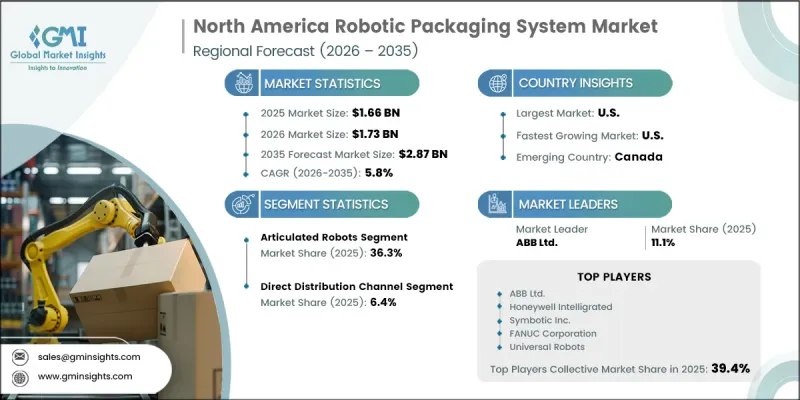
Growth across the market is fueled by increasing adoption of automation across the food and beverage, pharmaceutical, e-commerce fulfillment, and consumer goods manufacturing industries. A combination of long-term labor shortages in manufacturing, expanding pharmaceutical packaging investments linked to rising biologics production, and ongoing development of e-commerce fulfillment infrastructure is creating a stable demand environment for robotic packaging technologies. The continuing shift toward domestic manufacturing operations across the United States is emerging as one of the most influential growth drivers for the North America robotic packaging system market. Businesses are increasingly investing in automation to improve operational resilience, strengthen supply chains, and address workforce constraints. Labor availability challenges continue to affect production facilities, particularly in packaging and material-handling functions, prompting greater reliance on robotic solutions. At the same time, pharmaceutical manufacturers are accelerating investments in packaging automation to support increased production requirements for advanced therapies. These market dynamics, combined with broader industrial modernization efforts and sustained capital expenditure programs, are expected to support consistent expansion of the North America robotic packaging system market throughout the forecast period, according to the latest study released by Global Market Insights Inc.
| Market Scope | |
|---|---|
| Start Year | 2025 |
| Forecast Year | 2026-2035 |
| Start Value | $1.66 Billion |
| Forecast Value | $2.87 Billion |
| CAGR | 5.8% |
The articulated robots segment held a 36.3% share in 2025. Their strong market presence is attributed to exceptional flexibility and adaptability across a wide variety of packaging operations. These robotic systems are widely deployed for primary and secondary packaging activities, case packing, palletizing, product positioning, and labeling applications across the food, pharmaceutical, and consumer goods sectors. Their ability to perform multiple tasks within a single automation environment continues to drive adoption among manufacturers seeking greater efficiency and production flexibility.
The direct sales channel represented 77.9% share in 2025 and is forecast to grow at a CAGR of 6.4% through 2035. This growth rate exceeds that of both the overall market and the indirect distribution channel. The dominance of direct distribution stems from the highly customized and technically complex nature of robotic packaging projects. Large-scale industrial customers often require tailored automation solutions, extensive system integration, compliance documentation, and ongoing technical support. As a result, manufacturers and system integrators frequently maintain direct relationships with end users to ensure seamless project execution, optimized system performance, and long-term service support.
United States Robotic Packaging System Market accounted for 81.8% share in 2025 and is estimated to grow at a CAGR of 6% through 2035. Market expansion is supported by a combination of labor market challenges, industrial policy initiatives, pharmaceutical sector investments, and continued growth in e-commerce logistics. Significant investment commitments aimed at strengthening domestic manufacturing capabilities are encouraging companies to increase automation spending across production and packaging facilities. As manufacturers continue to modernize operations and improve productivity, robotic packaging systems are becoming an increasingly important component of capital investment strategies. Growing emphasis on supply chain security, operational efficiency, and advanced manufacturing technologies is expected to reinforce demand across the United States over the coming decade.
Key companies operating in the North America robotic packaging system market include ABB Ltd., BluePrint Automation, Brenton Engineering, Columbia/Okura LLC, Dexterity Inc., FANUC Corporation, Formic Technologies, Honeywell Intelligrated, JLS Automation, KUKA AG, Mujin Inc., Omron Corporation, Pickle Robot, Plus One Robotics, Premier Tech Chronos, Productive Robotics, Standard Bots, Staubli International, Symbotic Inc., Universal Robots, and Yaskawa Motoman. Companies operating in the North America robotic packaging system market are focusing on several strategic initiatives to strengthen their market position and expand their customer base. Leading participants are investing heavily in research and development to enhance robotic speed, precision, flexibility, and artificial intelligence capabilities. Strategic partnerships with system integrators, packaging equipment providers, and industrial automation specialists are helping companies deliver comprehensive end-to-end solutions. Market players are also expanding service offerings through predictive maintenance, remote monitoring, and lifecycle support programs to improve customer retention. Product portfolio diversification remains a priority, enabling suppliers to address a broader range of packaging applications and industries.
Table of Contents
Chapter 1 Methodology & Scope
- 1.1 Research approach
- 1.2 Quality Commitments
- 1.2.1 GMI AI policy & data integrity commitment
- 1.2.1.1 Source consistency protocol
- 1.2.1 GMI AI policy & data integrity commitment
- 1.3 Research Trail & Confidence Scoring
- 1.3.1 Research Trail Components
- 1.3.2 Scoring Components
- 1.4 Data Collection
- 1.4.1 Partial list of primary sources
- 1.5 Data mining sources
- 1.5.1 Paid sources
- 1.5.1.1 Sources, by region
- 1.5.1 Paid sources
- 1.6 Base estimates and calculations
- 1.6.1 Base year calculation for any one approach
- 1.7 Forecast model
- 1.7.1 Quantified market impact analysis
- 1.7.1.1 Mathematical impact of growth parameters on forecast
- 1.7.1 Quantified market impact analysis
- 1.8 Research transparency addendum
- 1.8.1 Source attribution framework
- 1.8.2 Quality assurance metrics
- 1.8.2.1 Our commitment to trust
Chapter 2 Executive Summary
- 2.1 Industry 360° synopsis, 2022 - 2035
- 2.2 Key market trends
- 2.2.1 Country
- 2.2.2 Robot type
- 2.2.3 Gripper type
- 2.2.4 Payload capacity
- 2.2.5 Application
- 2.2.6 End Use industry
- 2.2.7 Distribution channel
Chapter 3 Industry Insights
- 3.1 Industry ecosystem analysis
- 3.1.1 Supplier landscape
- 3.1.2 Profit margin
- 3.1.3 Value addition at each stage
- 3.1.4 Factor affecting the value chain
- 3.2 Industry impact forces
- 3.2.1 Growth drivers
- 3.2.1.1 US manufacturing reshoring & chronic labor shortage driving automation investment
- 3.2.1.2 Pharma biologics & GLP-1 anti-obesity drug packaging boom
- 3.2.1.3 E-commerce fulfillment capex by amazon, Walmart & 3PLS accelerating end-of-line automation
- 3.2.1.4 Federal incentives under IRA & chips act subsidizing domestic manufacturing automation
- 3.2.2 Industry pitfalls & challenges
- 3.2.2.1 High capital expenditure & extended ROI payback periods deterring SME adoption
- 3.2.2.2 Critical shortage of robot programming, integration & maintenance talent constraining deployment velocity
- 3.2.3 Opportunities
- 3.2.3.1 Rapid market growth in packaging robotics
- 3.2.3.2 Expanding use in food, beverage, and consumer goods sectors
- 3.2.1 Growth drivers
- 3.3 Growth potential analysis
- 3.4 Regulatory framework
- 3.4.1 Standards & compliance requirements
- 3.4.2 Regional regulatory frameworks
- 3.4.3 Certification standards
- 3.5 Major market trends and disruptions
- 3.6 Technology/innovation landscape
- 3.6.1 Current trends
- 3.6.2 Emerging trends
- 3.7 Pricing Analysis (driven by primary research)
- 3.7.1 Historical price trend analysis (driven by primary research)
- 3.7.2 Pricing strategy by player type (premium / value / cost- plus) (driven by primary research)
- 3.8 Future market trends
- 3.9 Trade data analysis (driven by paid database) (HS Code- 84795000)
- 3.9.1 Import/export volume & value trends (driven by primary research)
- 3.9.2 Key trade corridors & tariff impact (driven by primary research)
- 3.10 Impact of AI & Generative AI on the Market
- 3.10.1 AI- driven disruption of existing business models
- 3.10.2 Gen- AI use cases & adoption roadmap by segment
- 3.10.3 Risks, limitations & regulatory considerations
- 3.11 Porter's analysis
- 3.12 PESTEL analysis
- 3.13 Capacity & production landscape (driven by primary research)
- 3.13.1 Installed robot capacity by region & key manufacturer (driven by primary research)
- 3.13.2 Capacity utilization rates & expansion pipelines (driven by primary research)
Chapter 4 Competitive Landscape, 2025
- 4.1 Introduction
- 4.2 Company market share analysis
- 4.2.1 By country
- 4.2.1.1 U.S.
- 4.2.1.2 Canada
- 4.2.1 By country
- 4.3 Company matrix analysis
- 4.4 Competitive analysis of major market players
- 4.5 Competitive positioning matrix
- 4.6 Key developments
- 4.6.1 Mergers & acquisitions
- 4.6.2 Partnerships & collaborations
- 4.6.3 New product launches
- 4.6.4 Expansion plans
Chapter 5 Market Estimates & Forecast, By Robot Type, 2022 - 2035 (USD Billion) (Thousand Units)
- 5.1 Key trends
- 5.2 Articulated robots (6-axis)
- 5.3 SCARA robots
- 5.4 Delta robots
- 5.5 Cartesian/gantry robots
- 5.6 Collaborative robots (Cobots)
- 5.7 Cylindrical robots
- 5.8 Mobile robots (AMRs/AGVs)
Chapter 6 Market Estimates & Forecast, By Gripper Type, 2022 - 2035 (USD Billion) (Thousand Units)
- 6.1 Key trends
- 6.2 Vacuum Grippers
- 6.3 Mechanical Grippers
- 6.4 Clamp Grippers
- 6.5 Magnetic Grippers
- 6.6 Soft Robotics Grippers
- 6.7 Electroadhesion Grippers
- 6.8 Others
Chapter 7 Market Estimates & Forecast, By Payload Capacity, 2022 - 2035 (USD Billion) (Thousand Units)
- 7.1 Key trends
- 7.2 Light Payload (<10 kg)
- 7.3 Medium Payload (10-50 kg)
- 7.4 Heavy Payload (>50 kg)
Chapter 8 Market Estimates & Forecast, By Application, 2022 - 2035 (USD Billion) (Thousand Units)
- 8.1 Key trends
- 8.2 Pick & place operations
- 8.3 Palletizing & depalletizing
- 8.4 Case packing & tray packing
- 8.5 Material handling
- 8.6 Filling & dispensing
- 8.7 Sealing & capping
- 8.8 Labeling & coding
- 8.9 Inspection & quality control
Chapter 9 Market Estimates & Forecast, By End Use Industry, 2022 - 2035 (USD Billion) (Thousand Units)
- 9.1 Key trends
- 9.2 Food & beverage
- 9.3 Pharmaceuticals & healthcare
- 9.4 Consumer goods & cosmetics
- 9.5 Automotive
- 9.6 Electronics & electrical
- 9.7 Logistics & e-commerce
- 9.8 Chemicals & Industrials
Chapter 10 Market Estimates & Forecast, By Distribution Channel, 2022 - 2035 (USD Billion) (Thousand Units)
- 10.1 Key trends
- 10.2 Direct
- 10.3 Indirect
Chapter 11 Market Estimates & Forecast, By Country, 2022 - 2035, (USD Billion) (Thousand Units)
- 11.1 Key trends
- 11.2 U.S.
- 11.3 Canada
Chapter 12 Company Profiles
- 12.1 Global Companies
- 12.1.1 ABB Ltd.
- 12.1.1.1 Business Overview
- 12.1.1.2 Financial Data
- 12.1.1.3 Product Landscape
- 12.1.1.4 Strategic Outlook
- 12.1.1.5 SWOT Analysis
- 12.1.2 FANUC Corporation
- 12.1.3 KUKA AG
- 12.1.4 Omron Corporation
- 12.1.5 Staubli International
- 12.1.6 Universal Robots
- 12.1.7 Yaskawa Motoman
- 12.1.1 ABB Ltd.
- 12.2 Regional Champions
- 12.2.1 BluePrint Automation
- 12.2.2 Brenton Engineering
- 12.2.3 Columbia/Okura LLC
- 12.2.4 Honeywell Intelligrated
- 12.2.5 JLS Automation
- 12.2.6 Plus One Robotics
- 12.2.7 Premier Tech Chronos
- 12.2.8 Symbotic Inc.
- 12.3 Emerging Players
- 12.3.1 Dexterity Inc.
- 12.3.2 Formic Technologies
- 12.3.3 Mujin Inc.
- 12.3.4 Pickle Robot
- 12.3.5 Productive Robotics
- 12.3.6 Standard Bots

