PUBLISHER: Mordor Intelligence | PRODUCT CODE: 2120472

PUBLISHER: Mordor Intelligence | PRODUCT CODE: 2120472
Robotic Arms In Laboratories - Market Share Analysis, Industry Trends & Statistics, Growth Forecasts (2026 - 2031)
According to Mordor Intelligence, the robotic arms in laboratories market size is expected to grow from USD 2.64 billion in 2025 to USD 2.79 billion in 2026 and is forecast to reach USD 3.7 billion by 2031 at 5.81% CAGR over 2026-2031.
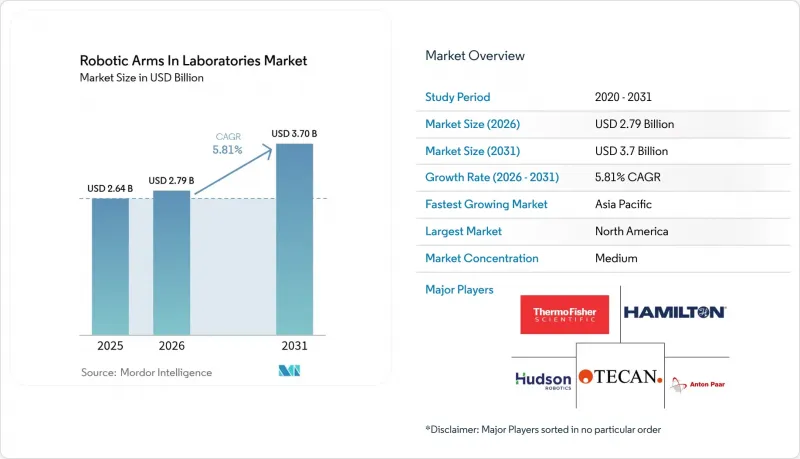
This report is Segmented by Type (Articulated Arm, Dual Arm, Parallel Link Arm, and More), Application (Drug Discovery, Digital Imaging, and More), Payload Capacity (Up To 5 Kg, 5 Kg To 15 Kg, and Above 15 Kg), End-User (Pharmaceutical and Biotechnology Companies, Academic and Research Institutes, and More), and Geography. The Market Forecasts are Provided in Terms of Value (USD).
Global Robotic Arms In Laboratories Market Trends and Insights
Escalating Demand for High-Throughput Screening Drives Miniaturization and Speed
Pharmaceutical discovery pipelines now process between 100,000 and 1 million compounds per campaign, volumes that make manual pipetting unsustainable. Roche's uMed acoustic liquid handler, launched in 2024, pairs sub-nanoliter dispensing with machine-vision inspection, trimming reagent use by 40% while enabling fully unattended 384-well plate shuttling by articulated robotic arms. The United States Food and Drug Administration's 2024 strategic plan recognizes automated high-throughput screening as critical for faster investigational new drug submissions, encouraging laboratories to invest in audit-ready robots. Public-sector facilities follow suit; the National Institutes of Health's translational sciences center now tests 10,000 compounds daily using robotic lines, demonstrating that academic labs can achieve commercial-grade throughput when adequately funded. As a result, robotic arms in laboratories market deployments that support high-throughput screening continue to climb across both commercial and academic sites.
Rising Adoption of Collaborative Laboratory Robots Reshapes Cleanrooms
Collaborative arms enable technicians to work safely alongside robots without full safety caging, a benefit that preserves floor space and reduces installation costs by approximately 40%. DENSO Wave's COBOTTA PRO, released in January 2025, achieves a contact pressure of 10 newtons, aligning with ISO/TS 15066 force limits and experiencing early uptake in Asian pharmaceutical cleanrooms. Wave's COBOTTA PRO, released in January 2025, achieves a contact pressure of 10 newtons, aligning with ISO/TS 15066 force limits and experiencing early uptake in Asian pharmaceutical cleanrooms. Universal Robots' UR20, already installed at over 200 drug-manufacturing sites, lifts 20 kg while occupying a 245 mm footprint, freeing valuable bench area. Europe's Annex 1 aseptic guidelines and the updated ISO/TS standard have trimmed validation times from 18 months to under 12, accelerating purchases in Italian and German fill-finish plants. These safety and compliance gains underpin the 7.56% CAGR for collaborative units, reinforcing growth momentum for the robotic arms in laboratories market.
High Upfront Capital Outlay for ISO-Compliant Robotic Cells Deters Academic Adopters
A six-axis arm with a cleanroom enclosure and ISO 17025 validation often exceeds USD 300,000, with service contracts adding 12-15% yearly. Academic labs relying on three-year NIH R01 grants struggle to allocate such funds, favoring manual workflows. ISO 15189 accreditation further mandates semi-annual gravimetric calibration, which costs up to USD 12,000 per cycle and approximately 60 technician hours. Small biotechnology firms, which form 70% of United States startups, lack capital reserves and instead outsource assays to contract research organizations. Horizon Europe grants require 30-40% cost sharing, slowing cobot purchases in Southern and Eastern member states. These financial barriers continue to temper near-term uptake within the robotic arms in laboratories market.
Other drivers and restraints analyzed in the detailed report include:
- Stricter Occupational Safety Mandates in Biosafety Labs Elevate Engineering Controls
- Pharmaceutical Shift Toward Continuous Manufacturing Demands Integrated Robots
- Integration Challenges with Legacy LIMS and ELN Platforms Fragment Data Workflows
For complete list of drivers and restraints, kindly check the Table Of Contents.
Segment Analysis
Articulated systems captured 40.58% of the robotic arms in laboratories market share in 2025, thanks to sub-50 µm repeatability and six-degree-of-freedom capabilities that suit microplate handling. Dual-arm robots remain a niche technology, but they enable parallel tasks, cutting the screening cycle time by up to 30%. Parallel-link architectures excel at rapid pick-and-place for vial capping in high-volume diagnostic labs. Collaborative designs recorded the fastest growth, expanding at 7.33% CAGR as manufacturers retrofit ISO Class 7 and 8 suites without cages. A FANUC CRX unit completes barcode scanning and seal-peel steps while sensing nearby staff, meeting Machinery Directive limits. The industry anticipates the forthcoming revision of IEC 61010-2-061 in 2026 to clarify safety criteria, thereby further enhancing the collaborative adoption of this standard. The robotic arms in laboratories market size for collaborative units is projected to surpass that of articulated platforms by 2028.
Collaborative arms thrive because they reduce installation costs by approximately 40%, compress commissioning schedules, and adapt to changing workflows. Pharmaceutical plants transitioning to personalized medicines value cobots that can be redeployed within hours. Yaskawa's HC-series integrates machine vision to distinguish between human hands and labware, thereby avoiding pinch points. Universities favor lightweight units, such as the Opentrons OT-2, for teach-pendant simplicity under constrained grant budgets. These dynamics underscore why collaborative designs now anchor vendor roadmaps inside the broader robotic arms in laboratories market.
Drug discovery dominated 32.35% revenue in 2025, but sample-prep loads in genomics and proteomics now outpace it, with an 6.86% CAGR. Sequencers like Illumina NovaSeq X Plus require robots that transfer 384-well plates through heating, bead cleanup, and fluorometric checks in under 90 minutes, slashing hands-on work by 80%.Proteomics labs running Orbitrap Astral instruments rely on robots for 2 µL pickups, eliminating carryover. Clinical diagnostics centers deploy similar arms in ISO Class 5 biosafety cabinets to process respiratory panels, maintaining operator safety. Digital imaging, including whole-slide histopathology, uses arms to load 200 slides per hour. Systems biology groups culture organoids with robotic microfluidics to study drug metabolism. Collectively, these high-precision tasks expand the market size of robotic arms in laboratories, particularly within genomics and proteomics facilities.
The United States Food and Drug Administration guidance on companion diagnostics encourages the use of automated preparation to reduce pre-analytical variance. Laboratories pursuing College of American Pathologists accreditation, therefore, favor systems that generate electronic audit logs. This regulatory pull, coupled with falling genome-sequencing costs, sustains double-digit growth for robots serving genomics workloads. Vendors now package library-prep kits with pre-calibrated motion files, making installation easier. As adoption broadens, the robotic arms in laboratories market reinforce their strategic role in multi-omic science.
Complete Report Scope:
- By Arm Type
- Articulated Arm
- Dual Arm
- Parallel Link Arm
- Collaborative Arm
- Other Arm Types
- By Application
- Drug Discovery
- Digital Imaging
- Genomics and Proteomics
- Clinical Diagnostics
- Systems Biology
- Other Applications
- By Payload Capacity
- Up To 5 kg
- 5 kg - 15 kg
- Above 15 kg
- By End-User
- Pharmaceutical and Biotechnology Companies
- Academic and Research Institutes
- Clinical Diagnostics Laboratories
- Contract Research Organizations
- By Geography
- North America
- United States
- Canada
- Mexico
- Europe
- United Kingdom
- Germany
- France
- Italy
- Rest of Europe
- Asia-Pacific
- China
- Japan
- India
- South Korea
- Rest of Asia
- Middle East
- Israel
- Saudi Arabia
- United Arab Emirates
- Turkey
- Rest of Middle East
- Africa
- South Africa
- Egypt
- Rest of Africa
- South America
- Brazil
- Argentina
- Rest of South America
- North America
Geography Analysis
North America held 34.05% of the revenue in 2025, reflecting the concentration of life-science hubs in Boston, the San Francisco Bay Area, and Research Triangle Park. The National Institutes of Health set aside USD 1.2 billion for shared instrumentation in fiscal 2025, funding cobots that assist translational oncology projects. Canada's National Research Council launched a CAD 50 million (USD 37 million) Smart Lab Initiative targeting 30% productivity gains in government facilities. Mexico's pharmaceutical plants in Jalisco and Mexico City automate vial filling to comply with the United States' current Good Manufacturing Practice, illustrating regional spillover. Together, these factors strengthen North American dominance within the robotic arms in laboratories market.
Europe followed with around 27.82% share in 2025 as Annex 1 aseptic rules and data-integrity expectations spurred upgrades. The United Kingdom awarded GBP 40 million (USD 51 million) to the Francis Crick and Wellcome Sanger institutes for genomics automation. Germany's Fraunhofer network installed cobots for media prep in 2024, while Italy and Spain onshored sterile fill-finish capacity in response to pandemic supply shocks. These investments keep Europe at the forefront of collaborative safety standards and validate the robotic arms in laboratories market across the region.
The Asia Pacific is projected to grow at a 6.78% CAGR through 2031, the fastest worldwide, as governments invest in biosafety labs and smart-manufacturing pilots. China earmarked CNY 3 billion (USD 420 million) for robotic automation at top academies, focusing on synthetic biology. India's Department of Biotechnology has launched a USD 150 million grant to modernize vaccine labs, aligning with the country's self-reliance goals. Japan's pharmaceutical majors are retrofitting plants with cobots to offset labor shortages, and South Korea has invested KRW 80 billion (USD 60 million) in a national cell-therapy center.
Meanwhile, Israel and Gulf states are automating diagnostics to serve the medical tourism industry. Although Africa and South America remain nascent, pilots in South Africa and Brazil hint at future uptake. These regional dynamics underline the Asia Pacific's role as the growth engine for robotic arms in laboratories market.
List of Companies Covered in this Report:
- Thermo Fisher Scientific Inc.
- Hamilton Company
- Hudson Robotics Inc.
- Tecan Group Ltd.
- Anton Paar GmbH
- bioMerieux SA
- Siemens Healthineers AG
- Beckman Coulter Inc.
- PerkinElmer Inc.
- QIAGEN NV
- Abbott Laboratories
- Yaskawa Electric Corporation
- FANUC Corporation
- Kawasaki Heavy Industries Ltd.
- Denso Wave Inc.
- Universal Robots A/S
- Precise Automation Inc.
- Labman Automation Ltd.
- Opentrons Labworks Inc.
- Biosero Inc.
Additional Benefits:
- The market estimate (ME) sheet in Excel format
- 3 months of analyst support
TABLE OF CONTENTS
1 INTRODUCTION
- 1.1 Study Assumptions and Market Definition
- 1.2 Scope of the Study
2 RESEARCH METHODOLOGY
3 EXECUTIVE SUMMARY
4 MARKET LANDSCAPE
- 4.1 Industry Value-Chain Analysis
- 4.2 Regulatory Landscape
- 4.3 Technological Outlook
- 4.4 Impact of Macroeconomic Factors on the Market
- 4.5 Porter's Five Forces Analysis
- 4.5.1 Threat of New Entrants
- 4.5.2 Bargaining Power of Buyers
- 4.5.3 Bargaining Power of Suppliers
- 4.5.4 Threat of Substitutes
- 4.5.5 Intensity of Competitive Rivalry
- 4.6 Market Drivers
- 4.6.1 Escalating Demand for High-Throughput Screening
- 4.6.2 Rising Adoption of Collaborative Laboratory Robots (Cobots)
- 4.6.3 Stricter Occupational Safety Mandates in Biosafety Labs
- 4.6.4 Pharmaceutical Shift Toward Continuous Manufacturing
- 4.6.5 Growth of Precision Medicine Driving Sample-Prep Automation
- 4.6.6 Emerging Government Grants for Smart Lab Infrastructure
- 4.7 Market Restraints
- 4.7.1 High Upfront Capital Outlay for ISO-Compliant Robotic Cells
- 4.7.2 Limited Dexterity in Handling Fragile Micro-volume Tasks
- 4.7.3 Integration Challenges with Legacy LIMS and ELN Platforms
- 4.7.4 Scarcity of Skilled Mechatronics Personnel in Academic Labs
5 MARKET SIZE AND GROWTH FORECASTS (VALUE)
- 5.1 By Arm Type
- 5.1.1 Articulated Arm
- 5.1.2 Dual Arm
- 5.1.3 Parallel Link Arm
- 5.1.4 Collaborative Arm
- 5.1.5 Other Arm Types
- 5.2 By Application
- 5.2.1 Drug Discovery
- 5.2.2 Digital Imaging
- 5.2.3 Genomics and Proteomics
- 5.2.4 Clinical Diagnostics
- 5.2.5 Systems Biology
- 5.2.6 Other Applications
- 5.3 By Payload Capacity
- 5.3.1 Up To 5 kg
- 5.3.2 5 kg - 15 kg
- 5.3.3 Above 15 kg
- 5.4 By End-User
- 5.4.1 Pharmaceutical and Biotechnology Companies
- 5.4.2 Academic and Research Institutes
- 5.4.3 Clinical Diagnostics Laboratories
- 5.4.4 Contract Research Organizations
- 5.5 By Geography
- 5.5.1 North America
- 5.5.1.1 United States
- 5.5.1.2 Canada
- 5.5.1.3 Mexico
- 5.5.2 Europe
- 5.5.2.1 United Kingdom
- 5.5.2.2 Germany
- 5.5.2.3 France
- 5.5.2.4 Italy
- 5.5.2.5 Rest of Europe
- 5.5.3 Asia-Pacific
- 5.5.3.1 China
- 5.5.3.2 Japan
- 5.5.3.3 India
- 5.5.3.4 South Korea
- 5.5.3.5 Rest of Asia
- 5.5.4 Middle East
- 5.5.4.1 Israel
- 5.5.4.2 Saudi Arabia
- 5.5.4.3 United Arab Emirates
- 5.5.4.4 Turkey
- 5.5.4.5 Rest of Middle East
- 5.5.5 Africa
- 5.5.5.1 South Africa
- 5.5.5.2 Egypt
- 5.5.5.3 Rest of Africa
- 5.5.6 South America
- 5.5.6.1 Brazil
- 5.5.6.2 Argentina
- 5.5.6.3 Rest of South America
- 5.5.1 North America
6 COMPETITIVE LANDSCAPE
- 6.1 Market Concentration
- 6.2 Strategic Moves
- 6.3 Market Share Analysis
- 6.4 Company Profiles (Includes Global level Overview, Market level overview, Core Segments, Financials as available, Strategic Information, Market Rank/Share for key companies, Products and Services, and Recent Developments)
- 6.4.1 Thermo Fisher Scientific Inc.
- 6.4.2 Hamilton Company
- 6.4.3 Hudson Robotics Inc.
- 6.4.4 Tecan Group Ltd.
- 6.4.5 Anton Paar GmbH
- 6.4.6 bioMerieux SA
- 6.4.7 Siemens Healthineers AG
- 6.4.8 Beckman Coulter Inc.
- 6.4.9 PerkinElmer Inc.
- 6.4.10 QIAGEN NV
- 6.4.11 Abbott Laboratories
- 6.4.12 Yaskawa Electric Corporation
- 6.4.13 FANUC Corporation
- 6.4.14 Kawasaki Heavy Industries Ltd.
- 6.4.15 Denso Wave Inc.
- 6.4.16 Universal Robots A/S
- 6.4.17 Precise Automation Inc.
- 6.4.18 Labman Automation Ltd.
- 6.4.19 Opentrons Labworks Inc.
- 6.4.20 Biosero Inc.
7 MARKET OPPORTUNITIES AND FUTURE OUTLOOK
- 7.1 White-Space and Unmet-Need Assessment

