PUBLISHER: Global Market Insights Inc. | PRODUCT CODE: 2083102

PUBLISHER: Global Market Insights Inc. | PRODUCT CODE: 2083102
Oligonucleotide Therapeutics Market Opportunity, Growth Drivers, Industry Trend Analysis, and Forecast 2026 - 2035
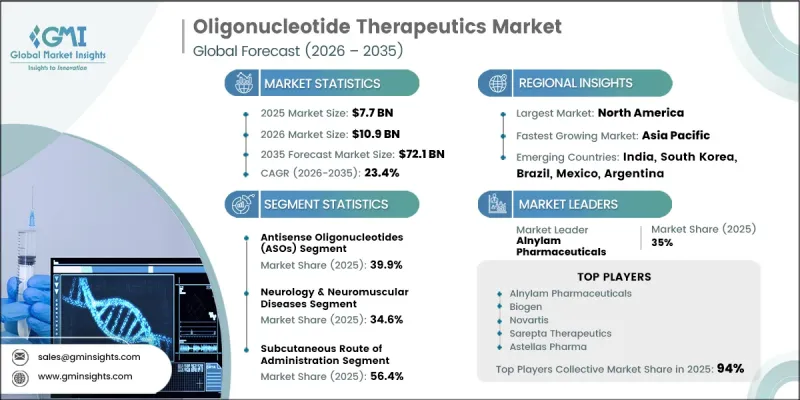
The Global Oligonucleotide Therapeutics Market was valued at USD 7.7 billion in 2025 and is estimated to grow at a CAGR of 23.4% to reach USD 72.1 billion by 2035.
The oligonucleotide therapeutics market is undergoing a significant structural transformation as nucleic acid-based drug modalities evolve from narrowly focused rare-disease treatments into a broader and more established therapeutic category across multiple clinical areas. Increasing scientific advancements in RNA-based medicine, improved delivery technologies, and growing clinical validation are collectively driving the expansion of this market. The integration of advanced conjugation chemistries has significantly improved drug stability, targeted delivery, and dosing convenience, supporting wider patient adoption. At the same time, the application of oligonucleotide therapies is extending beyond rare genetic disorders into more prevalent chronic and metabolic diseases, substantially broadening the commercial opportunity base. Regulatory approvals have increased steadily, reflecting rising confidence in the safety and efficacy of RNA-targeted treatments. Growing investment in biopharmaceutical research and development is accelerating pipeline expansion, while pharmaceutical companies are focusing on next-generation RNA platforms to enhance therapeutic precision and durability. These factors, combined with improved patient compliance through simplified administration formats and extended dosing intervals, are expected to sustain strong long-term growth across the global oligonucleotide therapeutics market.
| Market Scope | |
|---|---|
| Start Year | 2025 |
| Forecast Year | 2026-2035 |
| Start Value | $7.7 Billion |
| Forecast Value | $72.1 Billion |
| CAGR | 23.4% |
In 2025, antisense oligonucleotides accounted for 39.9% share. This dominance is attributed to their well-established clinical utility and extensive application across multiple therapeutic areas. These single-stranded nucleic acid sequences function by binding to specific messenger RNA targets, enabling gene expression modulation through degradation or translation interference mechanisms. Continued advancements in molecular design and delivery systems are further strengthening their clinical relevance and commercial adoption.
The subcutaneous administration route represented 56.4% share in 2025. Its prominence is driven by its compatibility with modern RNA-based drugs that allow self-administration and reduced dependence on clinical settings. This route improves patient convenience, enhances treatment adherence, and reduces healthcare system burden, making it a preferred option for long-term therapeutic regimens. Expanding use of long-acting formulations continues to reinforce its dominant position.
North America Oligonucleotide Therapeutics Market accounted for 57.9% share in 2025, maintaining its leadership position due to strong biopharmaceutical innovation, advanced healthcare infrastructure, and favorable reimbursement frameworks. The region benefits from early adoption of RNA-based therapies and a well-established regulatory environment that supports accelerated drug approvals. High investment in rare disease research and strong commercial uptake of premium-priced therapies continue to support sustained market dominance across North America.
Major companies operating in the global oligonucleotide therapeutics market include Alnylam Pharmaceuticals, Ionis Pharmaceuticals, Sarepta Therapeutics, Biogen, Astellas Pharma, Novartis, AstraZeneca, Novo Nordisk, Sanofi, Arrowhead Pharmaceuticals, and NS Pharma. Companies operating in the oligonucleotide therapeutics market are strengthening their competitive position through continuous investment in RNA platform technologies, advanced drug delivery systems, and precision medicine approaches. Market participants are expanding clinical pipelines across multiple therapeutic areas while enhancing formulation strategies to improve stability, efficacy, and patient compliance. Strategic collaborations with biotechnology firms, research institutions, and academic organizations are accelerating innovation and shortening development timelines. Companies are also focusing on scalable manufacturing capabilities to support growing commercial demand and ensure consistent product quality.
Table of Contents
Chapter 1 Methodology and Scope
- 1.1 Market scope and definition
- 1.2 Research approach
- 1.3 Quality commitments
- 1.3.1 GMI AI policy & data integrity commitment
- 1.3.1.1 Source consistency protocol
- 1.3.1 GMI AI policy & data integrity commitment
- 1.4 Research trail & confidence scoring
- 1.4.1 Research trail components
- 1.4.2 Scoring components
- 1.5 Data collection
- 1.5.1 Partial list of primary sources
- 1.6 Data mining sources
- 1.6.1 Paid sources
- 1.6.1.1 Sources, by region
- 1.6.1 Paid sources
- 1.7 Base estimates and calculations
- 1.7.1 Base year calculation for any one approach
- 1.8 Forecast model
- 1.8.1 Quantified market impact analysis
- 1.8.1.1 Mathematical impact of growth parameters on forecast
- 1.8.1 Quantified market impact analysis
- 1.9 Research transparency addendum
- 1.9.1 Source attribution framework
- 1.9.2 Quality assurance metrics
- 1.9.3 Our commitment to trust
Chapter 2 Executive Summary
- 2.1 Industry 360° synopsis
- 2.2 Key market trends
- 2.2.1 Regional trends
- 2.2.2 Molecule type trends
- 2.2.3 Indication trends
- 2.2.4 Route of administration trends
- 2.2.5 End use trends
- 2.3 CXO perspectives: Strategic imperatives
Chapter 3 Industry Insights
- 3.1 Industry ecosystem analysis
- 3.2 Industry impact forces
- 3.2.1 Growth drivers
- 3.2.1.1 Increasing approvals of novel oligonucleotide therapeutics across multiple disease indications
- 3.2.1.2 Rising prevalence and improved diagnosis of rare genetic disorders
- 3.2.1.3 Strong regulatory support through orphan drug designation and expedited approval pathways
- 3.2.2 Industry pitfalls and challenges
- 3.2.2.1 High treatment costs and reimbursement challenges
- 3.2.2.2 Complex manufacturing processes and stringent quality requirements
- 3.2.2.3 Limited applicability beyond specific genetic or molecular targets
- 3.2.3 Market opportunities
- 3.2.3.1 Expansion of oligonucleotide therapeutics into high-prevalence chronic diseases such as cardiovascular, metabolic, and neurodegenerative disorders
- 3.2.3.2 Growing investment in next-generation delivery platforms and tissue-targeted oligonucleotide technologies
- 3.2.1 Growth drivers
- 3.3 Growth potential analysis
- 3.4 Regulatory landscape
- 3.4.1 North America
- 3.4.2 Europe
- 3.4.3 Asia Pacific
- 3.4.4 Latin America
- 3.4.5 Middle East and Africa
- 3.5 Technology and innovation landscape
- 3.5.1 Current technological trends
- 3.5.2 Emerging technologies
- 3.6 Pricing analysis (Driven by Primary Research)
- 3.6.1 Historical price trend analysis
- 3.6.2 Pricing analysis, by molecule type
- 3.7 Porter’s analysis
- 3.8 PESTEL analysis
- 3.9 Investment & funding analysis
- 3.10 Pipeline and clinical trial landscape
- 3.11 Future market trends
- 3.12 Impact of AI & Generative AI on the market
Chapter 4 Competitive Landscape, 2025
- 4.1 Introduction
- 4.2 Company market share analysis
- 4.2.1 North America
- 4.2.2 Europe
- 4.2.3 Asia Pacific
- 4.3 Company matrix analysis
- 4.4 Competitive analysis of major market players
- 4.5 Competitive positioning matrix
- 4.6 Key developments
- 4.6.1 Merger and acquisition
- 4.6.2 Partnership and collaboration
- 4.6.3 New product launches
- 4.6.4 Expansion plans
Chapter 5 Market Estimates and Forecast, By Molecule Type, 2022 - 2035 ($ Mn)
- 5.1 Key trends
- 5.2 Antisense oligonucleotides (ASOs)
- 5.3 Small interfering RNA (siRNA)
- 5.4 Aptamers
Chapter 6 Market Estimates and Forecast, By Indication, 2022 - 2035 ($ Mn)
- 6.1 Key trends
- 6.2 Neurology & neuromuscular diseases
- 6.3 Rare hereditary & metabolic diseases
- 6.4 Cardiovascular & lipid disorders
- 6.5 Hematological disorders
- 6.6 Ophthalmology
- 6.7 Other therapeutic areas
Chapter 7 Market Estimates and Forecast, By Route of Administration, 2022 - 2035 ($ Mn)
- 7.1 Key trends
- 7.2 Subcutaneous
- 7.3 Intravenous
- 7.4 Intrathecal
- 7.5 Intravitreal
Chapter 8 Market Estimates and Forecast, By End Use, 2022 - 2035 ($ Mn)
- 8.1 Key trends
- 8.2 Hospitals
- 8.3 Specialty clinics & ambulatory care
- 8.4 Home care settings
- 8.5 Research institutes & academic medical centers
Chapter 9 Market Estimates and Forecast, By Region, 2022 - 2035 ($ Mn)
- 9.1 Key trends
- 9.2 North America
- 9.2.1 U.S.
- 9.2.2 Canada
- 9.3 Europe
- 9.3.1 Germany
- 9.3.2 UK
- 9.3.3 France
- 9.3.4 Spain
- 9.3.5 Italy
- 9.3.6 Netherlands
- 9.4 Asia Pacific
- 9.4.1 China
- 9.4.2 India
- 9.4.3 Japan
- 9.4.4 Australia
- 9.4.5 South Korea
- 9.5 Latin America
- 9.5.1 Brazil
- 9.5.2 Mexico
- 9.5.3 Argentina
- 9.6 Middle East and Africa
- 9.6.1 South Africa
- 9.6.2 Saudi Arabia
- 9.6.3 UAE
Chapter 10 Company Profiles
- 10.1 Alnylam Pharmaceuticals
- 10.2 Arrowhead Pharmaceuticals
- 10.3 Astellas Pharma
- 10.4 AstraZeneca
- 10.5 Biogen
- 10.6 Ionis Pharmaceuticals
- 10.7 Novartis
- 10.8 NS Pharma
- 10.9 Novo Nordisk
- 10.10 Sarepta Therapeutics
- 10.11 Sanofi

