PUBLISHER: Global Market Insights Inc. | PRODUCT CODE: 2083111

PUBLISHER: Global Market Insights Inc. | PRODUCT CODE: 2083111
Predictive Maintenance in Power Generation Market Opportunity, Growth Drivers, Industry Trend Analysis, and Forecast 2026 - 2035
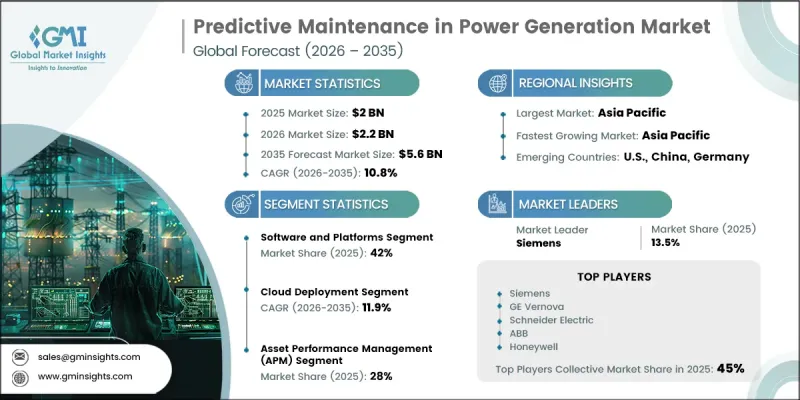
The Global Predictive Maintenance in Power Generation Market was valued at USD 2 billion in 2025 and is estimated to grow at a CAGR of 10.8% to reach USD 5.6 billion by 2035.
Growth in the global predictive maintenance in power generation market is driven by increasing adoption of AI-powered diagnostics, rising operational costs associated with unplanned equipment downtime, and accelerating digital transformation across power generation assets. Utilities are increasingly deploying condition monitoring systems, IoT-enabled sensors, and cloud-based analytics platforms to improve asset reliability across thermal, renewable, and nuclear power infrastructure. Aging power generation fleets and the rapid expansion of geographically distributed renewable energy assets are further intensifying demand for advanced maintenance solutions. As wind and solar installations operate under highly variable and hard-to-inspect conditions, traditional maintenance strategies are proving insufficient to prevent failures, strengthening the case for predictive approaches. Additionally, digital transformation initiatives such as SCADA modernization, OT/IT integration, and enterprise resource planning upgrades are enabling seamless data flow from operational equipment to analytics systems. This connected infrastructure is expanding the addressable market for predictive maintenance solutions by allowing AI-driven platforms to process real-time operational data and generate actionable maintenance insights at scale across diverse generation assets.
| Market Scope | |
|---|---|
| Start Year | 2025 |
| Forecast Year | 2026-2035 |
| Start Value | $2 Billion |
| Forecast Value | $5.6 Billion |
| CAGR | 10.8% |
The software and platforms segment accounted for 42% share in 2025. This segment includes AI-based diagnostic tools, cloud-based asset performance management systems, digital twin solutions, and middleware that connects operational technology data with analytics platforms. Growth in this category is driven by the scalability of software-based deployment models, where solutions can be replicated across multiple assets with minimal incremental cost after initial implementation. Increasing adoption of AI-powered asset monitoring platforms continues to enhance predictive accuracy and operational efficiency across power generation facilities.
The cloud deployment segment held a 44% share in 2025 and is projected to grow at a CAGR of 11.9%. Cloud-based systems enable centralized data aggregation and analysis across distributed power generation assets without requiring extensive on-site infrastructure. This model is particularly well suited for operators managing large renewable energy fleets across multiple locations, where aggregated data improves predictive accuracy and operational benchmarking across assets.
North America Predictive Maintenance in Power Generation Market accounted for 22% share in 2025 and is expected to grow at a CAGR of 9.2% through 2035. The region's growth is supported by ongoing investments in grid modernization initiatives and the widespread adoption of digital monitoring technologies across generation and transmission infrastructure. Continued integration of advanced analytics and connected asset management systems is strengthening predictive maintenance adoption across the power sector in the region.
Major companies operating in the global predictive maintenance in power generation market include Siemens, GE Vernova, Schneider Electric, ABB, Honeywell, IBM, Oracle, Mitsubishi Electric, AspenTech, Yokogawa Electric, Rockwell Automation, SAP, Emerson Electric, Baker Hughes, Hitachi Energy, AVEVA, Bentley Systems, C3 AI, SparkCognition, Uptake Technologies, Cognite, SKF, Envision Digital, PTC, and Senseye. Companies operating in the predictive maintenance in power generation market are strengthening their market position by investing in advanced AI analytics, expanding cloud-based platform capabilities, and enhancing real-time asset monitoring solutions. Market participants are focusing on integrating IoT sensors, digital twin models, and machine learning algorithms to improve predictive accuracy and reduce equipment downtime. Strategic collaborations with utilities, energy operators, and technology providers are helping companies expand deployment across diverse power generation assets. Businesses are also prioritizing platform scalability, interoperability with existing OT and IT systems, and cybersecurity enhancements to support large-scale adoption.
Table of Contents
Chapter 1 Methodology & Scope
- 1.1 Research approach
- 1.2 Quality commitment
- 1.2.1 GMI AI policy & data integrity commitment
- 1.2.1.1 Source consistency protocol
- 1.2.1 GMI AI policy & data integrity commitment
- 1.3 Research Trail & Confidence Scoring
- 1.3.1 Research Trail Components
- 1.3.2 Scoring Components
- 1.4 Data Collection
- 1.4.1 Partial list of primary sources
- 1.5 Data mining sources
- 1.5.1 Paid sources
- 1.5.1.1 Sources, by region
- 1.5.1 Paid sources
- 1.6 Base estimates and calculations
- 1.6.1 Base year calculation for any one approach
- 1.7 Forecast model
- 1.8 Research transparency addendum
- 1.8.1 Source attribution framework
- 1.8.2 Quality assurance metrics
- 1.8.3 Our commitment to trust
- 1.8.3.1 Market definitions
Chapter 2 Executive Summary
- 2.1 Industry synopsis, 2022 - 2035
- 2.2 Business trends
- 2.3 Component trends
- 2.4 Deployment trends
- 2.5 Power plant trends
- 2.6 Asset type trends
- 2.7 Application trends
- 2.8 Regional trends
Chapter 3 Industry Insights
- 3.1 Industry ecosystem analysis
- 3.2 Industry impact forces
- 3.2.1 Growth drivers
- 3.2.2 Industry pitfalls & challenges
- 3.3 Growth potential analysis
- 3.4 Regulatory landscape
- 3.5 Porter's analysis
- 3.5.1 Bargaining power of suppliers
- 3.5.2 Bargaining power of buyers
- 3.5.3 Threat of new entrants
- 3.5.4 Threat of substitutes
- 3.6 PESTEL analysis
- 3.7 Technology & Innovation Landscape
- 3.7.1 AI & machine learning in predictive maintenance
- 3.7.2 IoT-enabled condition monitoring in power plants
- 3.7.3 Digital twin applications in power generation assets
- 3.7.4 Edge computing & real-time analytics
- 3.7.5 Cloud-based predictive maintenance platforms
- 3.8 Pricing Analysis (Driven by Primary Research)
- 3.8.1 Pricing trends by Component (Software, Hardware, Services)
- 3.8.2 Pricing strategy by vendor type (OEMs vs Software Providers vs Service Providers)
- 3.9 Impact of AI & generative AI on the market
- 3.9.1 AI-driven Predictive Maintenance & Fault Detection
- 3.9.2 GenAI use cases in maintenance planning & asset management
- 3.9.3 Autonomous maintenance & decision intelligence
- 3.9.4 Risks, limitations & cybersecurity challenges
- 3.10 Emerging opportunities & trends
- 3.11 Investment analysis & future outlook
Chapter 4 Competitive Landscape, 2026
- 4.1 Introduction
- 4.2 Company market share analysis, by region, 2025
- 4.2.1 North America
- 4.2.2 Europe
- 4.2.3 Asia Pacific
- 4.2.4 Middle East & Africa
- 4.2.5 Latin America
- 4.3 Competitive positioning matrix
- 4.4 Key Developments
- 4.4.1 Mergers & acquisitions
- 4.4.2 Partnerships & collaborations
- 4.4.3 New product launches
- 4.4.4 Expansion plans and funding
Chapter 5 Market Size and Forecast, By Component, 2022 - 2035 (USD Million)
- 5.1 Key trends
- 5.2 Software & platforms
- 5.3 Hardware
- 5.4 Services
Chapter 6 Market Size and Forecast, By Deployment, 2022 - 2035 (USD Million)
- 6.1 Key trends
- 6.2 Cloud
- 6.3 On-Premise
- 6.4 Hybrid
Chapter 7 Market Size and Forecast, By Power Plant, 2022 - 2035 (USD Million)
- 7.1 Key trends
- 7.2 Thermal power plants
- 7.2.1 Coal-fired
- 7.2.2 Oil & Gas-fired
- 7.3 Renewables
- 7.3.1 Solar
- 7.3.2 Wind
- 7.3.3 Hydropower
- 7.3.4 Others
- 7.4 Energy storage & DER
- 7.5 Nuclear
Chapter 8 Market Size and Forecast, By Asset Type, 2022 - 2035 (USD Million)
- 8.1 Key trends
- 8.2 Turbine
- 8.3 Generators
- 8.4 Boilers
- 8.5 Transformers
- 8.6 Switchgear equipment
- 8.7 Pumps & compressors
- 8.8 Heat exchangers & cooling systems
- 8.9 Others
Chapter 9 Market Size and Forecast, By Application, 2022 - 2035 (USD Million)
- 9.1 Key trends
- 9.2 Asset performance management
- 9.3 Fault detection & diagnostics
- 9.4 Predictive asset health monitoring
- 9.5 Maintenance scheduling optimization
- 9.6 Remote monitoring & control
- 9.7 Others
Chapter 10 Market Size and Forecast, By Region, 2022 - 2035 (USD Million)
- 10.1 Key trends
- 10.2 North America
- 10.2.1 U.S.
- 10.2.2 Canada
- 10.3 Europe
- 10.3.1 UK
- 10.3.2 Germany
- 10.3.3 France
- 10.3.4 Italy
- 10.3.5 Spain
- 10.3.6 Russia
- 10.4 Asia Pacific
- 10.4.1 China
- 10.4.2 South Korea
- 10.4.3 Japan
- 10.4.4 India
- 10.4.5 Australia
- 10.5 Middle East & Africa
- 10.5.1 Saudi Arabia
- 10.5.2 UAE
- 10.5.3 Qatar
- 10.5.4 South Africa
- 10.6 Latin America
- 10.6.1 Argentina
- 10.6.2 Brazil
- 10.6.3 Mexico
Chapter 11 Company Profiles
- 11.1 ABB
- 11.2 AspenTech
- 11.3 AVEVA
- 11.4 Baker Hughes
- 11.5 Bentley Systems
- 11.6 C3 AI
- 11.7 Cognite
- 11.8 Emerson Electric
- 11.9 Envision Digital
- 11.10 GE Vernova
- 11.11 Hitachi Energy
- 11.12 Honeywell
- 11.13 IBM
- 11.14 Mitsubishi Electric
- 11.15 Oracle
- 11.16 PTC
- 11.17 Rockwell Automation
- 11.18 SAP
- 11.19 Schneider Electric
- 11.20 Senseye
- 11.21 Siemens
- 11.22 SKF
- 11.23 SparkCognition
- 11.24 Uptake Technologies
- 11.25 Yokogawa Electric

