PUBLISHER: Global Market Insights Inc. | PRODUCT CODE: 2083119

PUBLISHER: Global Market Insights Inc. | PRODUCT CODE: 2083119
Lignin-Based Wood Panel Adhesives Market Opportunity, Growth Drivers, Industry Trend Analysis, and Forecast 2026 - 2035
The Global Lignin-Based Wood Panel Adhesives Market was valued at USD 295.4 million in 2025 and is estimated to grow at a CAGR of 12.1% to reach USD 900.5 million by 2035.
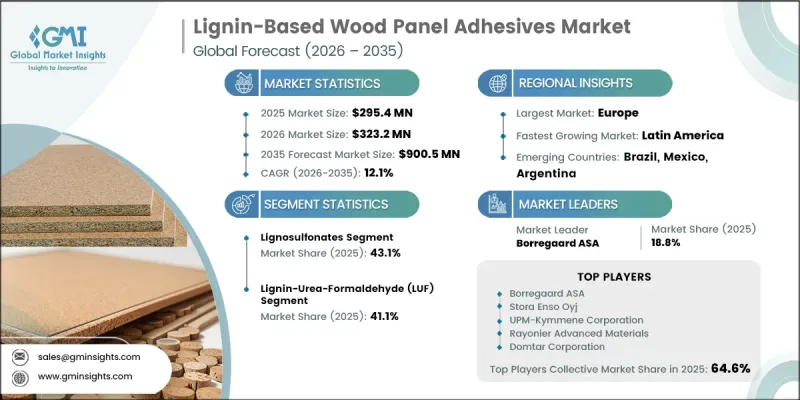
The expansion of the Lignin-Based Wood Panel Adhesives Market is driven by evolving environmental regulations, growing emphasis on carbon reduction, and changing raw material economics that are encouraging the transition away from conventional petroleum-derived adhesive systems. Beyond the projected growth rate, the market is shaped by a broader transformation in material selection strategies across the wood products industry. Manufacturers are increasingly adopting bio-based adhesive technologies as sustainability goals, regulatory requirements, and commercial viability become more closely aligned. Lignin-derived adhesive solutions offer a practical pathway for reducing or significantly lowering formaldehyde content while allowing producers to maintain existing manufacturing processes with minimal disruption. In addition, green building standards and sustainable construction requirements are becoming increasingly integrated into procurement policies across commercial, institutional, and public infrastructure projects. This shift is strengthening demand for renewable-content materials and supporting the growing adoption of lignin-based adhesive technologies across a wide range of wood panel applications.
| Market Scope | |
|---|---|
| Start Year | 2025 |
| Forecast Year | 2026-2035 |
| Start Value | $295.4 Million |
| Forecast Value | $900.5 Million |
| CAGR | 12.1% |
The lignosulfonates segment held a 43.1% share in 2025. Their leading position is supported by strong water solubility, well-established performance characteristics, and dependable commercial availability from large-scale producers. These lignin derivatives possess molecular structures that provide excellent compatibility with water-based resin formulations commonly utilized in engineered wood manufacturing, making them a preferred option for adhesive developers and panel producers.
The LUF systems segment held a 41.1% share in 2025. Continued innovation in formulation development and performance optimization is supporting adoption across multiple wood panel manufacturing segments and end-use applications.
North America Lignin-Based Wood Panel Adhesives Market captured 22% share in 2025. Regional growth is supported by stringent emission standards and regulatory requirements that have significantly influenced adhesive selection practices throughout the composite wood products sector. Compliance-focused manufacturing strategies and increasing demand for environmentally responsible building materials continue to create favorable conditions for bio-based adhesive adoption across the region. Growing industry acceptance of renewable alternatives and greater emphasis on low-emission products are expected to further strengthen market development in North America.
Key companies operating in the Global Lignin-Based Wood Panel Adhesives Market include UPM-Kymmene Corporation, Borregaard ASA, Stora Enso Oyj., Domtar Corporation, Rayonier Advanced Materials, Koskisen Oy, Latvijas Finieris AS, EcoSynthetix Inc., West Fraser Timber Co Ltd, Roseburg Forest Products, Aditya Birla Chemicals, Fraunhofer WKI, and Green Earth Technologies. Companies active in the Lignin-Based Wood Panel Adhesives Market are focusing on product innovation, strategic partnerships, and capacity expansion to strengthen their competitive position and increase market penetration. Significant investments are being directed toward research and development initiatives aimed at improving adhesive performance, enhancing formulation efficiency, and expanding application compatibility across engineered wood products. Many market participants are collaborating with wood panel manufacturers, research institutions, and construction industry stakeholders to accelerate the commercialization and adoption of bio-based adhesive technologies. Companies are also investing in sustainable raw material sourcing, production optimization, and process scalability to improve cost competitiveness.
Table of Contents
Chapter 1 Methodology & Scope
- 1.1 Market scope and definition
- 1.2 Research design
- 1.2.1 Research approach
- 1.2.2 Data collection methods
- 1.3 Data mining sources
- 1.3.1 Global
- 1.3.2 Regional/Country
- 1.4 Base estimates and calculations
- 1.4.1 Base year calculation
- 1.4.2 Key trends for market estimation
- 1.5 Primary research and validation
- 1.5.1 Primary sources
- 1.6 Forecast model
- 1.7 Research assumptions and limitations
Chapter 2 Executive Summary
- 2.1 Industry 360° synopsis
- 2.2 Key market trends
- 2.2.1 Lignin source type
- 2.2.2 Resin formulation type
- 2.2.3 Wood panel application
- 2.2.4 End-use industry
- 2.2.5 Regional
- 2.3 TAM Analysis, 2026-2035
- 2.4 CXO perspectives: Strategic imperatives
- 2.4.1 Executive decision points
Chapter 3 Industry Insights
- 3.1 Industry ecosystem analysis
- 3.1.1 Supplier landscape
- 3.1.2 Profit margin
- 3.1.3 Value addition at each stage
- 3.1.4 Factor affecting the value chain
- 3.1.5 Disruptions
- 3.2 Industry impact forces
- 3.2.1 Growth drivers
- 3.2.2 Industry pitfalls and challenges
- 3.2.3 Market opportunities
- 3.3 Growth potential analysis
- 3.4 Regulatory landscape
- 3.4.1 North America
- 3.4.2 Europe
- 3.4.3 Asia Pacific
- 3.4.4 Latin America
- 3.4.5 Middle East & Africa
- 3.5 Porter’s analysis
- 3.6 PESTEL analysis
- 3.7 Price trends
- 3.7.1 By region
- 3.7.2 By type
- 3.8 Future market trends
- 3.9 Technology and Innovation landscape
- 3.9.1 Current technological trends
- 3.9.2 Emerging technologies
- 3.10 Patent Landscape
- 3.11 Trade statistics (HS code)
- 3.11.1 Major importing countries
- 3.11.2 Major exporting countries
- 3.12 Sustainability and environmental aspects
- 3.12.1 Sustainable practices
- 3.12.2 Waste reduction strategies
- 3.12.3 Energy efficiency in production
- 3.12.4 Eco-friendly initiatives
- 3.13 Carbon footprint consideration
Chapter 4 Competitive Landscape, 2025
- 4.1 Introduction
- 4.2 Company market share analysis
- 4.2.1 By region
- 4.2.1.1 North America
- 4.2.1.2 Europe
- 4.2.1.3 Asia Pacific
- 4.2.1.4 LATAM
- 4.2.1.5 MEA
- 4.2.1 By region
- 4.3 Company matrix analysis
- 4.4 Competitive analysis of major market players
- 4.5 Competitive positioning matrix
- 4.6 Key developments
- 4.6.1 Mergers & acquisitions
- 4.6.2 Partnerships & collaborations
- 4.6.3 New Product Launches
- 4.6.4 Expansion Plans
Chapter 5 Market Estimates and Forecast, By Lignin Source Type, 2022-2035 (USD Million) (Kilo Tons)
- 5.1 Key trends
- 5.2 Kraft lignin
- 5.3 Lignosulfonates
- 5.4 Organosolv lignin
- 5.5 Others
Chapter 6 Market Estimates and Forecast, By Resin Formulation Type, 2022-2035 (USD Million) (Kilo Tons)
- 6.1 Key trends
- 6.2 Lignin-phenol-formaldehyde (LPF)
- 6.3 Lignin-urea-formaldehyde (LUF)
- 6.4 Neat lignin-based (Formaldehyde-Free)
- 6.5 Lignin-epoxy formulations
Chapter 7 Market Estimates and Forecast, By Wood Panel Application, 2022-2035 (USD Million) (Kilo Tons)
- 7.1 Key trends
- 7.2 Particleboard
- 7.3 Plywood
- 7.4 Medium Density Fiberboard (MDF)
- 7.5 Oriented Strand Board (OSB)
- 7.6 Laminated Veneer Lumber (LVL) & Other Engineered Wood Products
Chapter 8 Market Estimates and Forecast, By End-Use Industry, 2022-2035 (USD Million) (Kilo Tons)
- 8.1 Key trends
- 8.2 Furniture manufacturing
- 8.3 Construction & building
- 8.4 Flooring
- 8.5 Packaging
- 8.6 Automotive & transportation
- 8.7 Others
Chapter 9 Market Estimates and Forecast, By Region, 2022-2035 (USD Million) (Kilo Tons)
- 9.1 Key trends
- 9.2 North America
- 9.2.1 U.S.
- 9.2.2 Canada
- 9.3 Europe
- 9.3.1 Germany
- 9.3.2 UK
- 9.3.3 France
- 9.3.4 Spain
- 9.3.5 Italy
- 9.3.6 Rest of Europe
- 9.4 Asia Pacific
- 9.4.1 China
- 9.4.2 India
- 9.4.3 Japan
- 9.4.4 Australia
- 9.4.5 South Korea
- 9.4.6 Rest of Asia Pacific
- 9.5 Latin America
- 9.5.1 Brazil
- 9.5.2 Mexico
- 9.5.3 Argentina
- 9.5.4 Rest of Latin America
- 9.6 Middle East and Africa
- 9.6.1 Saudi Arabia
- 9.6.2 South Africa
- 9.6.3 UAE
- 9.6.4 Rest of Middle East and Africa
Chapter 10 Company Profiles
- 10.1 Aditya Birla Chemicals
- 10.2 Borregaard ASA
- 10.3 Domtar Corporation
- 10.4 EcoSynthetix Inc
- 10.5 Fraunhofer WKI
- 10.6 Green Earth Technologies
- 10.7 Koskisen Oy
- 10.8 Latvijas Finieris AS
- 10.9 Rayonier Advanced Materials
- 10.10 Roseburg Forest Products
- 10.11 Stora Enso Oyj
- 10.12 UPM-Kymmene Corporation
- 10.13 West Fraser Timber Co Ltd

