PUBLISHER: Global Market Insights Inc. | PRODUCT CODE: 2083245

PUBLISHER: Global Market Insights Inc. | PRODUCT CODE: 2083245
Over-the-Air Testing Market Opportunity, Growth Drivers, Industry Trend Analysis, and Forecast 2026 - 2035
The Global Over-The-Air Testing Market was valued at USD 2.9 billion in 2025 and is estimated to grow at a CAGR of 7.3% to reach USD 5.7 billion by 2035.
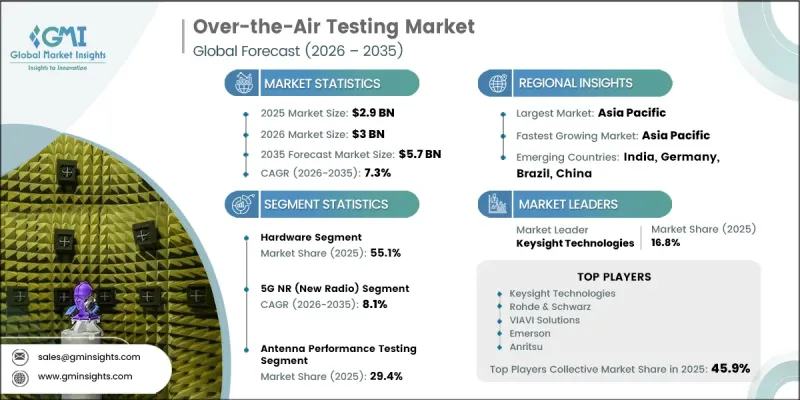
Market expansion is fueled by the rapid advancement of next-generation wireless communication technologies and the increasing complexity of connected devices. The growing deployment of advanced wireless networks is creating significant demand for testing infrastructure capable of accurately evaluating radiated performance, signal integrity, and connectivity reliability. As wireless devices become more sophisticated and incorporate advanced antenna architectures, manufacturers are increasingly relying on over-the-air testing solutions to ensure performance, compliance, and interoperability. Evolving regulatory requirements and certification standards across global markets are also contributing to demand, encouraging greater investment in testing capabilities and infrastructure. The industry is further benefiting from the continued evolution of wireless communication standards, which require more comprehensive performance validation across multiple frequency bands, antenna configurations, and connectivity environments. Increasing adoption of connected technologies across consumer electronics, industrial systems, and communication devices is expanding the addressable market for OTA testing services and equipment. As wireless ecosystems continue to grow in scale and complexity, over-the-air testing is becoming an essential component of product development, certification, and quality assurance processes worldwide.
| Market Scope | |
|---|---|
| Start Year | 2025 |
| Forecast Year | 2026-2035 |
| Start Value | $2.9 Billion |
| Forecast Value | $5.7 Billion |
| CAGR | 7.3% |
The hardware segment accounted for 55.1% share and is projected to grow at a CAGR of 4.2% from 2026 to 2035. The segment forms the core foundation of OTA testing infrastructure and includes specialized equipment required to conduct accurate wireless performance evaluations. Demand remains strong due to the essential role of physical testing environments and precision measurement systems in supporting certification requirements and ensuring reliable device performance. The high level of technical sophistication and infrastructure investment associated with OTA testing facilities continues to support the segment's leading market position.
The antenna performance testing segment held a 29.4% share in 2025. The segment focuses on evaluating critical wireless communication characteristics, including signal propagation efficiency, radiation behavior, beam management performance, and advanced antenna functionality. Growing adoption of increasingly complex antenna systems across modern wireless devices is driving demand for specialized testing capabilities. Manufacturers continue to prioritize antenna performance validation during product development to optimize connectivity, improve user experiences, and support regulatory compliance requirements.
China Over-The-Air Testing Market held a 50% share, generating USD 540.4 million in 2025. The country's leadership position is supported by its extensive wireless device manufacturing ecosystem, strong telecommunications industry presence, and large-scale production of connected technologies. Growing demand for wireless product certification, expanding deployment of advanced communication infrastructure, and continued investment in next-generation connectivity solutions are contributing to high OTA testing volumes across both development and compliance environments. These factors continue to strengthen China's position as a major hub for over-the-air testing activities within the Asia Pacific region.
Leading companies operating in the global over-the-air testing market include Rohde & Schwarz, Keysight Technologies, MVG, Emerson, VIAVI Solutions, ETS-Lindgren, and Anritsu. Companies operating in the over-the-air testing market are implementing a range of strategic initiatives to strengthen their competitive position and expand market share. Significant investments in research and development remain a key focus as organizations work to enhance testing accuracy, support emerging wireless technologies, and improve automation capabilities. Market participants are expanding their testing portfolios to address evolving connectivity standards and increasingly sophisticated wireless architectures. Strategic partnerships, acquisitions, and collaborations with device manufacturers, telecommunications companies, and technology providers are helping companies broaden their customer reach and accelerate innovation. Investments in advanced testing facilities, software-driven analytics platforms, and integrated validation solutions are also supporting competitive differentiation.
Table of Contents
Chapter 1 Research Methodology
- 1.1 Research approach
- 1.2 Quality Commitments
- 1.2.1 GMI AI policy & data integrity commitment
- 1.2.1.1 Source consistency protocol
- 1.2.1 GMI AI policy & data integrity commitment
- 1.3 Research Trail & Confidence Scoring
- 1.3.1 Research Trail Components
- 1.3.2 Scoring Components
- 1.4 Data Collection
- 1.4.1 Partial list of primary sources
- 1.5 Data mining sources
- 1.5.1 Paid sources
- 1.5.1.1 Sources, by region
- 1.5.1 Paid sources
- 1.6 Base estimates and calculations
- 1.6.1 Base year calculation for any one approach
- 1.7 Forecast model
- 1.7.1 Quantified market impact analysis
- 1.7.1.1 Mathematical impact of growth parameters on forecast
- 1.7.1 Quantified market impact analysis
- 1.8 Research transparency addendum
- 1.8.1 Source attribution framework
- 1.8.2 Quality assurance metrics
- 1.8.3 Our commitment to trust
Chapter 2 Executive Summary
- 2.1 Industry 360° synopsis, 2022 - 2035
- 2.2 Key market trends
- 2.2.1 Regional
- 2.2.2 Offering
- 2.2.3 Technology Standard
- 2.2.4 Test Type
- 2.2.5 Test Environment
- 2.2.6 End-Use Industry
- 2.3 TAM Analysis, 2026-2035
- 2.4 CXO perspectives: Strategic imperatives
Chapter 3 Industry Insights
- 3.1 Industry ecosystem analysis
- 3.1.1 Supplier landscape
- 3.1.2 Profit margin analysis
- 3.1.3 Cost structure
- 3.1.4 Value addition at each stage
- 3.1.5 Factor affecting the value chain
- 3.1.6 Disruptions
- 3.2 Industry impact forces
- 3.2.1 Growth drivers
- 3.2.1.1 Accelerating 5G NR Rollout & mmWave Frequency Expansion Driving Demand for Advanced OTA Test Infrastructure
- 3.2.1.2 Stringent Global Regulatory Certification Requirements (FCC, CE, 3GPP, PTCRB) Mandating OTA Validation Across Device Categories
- 3.2.1.3 Explosive Proliferation of IoT & Connected Devices Expanding Total Addressable Testing Volumes
- 3.2.1.4 Rising Automotive Electrification & V2X Deployment Creating Specialized OTA Validation Requirements
- 3.2.2 Industry pitfalls and challenges
- 3.2.2.1 High Capital Investment Requirements for Advanced OTA Test Chamber Infrastructure (mmWave Chambers: USD 2.5-4M per Facility)
- 3.2.2.2 Critical Shortage of Skilled RF Engineers & mmWave Measurement Expertise Globally
- 3.2.3 Market opportunities
- 3.2.3.1 AI-Integrated Automated Testing Platforms Reducing Time-to-Certification & Operational Overhead
- 3.2.3.2 Emerging Non-Terrestrial Network (NB-NTN) & LEO Satellite Communication Device Testing Segment
- 3.2.3.3 Rapid Expansion of Healthcare Wearable & Implantable Device OTA Certification Requirements
- 3.2.3.4 Smart City & Industrial IoT Infrastructure Buildout Opening New Testing Verticals
- 3.2.1 Growth drivers
- 3.3 Growth potential analysis
- 3.4 Technology and innovation landscape
- 3.4.1 Current technological trends
- 3.4.2 Emerging technologies
- 3.5 Pricing Analysis (Driven by primary research)
- 3.5.1 Historical Price Trend Analysis
- 3.5.2 Pricing Strategy by Player Type
- 3.6 Regulatory landscape
- 3.6.1 North America
- 3.6.1.1 National Institute of Standards and Technology (NIST) Measurement Standards & RF Metrology Framework
- 3.6.1.2 Federal Communications Commission (FCC) Equipment Authorization & OTA Compliance Requirements
- 3.6.1.3 Occupational Safety and Health Administration (OSHA) Laboratory Safety Standards
- 3.6.1.4 American National Standards Institute (ANSI) Testing & Measurement Standardization
- 3.6.1.5 ISO/IEC 17025 Laboratory Accreditation Requirements
- 3.6.2 Europe
- 3.6.2.1 CENELEC EMC & Electrical Testing Standards
- 3.6.2.2 Electromagnetic Compatibility (EMC) Directive
- 3.6.2.3 Low Voltage Directive (LVD)
- 3.6.2.4 Radio Equipment Directive (RED 2014/53/EU)
- 3.6.2.5 ISO/IEC 17025 Accreditation Framework
- 3.6.3 Asia Pacific
- 3.6.3.1 State Administration for Market Regulation (SAMR) Metrology & Measurement Oversight
- 3.6.3.2 China National Accreditation Service for Conformity Assessment (CNAS) Laboratory Accreditation Standards
- 3.6.3.3 Japanese Industrial Standards Committee (JISC) Testing & RF Measurement Standards
- 3.6.3.4 National Accreditation Board for Testing and Calibration Laboratories (NABL)
- 3.6.3.5 Bureau of Indian Standards (BIS) Electronics Testing & Certification Framework
- 3.6.4 Latin America
- 3.6.4.1 National Institute of Metrology, Quality and Technology (INMETRO) Metrology & Calibration Standards
- 3.6.4.2 Directorate General of Standards Testing & Certification Authorities
- 3.6.4.3 Inter-American Metrology System (SIM) Regional Framework
- 3.6.4.4 ISO/IEC 17025 Laboratory Accreditation Requirements
- 3.6.5 Middle East & Africa
- 3.6.5.1 Emirates Authority for Standardization and Metrology (ESMA) Testing & Certification Standards
- 3.6.5.2 Saudi Standards, Metrology and Quality Organization (SASO) Product Testing Regulations
- 3.6.5.3 Gulf Standardization Organization (GSO) Regional Testing Framework
- 3.6.5.4 African Organisation for Standardisation (ARSO) Regional Framework
- 3.6.5.5 ISO/IEC 17025 Laboratory Accreditation Framework
- 3.6.1 North America
- 3.7 Porter’s analysis
- 3.8 PESTEL analysis
- 3.9 Patent analysis (Driven by primary research)
- 3.10 Cost breakdown analysis
- 3.11 Impact of AI and Generative AI on the Market
- 3.11.1 AI Driven Disruption of Existing Business Models
- 3.11.2 GenAI Use Cases and Adoption Roadmap by Segment
- 3.11.3 Risks Limitations and Regulatory Considerations
- 3.12 Sustainability and environmental aspects
- 3.12.1 Sustainable practices
- 3.12.2 Waste reduction strategies
- 3.12.3 Energy efficiency in production
- 3.12.4 Eco-friendly Initiatives
- 3.12.5 Carbon footprint considerations
- 3.13 Forecast assumptions & scenario analysis (Driven by Primary Research)
- 3.13.1 Base Case- Key Macro & Industry Variables Driving CAGR
- 3.13.2 Optimistic Scenarios- Favorable macro and industry tailwinds
- 3.13.3 Pessimistic Scenario - Macroeconomic slowdown or industry headwinds
Chapter 4 Competitive Landscape, 2025
- 4.1 Introduction
- 4.2 Company market share analysis
- 4.2.1 North America
- 4.2.2 Europe
- 4.2.3 Asia Pacific
- 4.2.4 LATAM
- 4.2.5 MEA
- 4.3 Competitive analysis of major market players
- 4.4 Competitive positioning matrix
- 4.5 Key developments
- 4.5.1 Mergers & acquisitions
- 4.5.2 Partnerships & collaborations
- 4.5.3 New Product Launches
- 4.5.4 Expansion Plans and funding
- 4.6 Company tier benchmarking
- 4.6.1 Tier classification criteria & qualifying thresholds
- 4.6.2 Tier positioning matrix by revenue, geography & innovation
Chapter 5 Market Estimates & Forecast, By Offering, 2022 - 2035 (USD Mn)
- 5.1 Key trends
- 5.2 Hardware
- 5.2.1 Anechoic & Reverberation Chamber Systems
- 5.2.2 RF Measurement Instruments
- 5.2.3 Antenna Probes & Positioning Systems
- 5.2.4 Compact Antenna Test Range (CATR) Reflector Systems
- 5.2.5 Multi-Probe Array Systems
- 5.3 Software & Analytics
- 5.3.1 Test Orchestration & Management Platforms
- 5.3.2 RF Simulation & Electromagnetic Modeling Software
- 5.3.3 Data Analytics, Visualization & Reporting Tools
- 5.3.4 AI-Powered Test Automation Software
- 5.4 Services
- 5.4.1 Professional Services
- 5.4.2 Managed Services
Chapter 6 Market Estimates & Forecast, By Technology Standard, 2022 - 2035 (USD Mn)
- 6.1 Key trends
- 6.2 5G NR (New Radio)
- 6.3 4G LTE
- 6.4 Wi-Fi
- 6.5 Bluetooth
- 6.6 Low-Power Wide-Area Network (LPWAN)
- 6.7 Others
Chapter 7 Market Estimates & Forecast, By Test Type, 2022 - 2035 (USD Mn)
- 7.1 Key trends
- 7.2 Antenna Performance Testing
- 7.3 Conformance Testing
- 7.4 Compatibility Testing
- 7.5 Production Line Testing
Chapter 8 Market Estimates & Forecast, By Test Environment, 2022 - 2035 (USD Mn)
- 8.1 Key trends
- 8.2 Far-Field Anechoic Chambers
- 8.3 Compact Antenna Test Range (CATR)
- 8.4 Near-Field Systems
- 8.5 Reverberation Chambers
Chapter 9 Market Estimates & Forecast, By End-Use Industry, 2022 - 2035 (USD Mn)
- 9.1 Key trends
- 9.2 Consumer Electronics
- 9.3 Automotive
- 9.4 Telecommunications
- 9.5 Aerospace & Defense
- 9.6 Healthcare
- 9.7 Industrial IoT & Smart Devices
- 9.8 Others
Chapter 10 Market Estimates & Forecast, By Region, 2022 - 2035 (USD Mn)
- 10.1 Key trends
- 10.2 North America
- 10.2.1 US
- 10.2.2 Canada
- 10.3 Europe
- 10.3.1 Germany
- 10.3.2 UK
- 10.3.3 France
- 10.3.4 Italy
- 10.3.5 Spain
- 10.3.6 Russia
- 10.3.7 Norway
- 10.3.8 Netherlands
- 10.3.9 Sweden
- 10.4 Asia Pacific
- 10.4.1 China
- 10.4.2 India
- 10.4.3 Japan
- 10.4.4 Australia
- 10.4.5 South Korea
- 10.4.6 Singapore
- 10.4.7 Thailand
- 10.4.8 Indonesia
- 10.4.9 Vietnam
- 10.5 Latin America
- 10.5.1 Brazil
- 10.5.2 Mexico
- 10.5.3 Argentina
- 10.6 MEA
- 10.6.1 South Africa
- 10.6.2 Saudi Arabia
- 10.6.3 UAE
- 10.6.4 Turkey
Chapter 11 Company Profiles
- 11.1 Global Players
- 11.1.1 Rohde & Schwarz
- 11.1.2 Keysight Technologies
- 11.1.3 Anritsu
- 11.1.4 NI (Emerson)
- 11.1.5 VIAVI Solutions
- 11.1.6 ETS-Lindgren
- 11.1.7 MVG (Microwave Vision)
- 11.1.8 LitePoint
- 11.1.9 NSI-MI Technologies
- 11.1.10 ANSYS
- 11.1.11 Altair Engineering
- 11.1.12 Remcom
- 11.1.13 Cadence Design Systems
- 11.1.14 Bureau Veritas
- 11.1.15 Intertek
- 11.1.16 TUV SUD
- 11.1.17 SGS
- 11.1.18 TUV Rheinland
- 11.2 Regional Players
- 11.2.1 Bluetest
- 11.2.2 EMITE Ingenieria
- 11.2.3 Sporton International
- 11.2.4 Allion Labs
- 11.2.5 CETECOM Advanced

