
PUBLISHER: Global Market Insights Inc. | PRODUCT CODE: 2083247

PUBLISHER: Global Market Insights Inc. | PRODUCT CODE: 2083247
Rigid Metal Electrical Conduit Market Opportunity, Growth Drivers, Industry Trend Analysis, and Forecast 2026 - 2035
The Global Rigid Metal Electrical Conduit Market was valued at USD 991.2 million in 2025 and is estimated to grow at a CAGR of 4.7% to reach USD 1.6 billion by 2035.
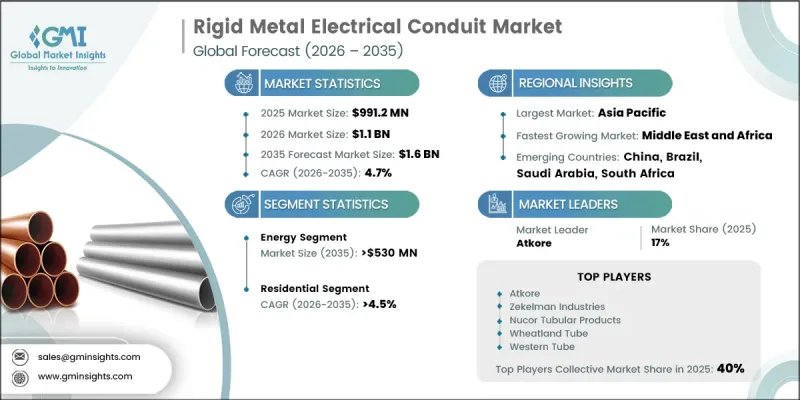
The market is shaped by ongoing advancements in construction practices, infrastructure modernization initiatives, and increasingly stringent electrical safety requirements. Rising investments in industrial, commercial, and residential construction projects create demand for durable electrical conduit systems capable of delivering enhanced protection and fire resistance. Growing emphasis on workplace safety and compliance with evolving regulatory standards is further supporting market expansion. In addition, the increasing deployment of industrial automation technologies and the continued growth of renewable energy developments are generating greater demand for conduit solutions that can reliably protect electrical systems in demanding operating environments. Rapid urbanization and industrial growth across developing economies are also contributing to market momentum, as expanding infrastructure projects require dependable electrical protection systems. Manufacturers are responding to these trends by developing advanced conduit solutions that offer improved durability, safety, and long-term performance. As investments in modern electrical infrastructure continue to increase worldwide, rigid metal electrical conduits are expected to remain a critical component of power distribution and electrical protection systems across a broad range of applications.
| Market Scope | |
|---|---|
| Start Year | 2025 |
| Forecast Year | 2026-2035 |
| Start Value | $991.2 Million |
| Forecast Value | $1.6 Billion |
| CAGR | 4.7% |
The energy sector is anticipated to generate USD 530 million by 2035. Growth within this segment is driven by rising investments in power infrastructure and energy-related projects that require reliable electrical protection systems. The need for robust conduit solutions continues to increase as operators seek dependable products capable of protecting electrical wiring in harsh and demanding environments. Expanding investments in modern power networks and energy infrastructure are further strengthening demand for rigid metal electrical conduits. Their ability to provide long-term durability, operational reliability, and enhanced protection makes them an essential component in critical energy applications.
The residential segment accounted for 31.6% share in 2025 and is forecast to grow at a CAGR of 4.5% through 2035. Market growth is being supported by increasing residential construction activity driven by urban expansion and population growth. Homeowners and developers are placing greater emphasis on secure and reliable electrical installations, leading to higher adoption of rigid metal conduit systems. In addition, evolving building regulations and stricter safety standards are encouraging the use of advanced wiring protection solutions in residential properties. The growing integration of modern electronic devices and connected home technologies is also contributing to demand, as these systems require robust electrical infrastructure capable of supporting higher performance and improved safety standards.
U.S. Rigid Metal Electrical Conduit Market was valued at USD 145.9 million in 2025 and is expected to grow at a CAGR of 3.6% through 2035. Market growth is being fueled by continued investments in infrastructure development, expanding industrial activity, and increasing focus on regulatory compliance and electrical safety. Demand for durable and fire-resistant conduit systems continues to rise across multiple sectors as organizations seek reliable solutions for protecting electrical installations. The modernization of power infrastructure and the increasing adoption of advanced energy systems are also supporting market expansion. Furthermore, growing investments in grid modernization and evolving energy networks are creating additional opportunities for rigid metal electrical conduit manufacturers throughout the United States.
Major companies operating in the global rigid metal electrical conduit market include Atkore, Schneider Electric, Legrand, Zekelman Industries, Wheatland Tube, Western Tube, Nucor Tubular Products, HellermannTyton, American Conduit, Anamet Electrical, Inc., Gibson Stainless & Specialty Inc., Pittsburgh Pipe, Quality Tube, RYMCO USA, SMC Electric, Techno Flex, Flexa GmbH, Weifang East Steel Pipe, Yale Electrical Supply, and Ammo International. Companies active in the rigid metal electrical conduit market are implementing a variety of strategies to strengthen their market position and expand their customer base. Product innovation remains a primary focus, with manufacturers investing in advanced materials, corrosion-resistant designs, and enhanced fire protection capabilities to meet evolving industry requirements. Strategic partnerships with contractors, distributors, and infrastructure developers are helping companies increase market penetration and improve supply chain efficiency. Many organizations are also expanding production capacity and strengthening regional distribution networks to meet growing demand. Investments in research and development are enabling the introduction of high-performance conduit solutions designed for modern electrical systems.
Table of Contents
Chapter 1 Methodology & Scope
- 1.1 Research approach
- 1.2 Quality commitment
- 1.2.1 GMI AI policy & data integrity commitment
- 1.2.1.1 Source consistency protocol
- 1.2.1 GMI AI policy & data integrity commitment
- 1.3 Research Trail & Confidence Scoring
- 1.3.1 Research Trail Components
- 1.3.2 Scoring Components
- 1.4 Data Collection
- 1.4.1 Partial list of primary sources
- 1.5 Data mining sources
- 1.5.1 Paid sources
- 1.5.1.1 Sources, by region
- 1.5.1 Paid sources
- 1.6 Base estimates and calculations
- 1.6.1 Base year calculation for any one approach
- 1.7 Forecast model
- 1.8 Research transparency addendum
- 1.8.1 Source attribution framework
- 1.8.2 Quality assurance metrics
- 1.8.3 Our commitment to trust
- 1.8.3.1 Market definitions
Chapter 2 Executive Summary
- 2.1 Industry synopsis, 2022 - 2035
- 2.2 Business trends
- 2.3 Trade size trends
- 2.4 Application trends
- 2.5 End use trends
- 2.6 Regional trends
Chapter 3 Industry Insights
- 3.1 Industry ecosystem analysis
- 3.2 Regulatory landscape
- 3.3 Industry impact forces
- 3.3.1 Growth drivers
- 3.3.2 Industry pitfalls & challenges
- 3.4 Growth potential analysis
- 3.5 Porter's analysis
- 3.5.1 Bargaining power of suppliers
- 3.5.2 Bargaining power of buyers
- 3.5.3 Threat of new entrants
- 3.5.4 Threat of substitutes
- 3.6 PESTEL analysis
- 3.7 Cost structure analysis of rigid metal conduits
- 3.8 Trade data analysis (Driven by Primary Research)
- 3.8.1 Import/export value trends (Driven by Primary Research)
- 3.8.2 Key trade corridors & tariff impact (Driven by Primary Research)
- 3.9 Emerging opportunities & trends
- 3.10 Investment analysis & future outlook
Chapter 4 Competitive Landscape, 2026
- 4.1 Introduction
- 4.2 Company market share analysis, by region, 2025
- 4.2.1 North America
- 4.2.2 Europe
- 4.2.3 Asia Pacific
- 4.2.4 Middle East & Africa
- 4.2.5 Latin America
- 4.3 Competitive positioning matrix
- 4.4 Key Developments
- 4.4.1 Mergers & acquisitions
- 4.4.2 Partnerships & collaborations
- 4.4.3 New product launches
- 4.4.4 Expansion plans and funding
Chapter 5 Market Size and Forecast, By Trade Size, 2022 - 2035 (USD Million)
- 5.1 Key trends
- 5.2 1/2 to 1 inch
- 5.3 1 1/4 to 2 inches
- 5.4 2 1/2 to 3 inches
- 5.5 3 to 4 inches
- 5.6 5 to 6 inches
- 5.7 Others
Chapter 6 Market Size and Forecast, By Application, 2022 - 2035 (USD Million)
- 6.1 Key trends
- 6.2 Rail infrastructure
- 6.3 Manufacturing facilities
- 6.4 Shipbuilding & offshore facilities
- 6.5 Process plants
- 6.6 Energy
- 6.7 Others
Chapter 7 Market Size and Forecast, By End Use, 2022 - 2035 (USD Million)
- 7.1 Key trends
- 7.2 Residential
- 7.3 Commercial
- 7.4 Industrial
- 7.5 Utility
Chapter 8 Market Size and Forecast, By Region, 2022 - 2035 (USD Million)
- 8.1 Key trends
- 8.2 North America
- 8.2.1 U.S.
- 8.2.2 Canada
- 8.2.3 Mexico
- 8.3 Europe
- 8.3.1 France
- 8.3.2 Germany
- 8.3.3 Italy
- 8.3.4 UK
- 8.3.5 Russia
- 8.4 Asia Pacific
- 8.4.1 China
- 8.4.2 India
- 8.4.3 Japan
- 8.4.4 South Korea
- 8.4.5 Australia
- 8.5 Middle East & Africa
- 8.5.1 Saudi Arabia
- 8.5.2 UAE
- 8.5.3 Qatar
- 8.5.4 South Africa
- 8.6 Latin America
- 8.6.1 Brazil
- 8.6.2 Argentina
Chapter 9 Company Profiles
- 9.1 American Conduit
- 9.2 Ammo International
- 9.3 Atkore
- 9.4 Anamet Electrical, Inc.
- 9.5 Flexa GmbH
- 9.6 Gibson Stainless & Specialty Inc.
- 9.7 HellermannTyton
- 9.8 Legrand
- 9.9 Nucor Tubular Products
- 9.10 Pittsburgh Pipe
- 9.11 Quality Tube
- 9.12 RYMCO USA
- 9.13 SMC Electric
- 9.14 Schneider Electric
- 9.15 Techno Flex
- 9.16 Weifang East Steel Pipe
- 9.17 Western Tube
- 9.18 Wheatland Tube
- 9.19 Yale Electrical Supply
- 9.20 Zekelman Industries

