PUBLISHER: Global Market Insights Inc. | PRODUCT CODE: 2083248

PUBLISHER: Global Market Insights Inc. | PRODUCT CODE: 2083248
Food Chopper Market Opportunity, Growth Drivers, Industry Trend Analysis, and Forecast 2026 - 2035
The Global Food Chopper Market was valued at USD 1.9 billion in 2025 and is estimated to grow at a CAGR of 5.5% to reach USD 3.3 billion by 2035.
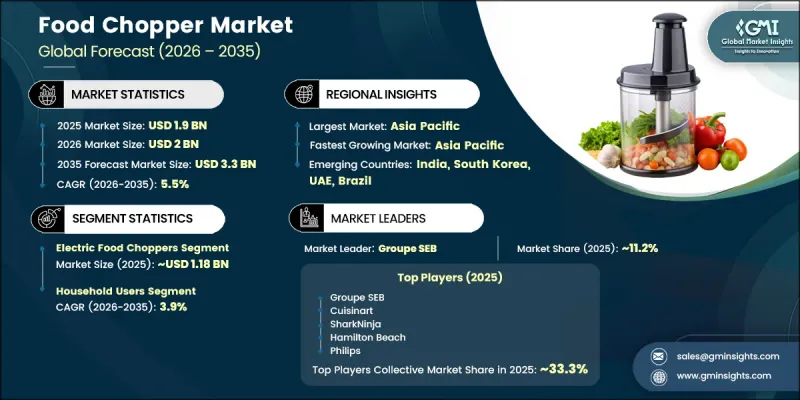
The market is expanding as consumers continue to seek kitchen appliances that simplify meal preparation and reduce cooking time. Rising demand for convenient, efficient, and user-friendly kitchen solutions has significantly increased the adoption of food choppers across residential kitchens. Electric food choppers have become increasingly popular due to their ability to deliver faster performance, greater convenience, and consistent food processing compared to conventional alternatives. Growing urbanization, changing lifestyles, and rising interest in preparing meals at home are further supporting market growth across both developed and emerging economies. The expansion of online retail platforms has also improved product accessibility, enabling consumers to choose from a wide range of food chopper models. Asia Pacific continues to lead the market in terms of revenue generation, supported by a large consumer base, rapid urban development, rising disposable incomes, expanding middle-class populations, and growing acceptance of modern kitchen appliances. Strong regional manufacturing capabilities are also contributing to sustained market expansion.
| Market Scope | |
|---|---|
| Start Year | 2025 |
| Forecast Year | 2026-2035 |
| Start Value | $1.9 Billion |
| Forecast Value | $3.3 Billion |
| CAGR | 5.5% |
The increasing popularity of home cooking and demand for time-saving appliances continue to strengthen the outlook for the food chopper market. Consumers are looking for products that reduce manual effort while improving efficiency in everyday meal preparation. Greater awareness of modern kitchen technologies, combined with higher household spending on small appliances, is encouraging wider adoption of advanced food choppers. The growing availability of innovative products through both physical stores and digital retail channels is further supporting market growth worldwide.
Electric food choppers generated USD 1.18 billion in 2025 and is projected to grow at a CAGR of 5.6% between 2026 and 2035. This segment continues to dominate the product category because it aligns with consumer demand for speed, convenience, and ease of operation. Busy lifestyles have increased preference for appliances that reduce preparation time while minimizing physical effort during cooking. Electric food choppers also provide greater consistency, higher processing speed, improved precision, and the ability to handle a wide variety of ingredients, making them a preferred choice for everyday household cooking.
The household segment accounted for 60% share in 2025 and is expected to grow at a CAGR of 3.9% during 2026-2035. Residential consumers represent the largest end-user group due to the growing need for practical, affordable, and easy-to-use kitchen appliances for daily meal preparation. Increasing urbanization, changing family structures, fast-paced lifestyles, and rising preference for preparing healthier meals at home are contributing to higher product adoption. In addition, broad product availability through offline retail outlets and e-commerce platforms, along with options across multiple price ranges, continues to strengthen household demand.
North America Food Chopper Market captured a significant share in 2025. The regional market benefits from high disposable incomes, busy lifestyles, and the continued popularity of home cooking. Increasing interest in health-conscious eating habits has encouraged greater use of food preparation appliances that simplify fresh meal preparation. Rising adoption of advanced kitchen technologies and growing demand for electric and cordless food choppers are further supporting market expansion. The expanding foodservice industry, including commercial kitchens, catering operations, and cloud kitchen businesses, is also contributing to increased demand for food choppers across North America.
Major players operating in the global food chopper industry are KitchenAid, Philips, Ninja / SharkNinja, Hamilton Beach, Bosch Home Appliances, Cuisinart, Breville, BLACK+DECKER, Braun Household, Tefal, Morphy Richards, Kenwood, Havells India, Panasonic, Dash, Moulinex, Midea, Russell Hobbs, Bajaj Electricals, Joyoung, SUPOR, and Preethi. Companies operating in the food chopper market are strengthening their competitive position through continuous product innovation, expansion of distribution channels, and investment in advanced appliance technologies. Manufacturers are introducing energy-efficient, multifunctional, and compact products that meet evolving consumer preferences for convenience and performance. Businesses are also enhancing their online presence, expanding retail partnerships, and improving after-sales support to increase customer engagement.
Table of Contents
Chapter 1 Methodology & Scope
- 1.1 Market scope and definition
- 1.2 Research design
- 1.2.1 Research approach
- 1.2.2 Data collection methods
- 1.3 Data mining sources
- 1.3.1 Global
- 1.3.2 Regional/Country
- 1.4 Base estimates and calculations
- 1.4.1 Base year calculation
- 1.4.2 Key trends for market estimation
- 1.5 Primary research and validation
- 1.5.1 Primary sources
- 1.6 Forecast model
- 1.7 Research assumptions and limitations
Chapter 2 Executive Summary
- 2.1 Industry 360° synopsis
- 2.2 Key market trends
- 2.2.1 Region
- 2.2.2 Product type
- 2.2.3 Material
- 2.2.4 Capacity
- 2.2.5 End-use
- 2.2.6 Distribution channel
Chapter 3 Industry Insights
- 3.1 Industry ecosystem analysis
- 3.1.1 Supplier landscape
- 3.1.2 Profit margin
- 3.1.3 Value addition at each stage
- 3.1.4 Factor affecting the value chain
- 3.2 Industry impact forces
- 3.2.1 Growth drivers
- 3.2.1.1 Rising consumer demand for convenience & time-efficient meal preparation
- 3.2.1.2 Proliferation of cloud kitchens, meal-kit delivery & foodservice expansion
- 3.2.1.3 Growing health-conscious home cooking trends & plant-based diet adoption
- 3.2.1.4 Product innovation in multi-blade, adjustable-speed & smart chopper systems
- 3.2.1.5 E-commerce penetration enabling access in emerging markets
- 3.2.2 Industry pitfalls & challenges
- 3.2.2.1 Intense competition from multifunctional kitchen appliances (blenders, food processors)
- 3.2.2.2 High cost of premium & smart models limiting penetration in price-sensitive markets
- 3.2.2.3 Proliferation of counterfeit products undermining consumer trust
- 3.2.2.4 Environmental concerns & regulatory pressure on plastic components
- 3.2.3 Opportunities
- 3.2.3.1 Expanding middle-class population in Asia Pacific & Latin America - first-time ownership wave
- 3.2.3.2 Integration of AI/IoT for connected smart choppers - premium segment opportunity
- 3.2.3.3 Sustainable & eco-friendly material innovation - biodegradable & recycled component adoption
- 3.2.3.4 Specialized commercial models for cloud kitchens, catering & institutional buyers
- 3.2.3.5 Cordless & USB-powered portable choppers - urban compact living segment
- 3.2.1 Growth drivers
- 3.3 Growth potential analysis
- 3.4 Future market trends
- 3.5 Technology and innovation landscape
- 3.5.1 Current technological trends
- 3.5.2 Emerging technologies
- 3.6 Regulatory landscape
- 3.6.1 Standards and compliance requirements
- 3.6.2 Regional regulatory frameworks
- 3.6.3 Certification standards
- 3.7 Trade data analysis (HS Code 8509.40.00,8210.00.00)
- 3.7.1 Import/Export Volume & Value Trends by Key Country (Driven by Primary Research)
- 3.7.2 Key Trade Corridors & Tariff Impact (US-China, EU-Asia, ASEAN Flows) (Driven by Primary Research)
- 3.8 Pricing analysis
- 3.8.1 Historical price trend analysis (driven by primary research)
- 3.8.2 Pricing strategy by player type (premium / value / mass market)
- 3.9 Impact of AI & generative AI on the market
- 3.9.1 AI-Driven Disruption of Existing Business Models (Demand Forecasting, Inventory Optimization)
- 3.9.2 GenAI Use Cases & Adoption Roadmap by Segment (Smart Recipe Integration, Autonomous Chopping Calibration)
- 3.9.3 Risks, Limitations & Regulatory Considerations (Cybersecurity in IoT Choppers, Data Privacy)
- 3.10 Historical Price Trend Analysis (2019-2024) (Driven by Primary Research)
- 3.11 Pricing Strategy by Player Type (Premium / Value / Cost-plus) (Driven by Primary Research)
- 3.12 Porter’s analysis
- 3.13 PESTEL analysis
- 3.14 Consumer buying behavior analysis
- 3.14.1 Demographic trends
- 3.14.2 Factors affecting buying decisions
- 3.14.3 Consumer product adoption
- 3.14.4 Preferred distribution channel
Chapter 4 Competitive Landscape, 2025
- 4.1 Introduction
- 4.2 Company market share analysis
- 4.3 Company matrix analysis
- 4.4 Competitive analysis of major market players
- 4.5 Competitive positioning matrix
- 4.6 Key developments
- 4.6.1 Mergers & acquisitions
- 4.6.2 Partnerships & collaborations
- 4.6.3 New product launches
- 4.6.4 Expansion plans
Chapter 5 Market Estimates & Forecast, By Product Type, 2022 - 2035, (USD Billion) (Million Units)
- 5.1 Key Trends
- 5.2 Manual Food Choppers
- 5.2.1 Pull-Cord Manual Choppers
- 5.2.2 Rotary Manual Choppers
- 5.2.3 Press-Operated / Rocking Manual Choppers
- 5.3 Electric Food Choppers
- 5.3.1 Mini / Compact Electric Choppers
- 5.3.2 Full-Size Electric Countertop Choppers
- 5.3.3 Multi-Function Electric Choppers (Chop, Slice, Dice, Puree)
- 5.4 Commercial-Grade Food Choppers
- 5.4.1 Heavy-Duty Electric Commercial Choppers
- 5.4.2 High-Volume Industrial-Light Choppers
Chapter 6 Market Estimates & Forecast, By Material, 2022 - 2035, (USD Billion) (Million Units)
- 6.1 Key Trends
- 6.2 Stainless Steel
- 6.3 Ceramic
- 6.4 Carbon Steel
- 6.5 BPA-Free Plastic
- 6.6 Others (Composite / Hybrid Materials)
Chapter 7 Market Estimates & Forecast, By Capacity, 2022 - 2035, (USD Billion) (Million Units)
- 7.1 Key Trends
- 7.2 Below 500 ml
- 7.3 500 ml - 1 Liter
- 7.4 1 Liter - 2 Liters
- 7.5 Above 2 Liters
Chapter 8 Market Estimates & Forecast, By End-use, 2022 - 2035, (USD Billion) (Million Units)
- 8.1 Key Trends
- 8.2 Household
- 8.2.1 Urban Households
- 8.2.2 Semi-Urban & Rural Households
- 8.3 Commercial Kitchens & Restaurants
- 8.3.1 Quick Service Restaurants (QSR)
- 8.3.2 Full-Service Restaurants & Fine Dining
- 8.4 Catering & Cloud Kitchens
- 8.4.1 Meal-Kit & Food Delivery Operators
- 8.4.2 Event & Institutional Catering Services
- 8.5 Food Processing & Packaging Units
- 8.5.1 Artisan Food Producers
- 8.5.2 Small-Scale Light Food Processing
- 8.6 Institutional
- 8.6.1 Hotels & Hospitality
- 8.6.2 Hospitals & Healthcare Facilities
- 8.6.3 Educational Institutions
Chapter 9 Market Estimates & Forecast, By Distribution Channel, 2022 - 2035, (USD Billion) (Million Units)
- 9.1 Key Trends
- 9.2 Online Retailers
- 9.2.1 E-Commerce Marketplaces (Amazon, Flipkart, Lazada, etc.)
- 9.2.2 Brand Direct-to-Consumer (DTC) Websites
- 9.2.3 Social Commerce & Live Shopping Platforms
- 9.3 Supermarkets & Hypermarkets
- 9.4 Specialty Kitchen & Appliance Stores
- 9.5 Department Stores
- 9.6 Wholesale & Club Stores
- 9.7 Direct Sales / B2B (Manufacturer to Institutional Buyers)
Chapter 10 Market Estimates & Forecast, By Region, 2022 - 2035, (USD Billion) (Million Units)
- 10.1 Key Trends
- 10.2 North America
- 10.2.1 U.S.
- 10.2.2 Canada
- 10.3 Europe
- 10.3.1 Germany
- 10.3.2 France
- 10.3.3 UK
- 10.3.4 Italy
- 10.3.5 Spain
- 10.4 Asia Pacific
- 10.4.1 China
- 10.4.2 Japan
- 10.4.3 India
- 10.4.4 Australia
- 10.4.5 South Korea
- 10.5 Latin America
- 10.5.1 Brazil
- 10.5.2 Mexico
- 10.5.3 Argentina
- 10.6 MEA
- 10.6.1 Saudi Arabia
- 10.6.2 UAE
- 10.6.3 South Africa
Chapter 11 Company Profiles
- 11.1 Cuisinart
- 11.2 Ninja / SharkNinja
- 11.3 KitchenAid
- 11.4 Hamilton Beach
- 11.5 Breville
- 11.6 Braun Household
- 11.7 Philips
- 11.8 Bosch Home Appliances
- 11.9 BLACK+DECKER
- 11.10 Morphy Richards
- 11.11 Havells India
- 11.12 Dash
- 11.13 Tefal
- 11.14 Moulinex
- 11.15 Kenwood
- 11.16 Panasonic
- 11.17 Midea
- 11.18 Russell Hobbs
- 11.19 Bajaj Electricals
- 11.20 Joyoung
- 11.21 SUPOR
- 11.22 Preethi

