PUBLISHER: Global Market Insights Inc. | PRODUCT CODE: 2027533

PUBLISHER: Global Market Insights Inc. | PRODUCT CODE: 2027533
Food Industry Heat Processing Equipment Market Opportunity, Growth Drivers, Industry Trend Analysis, and Forecast 2026 - 2035
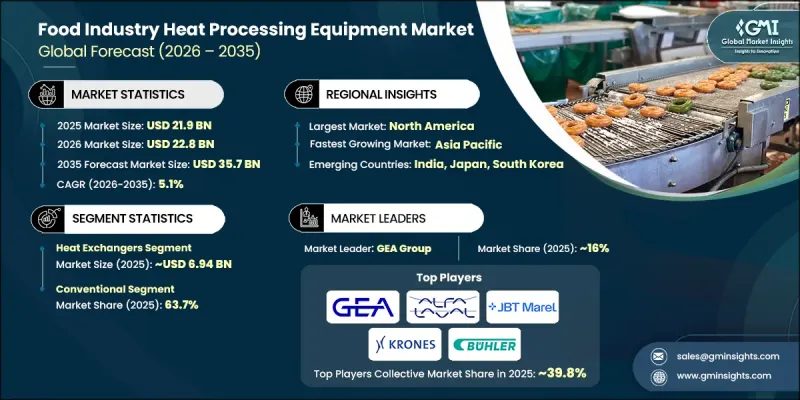
The Global Food Industry Heat Processing Equipment Market was valued at USD 21.9 billion in 2025 and is estimated to grow at a CAGR of 5.1% to reach USD 35.7 billion by 2035.
Expansion in the global food and beverage processing sector is significantly driving demand for advanced thermal processing systems. Food manufacturers rely on efficient heat processing equipment to ensure product safety, extend shelf life, and maintain consistent quality throughout production cycles. The rising consumption of packaged and processed food products is accelerating the need for high-capacity, efficient systems that can handle large-scale operations. Thermal processing plays a critical role in eliminating harmful microorganisms while supporting strict quality control standards. Increasing regulatory requirements related to food safety are also encouraging the adoption of advanced and controlled heating technologies. In response, manufacturers are investing in innovative equipment designed to improve productivity, reduce operational costs, and enhance energy efficiency. There is also a growing focus on systems that provide uniform heat distribution and precise temperature management, ensuring reliability and consistency across food processing operations.
| Market Scope | |
|---|---|
| Start Year | 2025 |
| Forecast Year | 2026-2035 |
| Start Value | $21.9 Billion |
| Forecast Value | $35.7 Billion |
| CAGR | 5.1% |
The heat exchangers segment generated USD 6.94 billion in 2025 and is expected to grow at a CAGR of 5% between 2026 and 2035. This segment holds a substantial share of the market due to its essential role in maintaining controlled temperatures across processing stages. Heat exchangers contribute to improved product safety, quality retention, and extended shelf stability by enabling consistent and efficient thermal regulation throughout production processes.
In 2025, the conventional heat technology accounted for 63.7% share and is anticipated to grow at a CAGR of 4.6% during 2026-2035. This segment continues to lead due to its operational simplicity, reliability, and cost-effectiveness. Widely adopted across various processing facilities, conventional systems are valued for their ease of use, low maintenance requirements, and dependable performance. The growing need for accessible and efficient processing solutions continues to support the adoption of these technologies.
United States Food Industry Heat Processing Equipment Market captured USD 4.4 billion in 2025 and is expected to grow at a CAGR of 5.1% through 2035. Market growth is driven by increasing demand for processed food products and the need for consistent quality and safety standards. Manufacturers are investing in advanced thermal processing systems to improve efficiency, ensure compliance with regulatory frameworks, and optimize production outcomes. Continuous innovation in equipment design is focused on enhancing energy efficiency, improving temperature accuracy, and minimizing product loss during processing.
Key companies operating in the Global Food Industry Heat Processing Equipment Market include Alfa Laval, GEA Group, SPX FLOW, Tetra Pak, Buhler Group, JBT Corporation, Krones AG, Marel, Heat and Control, Inc., HRS Heat Exchangers, Actini Group, KHS GmbH, IDMC Limited, FMT Food Machinery & Technology, and Scherjon Dairy Equipment. Companies in the Food Industry Heat Processing Equipment Market are strengthening their competitive position through continuous innovation, strategic collaborations, and expansion of product offerings. Many manufacturers are investing in research and development to introduce energy-efficient systems with advanced temperature control and automation capabilities. Partnerships with food processing companies help in customizing solutions tailored to specific operational requirements. Firms are also focusing on expanding their global footprint by entering emerging markets and enhancing distribution networks. Digital integration and smart monitoring technologies are being adopted to improve operational efficiency and equipment performance. Additionally, companies are emphasizing after-sales services and maintenance support to build long-term customer relationships and ensure sustained market growth.
Table of Contents
Chapter 1 Methodology & Scope
- 1.1 Market scope and definition
- 1.2 Research design
- 1.2.1 Research approach
- 1.2.2 Data collection methods
- 1.3 Data mining sources
- 1.3.1 Global
- 1.3.2 Regional/Country
- 1.4 Base estimates and calculations
- 1.4.1 Base year calculation
- 1.4.2 Key trends for market estimation
- 1.5 Primary research and validation
- 1.5.1 Primary sources
- 1.6 Forecast model
- 1.7 Research assumptions and limitations
Chapter 2 Executive Summary
- 2.1 Industry 360° synopsis
- 2.2 Key market trends
- 2.2.1 Regional
Chapter 3 Industry Insights
- 3.1 Industry ecosystem analysis
- 3.1.1 Supplier landscape
- 3.1.2 Profit margin
- 3.1.3 Value addition at each stage
- 3.1.4 Factor affecting the value chain
- 3.2 Industry impact forces
- 3.2.1 Growth drivers
- 3.2.1.1 Growth of the global food and beverage processing industry
- 3.2.1.2 Expansion of ready-to-eat and convenience food segments
- 3.2.1.3 Strict food safety and hygiene regulations in food manufacturing
- 3.2.2 Pitfalls & Challenges
- 3.2.2.1 High capital investment required for industrial heat processing systems
- 3.2.2.2 Energy-intensive nature of thermal food processing operations
- 3.2.3 Opportunities
- 3.2.3.1 Growing adoption of automated and digitally controlled processing systems
- 3.2.3.2 Rising demand for energy recovery and sustainable heating technologies
- 3.2.1 Growth drivers
- 3.3 Growth potential analysis
- 3.4 Future market trends
- 3.5 Technology and innovation landscape
- 3.5.1 Current technological trends
- 3.5.2 Emerging technologies
- 3.6 Regulatory landscape
- 3.6.1 Standards and compliance requirements
- 3.6.2 Regional regulatory frameworks
- 3.6.3 Certification standards
- 3.7 Porter's analysis
- 3.8 PESTEL analysis
- 3.9 Pricing analysis (driven by primary research)
- 3.9.1 Historical price trend analysis (driven by primary research) (2019-2024)
- 3.9.2 Pricing strategy by player type (premium / value / cost-plus) (driven by primary research)
- 3.9.3 TCO analysis: CAPEX vs OPEX considerations
- 3.10 Trade data analysis (driven by paid database)
- 3.10.1 Import/export volume & value trends (HS code 8438) (driven by paid database)
- 3.10.2 Key trade corridors & tariff impact (driven by paid database)
- 3.10.3 Leading exporting & importing countries
- 3.11 Capacity & production landscape (driven by primary research)
- 3.11.1 Installed capacity by region & key producer (driven by primary research)
- 3.11.2 Capacity utilization rates & expansion pipelines (driven by primary research)
Chapter 4 Competitive Landscape, 2025
- 4.1 Introduction
- 4.2 Company market share analysis
- 4.2.1 By Region
- 4.2.1.1 North America
- 4.2.1.2 Europe
- 4.2.1.3 Asia Pacific
- 4.2.1.4 Latin America
- 4.2.1.5 Middle East & Africa
- 4.2.1 By Region
- 4.3 Company matrix analysis
- 4.4 Competitive analysis of major market players
- 4.5 Competitive positioning matrix
- 4.6 Key developments
- 4.6.1 Mergers & acquisitions
- 4.6.2 Partnerships & collaborations
- 4.6.3 New product launches
- 4.6.4 Expansion plans
Chapter 5 Market Estimates & Forecast, By Type, 2022 - 2035, (USD Billion) (Thousand Units)
- 5.1 Key trends
- 5.2 Heat Exchangers
- 5.3 Pasteurizers & Sterilizers
- 5.4 Evaporators
- 5.5 Dehydration Equipment
- 5.6 Fryers
- 5.7 Ovens
- 5.8 Others
Chapter 6 Market Estimates & Forecast, By Operation, 2022 - 2035, (USD Billion) (Thousand Units)
- 6.1 Key trends
- 6.2 Manual
- 6.3 Semi-automatic
- 6.4 Fully automatic
Chapter 7 Market Estimates & Forecast, By Heat Technology, 2022 - 2035, (USD Billion) (Thousand Units)
- 7.1 Key trends
- 7.2 Conventional (gas, electricity)
- 7.3 Infrared
- 7.4 Microwave
- 7.5 Induction
Chapter 8 Market Estimates & Forecast, By End Use, 2022 - 2035, (USD Billion) (Thousand Units)
- 8.1 Key trends
- 8.2 Bakery and confectionery (bread, cakes).
- 8.3 Meat, poultry, and seafood.
- 8.4 Dairy products (milk, cheese).
- 8.5 Fruits and vegetables.
- 8.6 Beverages (juices, soft drinks).
- 8.7 Snacks (chips, nuts)
Chapter 9 Market Estimates & Forecast, By Distribution Channel, 2022 - 2035, (USD Billion) (Thousand Units)
- 9.1 Key trends
- 9.2 Direct
- 9.3 Indirect
Chapter 10 Market Estimates & Forecast, By Region, 2022 - 2035, (USD Billion) (Thousand Units)
- 10.1 Key trends
- 10.2 North America
- 10.2.1 U.S.
- 10.2.2 Canada
- 10.3 Europe
- 10.3.1 Germany
- 10.3.2 UK
- 10.3.3 France
- 10.3.4 Italy
- 10.3.5 Spain
- 10.4 Asia Pacific
- 10.4.1 China
- 10.4.2 India
- 10.4.3 Japan
- 10.4.4 South Korea
- 10.4.5 Australia
- 10.5 Latin America
- 10.5.1 Brazil
- 10.5.2 Mexico
- 10.5.3 Argentina
- 10.6 MEA
- 10.6.1 Saudi Arabia
- 10.6.2 UAE
- 10.6.3 South Africa
Chapter 11 Company Profiles
- 11.1 Alfa Laval
- 11.2 Tetra Pak
- 11.3 GEA Group
- 11.4 Buhler Group
- 11.5 JBT Corporation
- 11.6 SPX FLOW
- 11.7 Krones AG
- 11.8 Marel
- 11.9 Heat and Control, Inc.
- 11.10 HRS Heat Exchangers
- 11.11 IDMC Limited
- 11.12 Scherjon Dairy Equipment
- 11.13 KHS GmbH
- 11.14 FMT Food Machinery & Technology
- 11.15 Actini Group

