PUBLISHER: Global Market Insights Inc. | PRODUCT CODE: 2083256

PUBLISHER: Global Market Insights Inc. | PRODUCT CODE: 2083256
Sweat-Resistant Apparel Market Opportunity, Growth Drivers, Industry Trend Analysis, and Forecast 2026 - 2035
The Global Sweat-Resistant Apparel Market was valued at USD 65 billion in 2025 and is estimated to grow at a CAGR of 7.4% to reach USD 133.8 billion in 2035.
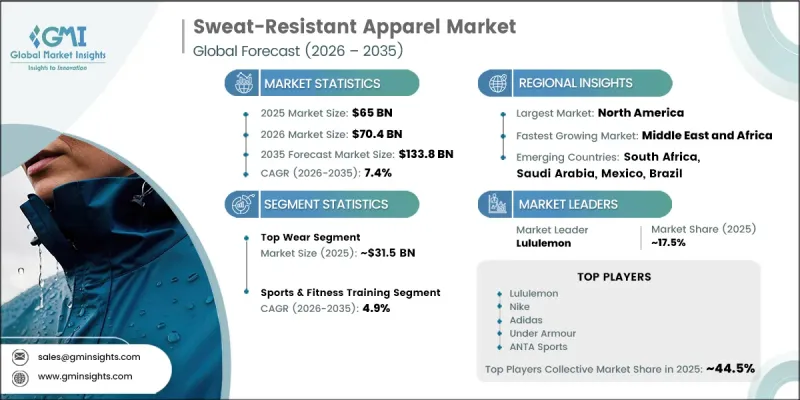
The industry is undergoing a clear structural shift as consumers increasingly prioritize functional performance attributes over purely aesthetic apparel considerations. Sweat resistance, odor management, and lightweight durability are now widely regarded as core expectations rather than optional premium features. This transition is reshaping competitive positioning between established sportswear manufacturers and emerging direct-to-consumer brands that are rapidly gaining share across mid-range and premium apparel categories. Advances in textile engineering and materials science are further accelerating market transformation by enabling large-scale production of high-performance moisture management fabrics. Innovations in fiber architecture have improved directional moisture transport, allowing sweat to move efficiently away from the skin while maintaining breathability and comfort. The integration of smart textile technologies represents a significant evolution in the market, with next-generation apparel increasingly incorporating embedded sensing systems capable of tracking physiological indicators such as body temperature variation, hydration patterns, and exertion levels. These developments are redefining apparel as an active performance and monitoring system rather than a passive clothing category, expanding its relevance across sportswear, lifestyle, and professional use cases. Growing consumer awareness of comfort, wellness, and performance optimization continues to reinforce demand across global markets.
| Market Scope | |
|---|---|
| Start Year | 2025 |
| Forecast Year | 2026-2035 |
| Start Value | $65 Billion |
| Forecast Value | $133.8 Billion |
| CAGR | 7.4% |
The top wear segment generated USD 31.5 billion in 2025 and is expected to grow at a CAGR of 6.1% through 2035. This category maintains strong market leadership due to the high concentration of sweat generation in upper-body clothing during physical activity, along with its widespread use across fitness, casual, and workwear applications. Demand is increasingly driven by multifunctional garments that combine moisture management, lightweight insulation, and advanced protective coatings, enabling year-round usage and expanding consumer value beyond traditional sports applications.
The casual and athleisure segment is projected to reach USD 50.8 billion by 2035. Its rapid expansion is supported by the normalization of flexible work environments and lifestyle-driven apparel choices that blur the distinction between performance wear and everyday clothing. Consumers increasingly demand garments that deliver comfort, moisture control, and adaptability across multiple settings, reinforcing the category's transition from niche athletic use to mainstream wardrobe essentials.
North America Sweat-Resistant Apparel Market captured USD 22.1 billion in 2025. Regional growth is strongly influenced by regulatory requirements mandating safer material compositions, which are accelerating the shift toward compliant textile formulations across the apparel supply chain. These regulatory frameworks are prompting widespread reformulation efforts among manufacturers and strengthening demand for advanced sweat-resistant and performance-oriented fabrics.
Major companies operating in the global sweat-resistant apparel market include Nike, Inc., Adidas AG, Under Armour, Inc., Lululemon Athletica, Puma SE, Columbia Sportswear, Decathlon S.A., On AG, ASICS Corporation, New Balance Athletics, Gymshark Ltd., Vuori, Inc., Rhone Apparel Inc., Fabletics, Inc., Alo Yoga, Sweaty Betty, ANTA Sports Products, Li-Ning Company Ltd., 2XU, Castore, Satisfy Running, Craft Sportswear, and P.E Nation. Companies in the sweat-resistant apparel market are prioritizing advanced fabric innovation, smart textile integration, and sustainable material development to strengthen competitive positioning. Manufacturers are investing in moisture-wicking technologies, breathable fiber structures, and performance-enhancing coatings that improve comfort and durability. Many brands are expanding direct-to-consumer channels and digital retail ecosystems to enhance customer engagement and improve margin control. Strategic collaborations with sports professionals, fitness influencers, and technology partners are supporting stronger brand differentiation and product validation. Firms are also focusing on sustainability-driven product lines, including PFAS-free and recycled fabric solutions, to comply with evolving regulations.
Table of Contents
Chapter 1 Methodology & Scope
- 1.1 Market scope and definition
- 1.2 Research design
- 1.2.1 Research approach
- 1.2.2 Data collection methods
- 1.3 Data mining sources
- 1.3.1 Global
- 1.3.2 Regional/Country
- 1.4 Base estimates and calculations
- 1.4.1 Base year calculation
- 1.4.2 Key trends for market estimation
- 1.5 Primary research and validation
- 1.5.1 Primary sources
- 1.6 Forecast model
- 1.7 Research assumptions and limitations
Chapter 2 Executive Summary
- 2.1 Industry 360° synopsis
- 2.2 Key market trends
- 2.2.1 Region
- 2.2.2 Product Type
- 2.2.3 Material
- 2.2.4 Application
- 2.2.5 End-user
- 2.2.6 Price Range
- 2.2.7 Distribution channel
Chapter 3 Industry Insights
- 3.1 Industry ecosystem analysis
- 3.1.1 Supplier landscape
- 3.1.2 Profit margin
- 3.1.3 Value addition at each stage
- 3.1.4 Factor affecting the value chain
- 3.2 Industry impact forces
- 3.2.1 Growth drivers
- 3.2.1.1 Rising Health Consciousness & Active Lifestyle Adoption Globally
- 3.2.1.2 Athleisure Fashion Trend Blurring Lines Between Sportswear & Casualwear
- 3.2.1.3 Continuous Innovation in Moisture-Wicking & Antimicrobial Fabric Technologies
- 3.2.1.4 Post-Pandemic Surge in Personal Hygiene & Comfort Apparel Demand
- 3.2.2 Industry pitfalls & challenges
- 3.2.2.1 High Production Costs of Advanced Performance Fabrics
- 3.2.2.2 Price Sensitivity in Mass-Market & Emerging Economy Consumer Segments
- 3.2.2.3 Environmental Concerns Over Synthetic Fabric Microplastic Shedding
- 3.2.3 Opportunities
- 3.2.3.1 Growing Demand for Sustainable & Eco-Friendly Sweat-Resistant Fabrics
- 3.2.3.2 Integration of Smart Textiles & Biometric Wearables in Performance Apparel
- 3.2.3.3 Expansion into Occupational & Workwear Application Segments
- 3.2.3.4 Rising Market Penetration in Asia Pacific & Latin America
- 3.2.1 Growth drivers
- 3.3 Growth potential analysis
- 3.4 Future market trends
- 3.5 Technology and innovation landscape
- 3.5.1 Moisture-Wicking & Quick-Dry Fabric Technologies
- 3.5.2 Antimicrobial & Odor-Control Treatments
- 3.5.3 Smart Textiles & Wearable Tech Integration
- 3.5.4 Sustainable & Bio-Based Fabric Innovations
- 3.6 Regulatory landscape
- 3.6.1 Textile Labeling & Consumer Safety Regulations
- 3.6.2 Environmental Compliance (REACH, OEKO-TEX Standards)
- 3.6.3 Fair Trade & Labor Standards in Apparel Manufacturing
- 3.7 Trade data analysis (HS Code - )
- 3.7.1 Import/Export Volume & Value Trends (Driven by Primary Research)
- 3.7.2 Key Trade Corridors & Tariff Impact
- 3.8 Impact of AI & generative AI on the market
- 3.8.1 AI-Driven Disruption of Existing Business Models
- 3.8.2 GenAI Use Cases & Adoption Roadmap by Segment
- 3.8.3 Risks, Limitations & Regulatory Considerations
- 3.9 Pricing Analysis
- 3.10 Porter's analysis
- 3.11 PESTEL analysis
- 3.12 Consumer behavior analysis
Chapter 4 Competitive Landscape, 2025
- 4.1 Introduction
- 4.2 Company market share analysis
- 4.3 Company matrix analysis
- 4.4 Competitive analysis of major market players
- 4.5 Competitive positioning matrix
- 4.6 Key developments
- 4.6.1 Mergers & acquisitions
- 4.6.2 Partnerships & collaborations
- 4.6.3 New product launches
- 4.6.4 Expansion plans
Chapter 5 Market Estimates & Forecast, By Product Type, 2022 - 2035, (USD Billion) (Million Units)
- 5.1 Key Trends
- 5.2 Top Wear
- 5.2.1 Shirts & T-shirts
- 5.2.2 Jackets & Outerwear
- 5.2.3 Tank Tops & Vests
- 5.2.4 Others
- 5.3 Bottom Wear
- 5.3.1 Leggings & Tights
- 5.3.2 Shorts
- 5.3.3 Pants & Trousers
- 5.3.4 Others
- 5.4 Innerwear & Undergarments
- 5.4.1 Undershirts & Base Layers
- 5.4.2 Sweat-Resistant Underwear
- 5.4.3 Others
Chapter 6 Market Estimates & Forecast, By Material Type, 2022 - 2035, (USD Billion) (Million Units)
- 6.1 Key Trends
- 6.2 Synthetic Fabrics
- 6.2.1 Polyester
- 6.2.2 Nylon
- 6.2.3 Rayon/Viscose
- 6.2.4 Spandex/Lycra Blends
- 6.2.5 Others
- 6.3 Natural & Blended Fabrics
- 6.3.1 Cotton Blends
- 6.3.2 Bamboo Fabric
- 6.3.3 Linen
- 6.3.4 Merino Wool
- 6.3.5 Others
Chapter 7 Market Estimates & Forecast, By End-user, 2022 - 2035, (USD Billion) (Million Units)
- 7.1 Key Trends
- 7.2 Men
- 7.2.1 Performance & Athletic Wear
- 7.2.2 Casual & Athleisure
- 7.3 Women
- 7.3.1 Performance & Athletic Wear
- 7.3.2 Casual & Athleisure
- 7.4 Kids
- 7.4.1 Sports & Active Wear
- 7.4.2 Everyday Wear
Chapter 8 Market Estimates & Forecast, By Application, 2022 - 2035, (USD Billion) (Million Units)
- 8.1 Key Trends
- 8.2 Sports & Fitness Training
- 8.2.1 Gym & Indoor Training
- 8.2.2 Running & Cycling
- 8.2.3 Team Sports
- 8.3 Outdoor & Adventure Activities
- 8.3.1 Hiking & Trekking
- 8.3.2 Golf
- 8.3.3 Camping & Expedition Wear
- 8.4 Casual & Athleisure Wear
- 8.4.1 Everyday Casual
- 8.4.2 Travel & Commute Wear
- 8.4.3 Social Occasions
- 8.5 Yoga & Mind-Body Fitness
- 8.5.1 Yoga
- 8.5.2 Pilates & Stretching
- 8.6 Others (Occupational / Workwear)
Chapter 9 Market Estimates & Forecast, By Price Range, 2022 - 2035, (USD Billion) (Million Units)
- 9.1 Key Trends
- 9.2 Low (Mass Market)
- 9.3 Medium (Mid-Range)
- 9.4 High (Premium)
Chapter 10 Market Estimates & Forecast, By Distribution Channel, 2022 - 2035, (USD Billion) (Million Units)
- 10.1 Key Trends
- 10.2 Online
- 10.2.1 Brand-Owned E-commerce Websites
- 10.2.2 Third-Party E-commerce Platforms (Amazon, Flipkart, etc.)
- 10.3 Offline
- 10.3.1 Specialty Sports & Athleisure Stores
- 10.3.2 Supermarkets & Hypermarkets
- 10.3.3 Brand-Owned Retail Stores
- 10.3.4 Big-Box Retailers
- 10.3.5 Others
Chapter 11 Market Estimates & Forecast, By Region, 2022 - 2035, (USD Billion) (Million Units)
- 11.1 Key Trends
- 11.2 North America
- 11.2.1 U.S.
- 11.2.2 Canada
- 11.3 Europe
- 11.3.1 Germany
- 11.3.2 France
- 11.3.3 UK
- 11.3.4 Italy
- 11.3.5 Spain
- 11.4 Asia Pacific
- 11.4.1 China
- 11.4.2 Japan
- 11.4.3 India
- 11.4.4 Australia
- 11.4.5 South Korea
- 11.5 Latin America
- 11.5.1 Brazil
- 11.5.2 Mexico
- 11.5.3 Argentina
- 11.6 MEA
- 11.6.1 Saudi Arabia
- 11.6.2 UAE
- 11.6.3 South Africa
Chapter 12 Company Profiles
- 12.1 Nike, Inc.
- 12.2 Adidas AG
- 12.3 Under Armour, Inc.
- 12.4 Lululemon Athletica
- 12.5 Puma SE
- 12.6 Columbia Sportswear
- 12.7 Decathlon S.A.
- 12.8 On AG
- 12.9 ASICS Corporation
- 12.10 New Balance Athletics
- 12.11 Gymshark Ltd.
- 12.12 Vuori, Inc.
- 12.13 Rhone Apparel Inc.
- 12.14 Fabletics, Inc.
- 12.15 Alo Yoga
- 12.16 Sweaty Betty
- 12.17 ANTA Sports Products
- 12.18 Li-Ning Company Ltd.
- 12.19 2XU
- 12.20 Castore
- 12.21 Satisfy Running
- 12.22 Craft Sportswear
- 12.23 P.E Nation

